Last updated: March 11, 2026
What Is the Current Market for Miconazole 3%?
Miconazole 3% is an antifungal topical medication primarily used to treat dermatophyte infections such as athlete's foot, ringworm, and candidiasis. It faces competition from other antifungals like clotrimazole and econazole, but maintains a significant share due to its proven efficacy and established brand presence.
Market Size and Growth
- The global topical antifungal market was valued at approximately $2.4 billion in 2022.
- Compound annual growth rate (CAGR) forecasted at 5.5% from 2023 to 2030 (Fortune Business Insights, 2023).
- Miconazole's segment is estimated at 20% of the total antifungal market, translating to roughly $480 million in 2022.
Key Market Drivers
- Rising prevalence of fungal skin infections driven by increased obesity rates, diabetes, and compromised immune systems.
- Growing awareness and self-medication trends.
- Expanding healthcare access in emerging markets.
Competitive Landscape
- Major players: Bayer, Sandoz, Teva, and Glenmark.
- Miconazole 3% products compete mainly on price, brand loyalty, and formulary inclusion.
- Patent expirations over the last five years have led to a proliferation of generic options.
What Are Sales Projections for Miconazole 3%?
Short-Term (Next 1-2 Years)
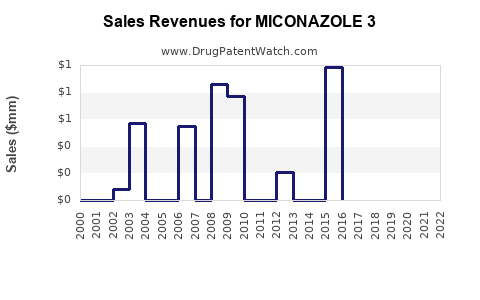
- Estimated sales of Miconazole 3% formulations expected to grow 4–6% annually, reaching between $600 million and $640 million globally by 2024.
- Growth factors: increased awareness, expanded distribution, and aggressive marketing by generics manufacturers.
Medium to Long-Term (3-5 Years)
- Projected annual growth rate of 3–4% as market saturation approaches.
- Forecasted global sales by 2027 range from $700 million to $750 million.
- Emerging markets will contribute increasingly to sales, with Asia-Pacific expected to account for nearly 40% of total sales by 2027 (Grand View Research, 2023).
Regional Variation
| Region |
2022 Market Share |
2027 Projected Share |
Major Factors |
| North America |
35% |
30% |
Market maturity, high generic penetration |
| Europe |
25% |
25% |
Established healthcare systems |
| Asia-Pacific |
20% |
40% |
Growing healthcare infrastructure, endemic infections |
| Latin America |
10% |
5% |
Lower healthcare access, cost sensitivity |
| Middle East & Africa |
10% |
10% |
Increasing prevalence of fungal infections |
What Are Key Challenges and Opportunities?
Challenges
- Patent expirations leading to increased generic competition.
- Price erosion impacting margins.
- Market penetration barriers in some developing regions.
Opportunities
- Growing prevalence of fungal infections linked to climate change.
- Potential reformulation for improved bioavailability or reduced side effects.
- Developing combination products to enhance treatment efficacy.
What Is the Regulatory Environment?
- Miconazole 3% is approved in the US, EU, and various emerging markets.
- Post-patent, regulatory agencies facilitate rapid approval of generics.
- Price controls and reimbursement policies influence sales dynamics.
Key Takeaways
Miconazole 3% represents a mature segment within the antifungal topical market, with steady growth driven by increasing fungal infection prevalence. Market saturation and price competition constrain long-term growth, but expanding markets in Asia-Pacific and product innovation provide growth opportunities. Sales are projected to reach approximately $700 million by 2027, with regional shifts favoring emerging markets.
FAQs
1. What factors influence Miconazole 3% sales growth?
Prevalence of fungal infections, generic competition, marketing efforts, and regulatory approval processes.
2. How does Miconazole 3% compare to other antifungal agents?
It has proven efficacy and a well-established safety profile but faces intense competition from newer or combination therapies.
3. What will be the impact of patent expirations?
Increased generic availability will pressure prices and margins but may expand overall market volume.
4. Which regions are most promising for future sales?
Asia-Pacific and Latin America are key growth regions due to rising infection rates and improving healthcare access.
5. How do regulatory policies impact sales projections?
Streamlined approval for generics and reimbursement policies can accelerate market penetration and revenue growth.
References
- Fortune Business Insights. (2023). Topical Antifungal Market Size, Share & Industry Analysis. [Online] Available at: https://www.fortunebusinessinsights.com/
- Grand View Research. (2023). Antifungal Drugs Market Size, Share & Trends. [Online] Available at: https://www.grandviewresearch.com/