Share This Page
MENEST Drug Patent Profile
✉ Email this page to a colleague
When do Menest patents expire, and when can generic versions of Menest launch?
Menest is a drug marketed by Monarch Pharms and is included in four NDAs.
The generic ingredient in MENEST is estrogens, esterified. There is one drug master file entry for this compound. Additional details are available on the estrogens, esterified profile page.
AI Deep Research
Questions you can ask:
- What is the 5 year forecast for MENEST?
- What are the global sales for MENEST?
- What is Average Wholesale Price for MENEST?
Summary for MENEST
| US Patents: | 0 |
| Applicants: | 1 |
| NDAs: | 4 |
| Raw Ingredient (Bulk) Api Vendors: | 94 |
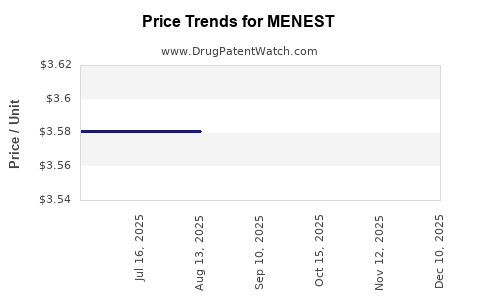
| Drug Prices: | Drug price information for MENEST |
| DailyMed Link: | MENEST at DailyMed |
US Patents and Regulatory Information for MENEST
| Applicant | Tradename | Generic Name | Dosage | NDA | Approval Date | TE | Type | RLD | RS | Patent No. | Patent Expiration | Product | Substance | Delist Req. | Exclusivity Expiration |
|---|---|---|---|---|---|---|---|---|---|---|---|---|---|---|---|
| Monarch Pharms | MENEST | estrogens, esterified | TABLET;ORAL | 084951-001 | Approved Prior to Jan 1, 1982 | DISCN | No | No | ⤷ Start Trial | ⤷ Start Trial | ⤷ Start Trial | ||||
| Monarch Pharms | MENEST | estrogens, esterified | TABLET;ORAL | 084949-001 | Approved Prior to Jan 1, 1982 | DISCN | No | No | ⤷ Start Trial | ⤷ Start Trial | ⤷ Start Trial | ||||
| Monarch Pharms | MENEST | estrogens, esterified | TABLET;ORAL | 084948-001 | Approved Prior to Jan 1, 1982 | DISCN | No | No | ⤷ Start Trial | ⤷ Start Trial | ⤷ Start Trial | ||||
| Monarch Pharms | MENEST | estrogens, esterified | TABLET;ORAL | 084950-001 | Approved Prior to Jan 1, 1982 | DISCN | No | No | ⤷ Start Trial | ⤷ Start Trial | ⤷ Start Trial | ||||
| >Applicant | >Tradename | >Generic Name | >Dosage | >NDA | >Approval Date | >TE | >Type | >RLD | >RS | >Patent No. | >Patent Expiration | >Product | >Substance | >Delist Req. | >Exclusivity Expiration |
MENEST Market Dynamics and Financial Trajectory
MENEST is a legacy oral estrogen product containing esterified estrogens. Its commercial outlook is structurally weak because the product competes in a mature menopause-therapy market, has limited differentiation, faces generic and therapeutic substitution, and is not reported as a standalone revenue product by its current or historical commercial owners. Public filings do not support a reliable MENEST-specific revenue series or a current valuation.
What is MENEST and how is it used?
MENEST is an oral estrogen tablet approved for estrogen-deficiency conditions, including moderate-to-severe vasomotor symptoms associated with menopause, vulvar and vaginal atrophy, hypoestrogenism caused by hypogonadism or castration, and primary ovarian failure. The product is associated with FDA application NDA 008237. Its active ingredient is esterified estrogens, a mixture of estrogenic compounds derived from natural sources or produced through chemical esterification.[1]
Historically marketed by Pfizer affiliates, MENEST belongs to the same broad therapeutic category as:
- Premarin, containing conjugated estrogens;
- oral estradiol products;
- transdermal estradiol patches, gels, and sprays;
- local vaginal estrogen products;
- estrogen-progestin combinations;
- newer non-estrogen menopause therapies.
The product has no progestin component. Patients with an intact uterus generally require appropriate progestogen protection when systemic estrogen is prescribed, because unopposed estrogen increases endometrial hyperplasia and cancer risk.[1]
MENEST dosage strengths
Historical labeling identifies tablet strengths including 0.3 mg, 0.625 mg, 1.25 mg, and 2.5 mg. Actual commercial availability can vary by manufacturer, wholesaler, and time period. Product-level supply should not be inferred solely from historical labeling.
How large is the MENEST market?
MENEST operates in a large underlying menopause-treatment market but occupies a small and declining segment of that market. The relevant commercial market is not the total hormone-therapy market. It is the narrower market for oral systemic estrogen products, particularly esterified estrogens.
The primary market pressures are:
- Therapeutic substitution. Prescribers can use generic estradiol, conjugated estrogens, transdermal estrogen, or local vaginal products depending on the indication.
- Safety-driven prescribing changes. The Women's Health Initiative changed the risk-benefit discussion around systemic menopausal hormone therapy, reducing broad preventive use and increasing individualized, lower-dose prescribing.[2]
- Generic pricing. Oral estrogen products have limited formulation differentiation. When multiple suppliers are available, reimbursement tends to push prices toward commodity levels.
- Route-of-administration competition. Transdermal products are often selected where clinicians seek to reduce certain estrogen exposure risks, while vaginal products are preferred for primarily genitourinary symptoms.
- Retail and supply-channel volatility. Legacy products can experience wholesaler shortages, intermittent manufacturing, or pharmacy-level substitution without generating meaningful brand-level demand.
MENEST therefore has greater relevance as a legacy product and regulatory asset than as a high-growth branded pharmaceutical.
What is the financial trajectory of MENEST?
MENEST-specific revenue is not separately disclosed in Pfizer's public financial reporting. Pfizer reports revenue by major product and therapeutic franchise, but legacy products with small sales are commonly aggregated into broader categories or omitted from product-level discussion.[3]
The most defensible financial trajectory is:
| Period | Commercial condition | Financial implication |
|---|---|---|
| Early commercial period | Branded oral estrogen with limited direct substitution | Higher pricing power and brand recognition |
| Post-generic period | Generic esterified estrogen and broader estradiol competition | Lower price and declining brand share |
| Post-WHI prescribing environment | More selective systemic estrogen use | Lower volume growth |
| Mature legacy period | Substitution by estradiol, transdermal products, and local therapies | Low standalone strategic value |
| Current economic profile | No separately reported revenue stream | No public basis for a precise MENEST forecast |
MENEST should not be modeled as a growth asset absent evidence of a new owner, a supply-constrained market, a relaunch, or a materially differentiated formulation. A conventional forecast would assign declining or flat nominal sales, with downside risk from generic availability and brand discontinuation.
What is the revenue exposure for the manufacturer?
Revenue exposure appears immaterial at the level of a multinational manufacturer such as Pfizer. Pfizer's annual reports identify major revenue-generating products and therapeutic areas but do not provide a MENEST revenue line.[3] This means:
- MENEST is unlikely to affect consolidated Pfizer earnings materially.
- Product-specific margin data are unavailable.
- Any discontinuation would have limited impact on corporate revenue.
- The product may still generate value for a specialty or generic manufacturer through portfolio aggregation, manufacturing utilization, or supply contracts.
The economics are more relevant to a small generic manufacturer than to a large innovator. For a smaller company, a legacy estrogen product can produce useful recurring revenue if manufacturing is reliable and competition is limited. That value is vulnerable to price erosion and supply disruption.
What is the FDA regulatory status of MENEST?
MENEST was approved as an oral estrogen product under FDA NDA 008237. The regulatory status of a brand name must be distinguished from the status of the active ingredient and from the commercial availability of specific strengths.
FDA approval does not establish that every historical strength remains actively marketed. FDA's discontinued-drug records and Drugs@FDA database should be used to determine whether a specific strength is currently marketed, discontinued, or withdrawn for reasons related to safety or efficacy.[4]
The product's label includes boxed-warning information applicable to systemic estrogen therapy. The warning addresses risks including endometrial cancer in women with a uterus, cardiovascular events, breast cancer, and probable dementia in certain older women using estrogen-alone therapy.[1]
Is MENEST a biologic or does it face biosimilar risk?
MENEST is a small-molecule drug, not a biologic. It does not face biosimilar competition under the Biologics Price Competition and Innovation Act. Its competitive risk comes from:
- Abbreviated New Drug Application, or ANDA, products;
- generic esterified estrogens;
- generic estradiol;
- therapeutic substitutes;
- compounded hormone products, subject to different regulatory controls.
The absence of biosimilar risk does not improve the product's commercial outlook because conventional generic substitution is the dominant competitive mechanism.
What is the Orange Book status of MENEST?
The Orange Book identifies approved drug products and, where applicable, listed patents and regulatory exclusivities. For a legacy product such as MENEST, the key commercial question is whether any active listed patent or regulatory exclusivity remains.
No commercially meaningful, current patent exclusivity position is apparent from the historical nature of the product and its long market life. MENEST's principal protection is therefore unlikely to be a live composition-of-matter or formulation patent. The Orange Book, not historical marketing material, is the controlling source for current patent listings and exclusivity data.[5]
When does MENEST lose exclusivity?
MENEST's original regulatory and patent exclusivity periods expired long ago. The product should be analyzed as an off-patent, mature prescription drug unless the FDA database identifies a later-listed patent, new formulation approval, or separate exclusivity event.
No current market thesis should rely on MENEST retaining branded exclusivity.
What patents protect MENEST?
The core esterified-estrogen product is a legacy formulation. Publicly available product records do not indicate a commercially significant active patent estate protecting the historical MENEST tablets.
Potential historical protection could have included:
- formulation claims;
- manufacturing claims;
- tablet-composition claims;
- packaging or dosage-form claims;
- patents associated with a particular estrogen mixture.
Those categories generally have limited residual value after decades on the market. Even when a manufacturing patent remains technically relevant, it may not prevent generic entry if an alternative process is available.
How strong is the MENEST patent estate?
The estate is weak from a modern commercial-protection perspective:
| Factor | Assessment |
|---|---|
| Composition-of-matter protection | Expired or commercially irrelevant |
| Orange Book patent barrier | No material current barrier identified |
| Formulation differentiation | Limited for conventional oral tablets |
| Method-of-use protection | Broad menopause indications are difficult to enforce as a durable barrier |
| Manufacturing protection | Potentially relevant only if a process is difficult to replicate |
| Regulatory exclusivity | Long expired |
| Litigation leverage | Low absent a new patent or formulation |
Are there Paragraph IV challenges to MENEST?
Paragraph IV litigation is relevant when an ANDA applicant certifies that a listed patent is invalid, unenforceable, or will not be infringed. MENEST does not present the profile of a currently protected blockbuster product with active Paragraph IV litigation.
No major, current Paragraph IV campaign is associated with the historical MENEST brand in the public record cited here. Any generic competition is more likely to have developed through the ordinary off-patent pathway rather than through high-value patent litigation.
What formulations are protected by MENEST patents?
The historical product is an immediate-release oral tablet. There is no well-established public record of an active, commercially important MENEST extended-release, transdermal, vaginal, implantable, or combination formulation patent estate.
This matters because formulation patents often create the main residual value for old products. MENEST lacks an evident differentiated delivery system that could support premium pricing or a new exclusivity period.
What generic entry risks exist for MENEST?
Generic entry risk is high because the product has:
- a long market history;
- no apparent current exclusivity barrier;
- a conventional oral dosage form;
- readily available therapeutic alternatives;
- limited brand differentiation;
- price-sensitive reimbursement.
Generic entry does not require a direct generic esterified-estrogen competitor to pressure MENEST. Generic estradiol tablets and transdermal products can reduce demand through therapeutic substitution.
The main countervailing factor is supply. If few manufacturers produce esterified estrogens, temporary shortages could support pricing or preserve residual brand demand. That effect would be operational rather than patent-driven.
Which companies compete with MENEST?
MENEST competes with manufacturers across several categories rather than with a single direct rival.
| Competitor category | Representative products | Competitive effect |
|---|---|---|
| Conjugated estrogens | Premarin | Direct systemic estrogen alternative |
| Oral estradiol | Generic estradiol tablets | Low-cost substitution |
| Transdermal estradiol | Patches, gels, sprays | Route and risk-profile substitution |
| Vaginal estrogen | Creams, tablets, rings | Captures local-symptom demand |
| Combination products | Estrogen-progestin therapies | Addresses patients requiring endometrial protection |
| Non-estrogen therapies | Selective menopause treatments | Reduces systemic estrogen demand |
Premarin historically held stronger brand recognition and commercial scale than MENEST. Generic estradiol has broader availability and typically stronger formulary positioning. Transdermal and local products have expanded the number of clinically acceptable alternatives.
What licensing deals affect MENEST?
No major recent licensing transaction involving MENEST is evident from public pharmaceutical transaction disclosures. Historical rights may have moved among Pfizer, Pharmacia, Upjohn, and related corporate entities through broader corporate transactions, but those changes do not establish a current standalone licensing opportunity.
The product's likely transaction value would be based on:
- manufacturing continuity;
- regulatory-file transfer;
- existing distribution;
- residual prescriptions;
- supply-chain relationships;
- portfolio fit.
A buyer would likely value MENEST as part of a package of mature products rather than as an individual strategic asset.
What patent litigation affects MENEST?
No major current patent litigation materially affects MENEST's commercial position in the cited public record. The absence of visible litigation is consistent with an off-patent product whose main risks are pricing, supply, and substitution rather than infringement.
Any future litigation would more likely involve:
- manufacturing contracts;
- product liability;
- labeling;
- supply obligations;
- generic approval disputes;
- ownership of regulatory materials.
How does MENEST compare with Premarin and generic estradiol?
| Metric | MENEST | Premarin | Generic estradiol |
|---|---|---|---|
| Active ingredient | Esterified estrogens | Conjugated estrogens | Estradiol |
| Brand strength | Legacy, limited | Historically strong | Usually low |
| Patent position | Mature/off-patent | Product and formulation history varies | Generally off-patent |
| Route | Oral tablet | Oral and other historical forms | Oral, transdermal, vaginal |
| Pricing power | Low | Higher brand potential | Low |
| Substitution risk | High | High but differentiated by brand | High |
| Growth profile | Declining or flat | Mature, indication-dependent | Volume-driven |
| Biosimilar exposure | None | None | None |
MENEST's principal weakness is not a single competitor. It is the breadth of available substitutes combined with limited formulation differentiation.
What is the commercial outlook for MENEST?
The base case is a low-growth or declining product with limited standalone financial significance. Upside could arise from a shortage of competing estrogen products, acquisition by a specialty generic company, or a relaunch supported by reliable supply and targeted distribution. Those factors would not create durable patent protection.
The most likely commercial model is:
- low to moderate unit demand;
- low pricing power;
- high payer substitution;
- limited marketing expenditure;
- dependence on manufacturing economics;
- declining strategic importance to large pharmaceutical companies.
Key Takeaways
- MENEST is an established oral esterified-estrogen product associated with FDA NDA 008237.
- Its original patent and regulatory exclusivity periods have expired.
- No material current patent estate or active Paragraph IV litigation is apparent.
- MENEST is a small-molecule drug and faces generic, not biosimilar, competition.
- Pfizer does not separately disclose MENEST revenue, so no reliable public product-level financial series exists.
- The product's market position is weaker than that of Premarin and generic estradiol.
- Financial performance is likely flat to declining, with supply availability as the main potential short-term support.
- Any residual asset value is more likely to come from manufacturing and distribution economics than from intellectual property.
FAQs
Is MENEST still commercially available?
Availability can vary by strength, manufacturer, and wholesaler. FDA product records and current pharmacy inventories should be distinguished from historical labeling.
Is MENEST the same as Premarin?
No. MENEST contains esterified estrogens, while Premarin contains conjugated estrogens. They are therapeutic alternatives but are not identical products.
Can generic estradiol replace MENEST?
Clinicians may use generic estradiol as a therapeutic alternative, but substitution depends on indication, dose, route, patient factors, and prescribing requirements.
Does MENEST have an active patent?
No commercially significant active patent barrier is apparent from the legacy product record. The FDA Orange Book remains the controlling source for current listed patents.
Is MENEST subject to Medicare pricing negotiations?
A drug's eligibility depends on statutory criteria, sales, product age, market status, and whether it is selected under the applicable Medicare negotiation cycle. A legacy product with limited sales would generally have low selection probability.
References
- U.S. Food and Drug Administration. (n.d.). Menest (esterified estrogens) prescribing information. FDA.
- Rossouw, J. E., Anderson, G. L., Prentice, R. L., LaCroix, A. Z., Kooperberg, C., Stefanick, M. L., Jackson, R. D., Beresford, S. A. A., Howard, B. V., Johnson, K. C., Kotchen, J. M., & Ockene, J. (2002). Risks and benefits of estrogen plus progestin in healthy postmenopausal women. JAMA, 288(3), 321-333.
- Pfizer Inc. (2023). Annual report pursuant to Section 13 or 15(d) of the Securities Exchange Act of 1934 for the fiscal year ended December 31, 2023. U.S. Securities and Exchange Commission.
- U.S. Food and Drug Administration. (n.d.). Drugs@FDA: FDA-approved drugs. FDA.
- U.S. Food and Drug Administration. (n.d.). Approved drug products with therapeutic equivalence evaluations, commonly known as the Orange Book. FDA.
More… ↓
