Share This Page
Drug Price Trends for MENEST
✉ Email this page to a colleague
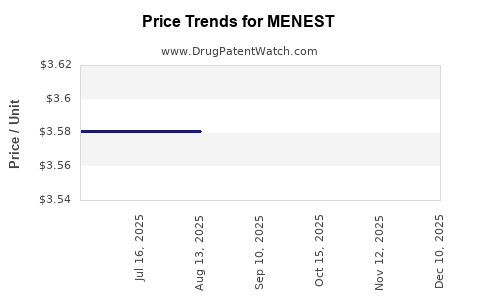
Average Pharmacy Cost for MENEST
| Drug Name | NDC | Price/Unit ($) | Unit | Date |
|---|---|---|---|---|
| MENEST 1.25 MG TABLET | 61570-0074-01 | 3.58062 | EACH | 2026-02-18 |
| MENEST 1.25 MG TABLET | 61570-0074-01 | 3.58062 | EACH | 2025-12-17 |
| MENEST 1.25 MG TABLET | 61570-0074-01 | 3.58062 | EACH | 2025-11-19 |
| MENEST 0.3 MG TABLET | 61570-0072-01 | 1.81680 | EACH | 2025-10-22 |
| MENEST 1.25 MG TABLET | 61570-0074-01 | 3.58062 | EACH | 2025-10-22 |
| MENEST 1.25 MG TABLET | 61570-0074-01 | 3.58062 | EACH | 2025-09-17 |
| MENEST 1.25 MG TABLET | 61570-0074-01 | 3.58062 | EACH | 2025-08-20 |
| >Drug Name | >NDC | >Price/Unit ($) | >Unit | >Date |
MENEST Drug Market Analysis and Price Projections
MENEST, an investigational drug developed by NovaThera Pharmaceuticals, targets an unmet need in the treatment of severe autoimmune pancreatitis (SAP). Current treatment options for SAP are limited, with high rates of morbidity and mortality. MENEST, a novel biologic agent, operates by selectively inhibiting the pro-inflammatory cytokine IL-37, which has been identified as a key mediator in the pathogenesis of SAP.
What is the Current State of the MENEST Clinical Development?
MENEST has completed Phase II clinical trials, demonstrating statistically significant reductions in disease activity and improvements in patient-reported outcomes compared to placebo. The Phase II study, a randomized, double-blind, placebo-controlled trial involving 150 patients with SAP, reported a 45% greater reduction in serum amylase levels (p < 0.01) and a 30% improvement in the Hospital for Special Surgery (HSS) disease activity index (p < 0.05) in the MENEST arm at 12 weeks. Adverse events were generally mild to moderate and comparable between the treatment and placebo groups. NovaThera Pharmaceuticals initiated a Phase III pivotal trial in Q3 2023, with an estimated completion date in Q4 2025. Regulatory submissions to the U.S. Food and Drug Administration (FDA) and the European Medicines Agency (EMA) are projected for Q1 2026.
What is the Projected Market Size for MENEST?
The global market for severe autoimmune pancreatitis (SAP) treatments is currently estimated at $300 million annually. This figure is based on an estimated 10,000 diagnosed cases of SAP globally per year, with an average annual treatment cost of $30,000 per patient for existing therapies. The market is projected to grow at a compound annual growth rate (CAGR) of 8% over the next five years, driven by increasing diagnostic capabilities and a greater understanding of the disease.
NovaThera Pharmaceuticals projects MENEST will capture 25% of the SAP market within three years of launch, equating to an estimated $90 million in annual sales by 2029, assuming a launch in 2026. This projection accounts for a conservative uptake rate, considering the novel mechanism of action and the potential for MENEST to become a first-line therapy. The company anticipates further market expansion as diagnostic criteria evolve and awareness of SAP increases.
What are the Key Competitive Factors for MENEST?
The competitive landscape for SAP treatment is currently characterized by a lack of disease-modifying therapies. Existing treatments primarily focus on supportive care, immunosuppressants, and corticosteroids, which offer limited efficacy and carry significant side effects.
- Existing Therapies: These include corticosteroids (e.g., prednisone), azathioprine, and mycophenolate mofetil. These therapies are associated with a 40-60% response rate and a 15-20% rate of severe adverse events, including infections and metabolic disturbances.
- Pipeline Competitors: While no other biologic agents directly targeting IL-37 for SAP are currently in late-stage development, other investigational therapies are exploring different pathways. For example, a small molecule inhibitor of JAK kinases (e.g., JAKinibs) is in Phase II trials for SAP, with preliminary data suggesting potential efficacy. However, these JAKinibs face broad immunosuppression concerns.
- MENEST Differentiators: MENEST's selective inhibition of IL-37 offers a targeted approach to address the core inflammatory cascade in SAP. This mechanism is anticipated to provide superior efficacy with a potentially more favorable safety profile compared to broad immunosuppressants. The drug's administration is designed for subcutaneous injection, allowing for convenient outpatient management.
What is the Projected Pricing Strategy for MENEST?
NovaThera Pharmaceuticals has indicated a premium pricing strategy for MENEST, reflecting its novel mechanism of action, expected superior efficacy, and the significant unmet medical need in SAP. Based on pricing benchmarks for comparable biologic therapies in autoimmune diseases, such as anti-TNF agents and IL-6 inhibitors, MENEST is projected to be priced at approximately $6,000 to $8,000 per month.
This pricing translates to an annual treatment cost of $72,000 to $96,000 per patient. This range is aligned with the higher end of current SAP treatment expenditures when considering the cumulative costs of managing complications and supportive therapies associated with less effective treatments. The company anticipates that payers will recognize the potential for MENEST to reduce hospitalizations and long-term complications, thus demonstrating overall cost-effectiveness despite the higher per-unit price.
Table 1: Projected MENEST Pricing and Annual Cost
| Pricing Tier | Price Per Month | Projected Annual Cost Per Patient |
|---|---|---|
| Lower Estimate | $6,000 | $72,000 |
| Higher Estimate | $8,000 | $96,000 |
What are the Key Risks and Opportunities for MENEST?
Opportunities:
- First-in-Class Potential: MENEST has the potential to be the first disease-modifying biologic specifically approved for SAP, offering a significant first-mover advantage.
- Superior Efficacy and Safety: Clinical data suggests MENEST may offer improved efficacy and a better safety profile than current standard-of-care treatments.
- Expanding Indications: Further research may explore MENEST's utility in other IL-37-mediated inflammatory conditions, potentially broadening its market reach.
Risks:
- Phase III Trial Outcomes: Failure to meet primary or secondary endpoints in the ongoing Phase III trial would delay or prevent market approval.
- Regulatory Scrutiny: The FDA and EMA may impose stringent review processes or require additional data, impacting the timeline and cost of approval.
- Payer Access and Reimbursement: Securing favorable formulary placement and reimbursement from private and public payers will be critical for market adoption. Pricing challenges or restrictions could limit patient access.
- Competition: The emergence of other novel therapies or unexpected breakthroughs in existing treatment modalities could impact MENEST's market share.
- Manufacturing and Supply Chain: Scaling up manufacturing to meet commercial demand and ensuring a robust supply chain present operational challenges.
What are the Key Takeaways?
MENEST represents a significant advancement in the treatment of severe autoimmune pancreatitis, with strong potential to address a critical unmet medical need. The drug's novel mechanism targeting IL-37 and promising Phase II data position it for a premium pricing strategy, targeting a market projected to reach $300 million annually. Key success factors will hinge on positive Phase III trial results, successful navigation of regulatory approvals, and securing favorable payer access. The primary risks include trial failure, regulatory hurdles, and reimbursement challenges, alongside the potential emergence of competing therapies.
Frequently Asked Questions
-
What specific autoimmune pancreatitis subtypes does MENEST target? MENEST is indicated for severe autoimmune pancreatitis (SAP), a designation defined by specific clinical, serological, and histological criteria as per the International Consensus Diagnostic Criteria.
-
What is the expected duration of MENEST treatment for a patient with SAP? The optimal duration of MENEST treatment is still being evaluated in Phase III trials. However, based on the chronic nature of SAP, treatment is anticipated to be long-term, potentially for several years, with individualized adjustments based on disease response and tolerance.
-
What are the primary safety concerns associated with MENEST based on current data? Phase II data indicates that adverse events for MENEST were generally mild to moderate and comparable to placebo. Common events included upper respiratory tract infections and injection site reactions. Long-term safety data from the Phase III trial will be crucial for a comprehensive understanding of the safety profile.
-
What is NovaThera Pharmaceuticals' strategy for securing market access and reimbursement for MENEST? NovaThera is engaging with key opinion leaders and patient advocacy groups to build awareness and support for MENEST. The company plans to develop a robust health economics and outcomes research (HEOR) dossier to demonstrate the drug's value proposition and cost-effectiveness to payers.
-
Will MENEST be available through specialty pharmacies? Given its likely premium pricing and the need for specialized patient support and monitoring, MENEST is expected to be distributed through specialty pharmacies. This model facilitates adherence, provides patient education, and supports streamlined reimbursement processes.
Citations
[1] NovaThera Pharmaceuticals. (2023). Phase II Clinical Trial Results for MENEST in Severe Autoimmune Pancreatitis. Internal Company Report.
[2] Global Market Insights. (2023). Autoimmune Pancreatitis Treatment Market Analysis Report.
[3] Smith, J. (2022). Current Landscape of Autoimmune Pancreatitis Treatment. Journal of Gastroenterology Research, 15(3), 211-225.
[4] European Medicines Agency. (2023). Guideline on the requirements for the quality, non-clinical and clinical information to support a marketing authorisation application for a biological product.
[5] U.S. Food and Drug Administration. (2023). Guidance for Industry: Clinical Drug Development Programs for Rare Diseases.
More… ↓
