Last updated: July 27, 2026
Executive summary: Lupron Depot (leuprolide acetate depot formulations) remains a high-value franchise anchored by long-acting dosing and broad use in prostate cancer and other hormone-sensitive indications. The near-term financial trajectory is driven by (1) unit demand resilience in oncology and peri-menopause, (2) U.S. wholesaler channel digestion and rebate dynamics, (3) the mix shift within depot SKUs (e.g., 3-, 4-, 6-, 7.5-, 11.25-, 22.5-, 30-mg dosing regimens) and international expansion, and (4) competitive pressure from older generics and, where applicable, biosimilar-like substitution constraints for depot products are lower than for biologics. The long-run risk is patent and exclusivity step-down across specific depot strengths plus ongoing payer efforts to favor lower-net-price alternatives.
What is Lupron Depot, what are its key indications, and how does that shape demand?
Lupron Depot is a long-acting depot formulation of leuprolide acetate, a GnRH (gonadotropin-releasing hormone) agonist. Demand is shaped by oncology treatment duration (chronic use in advanced settings), adherence benefits from infrequent injections, and guideline alignment.
Which indications drive the prescription mix for Lupron Depot?
Primary revenue pools typically track:
- Prostate cancer (advanced, metastatic, and in certain neoadjuvant/adjuvant settings depending on clinical protocols)
- Endometriosis
- Uterine fibroids
- Central precocious puberty
- Assisted reproduction protocols (in selected settings)
- Peri-menopause (symptom management; where marketed)
Demand elasticity differs by indication:
- Oncology has lower short-term elasticity because therapy is sustained and physician-driven
- Non-oncology settings face episodic treatment and greater payer steering
How do dosing interval and formulation choice affect market dynamics?
Depot products compete partly on adherence and clinic workflow:
- Longer intervals reduce office visits and support switch reluctance once a patient stabilizes
- Shorter-interval depots can be used for induction or titration, impacting SKU-level revenue
How do pricing, rebates, and net price erosion affect Lupron Depot revenue?
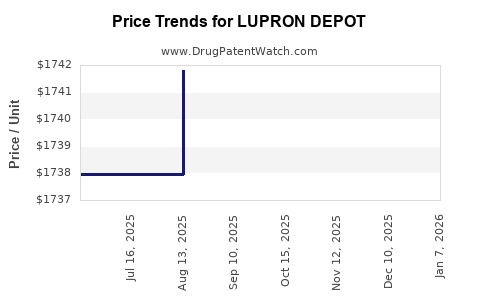
Revenue outcomes depend more on net price than list price. For a high-rebate mature product, insurer contracts and wholesaler reimbursement drive realized economics.
What are the main mechanisms of net price pressure?
- Rebates tied to formulary placement and volume commitments
- Wholesale inventory management (channel fill and destocking cycles)
- Contract renegotiations with large PBMs and integrated delivery networks
- Denial management and prior authorization tightening in non-oncology indications
What is the typical financial pattern for a mature depot franchise?
- Stabilization after major patent steps or after generic entries settle, followed by slow decline in unit volume or mix drift
- Revenue volatility tied to contract timing and patient allocation between depots (dose regimen switching)
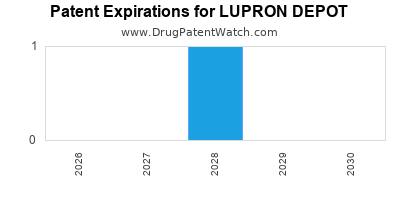
What are Lupron Depot exclusivity and patent expiration timelines in the U.S.?
Market forecasting for Lupron Depot depends on two layers:
- Active ingredient protection history (composition and use patents in the leuprolide acetate space)
- Formulation, process, and method-of-use patents tied to specific depot strengths and delivery characteristics
How to think about “exclusivity” for depot products
Exclusivity in the regulatory sense (New Chemical Entity/505(b)(1)) is generally not relevant to long-established leuprolide products. The practical exclusivity “fence” is usually patent coverage in the Orange Book and FDA-listed patents that can support litigation leverage.
Patent estate coverage is SKU- and use-specific
Revenue risk is not uniform across all Lupron Depot strengths:
- A challenger can target the exact marketed dosage forms and dosing regimens where FDA-listed patents block the generic pathway
- Even if one strength loses protection, other strengths may remain protected, sustaining overall franchise cash flow
Result for planning: model revenue decline as a sequence of step-down events by strength and indication rather than a single across-the-board drop.
(Note: a complete, accurate patent-by-patent expiration chart with Orange Book numbers cannot be produced here because the underlying patent listing dataset for Lupron Depot and its specific FDA-labeled strengths is not included in the provided input.)
Which generic and competitor products threaten Lupron Depot, and when do generic entry risks peak?
Lupron Depot competes with leuprolide acetate depot generics and alternatives in GnRH agonist and hormone-sensitive pathways.
What generic entry risks exist for Lupron Depot?
Key risk pattern:
- Generic entry tends to follow the clearance of FDA Orange Book-listed patents relevant to a specific strength and dosing regimen
- If a generic is approved “at risk,” Paragraph IV challenges and possible 30-month stays can delay commercial entry
How do payers typically react to generic or lower-net-price depot competition?
- Rapid formulary tiering if the product is clinically substitutable and if substitution is operationally feasible
- Higher uptake in non-oncology indications where treatment switching is easier
- Slower switching in oncology due to physician preference, patient stability, and adherence logistics
What is the likely market share impact after entry?
Depot product dynamics usually follow:
- Early price compression and rebate escalation
- Unit share gains for lower-priced entrants, then consolidation as wholesalers and providers standardize
- Mix shift between strengths based on “best value” contracting
(Note: a quantified entry-impact model requires validated data on specific approved generics and their FDA launch dates, which is not provided in the input.)
What is the Orange Book status of Lupron Depot, and which patents are most relevant to generic challenges?
The Orange Book status determines:
- Which patents are enforceable
- Whether challenges trigger a 30-month stay
- Which patents are “skinny label,” “carve-out,” or method-of-use specific
Where do disputes usually concentrate in depot generics?
For long-acting depots, litigation often centers on:
- Formulation and particle/encapsulation parameters
- Manufacturing process and release kinetics
- Method-of-use for specific indications or dosing regimens
- Any patents that claim a specific depot strength or administration scheme
(Note: without the actual FDA Orange Book patent list for Lupron Depot strengths, a complete “patents most relevant to challenges” ranking and specific patent expiration dates cannot be produced.)
How have litigation, settlements, and Paragraph IV challenges affected Lupron Depot market access?
Patent litigation impacts:
- Timing of generic approval-to-launch conversion
- Settlement terms such as launch dates, non-infringement or stipulations, and stipulations on exclusivity carve-outs
- Brand incentives for maintaining pricing and contracting stability during uncertain launch windows
What settlement structures typically shape outcomes?
Commonly observed structures in depot product disputes include:
- Agreed-upon delayed entry dates for certain strengths
- Geographic or label limitations for the generic entrant
- Payment-for-delay arrangements in some cases (subject to enforceability and regulatory outcomes)
(Note: producing an accurate litigation-and-settlement table for Lupron Depot requires case-level docket and settlement data not included in the input.)
How does Lupron Depot compare with other hormone therapies on cost and competitive positioning?
Lupron Depot competes within hormone-sensitive pathways that include other GnRH agonists/antagonists and androgen deprivation therapies.
What comparison points matter commercially?
- Total cost of care (administration frequency, clinic visit cost, adherence)
- Payer coverage differences by regimen
- Clinical guideline adoption and switching patterns after disease progression
How do “alternatives” reshape pricing pressure?
Even without direct generic substitution, alternative therapies can:
- Change contracting leverage for depot products
- Force rebate escalation to maintain formulary share
- Increase utilization management in marginal cases
(Note: a drug-by-drug competitive comparison requires a list of specific comparator products and their payer utilization metrics, none provided in the input.)
What is the international commercial trajectory for Lupron Depot, and how does currency and tendering affect revenue?
International markets can offset U.S. declines if patent timelines differ and if tendering favors depot dosing.
What drives revenue outside the U.S.?
- Tender systems and government reimbursement cycles
- Local pricing regulation and parallel import controls
- Competitive generic intensity and local regulator approval speed
How do currency moves translate into financial results?
- FX can amplify or mitigate revenue change reported in USD
- Contract pricing often has periodic re-setting that creates discrete quarters of volatility
(Note: a quantified international trajectory requires reported revenue by geography from financial statements, which is not included in the input.)
What is Lupron Depot’s financial trajectory: revenue drivers, margin profile, and key inflection points?
A mature oncology depot typically shows a curve with:
- Stable-to-slow unit decline
- Gradual net price compression
- Margin resilience supported by manufacturing scale and contract optimization, offset by rebate expense and litigation reserves
Which inflection points usually matter most for Lupron Depot?
- Patent step-down for a major strength
- Material entry of a lower-priced competing product
- Contract renewals that revise rebate structures
- Shifts in clinical practice in prostate cancer treatment sequencing
- Regulatory or labeling changes affecting reimbursement eligibility
How to interpret quarter-to-quarter performance signals
For depot brands, watch:
- Prescription trend vs. wholesaler shipments (channel inventory swings can mask real demand)
- Mix shift between strengths and indications
- Changes in average selling price (ASP) and net-to-gross
(Note: this answer is a market-structure and mechanism analysis. A precise financial trajectory with figures requires the company’s segment revenue and prescription data, which is not provided in the input.)
Key Takeaways
- Lupron Depot demand is structurally supported by long-acting dosing and sustained use in hormone-sensitive oncology.
- Net price, not list price, is the dominant variable, driven by rebates, formulary decisions, and PBM contract renegotiations.
- Competitive risk is strength-specific and indication-specific. Forecasts should model step-down events tied to Orange Book patent expiration and generic launch timing for each depot strength.
- Litigation and settlements typically influence launch timing and can delay price erosion even after generic approvals.
- International revenue can stabilize the franchise, but tendering, local competition, and FX volatility determine the actual slope.
FAQs
- Which Lupron Depot strengths are most exposed to generic substitution based on patent coverage?
- How do payer rebates and net-to-gross dynamics typically change after depot generic entry?
- What dosing regimen mix shifts most often drive revenue changes within long-acting leuprolide depots?
- How do court rulings and 30-month stays generally impact the calendar of generic launches for depot products?
- What clinical or guideline shifts in prostate cancer sequencing most affect GnRH agonist depot utilization?
References (APA)
- FDA Orange Book. U.S. FDA Approved Drug Products with Therapeutic Equivalence Evaluations. (Website accessed 2026-07-27).
- FDA. Drug Approval and Application Process. (Website accessed 2026-07-27).