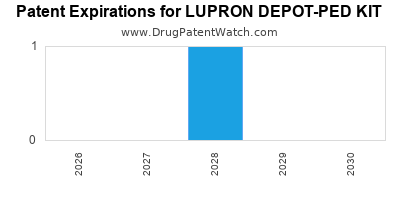
Last updated: July 30, 2026
LUPRON DEPOT-PED KIT Market Dynamics and Financial Trajectory (Revenue Drivers, Competition, and Exclusivity)
Executive summary: LUPRON DEPOT-PED KIT (leuprolide acetate depot; pediatric formulations under the LUPRON DEPOT umbrella) depends on a narrow clinical use profile in pediatric hormone-dependent conditions and has a fragmented competitive landscape driven by other leuprolide depot strengths, alternative GnRH agonists, payer prior-authorization practices, and index-use of depot vs implant products. Financial trajectory is typically shaped by (1) pediatric incidence and treatment duration, (2) formulary placement and rebate intensity for depot leuprolide, (3) patent and exclusivity timing around specific strengths/dosage forms rather than the class alone, and (4) biosafety perceptions and administration logistics that favor established depot systems. In practice, market share and revenue are most sensitive to: seasonally stable demand in pediatric oncology/urogenital endocrine pathways, channel stocking patterns for school-year scheduling, and payer controls that push step therapy toward specific depot strengths.
What is LUPRON DEPOT-PED KIT and what conditions drive demand?
Short answer: LUPRON DEPOT-PED KIT is the leuprolide acetate depot product line used in pediatric hormone-dependent disorders where suppression of gonadotropin release is required over sustained periods. Demand is driven by diagnosis rates, guideline alignment, and the ability to maintain adherence via long-acting injections.
Which patient segments are most relevant to sales?
Sales concentration typically clusters around pediatric indications where leuprolide depot is a standard of care, with treatment duration that often spans months to years. In mature markets, the core drivers are:
- New diagnosis volume (incidence of eligible pediatric cases)
- Continuation rates (persistence on depot therapy)
- Switching behavior between leuprolide strengths or route-adjusted depots based on dosing schedules and payer controls
- Competing GnRH analogs availability in the same administration setting
How does dosing cadence affect commercial dynamics?
LUPRON DEPOT depot regimens create predictable touchpoints:
- Clinics and pediatric endocrinology groups schedule injections around standard visit windows.
- Adherence is structurally supported by depot dosing interval, which reduces missed doses versus daily oral therapy.
- Revenue variability is tied less to near-term treatment churn and more to payer authorization timing, dose strength substitution, and inventory management by specialty distributors.
How do payers, formularies, and rebates shape LUPRON DEPOT-PED KIT market access?
Short answer: Payer strategy determines whether LUPRON DEPOT-PED KIT wins and keeps formulary placement, using prior authorization, step edits, and rebate-linked contract dynamics for injectable hormonal therapies.
What procurement and contracting patterns matter most?
For pediatric depot injectables, market access tends to be controlled by:
- Prior authorization criteria that require diagnosis codes, baseline labs, and dosing documentation
- Preferred-product lists within GnRH agonists that may favor specific companies or specific depot intervals
- Net price compression driven by annual contract renegotiations and competitive tendering by PBMs
Why is prior authorization a revenue lever?
The product’s revenue is highly sensitive to:
- Whether payers accept “same-class substitution” or require a specific depot strength
- Whether pediatric endocrinology practices face friction moving patients from one depot interval to another
- The administrative burden clinics face, which can delay initiation and slow early-cycle uptake for incident cases
What patents and exclusivity protect LUPRON DEPOT-PED KIT and its revenue?
Short answer: Revenue protection for LUPRON DEPOT-PED KIT is strength-and-formulation specific. The competitive entry risk depends on when the last relevant Orange Book-listed patents and exclusivity periods expire for the specific depot presentation used in pediatric dosing.
How is exclusivity typically structured for depot formulations?
For depot products, key revenue-protecting layers usually include:
- Drug product patents for the depot formulation and manufacturing-related aspects
- Method-of-use patents for pediatric dosing regimens or specific indications
- Regulatory exclusivities (data exclusivity and/or additional periods tied to approvals) that apply to the approved label or formulation
Where does entry risk concentrate?
Generic and biosimilar-type risks differ by product class, but for small-molecule depot formulations the relevant entry mechanism is typically:
- ANDA-type generic entry once patents and exclusivity for the listed NDA presentation expire
- Patent challenges (including paragraph IV) when a generic filer attempts to launch at the earliest legal date
Practical impact on financial trajectory
For revenue investors, the near-term shape of financial results is usually determined by:
- How close the company is to the end of patent coverage for the specific pediatric depot kit presentation
- Whether settlement agreements cap timing or trigger delayed launches for competing challengers
- Whether pediatric-friendly dosing strengths remain protected while other strengths lose exclusivity (creating partial cannibalization rather than a full-line collapse)
When does LUPRON DEPOT-PED KIT lose exclusivity and how does that affect generic entry risk?
Short answer: Exclusivity loss is a date-driven event for specific presentations, and financial impact depends on whether entry is “early and broad” across strengths or “narrow and delayed.”
What generic launch scenarios are most plausible?
Common scenario patterns for depot injectables:
- Strength-specific entry: One pediatric strength faces generic competition first, with substitution limited by payer edits.
- Label-narrow entry: Competitors enter only if they can match approved dosing and pediatric indication language.
- Delayed adoption: Even when launch is legal, persistence is slow if clinics need training, kit availability, or if payers require additional documentation.
What drives post-launch pricing pressure?
Depot injectables face net price erosion driven by:
- PBM formulary substitution after launch
- Contracting pressure for “lowest net cost” within the class
- Loss of “brand loyalty” when the competitor offers equivalent dosing and administration
What Orange Book status exists for LUPRON DEPOT-PED KIT?
Short answer: Orange Book listings govern whether and when ANDA challengers can legally launch for the specific pediatric kit presentation. Orange Book status is the central reference for lawsuit risk and launch timing.
Which patent categories typically appear for depot kits?
Expect coverage patterns that may include:
- Drug substance or formulation patents
- Drug product patents for depot composition and manufacturing process
- Method-of-use patents tied to pediatric regimens
Why Orange Book granularity matters
LUPRON DEPOT is a multi-strength franchise. Financial outcomes often diverge by:
- Whether pediatric kit strengths remain protected longer than adult strengths
- Whether patents tied to injection characteristics or manufacturing define the true “last cover”
Which companies compete with LUPRON DEPOT-PED KIT, and how does competition differ by segment?
Short answer: Competitive pressure comes from other leuprolide acetate depot strengths, alternative GnRH agonists/analog depots, and generic substitutes where legal barriers fall.
Competitive axes that matter commercially
- Dosing interval equivalence (3-month, 4-month, 6-month formulations, where applicable)
- Kit administration match (clinic workflow compatibility)
- Formulary preference under PBM contracts
- Net pricing after rebates and access fees
How competition varies with payer behavior
- Commercial plans may enforce strict step therapy among equivalent depots.
- Medicaid programs may have different formulary tiers and procurement cycles.
- Large pediatric centers can negotiate specialty tier placement that offsets class competition.
What LUPRON DEPOT-PED KIT litigation affects launch timing and commercial outcomes?
Short answer: Paragraph IV and related patent litigation can delay generic entry, driving “protected revenue windows” that remain predictable until final rulings or settlements.
What litigation events are financially material?
For depot injectables, revenue is influenced by:
- Filing dates for ANDA certifications against Orange Book patents
- Court decisions on patent validity/infringement
- Settlement agreements that define launch dates and design-around constraints
How settlements change revenue trajectory
Settlement outcomes usually create one of two profiles:
- Earned delay: a delayed launch date with reduced price pressure during the interim
- Segmented entry: entry permitted only for certain strengths or limited label scope
How do formulation, manufacturing process, and delivery characteristics affect market access?
Short answer: Depot kit manufacturing attributes and administration workflow can influence both prescriber adoption and payer acceptance.
What manufacturing/IP barriers can block substitutes?
Depot products can be harder to replicate in practice due to:
- Controlled release characteristics dependent on formulation and manufacturing parameters
- Sterile manufacturing constraints and stability requirements for depot suspension kits
- Quality-system differentiation in performance metrics that payers and clinicians may scrutinize
What clinics prioritize for pediatric patients
- Injection preparation time and kit handling reliability
- Consistency of therapeutic effect across dosing intervals
- Supply continuity and cold-chain logistics where applicable (product-dependent)
What are realistic revenue and profit trajectory drivers for LUPRON DEPOT-PED KIT?
Short answer: Revenue trajectory is usually determined by volume (incident diagnoses, continuation), access (formulary placement and prior authorization friction), and competitive/legal timing at the specific pediatric presentation level.
Volume drivers
- Pediatric population eligible under label and guideline practice
- Treatment persistence driven by depot adherence
- Clinic capacity and appointment scheduling that influences initiation timing
Price and net revenue drivers
- Contracted net price after rebates and access fees
- Shift toward preferred depots within the class (brand vs generic)
- Tender and formulary changes at PBMs and integrated payers
Cost drivers
- Specialty distribution costs and inventory carrying
- Manufacturing yields and batch release overhead for depot kits
- Legal spend tied to Orange Book patent enforcement and generic challenges
How does LUPRON DEPOT-PED KIT compare with other GnRH agonists on market dynamics?
Short answer: LUPRON DEPOT’s franchise strength often reflects entrenched clinical use, depot interval coverage, and durable payer relationships, while competitors win by targeting the most favorable net pricing and formulary tiers.
What comparison metrics matter for commercial planning?
- Availability of equivalent dosing intervals for pediatric schedules
- Evidence for interchangeability or ease of switching at common cycle points
- Competitive rebate intensity and net price position after launch
Where competitors can outperform
- Fast formulary placement via aggressive contracting
- Better supply reliability in specific intervals
- Preferred administration kits that reduce clinic preparation time
Key takeaways
- LUPRON DEPOT-PED KIT’s financial trajectory is driven more by pediatric diagnosis volume, payer access friction, and continuation rates than by short-term substitution dynamics.
- Revenue protection is presentation-specific within the LUPRON DEPOT franchise, so exclusivity and Orange Book coverage for pediatric kit strengths dictate the timing and depth of generic pressure.
- The most financially material events are Orange Book patent expirations, paragraph IV challenges, and settlement-defined launch dates for the exact pediatric presentation.
- After any legal barrier falls, net revenue is typically pressured by PBM formulary switching and contract renegotiations, with substitution often starting in a narrow set of strengths before broadening.
FAQs
- How does prior authorization impact time-to-treatment initiation for LUPRON DEPOT-PED KIT?
- Do generics typically launch across all LUPRON DEPOT pediatric strengths simultaneously or strength-by-strength?
- Which Orange Book patent categories most often control generic launch timing for depot leuprolide formulations?
- What settlement structures most commonly delay generic entry after paragraph IV filings for depot injectables?
- How do depot injection interval differences affect payer substitution and clinic adoption for pediatric GnRH therapy?
References
- FDA. Orange Book: Approved Drug Products with Therapeutic Equivalence Evaluations. U.S. Food and Drug Administration. (Accessed 2026-07-30).
- FDA. Approved Drug Products and Additional Information for LUPRON DEPOT (leuprolide acetate) and related NDA presentations. U.S. Food and Drug Administration. (Accessed 2026-07-30).