Last updated: August 13, 2026
LUMIFY Preservative Free is Bausch + Lomb’s single-use, preservative-free version of brimonidine tartrate ophthalmic solution 0.025%, an over-the-counter eye-drop product for temporary relief of ocular redness. Its commercial opportunity is driven by premium positioning, preservative-free demand, portability, and the established LUMIFY brand. Product-level revenue, gross margin, and unit data are not separately disclosed by Bausch + Lomb, so the financial analysis must rely on company reporting, category economics, regulatory status, and competitive positioning.
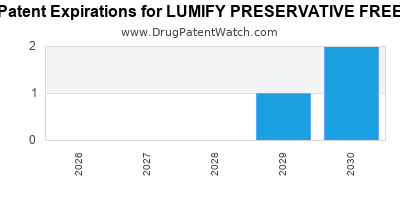
The product has limited conventional patent protection. Its principal defenses are brand recognition, retail distribution, consumer loyalty, packaging differentiation, regulatory know-how, and potential formulation or device claims. The active ingredient is old, and generic or private-label competition can enter through established OTC pathways if equivalent products satisfy FDA requirements.
What is LUMIFY Preservative Free and how does it work?
LUMIFY Preservative Free contains brimonidine tartrate ophthalmic solution 0.025%. It is marketed for temporary relief of redness of the eye due to minor irritations. The preservative-free presentation uses single-use containers rather than a conventional multidose bottle.
Brimonidine is an alpha-2 adrenergic receptor agonist. At the LUMIFY concentration, the product is positioned as a selective ocular vasoconstrictor that reduces visible redness while seeking to limit the rebound redness concerns associated with some older redness-relief products. The original LUMIFY product was launched by Bausch + Lomb as an over-the-counter redness reliever, expanding a pharmaceutical ingredient into a consumer eye-care brand. [1]
The preservative-free version targets consumers who:
- Experience sensitivity to preservatives used in multidose eye drops.
- Use eye drops frequently.
- Prefer single-use packaging for travel, work, or sports.
- Wear contact lenses or use other ophthalmic products, subject to label instructions.
- Pay a premium for a product perceived as cleaner or more comfortable.
The product is not an artificial tear, allergy medicine, antibiotic, or treatment for chronic ocular disease. Its label limits use to temporary relief of redness and directs consumers to seek medical advice for pain, vision changes, injury, infection, or persistent symptoms. [2]
When did LUMIFY Preservative Free launch and what is its FDA status?
Bausch + Lomb introduced LUMIFY Preservative Free in 2024 as an extension of the LUMIFY consumer eye-care franchise. The product is sold as an OTC ophthalmic product in single-use vials and uses the same 0.025% brimonidine concentration associated with the core LUMIFY redness-relief brand. [3]
The regulatory characteristics are commercially important:
| Attribute |
LUMIFY Preservative Free |
| Active ingredient |
Brimonidine tartrate |
| Strength |
0.025% ophthalmic solution |
| Route |
Topical ophthalmic |
| Status |
Over-the-counter eye-drop product |
| Primary use |
Temporary relief of eye redness |
| Packaging |
Preservative-free, single-use containers |
| Therapeutic category |
Consumer eye care and redness relief |
| Manufacturer/brand owner |
Bausch + Lomb |
| Biosimilar exposure |
None |
| Prescription generic substitution |
Not the primary competitive pathway |
FDA OTC eye-drop regulation has evolved through monograph reforms and product-specific regulatory pathways. The legal status of a consumer product must be assessed separately from the branded marketing presentation. The LUMIFY label identifies the product as an OTC redness reliever and provides Drug Facts labeling, warnings, directions, and active-ingredient information. [2]
How large is the market for preservative-free redness-relief eye drops?
The addressable market has three overlapping components: redness-relief eye drops, preservative-free ophthalmic products, and premium consumer eye care.
The largest opportunity is not necessarily conversion of all redness-relief users. LUMIFY Preservative Free is more likely to capture a narrower, higher-value segment that accepts a premium for preservative-free packaging. This can increase revenue per consumer while reducing the potential unit volume compared with a standard multidose bottle.
Market growth is supported by several factors:
- Greater consumer awareness of preservative sensitivity and ocular-surface comfort.
- Increased use of digital devices and associated self-treatment for eye discomfort.
- Expansion of premium eye-care products in pharmacies, mass retailers, club stores, and e-commerce.
- Brand familiarity generated by the original LUMIFY product.
- Demand for portable, hygienic, single-use packaging.
The primary limitation is category substitution. Consumers may purchase artificial tears, allergy drops, cooling drops, or competing redness relievers instead of LUMIFY Preservative Free. The product therefore competes for both the redness-relief budget and the broader discretionary eye-care budget.
How does LUMIFY Preservative Free compare with competing eye drops?
LUMIFY Preservative Free occupies a premium niche relative to conventional redness-relief products.
| Product type |
Common positioning |
Preservative-free availability |
Competitive implication |
| LUMIFY standard bottle |
Brimonidine-based redness relief |
Generally no for the standard multidose format |
Lower price per use and higher convenience |
| LUMIFY Preservative Free |
Brimonidine-based redness relief in single-use vials |
Yes |
Premium pricing and portability |
| Visine and Clear Eyes products |
Traditional redness relief and symptom products |
Varies by SKU |
Strong retail presence and price competition |
| Rohto products |
Cooling, redness, and lubricating eye care |
Varies by SKU |
Differentiated sensory experience |
| Preservative-free artificial tears |
Lubrication and dry-eye relief |
Common |
Substitute for discomfort, but not always for cosmetic redness |
| Allergy eye drops |
Itching and allergy relief |
Varies |
Compete when redness is secondary to allergy symptoms |
Bausch + Lomb has an advantage because LUMIFY is already associated with redness relief. The company does not need to establish a new brand from zero. The risk is that the preservative-free product cannibalizes standard LUMIFY sales rather than expanding the franchise.
Cannibalization is likely when existing LUMIFY users switch to the higher-priced single-use product. The economic effect depends on the price premium, manufacturing cost, and whether the consumer uses the product more frequently because of portability or perceived comfort.
What is the financial trajectory for LUMIFY Preservative Free?
Bausch + Lomb does not publicly report standalone revenue, operating profit, unit volume, or gross margin for LUMIFY Preservative Free. The product is included within the company’s broader consumer portfolio, which also includes eye-care and ocular-health brands. [4]
The most defensible financial interpretation is a staged trajectory:
Launch phase
The launch phase requires retailer placement, consumer education, sampling, packaging inventory, and promotional support. Single-use packaging typically creates higher material and filling costs than a multidose bottle. Early profitability can therefore be below that of an established standard LUMIFY SKU, even if the shelf price is higher.
The primary launch metrics are distribution points, repeat purchase, retailer reorder rates, digital conversion, and the percentage of sales incremental to the LUMIFY franchise.
Expansion phase
The product can improve financial performance if it secures broad pharmacy and mass-retail distribution while preserving a meaningful price premium. E-commerce is particularly suitable for a small, lightweight product sold in multipacks.
A favorable expansion pattern would include:
- Higher household penetration among existing LUMIFY users.
- Repeat purchases from consumers with preservative sensitivity.
- Multipack purchases that improve revenue per transaction.
- Cross-selling with artificial tears and other Bausch + Lomb eye-care products.
- Stable pricing despite promotional activity.
Maturity phase
At maturity, the product’s economics will depend on whether preservative-free packaging becomes a meaningful subcategory or remains a limited premium segment. If the product becomes a recognized format within redness relief, it can support durable revenue. If consumers view single-use vials as expensive or inconvenient, sales may remain concentrated among occasional users.
The key financial risk is that the product increases manufacturing and logistics costs faster than it increases net revenue. The key financial opportunity is premiumization of an established OTC brand without the cost of developing a new active ingredient.
How important is LUMIFY Preservative Free to Bausch + Lomb’s revenue?
LUMIFY is strategically relevant but is unlikely to be material to consolidated Bausch + Lomb revenue on a standalone basis at launch. Bausch + Lomb reports revenue by broad business segments rather than by individual OTC SKU. Its reported categories include Vision Care, Pharmaceuticals, Surgical, and Consumer products. [4]
The financial exposure is therefore indirect:
- A successful product supports Consumer segment growth.
- A premium SKU can improve the mix of the LUMIFY franchise.
- Retailer shelf space can strengthen Bausch + Lomb’s position in consumer eye care.
- Product failure would likely have limited effect on consolidated revenue but could weaken brand-extension economics.
- A successful launch can create a platform for additional preservative-free or single-use products.
LUMIFY’s contribution should be evaluated through incremental franchise revenue rather than gross sales alone. If the product mainly replaces standard LUMIFY purchases, the benefit will be margin mix and consumer retention. If it recruits new users, the product can expand the brand’s total addressable market.
What patents protect LUMIFY Preservative Free?
The active ingredient, brimonidine, is not a new chemical entity. Core composition-of-matter exclusivity is therefore not the principal protection for the product.
Potential IP layers include:
| IP layer |
Relevance to LUMIFY Preservative Free |
| Active ingredient patent |
Limited because brimonidine is an established compound |
| Concentration claims |
Possible, but difficult to enforce if publicly known and not technically distinct |
| Formulation claims |
Potentially relevant if the preservative-free solution has novel stability or delivery characteristics |
| Container or dispenser claims |
Potentially relevant to single-use packaging and dose delivery |
| Manufacturing claims |
May protect sterile filling, stability, or packaging processes |
| Trademark |
Major commercial protection for the LUMIFY name and brand identity |
| Trade dress |
Possible protection for packaging and shelf presentation |
| Regulatory exclusivity |
Limited relative to new prescription drugs |
No standalone patent estate for the preservative-free commercial SKU is identified in the FDA label and company materials cited here. A complete freedom-to-operate analysis would require a live search of U.S. Patent and Trademark Office records, assignment data, Orange Book entries, and relevant foreign databases.
What is the Orange Book status of LUMIFY Preservative Free?
Orange Book analysis is less decisive for this product than it would be for a conventional prescription NDA. LUMIFY Preservative Free is marketed as an OTC eye-care product, and its main commercial protection does not depend on a long prescription-drug exclusivity period.
The relevant questions are whether the product is associated with an NDA, whether any patents are listed against that regulatory application, and whether the specific preservative-free presentation has a separate listing. A branded OTC product can have regulatory and patent records that do not map cleanly onto the retail SKU.
The available public materials do not establish a separate Orange Book patent barrier that would prevent competing OTC brimonidine products. The practical competitive test is whether a rival can lawfully market an equivalent product using an approved or otherwise permissible OTC pathway.
When does LUMIFY Preservative Free lose exclusivity?
LUMIFY Preservative Free does not have a conventional new-drug exclusivity clock comparable to a newly approved prescription medicine. The active ingredient is established, and the product’s commercial protection depends primarily on trademarks, consumer demand, packaging, formulation know-how, and retail execution.
A competitor could challenge the franchise through several routes:
- Launch of an OTC brimonidine redness-relief product.
- Introduction of a preservative-free alternative using another active ingredient.
- Private-label retailer products.
- Premium artificial tears marketed toward redness and comfort.
- Trademark or packaging differentiation that avoids LUMIFY branding.
- Contract-manufactured products sold through online channels.
The most important loss-of-exclusivity event would not necessarily be a patent expiration. It would be the first credible competitor that matches the product’s preservative-free format, perceived comfort, price, and retail availability.
Are there Paragraph IV challenges, biosimilar risks, or patent litigation?
Paragraph IV litigation is generally associated with ANDA filings against listed patents for prescription products. LUMIFY Preservative Free does not present a conventional biologic or biosimilar risk. Brimonidine is a small-molecule active ingredient, and biosimilar provisions do not apply.
No material Paragraph IV litigation or patent settlement involving the specific preservative-free LUMIFY SKU is identified in the cited public materials. No significant product-specific patent litigation is established here.
Potential disputes would more likely involve:
- Trademark infringement.
- False advertising or comparative claims.
- Packaging or trade-dress issues.
- Formulation or container patents, if enforceable claims exist.
- Retailer or distributor contracts.
- Product liability or labeling claims.
What manufacturing and IP barriers affect the product?
The manufacturing barrier is higher than the chemical barrier. Sterile ophthalmic production requires validated facilities, microbial controls, stability testing, container-closure integrity, and reliable single-use packaging. These requirements increase capital and quality-system demands for new entrants.
Preservative-free products also create technical challenges. Multidose ophthalmic products often rely on preservatives or specialized dispensing systems to control contamination. A single-use format avoids repeated opening and closing but raises packaging, filling, and waste costs.
Bausch + Lomb’s advantages include:
- Existing sterile ophthalmic manufacturing capability.
- Established retail relationships.
- Brand recognition.
- Experience with OTC eye-care compliance.
- Ability to promote the product alongside other eye-care products.
These advantages can delay competitive erosion even when patent protection is limited.
What generic entry risks exist for LUMIFY Preservative Free?
Generic and private-label entry risk is moderate over the long term and lower in the immediate launch period. The product’s active ingredient is established, but a rival must still replicate the consumer proposition rather than only the pharmacology.
The highest-risk competitor would combine:
- Brimonidine 0.025%.
- Preservative-free single-use packaging.
- Strong retail distribution.
- A lower net price.
- Clear labeling for redness relief.
- Reliable supply and sterile manufacturing.
A lower-priced product could pressure LUMIFY’s price premium. A large retailer could also use private-label placement to reduce branded shelf space. Bausch + Lomb’s defense is the LUMIFY name, advertising, pharmacist familiarity, and consumer trust.
How does LUMIFY Preservative Free compare with standard LUMIFY?
| Metric |
Standard LUMIFY |
LUMIFY Preservative Free |
| Active ingredient |
Brimonidine tartrate 0.025% |
Brimonidine tartrate 0.025% |
| Format |
Multidose bottle |
Single-use vials |
| Preservative-free positioning |
No |
Yes |
| Likely price |
Lower per use |
Premium |
| Convenience |
Better for routine household use |
Better for travel and episodic use |
| Cost of goods |
Generally lower |
Generally higher |
| Main opportunity |
Broad consumer adoption |
Premium segment and sensitive users |
| Main risk |
Mature category competition |
Cannibalization and packaging cost |
The two products are complementary but can compete for the same LUMIFY consumer. Management’s financial objective is likely to increase total franchise value, not simply move users from one package to another.
Key Takeaways
- LUMIFY Preservative Free is a 0.025% brimonidine OTC eye drop in single-use, preservative-free packaging.
- Bausch + Lomb introduced it in 2024 as a premium extension of the LUMIFY brand.
- Product-level revenue and profit are not separately disclosed.
- The financial opportunity is premiumization, broader consumer segmentation, and higher value per purchase.
- The largest commercial risk is cannibalization of standard LUMIFY sales.
- The active ingredient is established, so chemical patent exclusivity is limited.
- Brand, distribution, sterile manufacturing, packaging, and consumer loyalty are more important barriers than a conventional patent estate.
- No material product-specific Paragraph IV, biosimilar, patent litigation, or settlement risk is identified in the cited public materials.
- Long-term competition is likely to come from private-label OTC products, preservative-free alternatives, and established redness-relief brands.
- The critical financial indicators are incremental franchise sales, net price premium, repeat purchase, retail distribution, and manufacturing cost per dose.
FAQs
Is LUMIFY Preservative Free a prescription drug?
No. It is marketed as an over-the-counter ophthalmic redness-relief product containing brimonidine tartrate 0.025%. [2]
Does LUMIFY Preservative Free contain preservatives?
No. Its single-use vial presentation is designed to provide preservative-free dosing.
Can a generic version of LUMIFY Preservative Free launch?
Potentially. Because brimonidine is an established active ingredient and conventional long-term exclusivity is limited, competing OTC products could enter if they satisfy applicable FDA requirements and avoid Bausch + Lomb’s trademarks and any enforceable formulation or packaging claims.
Is LUMIFY Preservative Free covered by a new chemical entity exclusivity period?
No. Brimonidine is an established small-molecule active ingredient, so the product does not receive new-chemical-entity exclusivity based on the active ingredient.
What would most increase the product’s investment value?
The strongest indicators would be sustained retail expansion, repeat purchase, a stable price premium over standard LUMIFY, limited cannibalization, and evidence that the preservative-free format expands the total LUMIFY consumer base.
References
-
Bausch + Lomb Corporation. (2024). LUMIFY Preservative Free eye drops product information. Bausch + Lomb.
-
U.S. Food and Drug Administration. (2024). LUMIFY Preservative Free brimonidine tartrate ophthalmic solution 0.025% Drug Facts label. FDA.
-
Bausch + Lomb Corporation. (2024). Bausch + Lomb introduces LUMIFY Preservative Free eye drops. Bausch + Lomb news release.
-
Bausch + Lomb Corporation. (2025). Annual report for the fiscal year ended December 31, 2024. U.S. Securities and Exchange Commission.