Last updated: August 6, 2026
Lotrisone, the branded combination of clotrimazole 1% and betamethasone dipropionate 0.05%, is a mature topical antifungal-corticosteroid product with limited current brand value. Its commercial position is driven by generic substitution, low barriers to formulation replication, and restricted clinical use caused by the risks of topical corticosteroids. The original U.S. patent and regulatory exclusivity periods expired decades ago. Current revenue is concentrated in generic clotrimazole-betamethasone products rather than the Lotrisone brand.
What is Lotrisone and how does the product work?
Lotrisone is a prescription topical cream used for inflammatory fungal skin infections, including tinea corporis, tinea cruris, and tinea pedis. It combines:
| Component |
Concentration |
Role |
| Clotrimazole |
1% |
Imidazole antifungal |
| Betamethasone dipropionate |
0.05% |
High-potency topical corticosteroid |
The combination treats fungal organisms while reducing inflammation and itching. The steroid component creates clinical and commercial limitations. Prolonged or inappropriate use can cause skin atrophy, striae, systemic corticosteroid exposure, and worsening or masking of infection. FDA labeling limits treatment duration and cautions against use on the face, groin, and underarms unless directed by a physician.[1]
Lotrisone is a cream dosage form. A lotion formulation, Lotrisone lotion, was also marketed historically, but the commercial relevance of the brand has declined as generic alternatives entered the market.
What is the FDA regulatory status of Lotrisone?
The U.S. Food and Drug Administration approved Lotrisone as a new drug application product in the 1980s. The product is now a legacy prescription medicine with generic equivalents approved through the abbreviated new drug application pathway.
The FDA regulatory profile is characterized by:
- No remaining meaningful new-drug exclusivity.
- Generic approvals for clotrimazole and betamethasone dipropionate cream.
- Prescription-only status for the combination product.
- A mature label with established safety and efficacy information.
- Limited innovation because the active ingredients and concentration ratios are well established.
The FDA-approved product is distinct from over-the-counter clotrimazole products. Clotrimazole alone is widely available without a prescription, while the clotrimazole-betamethasone combination remains prescription-based because of the potency and risks associated with betamethasone dipropionate.[2]
What is the Orange Book status of Lotrisone?
Lotrisone has historically been listed in the FDA Orange Book under its approved prescription drug application. The practical commercial significance of the listing is limited because the product’s patent and exclusivity protections have expired and generic versions are available.
For a mature topical product, Orange Book status matters less than it does for an oral small-molecule drug because:
- The principal patents are expired.
- Generic applicants can rely on the reference product’s safety and efficacy findings.
- Topical generics compete through ANDA approval, formulation similarity, manufacturing quality, and pharmacy substitution.
- Product-level revenue is fragmented among multiple generic suppliers.
Current commercial diligence should distinguish between the historical Lotrisone NDA and the availability of marketed generic clotrimazole-betamethasone products. The brand’s regulatory listing does not establish a continuing high-value exclusivity position.[3]
What patents protect Lotrisone and when did exclusivity expire?
The original protection for Lotrisone covered the combination of clotrimazole and betamethasone dipropionate in a topical formulation. Those rights are expired. No commercially relevant blocking patent estate is associated with the basic Lotrisone formulation today.
| Protection category |
Current position |
| Active-ingredient patents |
Expired |
| Combination-product patents |
Expired |
| Original formulation patents |
Expired |
| FDA new-drug exclusivity |
Expired |
| Pediatric exclusivity |
No current commercial relevance |
| Method-of-use patents |
No known active barrier affecting ordinary generic entry |
| Manufacturing patents |
No publicly significant blocking position for the basic product |
The product’s composition is technically straightforward. A generic manufacturer needs to control particle size, suspension uniformity, viscosity, preservative performance, emulsion stability, assay, impurities, microbial quality, and packaging compatibility. Those requirements can create execution costs but do not create durable exclusivity comparable to a novel chemical entity.
The absence of a current patent moat means that the economic value of Lotrisone is determined by cost position, wholesaler access, pharmacy contracts, product availability, and reimbursement rather than by intellectual property.
How many patents cover Lotrisone today?
No active patent estate appears to provide meaningful U.S. exclusivity for the basic clotrimazole 1% and betamethasone dipropionate 0.05% cream combination. Historical patents associated with the original product are expired or commercially non-blocking.
Patent risk can still arise from:
- A new vehicle or delivery system.
- A low-irritation formulation.
- A modified-release topical system.
- A device-assisted applicator.
- A new indication supported by clinical data.
- A proprietary manufacturing process with independent commercial value.
Those possibilities would protect an improved product, not the conventional Lotrisone formulation. A generic manufacturer entering with the standard cream would not ordinarily face a meaningful Paragraph IV patent challenge against an active Lotrisone patent.
Which companies manufacture generic Lotrisone?
Generic clotrimazole-betamethasone products have been marketed by several manufacturers and distributors over time. The competitive field has included companies active in generic dermatology, such as Taro Pharmaceutical Industries, Perrigo, Glenmark, Teva, and other ANDA holders or contract manufacturers, depending on product presentation and market period.
The relevant competitive distinction is between:
- The branded Lotrisone product.
- Authorized or legacy brand distribution.
- Generic cream products.
- Generic lotion products.
- Pharmacy-label products supplied through wholesalers.
Market participation can change as companies discontinue low-volume topical products, transfer ANDAs, or rationalize manufacturing portfolios. The number of approved suppliers therefore does not always equal the number of consistently available suppliers.
What is the market structure for Lotrisone?
Lotrisone operates in a highly commoditized prescription dermatology segment. Market dynamics are shaped by five factors.
Generic substitution
Generic substitution places substantial pressure on the brand. Once multiple ANDA products are available, payers and pharmacy benefit managers typically favor the lowest-cost therapeutically equivalent product. The brand must maintain clinical recognition or contracting support to preserve volume.
Low treatment cost
The product is generally used for short courses. Even where prescription volume remains stable, limited treatment duration restricts annual revenue per patient.
Narrow clinical role
Combination antifungal-steroid products can relieve symptoms quickly, but many clinicians prefer antifungal monotherapy when inflammation is limited. Dermatology guidance has raised concerns about routine use of potent steroid-antifungal combinations because steroid exposure can complicate diagnosis and produce adverse effects.[4]
OTC substitution
Patients with uncomplicated fungal infections may use over-the-counter clotrimazole, terbinafine, or similar antifungals. This reduces the addressable market for a prescription combination product.
Reimbursement pressure
The product is commonly reimbursed as a low-cost generic prescription. Pharmacy benefit managers can move utilization among equivalent suppliers, leaving manufacturers with limited pricing power.
How has the financial trajectory of Lotrisone changed?
Lotrisone’s financial trajectory follows the standard lifecycle of an older branded topical product:
| Period |
Commercial condition |
Financial effect |
| Initial launch |
Novel prescription combination |
Brand pricing and physician adoption |
| Pre-generic period |
Established dermatology product |
Stable revenue and repeat prescribing |
| Generic entry |
ANDA competition |
Rapid price and share erosion |
| Mature generic period |
Multiple suppliers |
Low unit prices and fragmented volume |
| Current phase |
Commodity topical medicine |
Limited brand value; margin depends on manufacturing efficiency |
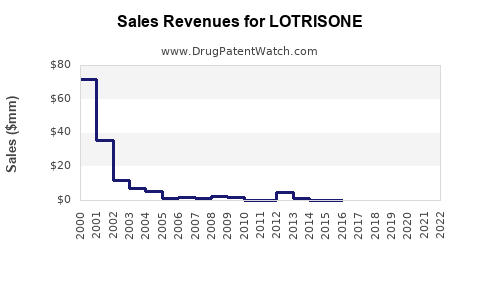
No standalone, current public revenue series for Lotrisone is generally reported by the former brand owner. Large pharmaceutical companies typically aggregate mature topical products within broader prescription, dermatology, or established-products reporting. As a result, revenue exposure cannot be measured reliably from public corporate filings without product-level sales data.
The financial conclusion is clear even without a standalone revenue series: the branded product no longer represents a material growth asset. The economic opportunity lies in generic supply, portfolio breadth, and manufacturing utilization rather than in premium brand pricing.
What generic entry risks exist for Lotrisone?
Generic entry risk is high because the product has no apparent active patent barrier and the reference formulation is technically conventional.
A prospective generic entrant would face commercial rather than legal risk:
- Limited market size.
- Price erosion after additional approvals.
- Low switching costs for pharmacies.
- Wholesaler inventory requirements.
- Potential supply interruptions caused by small market economics.
- Manufacturing costs that may be high relative to annual sales.
- Reimbursement exclusion if the product is not competitively priced.
For existing generic manufacturers, the principal risk is margin compression. For a new entrant, the main question is whether expected volume justifies regulatory, validation, and launch costs.
Are there Paragraph IV challenges or Lotrisone patent lawsuits?
No current, commercially significant Paragraph IV campaign is associated with the basic Lotrisone product. The original patent estate is too old to support a contemporary branded-defense strategy.
Historical litigation involving an older product could include patent, trademark, manufacturing, labeling, or ANDA disputes. Those matters should not be confused with an active patent barrier. The absence of an active Orange Book patent dispute means generic competition is primarily governed by FDA approval and market access.
There is also no meaningful biosimilar risk. Lotrisone is a small-molecule topical drug, not a biologic. Biosimilar legislation and biologic patent litigation do not apply. Competitive threats come from generic equivalents, OTC antifungals, alternative steroid-antifungal products, and newer topical therapies.
What formulations are protected by Lotrisone patents?
The original commercial protection centered on the conventional cream and related topical presentation. Those protections have expired. Current formulation differentiation is limited.
Potentially protectable future formulations could include:
- A lower-potency steroid combination.
- A non-greasy or fast-drying vehicle.
- A foam, spray, gel, or film-forming system.
- A formulation designed for sensitive skin.
- A pediatric formulation with lower corticosteroid exposure.
- A device that improves dosing or limits application area.
A reformulated product would need meaningful clinical, adherence, tolerability, or delivery advantages. A minor excipient change would face a weak commercial case unless it produced a clear manufacturing or patient benefit.
How does Lotrisone compare with competing dermatology products?
| Product category |
Main advantage |
Main commercial threat to Lotrisone |
| Clotrimazole alone |
OTC availability and lower steroid risk |
Replaces combination therapy in mild cases |
| Terbinafine |
Short treatment courses and strong antifungal activity |
Reduces need for clotrimazole |
| Ketoconazole topical |
Established antifungal option |
Competes in dermatophyte and yeast infections |
| Hydrocortisone-antifungal combinations |
Lower steroid potency |
Offers a lower-risk combination approach |
| Topical corticosteroid alone |
Controls inflammation |
Does not treat fungal infection |
| Newer dermatology agents |
Targeted indications and differentiated formulations |
Capture specialty prescribing |
Lotrisone’s strongest residual use case is a short prescription course for a confirmed or strongly suspected fungal infection with substantial inflammatory symptoms. Its weakest position is routine use for mild or diagnostically uncertain rashes.
What licensing deals affect Lotrisone?
No major current licensing transaction appears to drive the commercial value of Lotrisone. The product’s active ingredients are off-patent, and generic marketing rights are commonly handled through ANDA ownership, distribution agreements, contract manufacturing, or product transfers rather than high-value licensing deals.
Any transaction involving Lotrisone today would likely be a portfolio acquisition, ANDA transfer, supply agreement, or dermatology product bundle. It would not normally represent a strategic licensing deal for protected innovation.
What is the outlook for Lotrisone revenue?
The base-case outlook is flat to declining for the branded product and stable-to-pressured for the generic category.
Revenue drivers include:
- Prescription volume for inflammatory fungal infections.
- Number of active generic suppliers.
- Generic reimbursement rates.
- Manufacturing availability.
- Physician preference for combination therapy.
- OTC substitution.
- Stewardship concerns over potent topical corticosteroids.
A short-term volume increase could occur if a competing supplier experiences a shortage. Such gains would likely be temporary and would not establish durable pricing power. Long-term growth is constrained by the product’s age, lack of exclusivity, short treatment duration, and competition from antifungal monotherapy.
Key Takeaways
- Lotrisone contains clotrimazole 1% and betamethasone dipropionate 0.05%.
- The product is an old prescription topical combination with expired patent and exclusivity protection.
- Generic competition, OTC antifungals, and steroid-safety concerns limit brand growth.
- No active patent estate appears to block standard generic entry.
- Paragraph IV and biosimilar risks are not material to the current product.
- Standalone Lotrisone revenue is not generally disclosed in public company filings.
- The commercial opportunity is a low-margin generic supply business, not a premium branded asset.
- Future value would require a differentiated formulation, delivery system, or clinically improved steroid profile.
FAQs
Is Lotrisone still available in the United States?
The Lotrisone brand has limited commercial relevance, while generic clotrimazole-betamethasone products remain the principal source of supply.
Is generic clotrimazole-betamethasone therapeutically equivalent to Lotrisone?
FDA-approved generic products are required to demonstrate pharmaceutical equivalence and bioequivalence or applicable performance equivalence to the reference product under the ANDA pathway.[3]
Can Lotrisone be purchased over the counter?
The combination product is prescription-only in the United States. Clotrimazole alone is available over the counter, but it does not contain betamethasone.
Why is Lotrisone avoided on the face?
Betamethasone dipropionate is a potent topical corticosteroid. Facial use increases the risk of skin atrophy and other corticosteroid-related adverse effects, and the product label restricts use in sensitive areas.[1]
Is Lotrisone an attractive acquisition target?
The legacy brand is unlikely to be an attractive standalone acquisition target. A generic product or dermatology portfolio could have value if it provides manufacturing scale, reliable supply, or access to a broader prescription channel.
References
- U.S. Food and Drug Administration. (n.d.). Lotrisone cream: Prescribing information. FDA.
- U.S. Food and Drug Administration. (n.d.). Over-the-counter monograph M005: Topical antifungal drug products. FDA.
- U.S. Food and Drug Administration. (n.d.). Approved drug products with therapeutic equivalence evaluations, commonly known as the Orange Book. FDA.
- American Academy of Family Physicians. (2002). Diagnosis and management of tinea infections. American Family Physician, 65(10), 2095-2102.