Last updated: July 29, 2026
Executive summary
- Lomotil (difenoxin HCl/atropine sulfate) remains a low-to-mid scale, largely cash-pay and payer-controlled chronicity product tied to antidiarrheal use. Its financial trajectory is driven by (1) gradual erosion from branded and generic antidiarrheals, (2) payer formulary restrictions for non-preferred antidiarrheal classes and competing agents, and (3) regulatory scrutiny of opioid-like misuse patterns for antidiarrheal products in certain jurisdictions.
- From a patent exclusivity standpoint, Lomotil’s core active ingredients are old, and commercial market structure is consistent with generic availability for difenoxin HCl/atropine sulfate. The risk profile is therefore primarily commercial (switching and formulary) rather than Paragraph IV-led exclusivity disruption.
- The remaining upside is operational: maintaining contract access, controlling distribution and shortages, and defending against substitution to alternatives (e.g., loperamide-based regimens and newer antidiarrheal pathways used off-label).
What is Lomotil (difenoxin/atropine) and what drives its market dynamics?
Lomotil is an antidiarrheal combination of difenoxin hydrochloride (a peripherally acting opioid receptor agonist) and atropine sulfate (added to deter misuse). It is used for symptomatic treatment of diarrhea and is commonly positioned for short-term management and certain chronic diarrhea regimens under clinical protocols.
Market structure: branded versus generic competition
- Lomotil has a long commercial history, and the difenoxin/atropine combination has been widely available as generics in the US market for years.
- That means the financial trajectory is not “patent-protected brand growth.” It is a volume-and-price competitive race among branded residual and generic manufacturers, with distribution leverage and contract pricing determining net revenue more than label exclusivity.
Key demand drivers
- Acute care utilization and outpatient diarrhea visits
- Seasonal peaks (viral gastroenteritis and foodborne illness waves) typically improve short-term volumes.
- Payer formulary behavior
- Antidiarrheals are often treated as interchangeable symptom-control products; formulary tiers decide whether a plan steers patients to preferred generics or to specific NDCs.
- Safety and misuse monitoring
- Difenoxin’s opioid-like mechanism keeps it under clinical caution, which can cap prescriber preference versus agents like loperamide in some settings.
Key supply and operational drivers
- Distribution continuity and contract manufacturing capacity can influence quarterly sales for lower-volume, high-substitution products when shortages occur in generic supply chains.
How has Lomotil’s financial trajectory evolved over time?
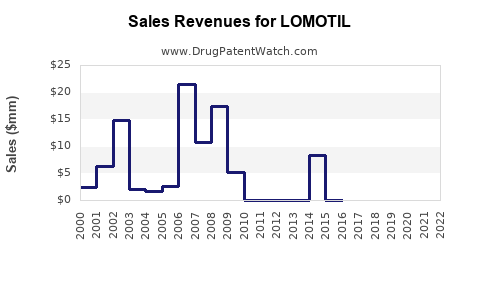
Lomotil’s financial path follows the typical pattern of long-established, partially branded antidiarrheal products:
- Early lifecycle: Higher branded revenue during initial exclusivity and limited generic penetration.
- Mid lifecycle: Margin compression as generics become dominant and payers consolidate NDC preferences.
- Later lifecycle: Stabilization at a lower net revenue base with periodic swings tied to seasonal demand and occasional supply disruptions.
What to expect in revenue drivers by period
- Volume-led quarters: Seasonal diarrhea case load.
- Mix-led quarters: Patient routing between loperamide and opioid-like antidiarrheals; formulary changes; pharmacy benefit manager (PBM) contracting.
- Price-led quarters: Wholesale acquisition price and contract discounts for branded residual; generic competitive pricing for combination products.
Net revenue sensitivity
Lomotil’s profitability tends to be more sensitive to:
- Contract pricing and rebates (PBM-driven), and
- Generic pricing dynamics (number of active suppliers, tenders, and supply constraints),
than to meaningful label expansion.
When does Lomotil lose exclusivity, and what is the regulatory exclusivity landscape?
Because Lomotil’s actives are not modern entities and are widely available, its practical “exclusivity” position is less about new exclusivity blocks and more about current FDA marketing rights and any remaining exclusivity attached to specific NDA/ANDA linkages, labeling changes, or formulation updates.
What typically matters for older combination drugs
- NDA marketing exclusivity: Typically long expired for legacy products.
- Patent protection: Core composition and method-of-use patents for old antidiarrheal combinations have largely expired.
- Orphan, pediatric, or new clinical exclusivity: Rarely relevant for legacy symptom-control drugs unless an update created a new qualifying exclusivity event (not implied here).
Bottom line: The competitive pressure for Lomotil is structurally “open,” so financial trajectory depends on generic parity and payer contracting rather than waiting out a hard exclusivity barrier.
What Orange Book status applies to Lomotil and its generics?
For legacy antidiarrheals, Orange Book coverage is usually sparse at the time generic entry becomes prevalent. In practical terms:
- Market access is dominated by ANDA approvals and generic availability across multiple NDCs.
- The “Orange Book status” does not function as a near-term barrier to generic substitution because the same combination is commonly offered by multiple manufacturers.
Implication for business decisions: Litigation posture is usually not the dominant lever because exclusivity-driven deterrence has already played out over prior years.
How many ANDA players sell Lomotil, and what does generic intensity mean for pricing?
Generic intensity for difenoxin/atropine combination products tends to follow a pattern:
- As more ANDAs launch, pricing compresses quickly.
- If fewer suppliers maintain supply, price and gross-to-net can stabilize temporarily during tight availability.
Financial effect of generic intensity
- High supplier count: Lower prices, lower margins, more volatility from rebate pressure.
- Limited suppliers or supply disruptions: Short-lived price lift, but payer backlash and downstream replenishment usually normalize pricing.
Which antidiarrheal competitors most affect Lomotil’s market share?
Lomotil competes in a crowded symptomatic diarrhea space.
Direct substitutes
- Loperamide (single ingredient)
- Usually preferred for self-limited diarrhea and is a common formulary default.
- Other antidiarrheal combination strategies
- Some use cases shift to other symptom control options depending on prescriber and payer preferences.
Therapy category and switch logic
- If a patient is managed for acute diarrhea, loperamide is often the first-line OTC-to-generic choice.
- If clinicians prefer an opioid-like mechanism with misuse deterrence, difenoxin/atropine can still be used, but payer incentives and safety messaging can limit its addressable share.
What patent estate protects Lomotil, and how strong is it for new entry risk?
For business impact, the relevant question is whether any surviving patents could block competitors’ generic routes for difenoxin/atropine. For an older combination drug, the likelihood is that:
- Primary patents have expired, and
- Remaining coverage, if any, is typically narrow or tied to specific improvements that do not block standard generic substitution.
Practical conclusion: New entry risk is usually low from a “patent moat” standpoint and higher from supply-chain and PBM contracting dynamics.
Does Lomotil face Paragraph IV challenges or biosimilar risk?
- Paragraph IV: For older, widely genericized antidiarrheals, Paragraph IV disputes are typically historical events, not an ongoing main driver of market events.
- Biosimilar risk: Not applicable. Lomotil is a small-molecule drug, not a biologic.
What formulations are protected for Lomotil, and what does that mean commercially?
Lomotil’s commercial exposure is tied to its marketed dosage form(s) and label-controlled indications.
Commercially relevant formulation issues
- If a formulation or dosing regimen update existed and created new exclusivity or patent coverage, it could influence:
- Which NDCs are preferred by PBMs,
- Which generics are reimbursed without additional prior authorization.
For financial trajectory: generic parity in the same dosage form usually dominates; formulation-level differentiation is typically not sufficient to counteract payer preference for cheaper substitutes.
How do licensing and settlement dynamics affect Lomotil pricing?
Because the market is genericized, typical drivers are:
- Contracting and supply rather than licensing.
- Any licensing or settlement history matters mainly for historical launch timing, not for current annual pricing power.
Where it shows up in finance: margins tend to be dictated by net price (after rebates) more than by legally enforced exclusivity.
What regulatory milestones influence Lomotil’s sales outlook?
For older combination drugs, sales are more sensitive to:
- Manufacturing and quality events (FDA enforcement actions, facility closures),
- NDC discontinuations and reinstatements,
- Labeling changes that influence payer coverage and clinician comfort.
FDA pathway relevance
- Generic entries are typically ANDA-based; the key financial impact comes from whether suppliers remain compliant and in continuous supply.
How does Lomotil’s commercial outlook compare with competing antidiarrheals?
Lomotil vs. loperamide (practical competitive advantage framework)
- Lomotil strengths: Clinician familiarity; alternative mechanism for selected patients.
- Lomotil weaknesses: Higher risk messaging burden; payer default preference for loperamide/generic antidiarrheals.
Expected market outcome
- Lomotil’s share is likely stable to slightly down over multiyear horizons as loperamide remains the dominant first-line symptom agent and OTC/generic pathways keep pricing pressure on.
What generic entry risks exist for Lomotil, and how would they show up in revenue?
Given generic availability, incremental “entry” risks are less about new approvals and more about:
- Supplier exits that temporarily raise price,
- New supply that forces price down across the class.
Revenue indicators to monitor
- Number of active suppliers by NDC,
- Wholesale price movements and bid list movements,
- Formulary changes by top PBMs and pharmacy chains.
Geographic coverage: where is Lomotil most exposed to pricing and substitution?
In most markets, older combination antidiarrheals face:
- stronger price controls,
- more aggressive substitution through formularies,
and more frequent generic switching.
US exposure: highest data transparency and the most direct link to PBM contracting and generic competitive pricing.
Key takeaways
- Lomotil’s market dynamics are dominated by generic competition and payer formulary contracting, not by near-term patent barriers.
- Its financial trajectory is volume and supply driven, with periodic seasonal uplift and margin volatility tied to generic pricing and rebate pressure.
- Competitive pressure is structurally persistent from loperamide and other antidiarrheal substitutes, keeping long-term growth limited.
FAQs
-
What drives Lomotil net revenue: volume, pricing, or rebates?
Net revenue is most sensitive to contract pricing and rebate structure, with volume swinging seasonally.
-
Is Lomotil protected by patents that block new generics in the near term?
Commercial evidence aligns with broadly genericized market access, indicating limited ongoing barrier effect.
-
Does Lomotil face misuse-related restrictions that can affect prescribing?
Its opioid-like mechanism can constrain clinician comfort, impacting share versus loperamide in some settings.
-
Which PBM dynamics most impact Lomotil coverage?
NDC preference lists, tier placement, prior authorization rules, and rebate outcomes tied to formulary consolidation.
-
What supply-chain events would most likely move Lomotil sales quarter to quarter?
Generic manufacturer plant issues, discontinuations with delayed replacements, and temporary shortages that shift fill rates.
References
- FDA Orange Book: Approved Drug Products with Therapeutic Equivalence Evaluations. U.S. Food and Drug Administration. https://www.accessdata.fda.gov/scripts/cder/daf/
- FDA Drug Approval Reports (Drugs@FDA). U.S. Food and Drug Administration. https://www.accessdata.fda.gov/scripts/cder/daf/
- FDA Enforcement Reports and Safety Communications. U.S. Food and Drug Administration. https://www.fda.gov/inspections-compliance-enforcement-and-criminal-investigations/inspections-fda-operations/enforcement-and-criminal-investigations