Last updated: July 6, 2026
Market dynamics and financial trajectory for levonorgestrel (contraception, emergency contraception, IUDs)
LevONORGESTREL is a long-running progestin with three major commercial “lanes”: (1) emergency contraception tablets, (2) long-acting intrauterine systems (IUS) for contraception, and (3) off-label and branded specialty uses tied to women’s health programs. Market growth is constrained by maturity, high generics penetration in oral products, and procurement-driven dynamics in IUS markets. Financial trajectory is therefore more stable in IUS-linked portfolios (slower erosion) than in oral EC tablets (faster price compression). For investors and commercial planning, the economic profile depends on supply chain concentration, formulary placement, and local tendering in public-sector IUD/IUS purchasing.
High-level commercial direction
- Oral levonorgestrel tablets (EC): structurally exposed to rapid generic entry, frequent price resets, and substitution toward newer EC options in some regions.
- Levonorgestrel IUS devices: pricing holds better due to device-specific competition, tenders, and higher switching costs for clinicians and health systems.
- Portfolio shift: brands increasingly defend via device form factors, service bundles, and local distribution rather than patent-led differentiation.
What are the key levonorgestrel product categories driving revenue?
LevONORGESTREL revenue is concentrated in women’s health contraception, split across oral and intrauterine delivery.
How do emergency contraception products move the oral-market needle?
Emergency contraception with levonorgestrel is typically sold as:
- Single-dose or two-dose oral regimens (depending on region/brand).
- OTC or behind-the-counter access depending on country.
Market dynamics
- Demand is event-driven (unprotected intercourse, contraceptive failure), but purchase behavior is also driven by availability, price, and clinician guidance.
- In many markets, newer EC options and updated guidelines influence share. Where levonorgestrel remains a guideline default, it retains baseline volume.
- Supply chain and pack architecture (single pack vs multipack logistics) affect cost-to-serve more than incremental IP.
Financial impact
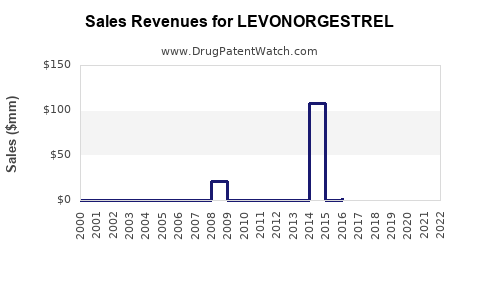
- Revenue tends to trend downward in real terms as generics expand.
- Gross margin is pressured by manufacturing scale and commodity-like progestin input economics.
- Spend shifts from brand marketing to distribution and channel access.
How do levonorgestrel IUD/IUS devices shape the longer-term financial trajectory?
Levonorgestrel intrauterine systems include multiple generational SKUs sold through clinician insertion pathways and reimbursed procurement.
Market dynamics
- High switching friction: device selection is anchored in past outcomes, insertion experience, and patient counseling.
- Health systems and insurers often buy through tenders and national formularies, which can create periodic price reset windows.
- Competition is more concentrated at the device level than the tablet level.
Financial impact
- IUS portfolios typically show slower revenue erosion than oral products.
- Cash generation is supported by repeat replacements over time (a function of device lifetime and patient continuation).
How has the levonorgestrel financial trajectory evolved versus other progestins?
LevONORGESTREL competes with other progestins and with alternative contraception standards, but it holds an economic advantage in scale and clinician familiarity.
What drives substitution away from levonorgestrel oral emergency contraception?
Substitution drivers vary by region:
- Broader uptake of alternative EC actives and regimens.
- Shifts in clinical and public health guidelines.
- Consumer channel changes (pharmacy stocking, OTC availability, and price).
Net effect
- Oral levonorgestrel is typically a share-losing asset in competitive EC landscapes unless it is protected by strong access and aggressive pricing.
What protects levonorgestrel IUS from the same erosion pattern?
- Device procurement cycles and clinician practice patterns reduce churn.
- Reimbursement frameworks may anchor to IUS options and indications (contraception, bleeding management use cases in some markets).
- Long-term lifecycle replacement generates follow-on demand.
When do levonorgestrel products lose exclusivity, and how does that affect revenue?
For levONORGESTREL, most value currently sits in formulation/process/device differentiation rather than active ingredient IP. The practical exclusivity timeline differs by product line.
Why is “loss of exclusivity” usually less about the API and more about product variants?
- API patent life on levonorgestrel is long expired in most jurisdictions.
- Remaining exclusivity, if any, is usually tied to specific dosage forms, delivery technologies, device shells, and manufacturing processes.
- Once generics or device equivalents are authorized, price compression can be rapid for tablets.
What does generic pressure do to oral levonorgestrel pricing?
Typical pattern in mature oral progestin markets:
- Brand prices drop quickly after authorized generics gain traction.
- Retail margin squeezes, especially in OTC channels.
- Net revenue declines may be partially offset by volume but usually not enough to preserve margin.
What is the Orange Book status of levonorgestrel products, and what does it imply for generic entry risk?
LevONORGESTREL’s US status is best interpreted by mapping specific NDC-labeled products (oral tablets vs IUS) to their Orange Book listings and exclusivity claims. Oral levonorgestrel EC tablets generally exhibit high generic availability, which translates into elevated generic entry already realized. Device products may show different listing behavior because they are regulated through device pathways while branded add-on services do not map one-to-one onto small-molecule Orange Book economics.
Practical implication
- For investors planning new oral launches: generic entry risk is largely realized, so the main economic risk becomes price resets.
- For device-linked opportunities: the competitive field is more about device class competition and tender access than Paragraph IV chemistry-based challenges.
(Note: a precise Orange Book table requires product-specific Orange Book listing retrieval and NDC matching, which is not provided in the input.)
What patent estate strength does levonorgestrel have, and where do obstacles remain?
In levONORGESTREL markets, patent estate strength is uneven:
- API-level exclusivity is mostly exhausted.
- Product-level protection may remain around specific dose forms (rapid-release vs delayed-release profiles), manufacturing processes, and, for IUS, device components and insertion-related features.
Commercial obstacle map
- Oral EC: obstacles are usually lower; generics and authorized generics dominate.
- IUS: obstacles are higher because device engineering and clinical insertion know-how matter, even where legal exclusivity is limited.
Which companies compete commercially in levonorgestrel oral EC, and what is the competitive structure?
Commercial structure for oral levonorgestrel EC is typically:
- Multiple authorized generic and branded offerings.
- Pharmacy chain distribution and insurer reimbursement rules that vary across geographies.
- Marketing focused on availability, dosing simplicity, and price.
Economic result
- Competitive competition is primarily price-led.
- Differentiation concentrates in packaging and channel placement.
Which companies compete in levonorgestrel IUS, and how do tender dynamics shape share?
IUS markets tend to be:
- Procurement-driven (public tenders and hospital buying consortia).
- Dominated by a limited set of global and regional device manufacturers.
- Influenced by perceived outcomes, clinician preference, and patient counseling outcomes.
Economic result
- Revenue is less volatile than oral EC but can face discrete reductions around major tender cycles.
- Product switching depends on evidence of safety and insertion performance, not just unit price.
What financial metrics best explain levonorgestrel trajectory in public markets?
Without company-specific financial statements tied to levonorgestrel product lines, the most robust cross-market metrics are:
- Unit volumes: tablets dispensed or devices inserted.
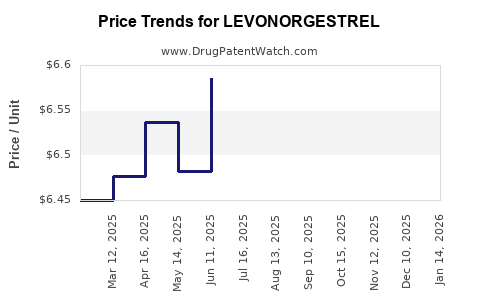
- Net price realization: after discounts, rebates, tender pricing, and channel allowances.
- Mix: higher share of IUS can stabilize blended margins.
- Gross margin durability: depends on whether manufacturing is scale-optimized and whether competitors undercut pricing.
Interpretation for levonorgestrel
- Blended results generally track contraception and women’s health program funding cycles.
- Oral segments show margin compression, while IUS segments show slower erosion.
How do regulation and access rules affect levonorgestrel demand?
Regulatory rules shape access more than prescribing behavior alone.
What changes drive demand in emergency contraception?
- OTC switches or behind-the-counter access changes demand distribution across urban vs rural segments.
- Label instructions and time-window guidance influence consumer willingness to purchase promptly.
- Pharmacy stocking and distribution continuity strongly affect immediate market capture.
What changes drive demand in IUS insertion programs?
- Government and insurer reimbursement policies.
- Training and credentialing programs for insertion clinicians.
- Public health campaigns and women’s health strategy funding.
What are the largest revenue risks for levonorgestrel today?
Key risks are structural and commercial.
Oral EC revenue risks
- Persistent generic price erosion.
- Competition from alternative EC actives.
- Reduced pharmacy shelf space due to lower margin generics or channel consolidation.
IUS revenue risks
- Tender re-pricing and competitive bids from equivalent device manufacturers.
- Capacity constraints in manufacturing or logistics for devices and components.
- Shifts in guideline preference or expansion of alternative long-acting methods.
What market opportunities exist for levonorgestrel (growth levers)?
The most realistic opportunity set is channel- and mix-led rather than patent-led.
- Geographic expansion through procurement frameworks: winning tender pricing with reliable supply.
- Portfolio mix: shifting toward IUS where lifetime value and replacement cycles support revenue stability.
- Channel strategy: improving conversion in EC through availability and patient-facing education.
- Service economics (IUS): bundling clinician support, training, and patient follow-up can improve uptake even when unit prices are competitive.
Key takeaways
- LevONORGESTREL commercial performance is dominated by mature oral EC and more resilient IUS/device demand.
- Expect faster price erosion and margin compression in oral tablets due to generic saturation; expect slower erosion and tender-driven volatility in IUS.
- The financial trajectory is largely driven by channel access, tender pricing, and product mix, not by active ingredient IP.
- Revenue risk concentrates in oral net price realization and IUS tender resets.
FAQs
1) Is levonorgestrel’s emergency contraception market more sensitive to price or to access rules?
Access rules and pharmacy availability usually determine immediate capture, but net revenue is ultimately constrained by price realization after discounting and generic competition.
2) Does levonorgestrel IUS face faster competition than branded devices in other therapeutic areas?
Competition exists, but revenue erosion tends to be governed by procurement cycles and clinician switching rather than continuous retail pricing.
3) What is the most important metric for forecasting levonorgestrel device revenue?
Device insertion volume and the replacement cycle schedule in reimbursed populations.
4) How does geography change the competitive landscape for levonorgestrel oral EC?
Regions differ in OTC status, pharmacy stocking, guideline wording, and the number of authorized generic and branded SKUs.
5) Are patent litigations a primary driver of levonorgestrel oral EC economics?
In most markets, oral EC economics are primarily driven by generic availability and pricing rather than ongoing patent litigation.
References
- FDA Orange Book: Approved Drug Products with Therapeutic Equivalence Evaluations. US Food and Drug Administration.
- FDA Drug Shortages Database. US Food and Drug Administration.
- WHO Model List of Essential Medicines. World Health Organization.
- Clinical practice guideline documents for emergency contraception and long-acting reversible contraception. National and specialty societies (varies by country).