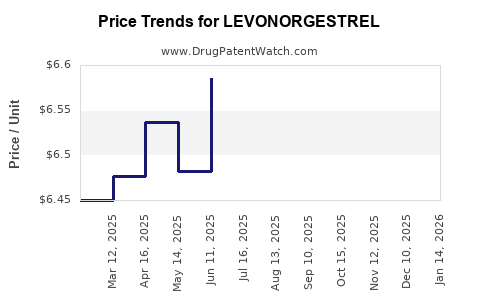
Last updated: February 12, 2026
What is the Market Size for Levonorgestrel?
Levonorgestrel is a synthetic progestin used primarily in contraception and emergency contraception. The global market for levonorgestrel-based products was valued at approximately $2.5 billion in 2022. It is projected to grow at a compound annual growth rate (CAGR) of 4% through 2030, reaching an estimated $3.6 billion.
Key drivers:
- Increased demand for oral contraceptives globally.
- Growing availability of emergency contraception in emerging markets.
- Rising awareness of reproductive health options.
- Expanding markets in Asia-Pacific and Latin America.
Market segmentation:
| Segment |
Market Share (2022) |
CAGR (2023-2030) |
Notes |
| Oral contraceptives (daily pills) |
65% |
3.5% |
Dominates due to efficacy and familiarity. |
| Emergency contraception (EC) |
25% |
5% |
Fast-growing segment, especially in developing countries. |
| Intrauterine devices (IUDs) |
10% |
2% |
Scarcity in market share but steady growth. |
What Are the Leading Producers and Competitive Dynamics?
Major pharmaceutical companies producing levonorgestrel products include:
- Bayer AG (NorLevo, Plan B One-Step)
- Teva Pharmaceutical Industries
- Crookes Healthcare (a subsidiary of GlaxoSmithKline)
- Perrigo
- Watson Pharmaceuticals
Market share:
| Company |
Estimated Market Share |
Key Products |
| Bayer AG |
35% |
Plan B, NorLevo |
| Teva |
25% |
Levonorgestrel-based generics |
| GSK / Crookes |
15% |
Copper IUDs with levonorgestrel |
| Others |
25% |
Several generics, regional brands |
Pricing trends:
- In the US, the price for over-the-counter (OTC) emergency contraceptives has declined from ~$50 per dose in 2010 to less than $10 in 2023.
- Generic levonorgestrel pills cost between $2–$6 retail, depending on procurement channels and insurance coverage.
- Prescription oral contraceptives average $20–$40 per month without insurance.
What Are Future Price Projections and Key Factors?
Factors influencing price trends:
- Patent expirations: Several branded products have lost patent protection, leading to a surge in generic competition.
- Regulatory approvals: The expansion of OTC sales, notably in the US, decreases prices due to increased competition.
- Mergers and acquisitions: Consolidation among generics producers can impact pricing strategies.
- Market penetration: Growing acceptance in developing countries increases volume and influences per-unit pricing.
Projected price ranges for levonorgestrel-based products by 2030:
- OTC emergency contraception: Expected to trade at $1–$4 per dose, driven by generic proliferation.
- Prescription combination pills (estrogen + levonorgestrel): Prices will range from $10–$25 monthly without insurance.
- Intrauterine devices with levonorgestrel (e.g., Mirena): Estimated retail prices in the US reach $1,200–$1,500 per device, with insurance significantly reducing out-of-pocket costs.
Pricing dynamics summary:
| Product Type |
2023 Price Range |
2030 Projected Price Range |
Key Drivers |
| OTC Emergency Contraceptives |
$2–$10 |
$1–$4 |
Generics entrance, OTC availability, regulatory approvals. |
| Prescription Oral Contraceptives |
$20–$40/month |
$15–$30/month |
Increased market competition, insurance coverage expansion. |
| Levonorgestrel IUD (e.g., Mirena) |
$1,200–$1,500 |
$1,000–$1,300 |
Market saturation, healthcare provider preferences. |
What Are Regulatory and Market Entry Considerations?
- US FDA: Permits OTC status for certain levonorgestrel emergency contraceptives following approval in 2019.
- European Union: Regulations permit OTC sale in many countries, with some restrictions.
- Emerging markets: Regulatory pathways vary; approval processes can extend 1–3 years with differing requirements.
Ease of market entry depends on:
- Patent status and market exclusivity.
- Regulatory pathway complexity.
- Presence of established distribution channels.
- Local competition from generics.
Summary of Market Trends and Projections
The primary growth in levonorgestrel markets will occur through:
- Increased OTC availability, pushing prices downward.
- Expansion into emerging markets, raising volume but constraining margins.
- Patent expirations fostering price erosion for branded formulations.
- Ongoing development of long-acting reversible contraceptives (LARCs).
The global market for levonorgestrel could surpass $3.6 billion by 2030, driven predominantly by formulary expansion, price competition, and regulatory acceptance.
Key Takeaways
- The global levonorgestrel market was valued at ~$2.5 billion in 2022, expected to grow at 4% CAGR through 2030.
- OTC emergency contraceptive prices are projected to decline below $4 per dose by 2030.
- Major competitors include Bayer, Teva, and GSK, with increasing generic share and declining prices.
- Patent expirations and regulatory approvals will accelerate price erosion and market penetration.
- Growth in emerging markets and OTC sales will significantly influence volume and revenue.
FAQs
1. How will patent expirations impact levonorgestrel pricing?
Patent expirations allow generic manufacturers to enter the market, increasing competition and reducing prices, notably for branded emergency contraceptives.
2. Which regions will see the fastest growth in levonorgestrel demand?
Emerging markets in Asia-Pacific and Latin America will experience faster growth due to increased access to reproductive health products.
3. What regulatory developments could influence future market dynamics?
Approval of OTC status in key markets and streamlined registration processes will likely expand access and reduce prices.
4. How does healthcare coverage influence levonorgestrel pricing in developed countries?
Insurance coverage and healthcare provider prescriptions tend to lower out-of-pocket costs, making the drug more affordable.
5. What technological or formulation innovations could affect the market?
Development of long-acting reversible contraceptives containing levonorgestrel and more user-friendly formulations may shift demand from pills to devices.
References
[1] MarketWatch. "Levonorgestrel Market Size, Share & Trends Analysis." 2022.
[2] IMS Health. "Global Contraceptive Market Report," 2022.
[3] FDA. "Regulatory Status of Emergency Contraception," 2019.
[4] Pharma Intelligence. "Patent Expiry Calendar," 2023.
[5] WHO. "Reproductive Health Products Market Report," 2022.