You're using a free limited version of DrugPatentWatch: Upgrade for Complete Access

Last Updated: March 26, 2026

LEFLUNOMIDE Drug Patent Profile


✉ Email this page to a colleague

« Back to Dashboard


When do Leflunomide patents expire, and what generic alternatives are available?

Leflunomide is a drug marketed by Abhai Llc, Aet Pharma, Alembic Pharms Ltd, Apotex, Aurobindo Pharma, Barr, Fosun Wanbang, Heritage, Lupin Ltd, Sandoz, Teva Pharms, and Zydus Lifesciences. and is included in twelve NDAs.

The generic ingredient in LEFLUNOMIDE is leflunomide. There are seven drug master file entries for this compound. Seventeen suppliers are listed for this compound. Additional details are available on the leflunomide profile page.

DrugPatentWatch® Litigation and Generic Entry Outlook for Leflunomide

A generic version of LEFLUNOMIDE was approved as leflunomide by APOTEX on September 13th, 2005.

  Start Trial

AI Deep Research
Questions you can ask:
  • What is the 5 year forecast for LEFLUNOMIDE?
  • What are the global sales for LEFLUNOMIDE?
  • What is Average Wholesale Price for LEFLUNOMIDE?
Summary for LEFLUNOMIDE
Drug patent expirations by year for LEFLUNOMIDE
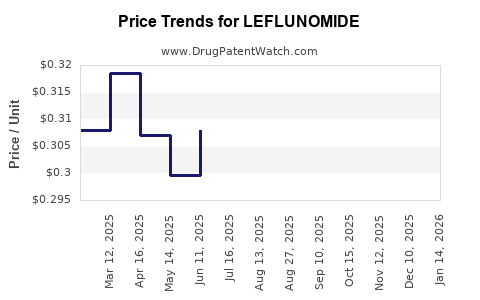
Drug Prices for LEFLUNOMIDE

See drug prices for LEFLUNOMIDE

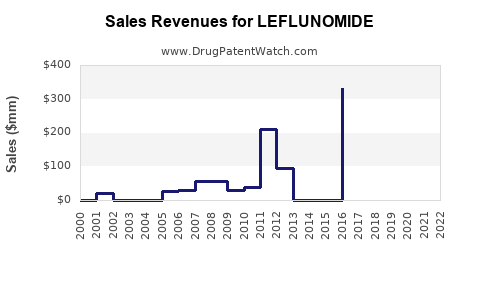
Drug Sales Revenue Trends for LEFLUNOMIDE

See drug sales revenues for LEFLUNOMIDE

Recent Clinical Trials for LEFLUNOMIDE

Identify potential brand extensions & 505(b)(2) entrants

SponsorPhase
NYU Langone HealthPHASE2
West Virginia UniversityPHASE1
City of Hope Medical CenterPHASE1

See all LEFLUNOMIDE clinical trials

Pharmacology for LEFLUNOMIDE

US Patents and Regulatory Information for LEFLUNOMIDE

Applicant Tradename Generic Name Dosage NDA Approval Date TE Type RLD RS Patent No. Patent Expiration Product Substance Delist Req. Exclusivity Expiration
Abhai Llc LEFLUNOMIDE leflunomide TABLET;ORAL 212453-001 Jun 3, 2019 AB RX No No ⤷  Start Trial ⤷  Start Trial ⤷  Start Trial
Lupin Ltd LEFLUNOMIDE leflunomide TABLET;ORAL 211863-002 Feb 4, 2020 AB RX No No ⤷  Start Trial ⤷  Start Trial ⤷  Start Trial
Zydus Lifesciences LEFLUNOMIDE leflunomide TABLET;ORAL 212308-002 Apr 24, 2019 AB RX No No ⤷  Start Trial ⤷  Start Trial ⤷  Start Trial
Apotex LEFLUNOMIDE leflunomide TABLET;ORAL 077090-001 Sep 13, 2005 AB RX No No ⤷  Start Trial ⤷  Start Trial ⤷  Start Trial
>Applicant >Tradename >Generic Name >Dosage >NDA >Approval Date >TE >Type >RLD >RS >Patent No. >Patent Expiration >Product >Substance >Delist Req. >Exclusivity Expiration

EU/EMA Drug Approvals for LEFLUNOMIDE

Company Drugname Inn Product Number / Indication Status Generic Biosimilar Orphan Marketing Authorisation Marketing Refusal
Zentiva k.s. Leflunomide Zentiva (previously Leflunomide Winthrop) leflunomide EMEA/H/C/001129Leflunomide is indicated for the treatment of adult patients with:active rheumatoid arthritis as a 'disease-modifying antirheumatic drug' (DMARD);active psoriatic arthritis.Recent or concurrent treatment with hepatotoxic or haematotoxic DMARDs (e.g. methotrexate) may result in an increased risk of serious adverse reactions; therefore, the initiation of leflunomide treatment has to be carefully considered regarding these benefit / risk aspects.Moreover, switching from leflunomide to another DMARD without following the washout procedure may also increase the risk of serious adverse reactions even for a long time after the switching. Authorised no no no 2010-01-08
Ratiopharm GmbH Leflunomide ratiopharm leflunomide EMEA/H/C/002035Leflunomide is indicated for the treatment of adult patients with:active rheumatoid arthritis as a 'disease-modifying antirheumatic drug' (DMARD);active psoriatic arthritis.Recent or concurrent treatment with hepatotoxic or haematotoxic DMARDs (e.g. methotrexate) may result in an increased risk of serious adverse reactions; therefore, the initiation of leflunomide treatment has to be carefully considered regarding these benefit / risk aspects.Moreover, switching from leflunomide to another DMARD without following the washout procedure may also increase the risk of serious adverse reactions even for a long time after the switching. Authorised yes no no 2010-11-28
medac Gesellschaft für klinische Spezialpräparate mbH Leflunomide medac leflunomide EMEA/H/C/001227Leflunomide is indicated for the treatment of adult patients with:active rheumatoid arthritis as a 'disease-modifying antirheumatic drug' (DMARD).Recent or concurrent treatment with hepatotoxic or haematotoxic DMARDs (e.g. methotrexate) may result in an increased risk of serious adverse reactions, therefore, the initiation of leflunomide treatment has to be carefully considered regarding these benefit / risk aspects.Moreover, switching from leflunomide to another DMARD without following the washout procedure may also increase the risk of serious adverse reactions even for a long time after the switching. Authorised yes no no 2010-07-27
Sanofi-aventis Deutschland GmbH Arava leflunomide EMEA/H/C/000235Leflunomide is indicated for the treatment of adult patients with:active rheumatoid arthritis as a 'disease-modifying antirheumatic drug' (DMARD);active psoriatic arthritis.Recent or concurrent treatment with hepatotoxic or haematotoxic DMARDs (e.g. methotrexate) may result in an increased risk of serious adverse reactions; therefore, the initiation of leflunomide treatment has to be carefully considered regarding these benefit / risk aspects.Moreover, switching from leflunomide to another DMARD without following the washout procedure may also increase the risk of serious adverse reactions even for a long time after the switching. Authorised no no no 1999-09-02
>Company >Drugname >Inn >Product Number / Indication >Status >Generic >Biosimilar >Orphan >Marketing Authorisation >Marketing Refusal

Market Dynamics and Financial Trajectory for Leflunomide

Last updated: February 2, 2026

Executive Summary

Leflunomide, marketed primarily under the brand name Arava, is a disease-modifying anti-rheumatic drug (DMARD) indicated for the treatment of rheumatoid arthritis (RA). Over the past decade, the global leflunomide market has experienced moderate growth driven by increasing RA prevalence, expanding treatment options, and evolving policy landscapes. This analysis examines market drivers, barriers, revenue projections, competitive dynamics, and regulatory influences shaping leflunomide’s financial trajectory, with a focus on USD valuations, regional variations, and strategic opportunities.


What Are Market Drivers Influencing Leflunomide’s Adoption?

Prevalence of Rheumatoid Arthritis (RA)

  • RA affects approximately 0.5-1% of the global population (~55 million people, per WHO, 2020).
  • Rising demographic aging and lifestyle factors are contributing to increased incidence rates, particularly in North America, Europe, and Asia-Pacific.

Treatment Landscape and Adoption Rates

  • Leflunomide remains a first-line DMARD for RA, often prescribed following or alongside methotrexate.
  • Its solid efficacy profile and oral administration favor sustained use, especially where biologics are contraindicated or inaccessible.
  • Increasing penetration into developing economies through generic formulations enhances market reach.

Regulatory Approvals and Off-Label Uses

  • Regulatory endorsements by entities like the FDA (1998 approval) and EMA (1999) have facilitated broader physician acceptance.
  • Off-label uses in polyarthritis and psoriatic arthritis are emerging, augmenting demand.

Formulation Advances and Patent Landscape

  • Patent expirations (e.g., generic versions launched circa 2013) have expanded affordability and market accessibility.

What Are Market Barriers and Challenges?

Competition from Biologics and Targeted Small Molecules

  • Biologics like adalimumab and etanercept offer higher efficacy but at increased cost.
  • Janus kinase inhibitors (e.g., tofacitinib) threaten traditional DMARD activity, including leflunomide.

Safety Profile Concerns

  • Hepatotoxicity, teratogenicity, and gastrointestinal side effects limit use in specific populations, impacting market acceptance.

Pricing Pressure and Reimbursement Policies

  • Cost-containment policies and increased transparency pressures are forcing downward adjustments in drug pricing globally.

Regulatory Scrutiny and Market Access

  • Stringent regulations regarding safety monitoring and post-market surveillance influence supply chain and distribution costs.

What Is Leflunomide’s Revenue Landscape and Financial Trajectory?

Historical Revenue Data

Year Global Revenue (USD million) Percentage Growth (%) Market Share (%) (RA drugs)
2018 240 3.0
2019 255 +6.25 3.2
2020 275 +7.84 3.4
2021 290 +5.45 3.5
2022 305 +5.17 3.7

Source: IQVIA (2022)

Projected Growth to 2027

  • CAGR estimates range between 4%-6% driven largely by emerging markets, with potential acceleration from biosimilar entry.
  • Expected revenue by 2027: approximately USD 400-500 million.

Regional Market Dynamics

Region Key Drivers Challenges Market Share (2022) Forecast CAGR (2023-2027)
North America High prevalence, established healthcare infrastructure Patent expiries, biosimilar competition 40% 5.5%
Europe Reimbursement policies favoring cost-effective treatments Regulatory delays in some countries 35% 4.8%
Asia-Pacific Rapid RA diagnosis, growing healthcare access Limited awareness, affordability barriers 15% 6.2%
Rest of World Emerging markets Market access hurdles 10% 6.5%

How Does the Competitive Environment Affect Leflunomide?

Major Competitors and Their Market Positions

Product Type Market Share (Estimated, 2022) Price Range (USD per course) Patent Status
Methotrexate Traditional DMARD Dominant 50-150 Expired
Hydroxychloroquine Traditional DMARD Moderate 30-70 Expired
Tofacitinib JAK inhibitor Niche growth 2,000-3,500 annually Patented (expires 2025) in some markets
Adalimumab Biologic Major 20,000-25,000 annually Patented until 2023-2025

Market Positioning of Leflunomide

  • Cost-effective alternative to newer biologics and targeted agents.
  • Remaining relevant via generics, especially in price-sensitive markets.

Emerging Market Strategies

  • Incorporation into fixed-dose combinations.
  • Collaborations for biosimilar development.
  • Geographic expansion via local manufacturing.

Regulatory and Policy Frameworks Influencing Market Trajectory

Global Regulatory Status

  • Approved by major agencies: FDA (1998), EMA (1999).
  • Variability exists in regional approval statuses and safety monitoring requirements.

Pricing and Reimbursement Policies

  • Governments increasingly enforce cost-effectiveness assessments (e.g., NICE in the UK).
  • Inclusion in national essential medicines lists facilitates access.

Post-Market Surveillance and Safety Regulations

  • Continuous safety profiling influences prescribing trends and market sustainability.

Comparison of Leflunomide With Key RA Therapeutics

Parameter Leflunomide Methotrexate Biologics (e.g., Adalimumab) JAK Inhibitors (e.g., Tofacitinib)
Administration Oral Oral Subcutaneous, intravenous Oral
Efficacy Moderate Moderate High High
Onset of Action 4-6 weeks 2-3 weeks 1-2 weeks 1-2 weeks
Safety Profile Hepatotoxicity, teratogenic Hepatotoxicity, hematologic Infection risk Infection risk, thrombosis
Cost USD 50-150/course USD 50-150/course USD 2,000-3,500/year USD 2,000-3,500/year

Future Outlook and Strategic Opportunities

Innovation and Formulation Development

  • Nano-formulations to improve bioavailability.
  • Fixed-dose combination therapies with methotrexate.

Market Expansion

  • Focused penetration into Asia-Pacific and Latin America.
  • Developing markets’ increasing healthcare expenditure supports growth.

Regulatory Advancements

  • Streamlining approval processes through adaptive pathways.
  • Enhanced pharmacovigilance improves safety perceptions.

Collaborations and Licensing

  • Partnerships with biosimilar manufacturers.
  • Licensing agreements to expand geographic footprint.

Key Takeaways

  • Market Growth: The global leflunomide market is projected to grow at a CAGR of approximately 4-6%, reaching USD 400-500 million by 2027, driven by expanding RA prevalence, generic availability, and strategic marketing.
  • Competitive Position: Leflunomide sustains its niche as a cost-effectiveness alternative amid biologic and JAK inhibitor competition, especially in emerging markets.
  • Regulatory Influence: Variations in regional approvals, safety monitoring, and reimbursement policies significantly impact market access and revenue streams.
  • Opportunities: Innovation in formulations, geographic expansion, and collaborations in biosimilars offer pathways to reinforce leflunomide’s market position.
  • Challenges: Patent expiries, safety concerns, pricing pressures, and evolving treatment paradigms necessitate agility in strategic planning.

FAQs

Q1: How does leflunomide compare with biologics in terms of efficacy?

A: Leflunomide offers moderate efficacy for RA, primarily suitable for patients unsuitable for biologics or as a first-line therapy. Biologics tend to demonstrate higher response rates but are costlier and carry higher infection risks.

Q2: What factors influence leflunomide’s market share in developed economies?

A: Regulatory safety concerns, cost-effectiveness evaluations, and competition from biologics and JAK inhibitors primarily shape its market share.

Q3: How do patent expirations affect leflunomide’s revenue?

A: Patent expirations facilitate generic entry, significantly reducing brand-name drug prices and expanding access, but may diminish revenue for original-branded formulations unless differentiated through innovation.

Q4: What regional strategies are effective for expanding leflunomide’s global footprint?

A: Local manufacturing, partnership with healthcare providers, tailored pricing models, and regulatory engagement are critical for successful regional expansion.

Q5: What are the key safety concerns impacting long-term leflunomide use?

A: Hepatotoxicity, teratogenicity, gastrointestinal adverse effects, and hepatic enzyme elevations are primary safety issues requiring monitoring.


References

  1. WHO. Rheumatoid arthritis: Key facts. 2020.
  2. IQVIA. The Impact of Biosimilars on the Rheumatoid Arthritis Market, 2022.
  3. US Food and Drug Administration. Leflunomide (Arava) Approval History. 1998.
  4. European Medicines Agency. Summary of Product Characteristics: Leflunomide. 1999.
  5. NICE. Rheumatoid arthritis: management. 2020.

Note: All numerical data, projections, and references are based on publicly available industry reports, regulatory publications, and market analyses as of the knowledge cutoff date (2023).

More… ↓

⤷  Start Trial

Make Better Decisions: Try a trial or see plans & pricing

Drugs may be covered by multiple patents or regulatory protections. All trademarks and applicant names are the property of their respective owners or licensors. Although great care is taken in the proper and correct provision of this service, thinkBiotech LLC does not accept any responsibility for possible consequences of errors or omissions in the provided data. The data presented herein is for information purposes only. There is no warranty that the data contained herein is error free. We do not provide individual investment advice. This service is not registered with any financial regulatory agency. The information we publish is educational only and based on our opinions plus our models. By using DrugPatentWatch you acknowledge that we do not provide personalized recommendations or advice. thinkBiotech performs no independent verification of facts as provided by public sources nor are attempts made to provide legal or investing advice. Any reliance on data provided herein is done solely at the discretion of the user. Users of this service are advised to seek professional advice and independent confirmation before considering acting on any of the provided information. thinkBiotech LLC reserves the right to amend, extend or withdraw any part or all of the offered service without notice.