Last Updated: September 24, 2026

LEFLUNOMIDE - Generic Drug Details


✉ Email this page to a colleague

« Back to Dashboard


What are the generic drug sources for leflunomide and what is the scope of freedom to operate?

Leflunomide is the generic ingredient in two branded drugs marketed by Sanofi Aventis Us, Abhai Llc, Aet Pharma, Alembic Pharms Ltd, Apotex, Aurobindo Pharma, Barr, Fosun Wanbang, Heritage, Lupin, Sandoz, Teva Pharms, and Zydus Lifesciences, and is included in thirteen NDAs. Additional information is available in the individual branded drug profile pages.

Seventeen suppliers are listed for this compound.

Summary for LEFLUNOMIDE
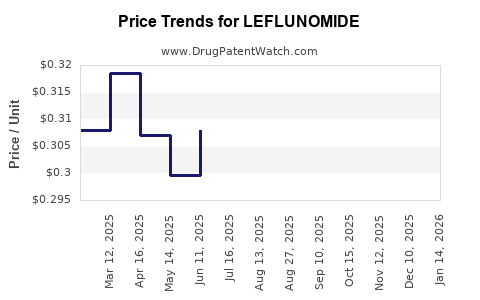
Drug Prices for LEFLUNOMIDE

See drug prices for LEFLUNOMIDE

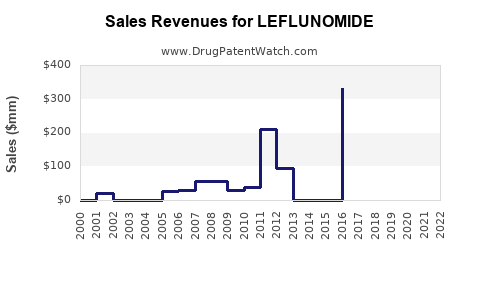
Drug Sales Revenue Trends for LEFLUNOMIDE

See drug sales revenues for LEFLUNOMIDE

Recent Clinical Trials for LEFLUNOMIDE

Identify potential brand extensions & 505(b)(2) entrants

SponsorPhase
NYU Langone HealthPHASE2
West Virginia UniversityPHASE1
City of Hope Medical CenterPHASE1

See all LEFLUNOMIDE clinical trials

Pharmacology for LEFLUNOMIDE

US Patents and Regulatory Information for LEFLUNOMIDE

Applicant Tradename Generic Name Dosage NDA Approval Date TE Type RLD RS Patent No. Patent Expiration Product Substance Delist Req. Exclusivity Expiration
Apotex LEFLUNOMIDE leflunomide TABLET;ORAL 077090-001 Sep 13, 2005 AB RX No No ⤷  Start Trial ⤷  Start Trial ⤷  Start Trial
Alembic Pharms Ltd LEFLUNOMIDE leflunomide TABLET;ORAL 091369-001 Nov 21, 2011 AB RX No No ⤷  Start Trial ⤷  Start Trial ⤷  Start Trial
Heritage LEFLUNOMIDE leflunomide TABLET;ORAL 077086-001 Sep 13, 2005 AB RX No No ⤷  Start Trial ⤷  Start Trial ⤷  Start Trial
Barr LEFLUNOMIDE leflunomide TABLET;ORAL 077083-001 Sep 13, 2005 DISCN No No ⤷  Start Trial ⤷  Start Trial ⤷  Start Trial
Sanofi Aventis Us ARAVA leflunomide TABLET;ORAL 020905-002 Sep 10, 1998 AB RX Yes Yes ⤷  Start Trial ⤷  Start Trial ⤷  Start Trial
Abhai Llc LEFLUNOMIDE leflunomide TABLET;ORAL 212453-001 Jun 3, 2019 AB RX No No ⤷  Start Trial ⤷  Start Trial ⤷  Start Trial
>Applicant >Tradename >Generic Name >Dosage >NDA >Approval Date >TE >Type >RLD >RS >Patent No. >Patent Expiration >Product >Substance >Delist Req. >Exclusivity Expiration

Expired US Patents for LEFLUNOMIDE

Applicant Tradename Generic Name Dosage NDA Approval Date Patent No. Patent Expiration
Sanofi Aventis Us ARAVA leflunomide TABLET;ORAL 020905-001 Sep 10, 1998 ⤷  Start Trial ⤷  Start Trial
Sanofi Aventis Us ARAVA leflunomide TABLET;ORAL 020905-003 Sep 10, 1998 ⤷  Start Trial ⤷  Start Trial
Sanofi Aventis Us ARAVA leflunomide TABLET;ORAL 020905-002 Sep 10, 1998 ⤷  Start Trial ⤷  Start Trial
Sanofi Aventis Us ARAVA leflunomide TABLET;ORAL 020905-001 Sep 10, 1998 ⤷  Start Trial ⤷  Start Trial
>Applicant >Tradename >Generic Name >Dosage >NDA >Approval Date >Patent No. >Patent Expiration

EU/EMA Drug Approvals for LEFLUNOMIDE

Company Drugname Inn Product Number / Indication Status Generic Biosimilar Orphan Marketing Authorisation Marketing Refusal
Zentiva k.s. Leflunomide Zentiva (previously Leflunomide Winthrop) leflunomide EMEA/H/C/001129Leflunomide is indicated for the treatment of adult patients with:active rheumatoid arthritis as a 'disease-modifying antirheumatic drug' (DMARD);active psoriatic arthritis.Recent or concurrent treatment with hepatotoxic or haematotoxic DMARDs (e.g. methotrexate) may result in an increased risk of serious adverse reactions; therefore, the initiation of leflunomide treatment has to be carefully considered regarding these benefit / risk aspects.Moreover, switching from leflunomide to another DMARD without following the washout procedure may also increase the risk of serious adverse reactions even for a long time after the switching. Authorised no no no 2010-01-08
Ratiopharm GmbH Leflunomide ratiopharm leflunomide EMEA/H/C/002035Leflunomide is indicated for the treatment of adult patients with:active rheumatoid arthritis as a 'disease-modifying antirheumatic drug' (DMARD);active psoriatic arthritis.Recent or concurrent treatment with hepatotoxic or haematotoxic DMARDs (e.g. methotrexate) may result in an increased risk of serious adverse reactions; therefore, the initiation of leflunomide treatment has to be carefully considered regarding these benefit / risk aspects.Moreover, switching from leflunomide to another DMARD without following the washout procedure may also increase the risk of serious adverse reactions even for a long time after the switching. Authorised yes no no 2010-11-28
medac Gesellschaft für klinische Spezialpräparate mbH Leflunomide medac leflunomide EMEA/H/C/001227Leflunomide is indicated for the treatment of adult patients with:active rheumatoid arthritis as a 'disease-modifying antirheumatic drug' (DMARD).Recent or concurrent treatment with hepatotoxic or haematotoxic DMARDs (e.g. methotrexate) may result in an increased risk of serious adverse reactions, therefore, the initiation of leflunomide treatment has to be carefully considered regarding these benefit / risk aspects.Moreover, switching from leflunomide to another DMARD without following the washout procedure may also increase the risk of serious adverse reactions even for a long time after the switching. Authorised yes no no 2010-07-27
Sanofi-aventis Deutschland GmbH Arava leflunomide EMEA/H/C/000235Leflunomide is indicated for the treatment of adult patients with:active rheumatoid arthritis as a 'disease-modifying antirheumatic drug' (DMARD);active psoriatic arthritis.Recent or concurrent treatment with hepatotoxic or haematotoxic DMARDs (e.g. methotrexate) may result in an increased risk of serious adverse reactions; therefore, the initiation of leflunomide treatment has to be carefully considered regarding these benefit / risk aspects.Moreover, switching from leflunomide to another DMARD without following the washout procedure may also increase the risk of serious adverse reactions even for a long time after the switching. Authorised no no no 1999-09-02
Teva B.V. Repso leflunomide EMEA/H/C/001222Leflunomide is indicated for the treatment of adult patients with:active rheumatoid arthritis as a ‘disease-modifying antirheumatic drug’ (DMARD);active psoriatic arthritis.Recent or concurrent treatment with hepatotoxic or haematotoxic DMARDs (e.g. methotrexate) may result in an increased risk of serious adverse reactions; therefore, the initiation of leflunomide treatment has to be carefully considered regarding these benefit / risk aspects.Moreover, switching from leflunomide to another DMARD without following the washout procedure may also increase the risk of serious adverse reactions even for a long time after the switching. Withdrawn yes no no 2011-03-14
Teva Pharma B.V. Leflunomide Teva leflunomide EMEA/H/C/002356Leflunomide is indicated for the treatment of adult patients with active rheumatoid arthritis as a 'disease-modifying antirheumatic drug' (DMARD).Recent or concurrent treatment with hepatotoxic or haematotoxic DMARDs (e.g. methotrexate) may result in an increased risk of serious adverse reactions; therefore, the initiation of leflunomide treatment has to be carefully considered regarding these benefit / risk aspects.Moreover, switching from leflunomide to another DMARD without following the washout procedure may also increase the risk of serious adverse reactions even for a long time after the switching. Withdrawn yes no no 2011-03-10
>Company >Drugname >Inn >Product Number / Indication >Status >Generic >Biosimilar >Orphan >Marketing Authorisation >Marketing Refusal

Leflunomide Market Dynamics, Patent Status, Competition, and Financial Trajectory

Last updated: August 11, 2026

Leflunomide is a mature, low-cost oral disease-modifying antirheumatic drug used primarily for rheumatoid arthritis. Its commercial trajectory shifted from branded Arava sales to commoditized generic demand after loss of exclusivity. The market is stable but structurally limited by competition from methotrexate, biologics, and targeted synthetic DMARDs, along with safety monitoring requirements and declining branded pricing power.

What is leflunomide and how is it used?

Leflunomide is an oral immunomodulatory drug approved by the U.S. Food and Drug Administration in 1998 for adults with active rheumatoid arthritis. Sanofi marketed the originator product as Arava. Leflunomide inhibits dihydroorotate dehydrogenase, reducing pyrimidine synthesis and limiting activated lymphocyte proliferation.

The principal active metabolite is teriflunomide, which has a long half-life. Leflunomide is available primarily as 10 mg, 20 mg, and 100 mg tablets. The 100 mg dose is generally used as a loading regimen, while 20 mg once daily is the standard maintenance dose. The FDA label permits a 10 mg maintenance dose when tolerability is an issue. [1]

Leflunomide’s principal commercial indications and uses are:

Area Market role
Rheumatoid arthritis FDA-approved primary indication
Psoriatic arthritis Used off-label in some markets
Other inflammatory diseases Limited off-label use
Veterinary medicine Relevant in selected animal-health applications, separate from the human market

The drug competes with conventional synthetic DMARDs, including methotrexate, sulfasalazine, and hydroxychloroquine. It also competes indirectly with tumor necrosis factor inhibitors, interleukin inhibitors, abatacept, rituximab, and Janus kinase inhibitors.

When did leflunomide lose market exclusivity?

Leflunomide lost meaningful U.S. market exclusivity after the expiration of the originator’s core intellectual-property protection and subsequent FDA approval of generic products. The branded product no longer has the commercial protection associated with a single-source market.

What is the FDA and Orange Book status of Arava?

Arava was approved under NDA 020905 on September 10, 1998. The product remains a reference-listed drug for generic approval purposes, but generic leflunomide tablets are widely available in the United States. [1, 2]

The current commercial position is:

Issue Status
FDA reference product Arava
Active ingredient Leflunomide
Dosage form Oral tablets
Generic availability Yes
Current branded market power Low
Biosimilar pathway Not applicable
Orange Book relevance Primarily reference-product and therapeutic-equivalence listing
Blocking compound patent No material current barrier to ordinary generic entry

The principal leflunomide compound patents are expired. Any remaining patent activity would be unlikely to restore originator exclusivity for the ordinary tablet market without a new, commercially differentiated formulation or indication.

What patents protect leflunomide?

The historical patent estate covered the leflunomide chemical entity, related substituted isoxazole compounds, pharmaceutical compositions, and therapeutic use. The most commercially important protection was the compound patent associated with the Arava launch.

How strong is the current patent estate for leflunomide?

The current patent estate is weak from a market-exclusion perspective.

Patent category Historical relevance Current commercial effect
Core compound patents High Expired
Tablet formulation patents Limited No known broad barrier to generic tablets
Method-of-use patents Limited No material protection for the established RA indication
Manufacturing patents Potentially relevant to individual suppliers Do not generally prevent finished-dose competition
Pediatric exclusivity Historical, if granted Expired
New delivery systems Potential future opportunity Requires differentiated development and FDA support

Patent exhaustion and generic competition have removed the main barriers to production of standard leflunomide tablets. Manufacturing know-how remains relevant to impurity control, stability, dissolution, and supply reliability, but it does not create the type of exclusivity associated with an unexpired composition-of-matter patent.

Are there Paragraph IV challenges to leflunomide?

Paragraph IV litigation was relevant during the transition from Arava to generic leflunomide. Once the primary patents expired and multiple manufacturers entered, litigation risk fell sharply.

A generic applicant using a Paragraph IV certification would have challenged the validity, enforceability, or infringement position of listed patents. The commercial value of such a challenge was greatest before broad generic entry. It is now limited because the market has already moved to multisource supply.

No active Paragraph IV event is known to represent a material barrier to routine generic leflunomide availability. The more important current risks are manufacturing compliance, product recalls, supply interruptions, and reimbursement pressure.

What formulations are protected by leflunomide patents?

The principal product is an immediate-release tablet. The historical product and generic market do not depend on an extended-release, injectable, implantable, or combination formulation.

A commercially meaningful reformulation would need to address a specific limitation, such as:

  • Reduced gastrointestinal adverse effects
  • Lower hepatotoxicity risk
  • Faster drug elimination
  • Improved adherence
  • Alternative dosing for patients unable to tolerate daily treatment
  • Combination therapy with another DMARD

The largest technical obstacle is leflunomide’s long-lived active metabolite. Accelerated elimination can require cholestyramine or activated charcoal under the FDA label, particularly in cases of serious toxicity or pregnancy exposure. [1] A formulation that materially improved clearance or safety could have greater lifecycle-management value than a conventional tablet reformulation.

How does leflunomide compare with methotrexate and biologic DMARDs?

Leflunomide has a low acquisition cost and oral administration, but it lacks the clinical and commercial momentum of newer therapies.

Attribute Leflunomide Methotrexate Biologic DMARDs JAK inhibitors
Administration Oral Oral or injectable Usually injectable or infusion Oral
Cost position Low Very low High High
Role in treatment Conventional DMARD Common first-line anchor Escalation or targeted therapy Targeted escalation
Generic competition Extensive Extensive Increasing biosimilar pressure Patent-dependent
Monitoring burden Liver, blood counts, pregnancy risk Liver, blood counts, pulmonary and pregnancy considerations Infection and immunogenicity monitoring Infection, cardiovascular and malignancy warnings
Differentiation Oral alternative to methotrexate Established first-line standard Higher efficacy in selected patients Rapid oral targeted therapy

Methotrexate remains the main reference competitor in conventional DMARD treatment. Leflunomide is used when methotrexate is ineffective, contraindicated, or poorly tolerated. Its low price preserves demand, but its lack of exclusivity prevents premium pricing.

What FDA safety issues affect leflunomide demand?

Safety restrictions are a major commercial constraint. The FDA label includes a boxed warning for embryofetal toxicity and severe liver injury. Leflunomide is contraindicated in pregnancy unless the potential benefit justifies the risk, and women of childbearing potential require pregnancy exclusion and, when necessary, accelerated drug elimination. [1]

The main monitoring requirements include:

  • Baseline and periodic liver testing
  • Blood-pressure monitoring
  • Complete blood counts
  • Assessment for infection
  • Pregnancy prevention and testing
  • Evaluation for peripheral neuropathy and serious skin reactions

These requirements reduce use among patients and prescribers seeking simpler treatment pathways. They also favor methotrexate in some treatment algorithms and biologics or other targeted agents in patients with inadequate disease control.

What is the financial trajectory of leflunomide?

Leflunomide’s financial trajectory has four phases:

1. Branded launch and adoption

Arava generated branded revenue as an oral alternative to methotrexate. The product benefited from established rheumatoid arthritis demand and a conventional DMARD positioning.

2. Mature branded competition

Before generic entry, sales faced pressure from methotrexate, anti-TNF products, and expanding biologic treatment options. Safety monitoring also limited broad substitution for methotrexate.

3. Loss of exclusivity

Generic entry caused the expected decline in branded volume and net price. Pharmacy benefit managers and wholesalers shifted purchasing toward lower-cost suppliers.

4. Generic commodity phase

The current market is driven by prescription volume, manufacturing scale, channel access, and contract pricing rather than patent exclusivity. Generic suppliers compete on:

  • Wholesale acquisition cost
  • Rebate and contract terms
  • FDA manufacturing compliance
  • Supply continuity
  • Tablet strengths and package configuration
  • Pharmacy and wholesaler relationships

Sanofi does not report Arava as a major standalone growth product in its current public financial disclosures. The originator’s economic contribution is therefore best understood as legacy revenue rather than a material driver of corporate growth. [3]

No reliable public source provides a uniform, current global revenue series for leflunomide across branded and generic suppliers. Public company reporting generally aggregates generic products or reports them within broader business segments.

Which companies compete in the leflunomide market?

The U.S. generic market has included major and specialized generic manufacturers. Historical and current suppliers may include Mylan, Teva, Dr. Reddy’s Laboratories, Sandoz, Zydus, Lupin, and other FDA-approved manufacturers, subject to market-specific availability and supply status.

The competitive structure is fragmented compared with patented drugs. No single generic supplier typically controls the full market for an extended period. Supplier share can change quickly after:

  • A manufacturing warning letter
  • A product recall
  • A shortage at a competing facility
  • A wholesaler contract change
  • A change in Medicaid or commercial reimbursement
  • A new abbreviated new drug application approval

The largest business risk is operational rather than legal. A supplier with redundant manufacturing, reliable active pharmaceutical ingredient sourcing, and strong regulatory compliance can gain share even without a differentiated product.

What generic entry risks exist for leflunomide?

Generic entry risk is already realized rather than prospective. The relevant commercial scenario is continued price erosion and periodic supply disruption.

Base case

Leflunomide remains a stable, low-price generic with recurring demand from rheumatoid arthritis patients who need an oral conventional DMARD.

Downside case

Use declines as treatment guidelines and physician preferences shift toward methotrexate, biologics, and JAK inhibitors. Net pricing falls further, and manufacturers exit because of low margins.

Upside case

Demand improves modestly if payers emphasize low-cost oral DMARDs, if methotrexate intolerance increases, or if healthcare systems seek lower-cost alternatives before biologic escalation.

A large price rebound is unlikely without a new formulation, new indication, or significant supply contraction.

What licensing deals and lifecycle opportunities exist?

There is no major current licensing transaction that changes the competitive position of standard leflunomide tablets. Historical commercialization depended on originator development and marketing arrangements, but the generic market is primarily supply-chain driven.

Potential licensing value could arise from:

  • A safer or faster-clearance formulation
  • A fixed-dose combination with another conventional DMARD
  • A new delivery system
  • A veterinary product with differentiated positioning
  • A regional distribution agreement in markets with limited generic competition
  • Use of leflunomide or teriflunomide in a new disease area supported by clinical evidence

These opportunities would require new clinical, regulatory, and patent investment. They would not automatically restore protection to the existing tablet product.

What is the geographic coverage of leflunomide?

Leflunomide is marketed or has been marketed across the United States, Europe, and other international markets. Patent status and generic penetration differ by country, but most major markets have moved beyond originator exclusivity.

Geographic economics depend on:

  • National reimbursement controls
  • Tender systems
  • Local manufacturing requirements
  • Import restrictions
  • Reference-pricing rules
  • Registration status for each strength
  • Local pharmacovigilance obligations

Emerging markets may offer volume growth, but low prices and local competition constrain revenue per prescription. In Europe, centralized price controls and hospital or payer procurement often intensify generic competition.

Key Takeaways

  • Leflunomide is a mature oral DMARD with broad generic availability.
  • Arava’s commercial exclusivity has ended, and the core patent estate no longer blocks ordinary generic entry.
  • The market is driven by low price, stable rheumatoid arthritis demand, manufacturing reliability, and reimbursement access.
  • Methotrexate is the main conventional-DMARD competitor; biologics and JAK inhibitors limit long-term growth.
  • FDA warnings for hepatotoxicity, embryofetal toxicity, and the need for accelerated elimination constrain prescribing.
  • Generic suppliers face operational and pricing risk rather than major patent litigation risk.
  • Sanofi’s legacy Arava revenue is no longer a material disclosed growth driver.
  • A meaningful commercial upside case requires a differentiated formulation, new indication, or supply disruption.

FAQs

Is leflunomide still a profitable drug for manufacturers?

It can generate recurring generic revenue, but margins are generally lower than for patented or limited-source products. Profitability depends on production scale, supply reliability, procurement contracts, and regulatory compliance.

Can a generic company obtain exclusivity for a new leflunomide formulation?

Potentially. A novel formulation could receive patent protection and, depending on the regulatory pathway, additional FDA exclusivity. The formulation would need meaningful clinical or pharmaceutical differentiation.

Is teriflunomide the same as leflunomide?

Teriflunomide is the principal active metabolite of leflunomide. It is also marketed as a separate drug for multiple sclerosis, including under the brand Aubagio and as generic teriflunomide.

Does leflunomide have biosimilar competition?

No. Leflunomide is a chemically synthesized small molecule, so competition occurs through generic-drug approval pathways rather than biosimilar regulation.

Could leflunomide prices increase because of a shortage?

Yes. A manufacturing interruption or supplier exit could cause short-term price increases or allocation problems. A sustained price increase would require a meaningful reduction in available suppliers because multiple generic manufacturers participate in the market.

References

  1. U.S. Food and Drug Administration. (2024). Arava (leflunomide) prescribing information. FDA.
  2. U.S. Food and Drug Administration. (2024). Orange Book: Approved drug products with therapeutic equivalence evaluations. FDA.
  3. Sanofi. (2024). Universal registration document and annual financial report 2023. Sanofi.
  4. U.S. Food and Drug Administration. (1998). Approval package for NDA 020905: Arava (leflunomide). FDA.
  5. Smolen, J. S., Landewé, R. B. M., Bergstra, S. A., et al. (2023). EULAR recommendations for the management of rheumatoid arthritis with synthetic and biological disease-modifying antirheumatic drugs. Annals of the Rheumatic Diseases, 82(1), 3-18.

More… ↓

⤷  Start Trial

Make Better Decisions: Try a trial or see plans & pricing

Drugs may be covered by multiple patents or regulatory protections. All trademarks and applicant names are the property of their respective owners or licensors. Although great care is taken in the proper and correct provision of this service, thinkBiotech LLC does not accept any responsibility for possible consequences of errors or omissions in the provided data. The data presented herein is for information purposes only. There is no warranty that the data contained herein is error free. We do not provide individual investment advice. This service is not registered with any financial regulatory agency. The information we publish is educational only and based on our opinions plus our models. By using DrugPatentWatch you acknowledge that we do not provide personalized recommendations or advice. thinkBiotech performs no independent verification of facts as provided by public sources nor are attempts made to provide legal or investing advice. Any reliance on data provided herein is done solely at the discretion of the user. Users of this service are advised to seek professional advice and independent confirmation before considering acting on any of the provided information. thinkBiotech LLC reserves the right to amend, extend or withdraw any part or all of the offered service without notice.