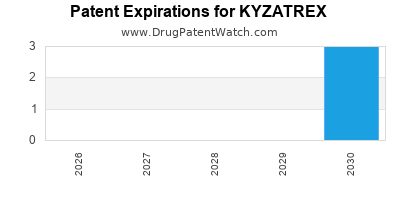
Last updated: September 4, 2026
KYZATREX is an oral testosterone undecanoate product commercialized by Marius Pharmaceuticals for adult men with hypogonadism associated with a medical condition. FDA approval in September 2022 created a new branded competitor in testosterone replacement therapy, a large but highly genericized market. Its commercial opportunity depends on converting patients from injections, topical gels, and older oral testosterone products while managing cardiovascular, blood-pressure, prostate, and controlled-substance concerns.
Marius is privately held and does not publicly report product-level revenue, prescription volume, EBITDA, or guidance. The public record therefore supports a market and strategic assessment, but not a verified revenue forecast.
What is KYZATREX and how does it work?
KYZATREX contains testosterone undecanoate in oral capsules. It is approved for testosterone replacement therapy in adult males with hypogonadism caused by a medical condition and confirmed by two separate morning testosterone measurements.
The product is taken twice daily with food. The starting dose is generally 237 mg twice daily, with dose adjustments based on testosterone concentrations and tolerability. The formulation uses lipid-based absorption technology intended to improve oral delivery of testosterone undecanoate.
| Product attribute |
KYZATREX |
| Active ingredient |
Testosterone undecanoate |
| Dosage form |
Oral capsule |
| Initial FDA approval |
September 29, 2022 |
| Sponsor |
Marius Pharmaceuticals |
| Indication |
Testosterone replacement in adult males with hypogonadism |
| Dosing |
Twice daily with food |
| Controlled-substance status |
Schedule III anabolic steroid |
| Primary alternatives |
Generic testosterone injections, topical gels, patches, Xyosted, Natesto, Tlando, Jatenzo |
| Commercial model |
Branded prescription product |
The FDA label requires blood-pressure monitoring because testosterone products can increase blood pressure. The label also includes class warnings involving erythrocytosis, venous thromboembolism, prostate effects, lipid changes, edema, sleep apnea, and potential cardiovascular risk assessment. These warnings affect prescriber selection and payer utilization controls. (U.S. Food and Drug Administration [FDA], 2022a)
How large is the testosterone replacement therapy market?
The testosterone replacement therapy market is sizable but structurally difficult for a branded entrant. Most volume is supplied by low-cost generic injections and topical products. Commercial growth requires differentiation in administration, adherence, tolerability, or patient preference rather than simple disease expansion.
The key market segments are:
- Injectable testosterone cypionate and enanthate, which have the lowest acquisition cost and broad physician familiarity.
- Topical gels and solutions, which avoid injections but create transfer and application concerns.
- Oral testosterone products, including KYZATREX, Jatenzo, and Tlando.
- Long-acting implants and alternative delivery systems.
- Nasal testosterone, including Natesto.
KYZATREX competes most directly with other oral products. It does not compete only on pharmacology. It also competes on dosing frequency, food requirements, blood-pressure effects, insurance coverage, prior authorization, and patient willingness to pay for a branded product.
How does KYZATREX compare with Jatenzo and Tlando?
| Attribute |
KYZATREX |
Jatenzo |
Tlando |
| Active ingredient |
Testosterone undecanoate |
Testosterone undecanoate |
Testosterone undecanoate |
| Route |
Oral |
Oral |
Oral |
| Dosing burden |
Twice daily |
Twice daily |
Twice daily |
| Food requirement |
Taken with food |
Taken with food |
Taken with food |
| FDA approval |
2022 |
2019 |
2022 |
| Commercial positioning |
Oral alternative to injections and topicals |
First FDA-approved oral testosterone undecanoate product in the U.S. |
Oral testosterone alternative |
| Main competitive issue |
Brand access and blood-pressure monitoring |
Established first-mover awareness |
Limited market scale and payer competition |
Jatenzo was the first oral testosterone undecanoate product approved in the United States. KYZATREX entered with a similar therapeutic concept but had to compete against an incumbent oral product, established generic testosterone therapies, and the substantial cost sensitivity of the category. (FDA, 2019; FDA, 2022a; FDA, 2022b)
What is the FDA regulatory status of KYZATREX?
KYZATREX has full FDA approval under a traditional new drug application pathway. It is not a biologic and does not face biosimilar substitution. Any future competitor would generally enter through an abbreviated new drug application, subject to applicable patents and regulatory requirements.
The principal regulatory characteristics are:
- Approved indication limited to adult males with hypogonadism associated with a medical condition.
- Requirement for laboratory confirmation before treatment.
- Blood-pressure monitoring during treatment.
- Periodic testosterone monitoring to support dose adjustment.
- Controlled-substance scheduling under federal law.
- No automatic pharmacy substitution against generic testosterone injections or topical products because dosage forms and delivery systems differ.
The approval does not establish an unrestricted market for all testosterone use. Off-label or lifestyle-oriented use remains outside the approved indication and creates medical, compliance, and reimbursement risk.
What patents protect KYZATREX?
KYZATREX is protected by formulation and drug-delivery intellectual property directed to oral testosterone undecanoate absorption. The commercial value of this estate is greater than the value of testosterone undecanoate as an active ingredient, because testosterone itself is an old molecule and generic testosterone products are widely available.
Relevant protection categories include:
- Lipid-based oral testosterone formulations.
- Capsule compositions that improve gastrointestinal absorption.
- Dosing methods for achieving testosterone exposure through oral administration.
- Food-dependent administration and pharmacokinetic performance.
- Manufacturing processes for the capsule formulation.
- Method-of-use claims for treating testosterone deficiency.
The FDA Orange Book is the controlling source for patents listed against the approved product. Patent listings, expiration dates, pediatric exclusivity, and any subsequent additions should be reviewed directly in the current Orange Book entry for KYZATREX. The product’s commercial protection is likely to depend primarily on formulation and method-of-use claims rather than composition-of-matter protection for testosterone undecanoate itself. (FDA, n.d.)
How strong is the KYZATREX patent estate?
The estate has moderate strategic value but should not be treated as equivalent to a new chemical entity patent estate.
Its strengths are:
- The formulation creates a practical product distinction from generic injectable and topical testosterone.
- Oral delivery can support method-of-use and formulation claim layers.
- A competitor cannot necessarily rely on the availability of generic testosterone undecanoate alone to reproduce the approved product’s pharmacokinetic profile.
- Manufacturing know-how may create additional barriers even where broad composition claims are vulnerable.
Its weaknesses are:
- Testosterone undecanoate is not a new active ingredient.
- Oral testosterone has established prior art, including prior products and development programs.
- Formulation claims may face obviousness, enablement, written-description, or claim-construction challenges.
- A generic entrant could seek a non-infringing formulation or carve out patented indications.
- Patent litigation outcomes depend on the precise Orange Book claims and technical evidence.
When does KYZATREX lose exclusivity?
KYZATREX’s market exclusivity has several components rather than one universal expiration date.
| Exclusivity layer |
Status |
| FDA approval exclusivity |
Traditional approval framework; no new chemical entity exclusivity because testosterone is an established active ingredient |
| Orphan exclusivity |
Not applicable to the broad hypogonadism indication |
| Pediatric exclusivity |
No publicly established six-month pediatric extension identified in the core approval record |
| Patent protection |
Depends on current Orange Book-listed patents and any unlisted enforcement patents |
| Regulatory exclusivity end point |
Determined by the specific approval pathway and listed patent certifications |
| Generic entry date |
Could occur after relevant patents expire or are successfully challenged, subject to FDA approval |
Because KYZATREX does not have new chemical entity exclusivity, patent validity and claim scope are central to its commercial durability. The effective launch date for a generic may also depend on Paragraph IV litigation, 30-month stays, settlement terms, first-filer status, and FDA approval timing.
Are there Paragraph IV challenges to KYZATREX?
A Paragraph IV challenge would assert that an Orange Book-listed patent is invalid, unenforceable, or not infringed. A generic applicant may also submit a Paragraph III certification agreeing to wait until patent expiration or a Section VIII statement carving out patented uses.
No reliable public conclusion about a specific KYZATREX Paragraph IV challenge should be drawn without a current review of FDA ANDA records, Abbreviated New Drug Application litigation, and federal court dockets. The absence of widely reported litigation does not prove that no ANDA has been filed, because some filings may not produce immediate public litigation or may remain commercially confidential.
The key litigation indicators are:
- A notice letter to the NDA holder.
- Filing of an infringement action within 45 days.
- A statutory 30-month stay of approval.
- The identity of the first Paragraph IV filer.
- Whether the challenger targets all listed patents or only selected claims.
- Whether a settlement permits an early launch before patent expiry.
What patent litigation affects KYZATREX?
The commercial risk profile currently appears more dependent on future generic challenges than on a publicly established, high-profile KYZATREX patent dispute. The critical legal questions would concern:
- Whether the claimed oral formulation is non-obvious over earlier testosterone undecanoate formulations.
- Whether the patent specification supports the full scope of the claims.
- Whether a proposed generic uses the same absorption-enhancing excipients or process.
- Whether method-of-use claims can be avoided through labeling.
- Whether patent listings satisfy the FDA’s listing standards.
For investors and licensors, the relevant diligence target is not merely the number of patents. It is the overlap between issued claims, the approved label, the generic’s proposed product, and the evidence supporting pharmacokinetic equivalence.
What are KYZATREX’s revenue prospects?
KYZATREX has a credible addressable market but a difficult revenue path.
Positive revenue drivers
- Large diagnosed and undertreated male hypogonadism population.
- Patient preference for oral treatment over injections.
- Avoidance of topical transfer concerns.
- Potential adherence advantages for patients unwilling to self-inject.
- Expansion of prescriber familiarity with oral testosterone.
- Specialty-pharmacy and copay-support programs.
- Potential use in patients who have discontinued topical or injectable therapy.
Revenue constraints
- Generic testosterone is inexpensive.
- Payers may require failure of lower-cost products.
- Twice-daily dosing is less convenient than some alternatives.
- Food-dependent administration limits flexibility.
- Blood-pressure monitoring may reduce use in patients with cardiovascular risk.
- Testosterone therapy is subject to diagnosis and laboratory-confirmation requirements.
- Competing oral products dilute category-level growth.
- The sponsor does not disclose audited KYZATREX revenue publicly.
A reasonable commercial model is therefore volume-led and access-constrained. KYZATREX can grow prescriptions without achieving premium-market economics if net price concessions, patient assistance, and payer rebates are high.
Who is challenging KYZATREX commercially?
KYZATREX faces competition from several manufacturer groups:
| Competitor |
Company or supplier type |
Competitive threat |
| Generic testosterone cypionate |
Multiple generic manufacturers |
Lowest-cost injectable option |
| Generic testosterone gel |
Multiple generic manufacturers |
Broad payer coverage and established use |
| Xyosted |
Halozyme |
At-home autoinjector convenience |
| Natesto |
Acerus, subject to commercial and corporate changes |
Nasal delivery |
| Jatenzo |
Commercial rights and ownership have changed over time |
Direct oral testosterone competitor |
| Tlando |
Antares Pharma and commercial partners |
Direct oral testosterone competitor |
| Aveed |
Endo Pharmaceuticals |
Long-acting injectable administration |
| Testopel |
Various commercial channels |
Implant-based delivery |
The principal strategic threat is not one direct rival. It is the combined pressure from low-cost generics and multiple branded delivery systems.
What manufacturing and intellectual-property barriers protect KYZATREX?
Manufacturing barriers may be meaningful even if patent protection is contested. An oral testosterone product must achieve reproducible absorption, content uniformity, stability, and pharmacokinetic performance. The formulation must also maintain commercial manufacturing economics while complying with controlled-substance handling requirements.
Potential barriers include:
- Specialized lipid excipient sourcing.
- Encapsulation and fill-weight control.
- Stability and packaging requirements.
- Batch-to-batch exposure consistency.
- Bioequivalence testing.
- Controlled-substance manufacturing controls.
- Scale-up validation.
- FDA chemistry, manufacturing, and controls review.
These barriers increase development cost for a generic or follow-on product but do not prevent entry if the commercial market supports the investment.
What licensing deals affect KYZATREX?
KYZATREX was developed and commercialized by Marius Pharmaceuticals. Publicly available company materials identify Marius as the commercial sponsor. No major publicly disclosed licensing transaction has established a separate large-pharmaceutical co-commercialization structure comparable to the partnerships used for some specialty drugs.
The absence of a disclosed large-partner deal has two implications. Marius retains greater control over pricing, promotion, and channel strategy, but it also bears the cost of sales infrastructure, payer contracting, medical affairs, and market access. A later licensing or acquisition transaction could provide an external valuation signal, but no reliable product-level valuation can be calculated from public data.
What generic launch risks exist for KYZATREX?
A generic launch could occur through several scenarios:
- Late, patent-expiry launch. The challenger waits for the last enforceable patent to expire.
- Paragraph IV launch. The challenger enters after invalidity or non-infringement litigation, subject to court outcomes.
- Settlement launch. The NDA holder grants an agreed entry date, potentially before the outer patent-expiry date.
- Carved-out indication launch. The generic removes a patented method of use from its label.
- Alternative-formulation launch. The entrant pursues a formulation with different excipients or release characteristics.
The highest-risk scenario for Marius would be an early generic that demonstrates equivalent exposure while avoiding the strongest formulation claims. The lower-risk scenario would be a patent estate with overlapping claims that delay approval until the late 2030s. The actual outcome depends on the current Orange Book record and litigation history.
How does KYZATREX compare with the broader testosterone market?
KYZATREX has a differentiated route of administration but not a differentiated active ingredient. That distinction defines its valuation.
| Factor |
KYZATREX position |
| Clinical need |
Established and substantial |
| Active-ingredient novelty |
Low |
| Delivery differentiation |
Moderate to high |
| Pricing power |
Limited by generic alternatives |
| Payer leverage |
Strong against branded products |
| Patent dependence |
High |
| Manufacturing complexity |
Moderate |
| Biosimilar exposure |
None |
| Generic substitution risk |
Material |
| Commercial upside |
Meaningful if oral adoption expands |
| Financial transparency |
Limited because Marius is privately held |
Key Takeaways
- KYZATREX is an FDA-approved oral testosterone undecanoate capsule launched in 2022.
- Its main commercial advantage is oral delivery, not active-ingredient novelty.
- Generic injections and topical testosterone create persistent pricing pressure.
- Jatenzo and Tlando are the closest branded competitors.
- Blood-pressure monitoring, food-dependent dosing, and twice-daily administration affect prescribing.
- Patent value is concentrated in formulation, absorption, manufacturing, and method-of-use claims.
- KYZATREX has no biosimilar risk, but it has material generic-entry risk.
- Marius Pharmaceuticals does not publicly disclose product-level revenue or profitability.
- The product’s financial trajectory cannot be verified from public company filings alone.
- Current Orange Book listings and any Paragraph IV litigation are the decisive indicators for long-term exclusivity.
FAQs About KYZATREX Market and Patent Risk
Is KYZATREX a new chemical entity?
No. KYZATREX contains testosterone undecanoate, an established active ingredient. Its differentiation comes from formulation and oral delivery technology.
Does KYZATREX have a biosimilar competitor?
No. Biosimilar rules apply to biologic products. KYZATREX is a small-molecule oral drug and would face generic, not biosimilar, competition.
Is KYZATREX more convenient than testosterone injections?
It may be more acceptable to patients who dislike injections, but it requires twice-daily dosing with food. Convenience depends on patient preference and adherence behavior.
Does insurance cover KYZATREX?
Coverage varies by payer. Branded testosterone products commonly face prior authorization, quantity limits, step therapy, or requirements for laboratory confirmation and documented hypogonadism.
What would most increase KYZATREX’s valuation?
The strongest valuation drivers would be sustained prescription growth, favorable net pricing, broad commercial coverage, evidence of switching from generic injections and gels, and a durable formulation patent estate that delays generic entry.
References
- U.S. Food and Drug Administration. (2019). Jatenzo: FDA approves first oral testosterone replacement therapy.
- U.S. Food and Drug Administration. (2022a). Kyzatrex prescribing information. Marius Pharmaceuticals.
- U.S. Food and Drug Administration. (2022b). Tlando prescribing information. Antares Pharma, Inc.
- U.S. Food and Drug Administration. (n.d.). Approved drug products with therapeutic equivalence evaluations: Orange Book.
- U.S. Drug Enforcement Administration. (n.d.). Controlled substances by schedule.