Last updated: July 25, 2026
KLOR-CON M20 (potassium chloride extended-release capsules; “M20” indicates the 20 mEq strength) is a legacy electrolyte therapy sold as an over-the-counter prescription-adjacent brand product in the U.S. The financial trajectory is shaped less by patent-led exclusivity and more by (1) relentless generic price pressure, (2) product-level supply and substitution behavior in the hospital and institutional channel, and (3) insurer and formulary switching to equivalent potassium chloride ER generics.
Executive snapshot
- Core use case: chronic or recurrent hypokalemia prevention and treatment where potassium supplementation is needed without rapid serum swings.
- Primary competitive force: potassium chloride extended-release generics and channel substitution; brand economics are typically compressed.
- Pricing regime: brand-to-generic discounting in many therapeutic formularies; net price is usually much closer to generics than headline list price.
- Exclusivity posture: potassium chloride products are generally not protected by long-lived small-molecule exclusivities; competitive risk is structurally “always on.”
- What moves revenue: script volume stability, institutional conversion, package-level availability, and payer restrictions on “brand only.”
What is KLOR-CON M20 and how is it used in patient care?
Plain-terms answer: KLOR-CON M20 is a potassium chloride extended-release oral solid used to prevent or treat low potassium, especially when sustained delivery is preferred.
Mechanism and clinical placement
- Potassium chloride is the potassium source.
- “Extended-release” dosing targets more gradual absorption to reduce GI upset risk and to support steadier serum potassium.
How it is typically prescribed
- Outpatient continuation after a hypokalemia event.
- Chronic use in patients with ongoing potassium losses such as:
- diuretic therapy
- GI losses (diarrhea, malabsorption)
- other renal or metabolic drivers of hypokalemia
Channel dynamics tied to use
- Retail scripts: usually compete on copays and substitution rules.
- Institutional procurement: tends to favor low-cost equivalents once formulary conversion occurs.
What are the current market dynamics for KLOR-CON M20 (U.S. electrolyte therapy demand)?
KLOR-CON M20 sits inside the larger U.S. potassium chloride ER market where demand is persistent but value capture is limited by generic breadth.
Demand drivers
- Diuretic prevalence: millions of patients take thiazide and loop diuretics, creating ongoing potassium supplementation need.
- Safety monitoring: labs and clinical protocols support ongoing potassium replacement.
- Chronic indications: many patients remain on supplementation long-term even when corrected, especially where underlying causes persist.
Headwinds
- Generic substitution: potassium chloride ER products are highly substitutable by dose and ER characteristics.
- Formulary management: pharmacy and therapeutics committees typically standardize to low-cost options.
- Margin compression: retail and institutional pricing converge toward generics over time.
Channel and buyer behavior
- Hospital formularies often standardize on one or two ER potassium chloride SKUs per dose range to reduce procurement and administration complexity.
- Nursing workflow and medication administration routes favor stable supply and packaging that align across a facility’s med list.
How does pricing typically evolve for KLOR-CON M20 versus potassium chloride ER generics?
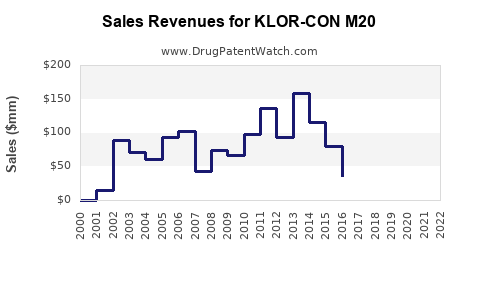
The revenue profile of a legacy brand like KLOR-CON M20 is usually dominated by net price erosion as generics gain penetration.
Pricing mechanics
- Payer reimbursement: net prices reflect rebate pressure, tier placement, and substitution.
- Wholesale and channel inventory: institutional purchasing can spike before shortages, then normalize once availability stabilizes.
- Dispensing substitution: pharmacists can substitute generics where allowed, forcing brand price concessions.
What to expect in financial trajectory
- Revenue can remain stable for a period due to inertia and patient-specific prescribing.
- Over time, brand volume declines as:
- formularies lock in generics
- prescribers shift to “generic as directed”
- insurers enforce lower-cost tiers
When does KLOR-CON M20 lose exclusivity and what does that mean commercially?
A key dynamic for older small-molecule oral solids is that exclusivity windows often end years ago, with ongoing competition from multiple generic entrants. For a product like KLOR-CON M20, commercialization after exclusivity generally looks like:
- Near-term (early lifecycle): brand differentiation can sustain volume.
- Mid-to-late lifecycle: generics capture most formulary share; brand survives with remaining brand-preferred patients and procurement exceptions.
Commercial implication: once broad generic competition is established, financial trajectory depends on how many patients and institutions remain on the brand despite substitution options, not on new patent-protected growth.
What generic entry risks exist for KLOR-CON M20 (and how do they show up in P&L)?
Generic entry risk for electrolyte brands typically manifests as share and pricing decline rather than product discontinuation.
Typical entry channels
- 505(j) generics: can rely on known safety and efficacy for potassium chloride ER products.
- Labeling equivalence: if the generic matches dose and release characteristics, switching is administratively simple.
P&L impact channels
- Gross-to-net compression: rebates and contracting intensify to preserve shelf and formulary presence.
- Volume shift: scripts move to lower-cost equivalents.
- Inventory and supply costs: any brand-to-generic substitution increases demand volatility for the remaining brand base.
What patent estate and Orange Book status protect KLOR-CON M20?
For potassium chloride products broadly, protection commonly comes down to:
- limited formulation or packaging patents (if any still active)
- method-of-use or specific dosing regimen patents, which are often weak after long time horizons
- any residual exclusivity around specific manufactured forms or delivery characteristics
But for KLOR-CON M20’s market dynamics, patent strength is usually not the primary driver. The commercial reality is that potassium chloride ER is heavily genericized, and substitution is the dominant force.
Which companies compete with KLOR-CON M20 in potassium chloride ER capsules?
Competition is not concentrated around one generic firm. The U.S. potassium chloride ER market generally features:
- multiple generic manufacturers across dose strengths
- pharmacy chain private labels in some segments
- wholesalers’ broad sourcing options that reduce supply risk
Competitive behavior patterns
- Low-cost leadership and aggressive contracting
- Rapid adoption after a generic is listed and priced attractively
- Institutional switching to reduce SKU count and procurement complexity
How does KLOR-CON M20 perform across retail, mail order, and hospital channels?
Retail
- Volume is shaped by:
- brand vs generic copay differentials
- PBM formulary tiers
- prescription substitution rules
Mail order
- Typically favors formulary adherence and contracted pricing.
- Long-term supplementation patients may remain on a set product for months unless plan changes.
Hospitals
- Converter incentives exist:
- centralized pharmacy purchasing
- standard order sets
- lab-based electrolyte protocols
- Any supply stability issues amplify substitution because hospitals cannot delay electrolyte replacement.
What supply and manufacturing dynamics affect KLOR-CON M20 availability?
For extended-release oral solids, key operational sensitivities include:
- raw material supply continuity (potassium chloride and excipients)
- manufacturing batch yields
- stability and release-spec compliance under regulatory inspection cycles
Commercial translation
- When availability is tight, remaining volume can spike for brands that still have stock.
- When supply normalizes, brand share generally returns toward generic penetration.
How does reimbursement and payer policy influence KLOR-CON M20 sales?
Payer tools that matter
- Formulary tier placement
- Quantity limits and therapeutic interchange policies
- Step edit rules that require generic use before brand coverage
- Contracted discounts with PBMs and buying groups
Typical outcome
- Brand net pricing compresses toward generics.
- A smaller residual market remains when substitution is clinically inconvenient or administratively constrained.
Revenue trajectory: what patterns are most likely for KLOR-CON M20 over time?
Given the structural economics of legacy potassium chloride ER:
- Early years: stronger brand monetization possible if fewer generics compete.
- Later years: volume erosion and net price declines dominate.
Common longitudinal pattern for legacy brand electrolyte products
- Revenue tends to flatten after generic breadth becomes high.
- Margins drift down as contracting and rebates increase.
- Profit can remain positive but constrained unless the brand retains a protected formulary niche or operates with exceptional cost efficiency.
How does KLOR-CON M20 compare with other KLOR-CON strengths and potassium chloride ER products?
Strengths and formulations compete within a class, but switching occurs mostly by:
- dose equivalence (mEq strength)
- ER profile compatibility
- pill burden and patient tolerance
Practical substitution
- If a patient tolerates one ER strength, prescribers may switch within the brand family or to generic equivalents by dose and release characteristics.
- Hospitals frequently swap among ER products to match procurement contracts.
What are the most important milestones that would signal change in KLOR-CON M20 financial performance?
Look for events that move institutional contracts or retail substitution behavior:
- PBM formulary updates affecting tier placement
- hospital group purchasing organization contract award changes
- generic price resets (often downward) across key competitors
- supply disruptions that temporarily limit generic availability
- any product discontinuation notices or packaging changes that create short-term turbulence
Key Takeaways
- KLOR-CON M20’s market dynamics are dominated by generic substitution and payer formulary behavior, not by patent-led exclusivity.
- Revenue trajectory typically shows net price compression and gradual volume erosion once generic penetration is established across retail and institutional channels.
- Financial outcomes hinge on maintaining availability, contracted positioning, and any residual brand-preferred cohorts in hospitals and long-term outpatient care.
- Competitive risk is structurally persistent because potassium chloride ER products are highly substitutable and usually enter via 505(j) pathways.
FAQs
-
Is KLOR-CON M20 generally interchangeable with potassium chloride extended-release generic capsules?
Interchange is driven by dose strength and extended-release equivalence; in practice, substitution is common where formulary and dispensing rules allow.
-
How do hospital electrolyte protocols affect KLOR-CON M20 versus generic switching?
Protocols and standardized order sets determine which potassium chloride ER SKU is stocked and ordered; contract-driven formulary selection typically drives switching.
-
Does KLOR-CON M20 face pricing pressure from PBM formulary placement?
Yes. Legacy electrolyte brands often see tier and contract pressure that compress net pricing toward generics.
-
What supply events most likely impact KLOR-CON M20 sales?
Batch availability, excipient shortages, and regulatory manufacturing interruptions can shift demand temporarily toward the products that are in stock.
-
Do patents materially change the long-run profitability of KLOR-CON M20?
For broadly genericized potassium chloride ER products, profitability is usually driven more by contract positioning, supply reliability, and substitution than by patent milestones.
References (APA)
- FDA. (n.d.). Drugs@FDA: FDA Approved Drug Products. U.S. Food and Drug Administration.
- FDA. (n.d.). Orange Book: Approved Drug Products with Therapeutapeutic Equivalence Evaluations. U.S. Food and Drug Administration.
- U.S. FDA. (n.d.). Generic Drug User Fee Amendments and 505(j) pathway information. U.S. Food and Drug Administration.