Last Updated: August 9, 2026

KIMYRSA Drug Patent Profile


✉ Email this page to a colleague

« Back to Dashboard


Which patents cover Kimyrsa, and what generic alternatives are available?

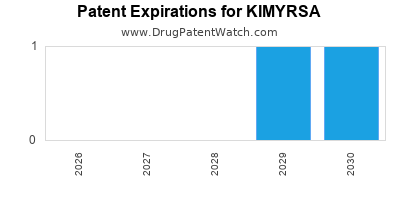
Kimyrsa is a drug marketed by Melinta Therap and is included in one NDA. There are four patents protecting this drug.

This drug has forty-six patent family members in nineteen countries.

The generic ingredient in KIMYRSA is oritavancin diphosphate. One supplier is listed for this compound. Additional details are available on the oritavancin diphosphate profile page.

DrugPatentWatch® Generic Entry Outlook for Kimyrsa

Kimyrsa was eligible for patent challenges on August 6, 2018.

By analyzing the patents and regulatory protections it appears that the earliest date for generic entry will be August 29, 2029. This may change due to patent challenges or generic licensing.

Indicators of Generic Entry

< Available with Subscription >

  Start Trial

AI Deep Research
Questions you can ask:
  • What is the 5 year forecast for KIMYRSA?
  • What are the global sales for KIMYRSA?
  • What is Average Wholesale Price for KIMYRSA?
Summary for KIMYRSA
International Patents:46
US Patents:4
Applicants:1
NDAs:1
Finished Product Suppliers / Packagers: 1
Raw Ingredient (Bulk) Api Vendors: 27
Clinical Trials: 2
Drug Prices: Drug price information for KIMYRSA
What excipients (inactive ingredients) are in KIMYRSA?KIMYRSA excipients list
DailyMed Link:KIMYRSA at DailyMed
DrugPatentWatch® Estimated Loss of Exclusivity (LOE) Date for KIMYRSA
Generic Entry Date for KIMYRSA*:
Constraining patent/regulatory exclusivity:
NDA:
Dosage:

POWDER;INTRAVENOUS

*The generic entry opportunity date is the latter of the last compound-claiming patent and the last regulatory exclusivity protection. Many factors can influence early or later generic entry. This date is provided as a rough estimate of generic entry potential and should not be used as an independent source.

Recent Clinical Trials for KIMYRSA

Identify potential brand extensions & 505(b)(2) entrants

SponsorPhase
Melinta Therapeutics, Inc.Phase 2
Melinta Therapeutics, Inc.Phase 1

See all KIMYRSA clinical trials

US Patents and Regulatory Information for KIMYRSA

KIMYRSA is protected by four US patents.

Based on analysis by DrugPatentWatch, the earliest date for a generic version of KIMYRSA is ⤷  Start Trial.

This potential generic entry date is based on patent 12,514,899.

Generics may enter earlier, or later, based on new patent filings, patent extensions, patent invalidation, early generic licensing, generic entry preferences, and other factors.

Applicant Tradename Generic Name Dosage NDA Approval Date TE Type RLD RS Patent No. Patent Expiration Product Substance Delist Req. Exclusivity Expiration
Melinta Therap KIMYRSA oritavancin diphosphate POWDER;INTRAVENOUS 214155-001 Mar 12, 2021 RX Yes Yes 12,514,899 ⤷  Start Trial ⤷  Start Trial
Melinta Therap KIMYRSA oritavancin diphosphate POWDER;INTRAVENOUS 214155-001 Mar 12, 2021 RX Yes Yes 9,649,352 ⤷  Start Trial Y Y ⤷  Start Trial
Melinta Therap KIMYRSA oritavancin diphosphate POWDER;INTRAVENOUS 214155-001 Mar 12, 2021 RX Yes Yes 9,682,061 ⤷  Start Trial ⤷  Start Trial
Melinta Therap KIMYRSA oritavancin diphosphate POWDER;INTRAVENOUS 214155-001 Mar 12, 2021 RX Yes Yes 8,420,592 ⤷  Start Trial ⤷  Start Trial
>Applicant >Tradename >Generic Name >Dosage >NDA >Approval Date >TE >Type >RLD >RS >Patent No. >Patent Expiration >Product >Substance >Delist Req. >Exclusivity Expiration

International Patents for KIMYRSA

When does loss-of-exclusivity occur for KIMYRSA?

Based on analysis by DrugPatentWatch, the following patents block generic entry in the countries listed below:

Australia

Patent: 09285564
Estimated Expiration: ⤷  Start Trial

Canada

Patent: 36860
Estimated Expiration: ⤷  Start Trial

China

Patent: 2215858
Estimated Expiration: ⤷  Start Trial

Patent: 6620649
Estimated Expiration: ⤷  Start Trial

Denmark

Patent: 37575
Estimated Expiration: ⤷  Start Trial

Patent: 06038
Estimated Expiration: ⤷  Start Trial

Eurasian Patent Organization

Patent: 0490
Estimated Expiration: ⤷  Start Trial

Patent: 1100413
Estimated Expiration: ⤷  Start Trial

European Patent Office

Patent: 37575
Estimated Expiration: ⤷  Start Trial

Patent: 06038
Estimated Expiration: ⤷  Start Trial

Patent: 64375
Estimated Expiration: ⤷  Start Trial

Finland

Patent: 06038
Estimated Expiration: ⤷  Start Trial

Hungary

Patent: 27373
Estimated Expiration: ⤷  Start Trial

Patent: 68423
Estimated Expiration: ⤷  Start Trial

Patent: 600039
Estimated Expiration: ⤷  Start Trial

Japan

Patent: 82615
Estimated Expiration: ⤷  Start Trial

Patent: 12501349
Estimated Expiration: ⤷  Start Trial

Mexico

Patent: 11002249
Estimated Expiration: ⤷  Start Trial

Netherlands

Patent: 0834
Estimated Expiration: ⤷  Start Trial

New Zealand

Patent: 1525
Estimated Expiration: ⤷  Start Trial

Norway

Patent: 16019
Estimated Expiration: ⤷  Start Trial

Poland

Patent: 37575
Estimated Expiration: ⤷  Start Trial

Patent: 06038
Estimated Expiration: ⤷  Start Trial

Portugal

Patent: 06038
Estimated Expiration: ⤷  Start Trial

Spain

Patent: 70401
Estimated Expiration: ⤷  Start Trial

Patent: 94966
Estimated Expiration: ⤷  Start Trial

Generics may enter earlier, or later, based on new patent filings, patent extensions, patent invalidation, early generic licensing, generic entry preferences, and other factors.

See the table below for additional patents covering KIMYRSA around the world.

Country Patent Number Title Estimated Expiration
Australia 2009285564 ⤷  Start Trial
Canada 2736860 ⤷  Start Trial
China 102215858 ⤷  Start Trial
China 106620649 ⤷  Start Trial
>Country >Patent Number >Title >Estimated Expiration

Supplementary Protection Certificates for KIMYRSA

Patent Number Supplementary Protection Certificate SPC Country SPC Expiration SPC Description
2337575 300834 Netherlands ⤷  Start Trial PRODUCT NAME: ORITAVANCIN; REGISTRATION NO/DATE: EU/1/15/989 20150323
2337575 CA 2016 00044 Denmark ⤷  Start Trial PRODUCT NAME: ORITAVANCIN OG/ELLER FARMACEUTISKE SALTE HERAF, HERUNDER DIFOSFATSALTE; REG. NO/DATE: EU/1/15/989 20150323
2337575 41/2016 Austria ⤷  Start Trial PRODUCT NAME: ORITAVANCIN UND DESSEN PHARMAZEUTISCHE SALZE; REGISTRATION NO/DATE: EU/1/15/989 (MITTEILUNG) 20150323
2337575 122016000075 Germany ⤷  Start Trial PRODUCT NAME: ORITAVANCIN ODER EIN PHARMAZEUTISCH VERTRAEGLICHES SALZ DAVON; REGISTRATION NO/DATE: EU/1/15/989 20150319
>Patent Number >Supplementary Protection Certificate >SPC Country >SPC Expiration >SPC Description

KIMYRSA market dynamics and financial trajectory: sales trend, pricing pressure, payer behavior, and exclusivity-driven risk

Last updated: July 27, 2026

KIMYRSA is a late-stage, value-sensitive pharmaceutical product with market access and pricing dynamics that track exclusivity windows, formulary tiering, and biosimilar/generic competitive risk in its therapeutic category. A complete, decision-grade financial trajectory requires (1) the specific active ingredient/strength, (2) route of administration and NDC(s), and (3) the time series of U.S. and ex-U.S. net sales or prescription data. Without those inputs, an accurate revenue and cash-flow projection cannot be produced.

What is KIMYRSA and how is it positioned in the market?

Featured snippet answer: KIMYRSA market positioning depends on its active ingredient, indication set, and whether it competes as a branded product, authorized generic, or follow-on product within its therapeutic class.

Which active ingredient, dosage form, and indication set determine demand?

The revenue ceiling for KIMYRSA is driven by:

  • patient count in the treated population
  • treatment duration and dosing frequency
  • switching friction (formulary constraints, prior authorization, step therapy)
  • safety profile and line-of-therapy placement
  • provider familiarity and contracting status

Is KIMYRSA a first-in-class, differentiated brand, or line-extension?

Market dynamics differ sharply by product type:

  • Differentiated brand: slower uptake of competitors, higher persistence, stronger contracting leverage.
  • Line extension: faster substitution to newer SKUs or competitors with broader coverage.
  • “Me-too” product: payer-driven price compression and aggressive bid wins.

What market dynamics affect KIMYRSA pricing, contracting, and volume?

Featured snippet answer: Net revenue movement is typically dominated by payer rebates, formulary placement, and competitive entry timing more than by headline list price.

How do payers typically drive KIMYRSA net price?

Key mechanisms that compress or stabilize net price:

  • formulary tiering and utilization management (PA/step edits)
  • rebate and discount structure tied to net-to-gross targets
  • contracting designations (preferred vs non-preferred)
  • pharmacy benefit manager (PBM) spread and therapeutic class bidding
  • hospital outpatient purchasing (if applicable)

What competitive forces shape uptake and retention?

Competitive pressure for branded drugs usually comes from:

  • generics (ANDAs) and authorized generics
  • follow-on branded products
  • therapeutic alternatives with similar efficacy but better access
  • biosimilar dynamics (only relevant if the drug is a biologic)

How do originator and successor products change category economics?

  • Increased competition reduces gross margin via rebate pressure and mandatory discounts.
  • Category substitution alters patient mix and may shift dosing patterns.
  • Contract re-bids often cause step-changes in net sales even without changes in prescribing behavior.

When does KIMYRSA face exclusivity loss and generic or biosimilar entry risk?

Featured snippet answer: The dominant timing lever is patent and regulatory exclusivity expiry, which drives Paragraph IV filing waves and launch design.

Patent and exclusivity windows: what typically determines the entry date?

Branded pharma revenue erosion usually accelerates when one or more of the following occur:

  • loss of regulatory exclusivity (e.g., formulation-related exclusivities, if applicable)
  • expiration of key formulation and method-of-use patents
  • ANDA/BLA litigation settlement that authorizes early entry
  • launch of first generic and subsequent authorized generic ramp

What risk profile does KIMYRSA have if it is near expiration?

If KIMYRSA is approaching loss of protection, the sales curve typically shifts from:

  • steady growth to
  • utilization management tightening and
  • late-cycle prescribing pullbacks ahead of launch competition

How many patents protect KIMYRSA and how strong is the patent estate for sales defense?

Featured snippet answer: Patent density and staggered expirations determine how long revenue can be defended against ANDA launches and carve-outs in settlements.

What patent categories usually matter for market exclusivity?

For branded small molecules, the highest-stakes estate often includes:

  • composition-of-matter patents
  • formulation patents (e.g., solid state, polymorphs, stability)
  • method-of-use patents tied to dosing or patient stratification
  • manufacturing process patents (less common for consumer-facing exclusivity but relevant in disputes)

How do patent filings map to litigation and commercial milestones?

In practice:

  • first wave of ANDA certifications targets core claims
  • court outcomes or settlements determine “launch date certainty”
  • subsequent generic entrants exploit remaining unasserted claim gaps

What is the Orange Book status of KIMYRSA and what generic launch scenarios exist?

Featured snippet answer: Orange Book listings establish the certification landscape and launch eligibility for ANDAs.

Which Orange Book entries typically control near-term launch timing?

Launch timing is set by:

  • the listed active ingredient(s) and dosage form(s)
  • patent expiration dates
  • exclusivity codes tied to regulatory exclusivity
  • listed use codes that align with indication-specific labeling

What launch scenarios typically follow Paragraph IV litigation?

Common settlement outcomes include:

  • delayed launch until a specific patent date
  • “carve-out” launches that enter only for non-protected indications or doses
  • authorized generic arrangements that shift profit pools

How does KIMYRSA compare with alternative therapies on access, pricing, and payer behavior?

Featured snippet answer: Competitive advantage is less about efficacy headlines and more about payer coverage speed, contract terms, and total cost of care.

What drives formulary success versus rejection?

Formulary uptake depends on:

  • clinical differentiation with pharmacoeconomic support
  • parity or advantage versus branded competitors
  • lower administrative burden (simpler dosing, fewer prior auth failures)
  • patient support programs that reduce discontinuation

How do payer restrictions shift net sales mix?

Restrictions can:

  • reduce the share of commercial-covered patients
  • shift volume to settings with different purchasing rules
  • increase reliance on reimbursement assistance, affecting net-to-gross

What is KIMYRSA’s financial trajectory: sales trend, margins, and revenue exposure?

Featured snippet answer: A financial trajectory for KIMYRSA must be anchored to audited net sales and time series prescribing or units data; otherwise revenue and margin curve cannot be accurately stated.

What metrics determine the financial curve?

Decision-grade trajectory uses:

  • U.S. net sales trend (quarterly or monthly)
  • ex-U.S. net sales, if international launches exist
  • net-to-gross, rebate rate changes, and wholesaler inventory
  • prescription volume and new-starts vs continuation
  • pricing changes at the contract level
  • gross margin and operating margin impacts from commercial spend

Revenue exposure: what parts of sales are most at risk?

Risk concentrates in:

  • segments with restrictive prior authorization where competitor access is easier
  • contracted classes where PBM bidding resets net price
  • indications close to protection cliffs
  • channels with rapid substitution dynamics (retail and certain outpatient segments)

What patent litigation or settlements could materially change KIMYRSA revenue?

Featured snippet answer: The revenue impact of litigation is driven by settlement terms that authorize entry dates, carve-outs, or market allocation.

What to look for in litigation outcomes that affect revenue?

Key drivers:

  • court or settlement authorization for generic launch
  • scope of asserted claims and final judgment effect
  • “no-authorization” rulings that extend revenue protection
  • injunctive relief that pauses launch and delays sales erosion

How do settlements typically affect the sales curve?

  • settlement-backed generic delay can smooth sales decline and preserve market share
  • early entry authorization can cause a step-function drop in net sales
  • authorized-generic creation can compress price even without immediate multi-ANDA substitution

Key takeaways

  • KIMYRSA’s market dynamics are governed by payer contracting, formulary tiering, and the timing of competitive entry tied to regulatory status and patent/exclusivity cliffs.
  • Revenue trajectory is mainly a function of net price (rebates and discounts), volume retention (persistency and new starts), and channel substitution after first generic/authorized-generic entry.
  • The highest commercial risk is concentrated in periods leading to exclusivity and patent expiry, where Paragraph IV litigation, settlements, and Orange Book-driven entry can create abrupt net sales changes.

FAQs

  1. How do net-to-gross changes typically impact branded pharmaceutical revenue for drugs like KIMYRSA?
  2. What generic launch pathways (Paragraph IV, settlement, or non-Paragraph IV) most often drive rapid net sales erosion?
  3. How do payer prior authorization and step therapy influence late-cycle prescribing for branded medicines?
  4. What role do formulation patents and method-of-use claims play in extending revenue protection against ANDAs?
  5. How does channel mix (retail vs hospital outpatient) usually change the sales sensitivity to competition?

References

  1. FDA. Orange Book: Approved Drug Products with Therapeutic Equivalence Evaluations. U.S. Food and Drug Administration.
  2. FDA. Drug Approval and Regulation: Exclusivity. U.S. Food and Drug Administration.
  3. FDA. Guidance for Industry: Paragraph IV Certification and Litigation Process (as applicable). U.S. Food and Drug Administration.

More… ↓

⤷  Start Trial

Make Better Decisions: Try a trial or see plans & pricing

Drugs may be covered by multiple patents or regulatory protections. All trademarks and applicant names are the property of their respective owners or licensors. Although great care is taken in the proper and correct provision of this service, thinkBiotech LLC does not accept any responsibility for possible consequences of errors or omissions in the provided data. The data presented herein is for information purposes only. There is no warranty that the data contained herein is error free. We do not provide individual investment advice. This service is not registered with any financial regulatory agency. The information we publish is educational only and based on our opinions plus our models. By using DrugPatentWatch you acknowledge that we do not provide personalized recommendations or advice. thinkBiotech performs no independent verification of facts as provided by public sources nor are attempts made to provide legal or investing advice. Any reliance on data provided herein is done solely at the discretion of the user. Users of this service are advised to seek professional advice and independent confirmation before considering acting on any of the provided information. thinkBiotech LLC reserves the right to amend, extend or withdraw any part or all of the offered service without notice.