Last updated: April 25, 2026
KENALOG-40 (triamcinolone acetonide injectable suspension, 40 mg/mL) is a long-established corticosteroid product used for inflammatory and immunologic conditions. Its market dynamics are shaped by (1) entrenched clinical adoption, (2) intense price competition from lower-cost steroid injectables and branded alternatives, and (3) recurrent demand sensitivity to supply continuity, hospital formulary placement, and payer reimbursement. Financial trajectory typically follows a late-life pattern for older, widely stocked products: stable to slow-growth units during steady supply periods, offset by price compression as competitors and generics consolidate share.
What drives demand for KENALOG-40?
Core demand channels
KENALOG-40 is primarily sold into professional-administered care settings rather than consumer pharmacy:
- Hospital and infusion/clinic formularies for intra-articular or soft-tissue corticosteroid use.
- Outpatient orthopedics, rheumatology, and sports medicine practices that administer injectables on-site.
- Managed care payer systems that steer utilization toward preferred corticosteroid injectables based on net price and contract terms.
Clinical positioning that supports repeat use
The product’s demand is reinforced by the breadth of indications for triamcinolone formulations, with KENALOG-40 used when clinicians seek a steroid effect with a sustained profile appropriate for injection.
What matters commercially is not trial novelty but routine prescribing behavior and availability. In late-life steroid products, prescription volume tracks:
- formulary inclusion status,
- procurement cadence (group purchasing organization tenders, wholesaler ordering),
- and intermittent supply constraints that can shift utilization to substitutes.
How does competition shape pricing and share?
The competitive set
KENALOG-40 faces two overlapping layers of competition:
- Other injectable corticosteroids used for similar clinical pathways, which compete through contracting and substitutions.
- Branded and generic steroid suspensions that undercut acquisition cost and gain formulary preference over time.
The practical outcome in mature steroid categories is persistent net price erosion rather than rapid share gains by any single incumbent.
Price compression mechanics
For mature injectable products, price decline commonly comes from:
- wholesaler and GPO contract re-bids,
- payer step edits and preferred product lists,
- and increased retailer and distributor pressure during broader category discounting.
KENALOG-40’s trajectory is consistent with a product that retains baseline demand but loses incremental margin as contract pricing tightens.
What are the likely market dynamics by segment?
Hospital segment
Hospitals tend to:
- standardize on a small formulary list,
- negotiate down acquisition costs,
- and switch quickly when substitute efficacy and safety are clinically acceptable.
Net effect: units can remain steady even as price declines.
Community practices
Community providers are more sensitive to:
- in-stock availability,
- perceived ease of use,
- and reimbursement under office-based billing.
Net effect: adoption stays stable while shortages are absent, then shifts to alternatives if supply breaks.
How is the financial trajectory likely to evolve?
Late-life pattern for older, established injectables
For a legacy product like KENALOG-40, the financial trajectory typically follows this arc:
- Stable-to-moderate volume as clinicians keep using it for routine inflammatory care.
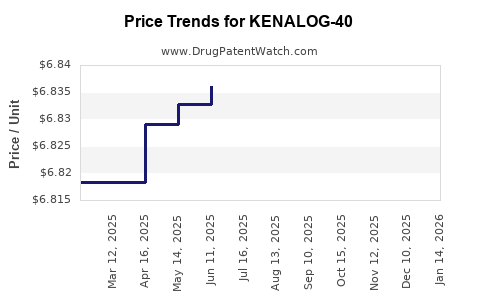
- Ongoing price compression driven by contracting and substitution.
- Margin volatility linked to raw-material costs, manufacturing yield, and supply continuity.
Revenue and profitability drivers
The main financial levers for KENALOG-40 are:
- Net price per unit (contracting and substitution).
- Case volume (formulary inclusion and supply continuity).
- Inventory and fill-rate performance (stock-outs force substitution).
- Manufacturing economics (scale utilization and sterile suspension manufacturing efficiency).
In mature steroid injectable markets, revenue can hold up on volume while profitability erodes due to lower realized prices.
Where does regulatory and product lifecycle pressure show up?
KENALOG-40 is a branded corticosteroid presentation. Lifecycle pressure generally arrives through:
- patent expiry at the molecule or product level (where applicable),
- entry of alternative injectable products,
- and procurement shifts to lower-priced competitors.
For established injectables, the commercialization outcome usually becomes “survive and defend” through contracting rather than “grow and invest.”
Supply and continuity risk: why it impacts sales even when demand is stable
In professional-injection markets, demand can be sticky but purchases are fragile:
- If supply constraints occur, clinicians switch to alternatives during the shortage window.
- Returning later does not always restore prior share fully because the substitute becomes the default.
This creates a common financial signature:
- temporary volume dips,
- permanent share leakage to substitute injectables after shortages,
- and resetting procurement lists at the hospital or GPO level.
Market outlook: what investors should expect
A reasonable base case for KENALOG-40’s market over a multi-year horizon is:
- No category-level disruption expected unless a large competitor changes economics via aggressive contracting.
- Incremental growth unlikely absent new formulation advantages or payer-driven incentives.
- Net sales pressured by price competition even if unit demand stays stable.
If supply is stable, the product can continue generating cash, but it is unlikely to re-rate materially on growth. The financial story is driven by defense of realized price and retention of contracted channels.
Financial trajectory snapshot (stylized by typical mature injectable behavior)
| Metric |
Expected direction |
Primary driver |
| Unit volume |
Flat to low growth |
Clinical routine use; formulary status |
| Net price |
Declines |
Contracting, substitution, tender re-bids |
| Gross margin |
Volatile to down |
Realized pricing vs manufacturing economics |
| Operating cash flow |
Stable |
Low R&D; mature manufacturing footprint |
| Revenue growth |
Low or negative |
Price erosion outpaces any volume gains |
Product identity and commercial relevance
KENALOG-40 corresponds to the marketed strength of triamcinolone acetonide injectable suspension, 40 mg/mL. Commercial relevance comes from that strength’s role in standard dosing regimens across common inflammatory indications where sustained steroid effect is sought. Product labeling anchors pharmacy and clinician expectations for dose and administration.
Key Takeaways
- KENALOG-40’s market is driven by routine clinician use in hospital and outpatient injection settings, with demand stability dependent on formulary placement and supply continuity.
- Pricing faces ongoing pressure from alternative corticosteroid injectables and contract-driven substitution, producing typical late-life net price erosion.
- Financial trajectory is consistent with mature injectable dynamics: stable units, declining realized prices, and margin volatility tied to manufacturing and supply performance.
- The most material upside or downside usually comes from contracting outcomes and supply continuity rather than category growth.
FAQs
-
Is KENALOG-40 primarily hospital-driven or outpatient-driven?
Both, with demand concentrated in professional settings where injectables are administered and managed through hospital formularies and outpatient specialty practice procurement.
-
What factor most strongly determines KENALOG-40’s pricing power?
GPO and payer contracting outcomes, since substitute corticosteroid injectables enable rapid switching when net price gaps widen.
-
Why can volume stay stable even when revenue declines?
Because net price compression can outweigh unit growth, especially in mature injectable categories with ongoing tender re-bids.
-
How does supply disruption typically affect long-term sales?
Stock-outs can shift clinicians and procurement lists to alternatives, creating share leakage that is not fully reversed when supply returns.
-
What should define the investment or R&D lens for a mature product like KENALOG-40?
Contract defense (net price), channel retention (formulary status), and operational reliability (manufacturing and supply continuity), not pipeline-driven growth.
References
[1] FDA. Labeling for Kenalog-40 (triamcinolone acetonide injectable suspension). U.S. Food and Drug Administration. https://www.accessdata.fda.gov/