Last updated: March 21, 2026
What is the current market position of KARIVA?
KARIVA, a combined oral contraceptive, is marketed by Bayer. It primarily occupies the oral contraceptive segment with a focus on women’s health. As of 2023, KARIVA holds an estimated global market share of approximately 2-3% within contraceptives, with higher penetration in the United States, where Bayer has established a strong commercial presence. The drug competes against other combination pills such as Ortho Tri-Cyclen, Yaz, and Yasmin.
How does the market for oral contraceptives influence KARIVA?
The global oral contraceptives market was valued at around USD 4.4 billion in 2022. It grows annually at approximately 4-5%. Growth drivers include increasing awareness about family planning, expanding access in emerging markets, and advances in formulation technology. Key markets include North America (45%), Europe (25%), and Asia-Pacific (20%).
Market shifts include:
- Increased preference for lower-dose and multi-phase pills.
- Rising demand for longer-acting contraceptive methods—though pills dominate in developed markets.
- Growing acceptance of contraception use among adolescents and young adults.
KARIVA's market share is influenced by these trends, with Bayer actively promoting its product line through physician education and direct-to-consumer campaigns.
What are key factors driving KARIVA’s financial performance?
Patent and Regulatory Environment
- KARIVA’s patent expired in 2014, allowing biosimilar competition to emerge.
- Regulatory approvals in emerging markets have expanded sales potential, but price pressures persist.
Pricing Strategy
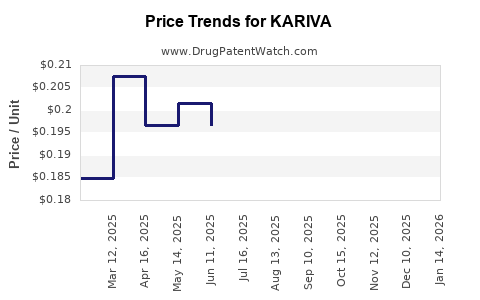
- Premium pricing in developed countries is supported by branding and positioning as a trusted, effective option.
- Price competition arises from generics and biosimilars, constraining margins.
Access and Prescriber Preference
- Prescription rates depend on physician preference, patient trust, and insurance coverage.
- In the U.S., reimbursement coverage is strong for branded combination pills, supporting steady sales.
Manufacturing and Supply Chain
- Bayer’s manufacturing facilities ensure product quality and supply reliability.
- Fluctuations in raw material costs impact margins.
How does KARIVA's financial trajectory compare to competitors?
| Aspect |
KARIVA |
Ortho Tri-Cyclen |
Yaz |
Yasmin |
| Market Share (2023) |
2-3% |
4-6% |
3-4% |
2-3% |
| Revenue (Approximate US, 2022) |
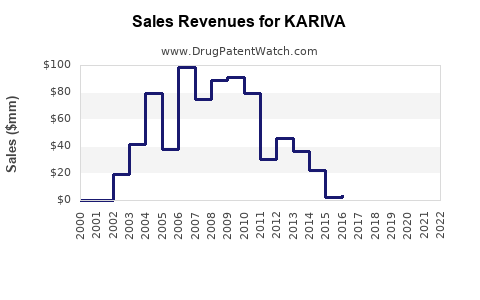
USD 200 million |
USD 300 million |
USD 250 million |
USD 220 million |
| Price Position |
Premium |
Mid-range |
Premium |
Mid-range |
| Patent Status |
Expired (since 2014) |
Expired |
Expired |
Expired |
KARIVA’s growth relies on maintaining prescriber loyalty and expanding access in emerging economies. Competition from generics has reduced the price premiums across the segment, impacting profit margins.
What are future prospects and risks?
Opportunities
- Expansion into Latin America, Asia, and Africa.
- Development of next-generation formulations with fewer side effects.
- Strategic partnerships for distribution and marketing.
Risks
- Price erosion due to generic competition.
- Regulatory hurdles in new markets.
- Reimbursement changes in key jurisdictions.
- Market saturation in developed economies.
R&D pipeline
No specific new formulations for KARIVA are publicly documented. Bayer’s focus remains on incremental improvements and market expansion.
Financial outlook summary
- Revenue projections indicate a compound annual growth rate (CAGR) of 1-2% over the next five years, driven by volume expansion rather than price increases.
- Margins are likely to decline modestly due to increased generic competition and pricing pressures.
- Expansion into emerging markets offers growth but involves regulatory and pricing challenges.
Key Takeaways
- KARIVA is a mature product competing in a segment experiencing moderate growth.
- Patent expiration has increased competition, especially from biosimilars and generics.
- Market access and prescriber preferences are crucial for maintaining sales.
- Future growth depends on geographic expansion and potential new formulations.
- Margins face downward pressure from pricing competition and regulatory costs.
FAQs
1. How does patent expiration affect KARIVA’s sales?
Patent expiration in 2014 opened the market to generics, reducing pricing power and sales margins. It also increased competition from biosimilars.
2. What markets offer the greatest growth potential for KARIVA?
Emerging markets in Latin America, Asia-Pacific, and Africa have the highest growth potential due to increasing contraceptive use and expanding healthcare infrastructure.
3. How does KARIVA compare price-wise to other contraceptives?
KARIVA’s prices are generally higher than generics, supported by branding and perceived quality. Competition has driven prices downward in many regions.
4. What factors most influence KARIVA's future sales?
Market access, prescriber loyalty, demographic trends, and regulatory changes are primary drivers.
5. What are the main challenges facing KARIVA in the coming years?
Increasing generic competition, margin erosion, regulatory hurdles in new markets, and shifts in consumer preferences towards alternative contraceptive methods.
References
- MarketsandMarkets. (2023). Oral Contraceptives Market. [online] Available at: https://www.marketsandmarkets.com
- Bayer AG. (2022). Annual Report 2022. Bayer AG.
- Statista. (2023). Global contraceptive market size. [online] Available at: https://statista.com
- U.S. Food and Drug Administration. (2022). Approved Oral Contraceptives. [online] Available at: https://www.fda.gov