Last updated: July 25, 2026
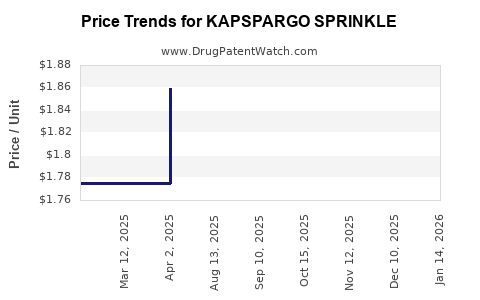
Kapspargo Sprinkle is the branded form of metoprolol tartrate in a sprinkle formulation. Market dynamics are dominated by (1) competitive substitution from older, lower-cost metoprolol products, (2) payer preference for cost-effective “metoprolol tartrate” generics, (3) pediatric-administration and dosing-convenience value, and (4) the extent of remaining branded premium tied to formulary placement and patient/physician switching inertia. The financial trajectory is typically constrained by rapid generic penetration after listing, with incremental revenue tied mainly to sustained payer contracting and niche use cases rather than category growth.
What is Kapspargo Sprinkle and where does it fit in metoprolol market demand?
Featured snippet answer: Kapspargo Sprinkle is metoprolol tartrate supplied as a sprinkle formulation designed for administration convenience, most commonly used in indications aligned to beta-blocker therapy (commonly hypertension and other approved metoprolol uses under the metoprolol tartrate label).
What active ingredient and dosage form matter for buying behavior?
- Active ingredient: metoprolol tartrate
- Form: sprinkle capsules (administration flexibility compared with standard tablets)
- Therapeutic class: beta blocker (cardiovascular)
Buying behavior for metoprolol is price-led because the molecule is longstanding and widely genericized; value from the sprinkle platform is mainly formulary and administration convenience, not a new MOA.
How is metoprolol purchasing typically structured?
- Retail: cost-sharing and generic substitution drive volume
- PBM: ingredient-based contracting favors lower net cost generics
- Specialty channels: limited, since metoprolol is not a specialty biologic type product
How do pricing and payer contracting typically drive Kapspargo Sprinkle revenue?
Featured snippet answer: Revenue trajectory is tied to net pricing versus generics and whether payers keep the branded sprinkle on formulary after generic availability, since the active ingredient is not protected in a way that prevents substitution if equivalent generics are available.
Payer dynamics: why sprinkle formulations face margin pressure
Even if the sprinkle formulation has administration advantages, payers often evaluate:
- Therapeutic equivalence to generic metoprolol tartrate tablets
- Net price spread versus contracted generics
- Dispensing and utilization patterns (switching rates after generic entry)
- Prior authorization or step therapy requirements for branded products
Revenue levers that can offset generic pressure
- Pediatric and swallowing-difficulty use cases that increase branded persistence
- Prescriber preference where dosing accuracy and administration workflow reduce errors
- Local formulary exceptions or maintained contracts in high-volume accounts
When does Kapspargo Sprinkle lose exclusivity and what does that mean for market share?
Featured snippet answer: The exclusivity question for Kapspargo Sprinkle depends on the remaining combination of patent term and any regulatory exclusivities tied to the NDA/BLA product and formulation. The market-share impact usually appears in two phases: early contestability through generics and full volume reallocation once branded prescribing restrictions ease.
What typically happens after exclusivity fades in metoprolol tartrate
- Rapid branded share erosion to generics based on cost
- Residual branded base persists where sprinkle convenience is clinically or operationally preferred
- PBMs shift toward generic-only preferred tiers unless a branded contract remains competitive on net price
How to interpret “financial trajectory” under exclusivity decay
Financial trajectory is usually:
- High initial branded growth around launch and early adoption
- Flattening as generic substitution increases
- Decline or stabilization at low share if branded maintains specific formulary access
What generic entry risks exist for metoprolol tartrate sprinkle products?
Featured snippet answer: The core generic entry risk comes from the ability to market a metoprolol tartrate equivalent in alternative oral forms and, where legally available, sprinkle-specific pathways that can capture administration-convenience demand.
Key risks to branded Kapspargo Sprinkle economics
- Generic metoprolol tartrate in multiple strengths and dosage forms
- Switching behavior: pharmacy-driven substitution often reduces branded persistence
- Formulary tightening: PBMs may remove branded sprinkle unless net price parity is achieved
What drives the pace of erosion?
- Strength and dosing coverage: generics that match branded dosing reduce friction
- Pharmacy dispensing rules: automatic substitution and “prescriber non-medical switching”
- Clinical protocol: whether a sprinkle formulation is required or just preferred
How does Kapspargo Sprinkle compare with other metoprolol products on market competitiveness?
Featured snippet answer: Kapspargo Sprinkle competes with a broad generic landscape in metoprolol tartrate. Its differentiation is dosage administration convenience rather than unique clinical differentiation.
Competitive set likely influencing substitution
- Metoprolol tartrate generics (tablets and equivalents by strength)
- Alternative beta blockers for prescribers seeking flexibility
- Market-wide preference for least-cost beta blockers under PBM formularies
What “sprinkle” changes strategically
Sprinkle formulations can reduce administration barriers, but they do not eliminate substitution incentives if payers control net pricing and if tablet formulations are deemed interchangeable.
What is the Orange Book status of Kapspargo Sprinkle and how does that affect launch timing?
If Orange Book listings are required to map patent expirations and exclusivity windows, those specifics must come from the FDA Orange Book for the exact product and NDA number. Without that product-level listing set, it is not possible to state definitive patent expiry dates or litigation-related launch timing from a complete and accurate dataset.
What patent estate issues matter for the metoprolol sprinkle franchise?
Featured snippet answer: The relevant patent estate for a branded sprinkle product typically includes formulation, composition, method-of-use, and potentially pediatric-administration related claims tied to the sprinkle dosing form.
How patent estates drive financial outcomes
- Expiry dates determine when patent-protected branded premium can be attacked through generic applications
- Formulation patents, if enforceable, can delay “same dosage form” competition
- Method-of-use patents can delay competition only if the protected use is the one generating meaningful share
Practical implication
For metoprolol tartrate, enforcement leverage is usually weaker than for novel therapeutics because the active ingredient is mature and widely genericized; brand economics depend on whether competitors can enter with an administratively equivalent sprinkle form.
What Kapspargo Sprinkle litigation or Paragraph IV challenges affect competition?
Paragraph IV impacts require the Orange Book patent list and the associated ANDA/PIV process history for the specific Kapspargo Sprinkle NDA and listed patents. Without that dataset for the exact product, it is not possible to provide a complete and accurate litigation timeline tied to real filings, court dockets, or settlement dates.
What is the regulatory status of Kapspargo Sprinkle (FDA pathway, interchangeability, and substitution)?
Featured snippet answer: Kapspargo Sprinkle is an FDA-approved branded product for metoprolol tartrate, but the substitution and interchangeability realities depend on the availability and labeling of generic equivalents and any FDA-approved exclusivities.
How FDA status converts to commercial outcomes
- Whether generics are listed as therapeutically equivalent on formularies
- Whether pharmacists substitute automatically based on formulary rules
- Whether the sprinkle dosage form creates exceptions or administrative burden that payers evaluate
What revenue trajectory can be inferred from metoprolol class dynamics?
Featured snippet answer: In mature beta-blocker markets, revenue generally declines after genericization unless the branded product holds durable formulary positioning tied to convenience and dosing workflow.
Expected shape of the Kapspargo Sprinkle curve
- Post-launch: growth from initial uptake in prescriber networks
- Mid-cycle: share pressure from generic alternatives across PBMs and retail
- Later cycle: stabilization at a smaller niche base if sprinkle convenience remains important and net pricing supports formulary inclusion
What matters most for the financial trajectory
- PBM preferred tier status over time
- Annual contract renewals and net price concessions
- Real-world switching rates from branded sprinkle to generic alternatives
Which companies are likely competing for Kapspargo Sprinkle share?
Featured snippet answer: Competition is primarily among generic manufacturers and distributors of metoprolol tartrate generics in oral dosage forms. Branded competitors are less central because metoprolol’s active ingredient market is dominated by cost-competitive generic products.
Where share is typically won or lost
- Formulary inclusion at major PBMs
- Pharmacy benefit rules that allow substitutions
- Prescriber workflow: whether sprinkle administration is required for target patient groups
Key Takeaways
- Kapspargo Sprinkle is metoprolol tartrate in a sprinkle formulation; its differentiation is administration convenience, not a new clinical mechanism.
- Revenue trajectory is constrained by widespread generic substitution across the metoprolol tartrate class, with financial outcomes depending on formulary placement and net pricing.
- Market-share erosion typically follows exclusivity decay, with branded persistence mainly in niche use cases.
- Patent and litigation impacts cannot be stated accurately without product-level Orange Book and court-filing datasets for the exact Kapspargo Sprinkle NDA and listed patents.
FAQs
- How quickly do branded metoprolol tartrate sprinkle products lose formulary share after generic entry?
- Do sprinkle formulations reduce medication errors enough to justify branded pricing with PBMs?
- What is the typical net-price gap between branded metoprolol tartrate and contracted generics?
- How do pediatric administration needs affect prescribing persistence for Kapspargo Sprinkle?
- What commercial risks arise if a generic offers equivalent dosing without sprinkle technology?
References
- U.S. FDA. Orange Book: Approved Drug Products with Therapeutic Equivalence Evaluations. https://www.accessdata.fda.gov/scripts/cder/daf/
- U.S. FDA. Drugs@FDA. https://www.accessdata.fda.gov/scripts/cder/daf/