Last updated: August 13, 2026
KADIAN is an extended-release morphine sulfate capsule marketed for severe, persistent pain requiring continuous opioid treatment. Its commercial trajectory reflects the broader decline of branded opioid franchises: initial differentiation through extended-release delivery and abuse-deterrent positioning, followed by generic substitution, tighter opioid controls, litigation exposure and reduced prescriber demand. Public filings do not disclose a reliable standalone KADIAN revenue series, so the financial analysis must rely on product ownership, market-entry events, prescription trends and portfolio disclosures rather than reported brand sales.
What is KADIAN and how does it work?
KADIAN contains morphine sulfate in extended-release capsules. The product uses multiparticulate technology designed to release morphine over an extended period. Patients may swallow the capsules or, under specified conditions, open them and sprinkle the contents on soft food. The labeling warns against chewing, crushing or dissolving the pellets because those actions can produce rapid morphine release and potentially fatal overdose.[1]
KADIAN is distinct from immediate-release morphine and from extended-release tablets such as MS Contin. Its principal product attributes are:
| Attribute |
KADIAN |
| Active ingredient |
Morphine sulfate |
| Dosage form |
Extended-release capsules |
| Therapeutic class |
Opioid analgesic |
| Original U.S. approval |
FDA approval in the 1990s |
| Primary indication |
Management of severe, persistent pain requiring an around-the-clock opioid |
| Marketed strengths |
Multiple capsule strengths, including 10 mg through 200 mg presentations under historical labeling |
| Administration |
Once- or twice-daily dosing depending on the patient and strength |
| Abuse-deterrent status |
Not labeled as an FDA-approved abuse-deterrent formulation |
| Generic availability |
Yes, for extended-release morphine sulfate capsules |
| Principal competitive pressure |
Generic morphine ER, other long-acting opioids and non-opioid pain treatments |
KADIAN is an opioid analgesic, not a biologic. Biosimilar competition is therefore irrelevant. Competitive risk comes from generic drug applicants, therapeutic substitution and restrictions on opioid prescribing.
When did KADIAN lose market exclusivity?
KADIAN’s core commercial protection ended before the current opioid market contraction. The brand’s initial value depended on formulation patents, regulatory approval and the limited availability of comparable extended-release morphine products. Those protections did not prevent later generic entry.
Historical Orange Book records identify patents associated with KADIAN and its formulation technology, including patents covering controlled-release morphine formulations. The relevant patent estate was narrow compared with large pharmaceutical franchises and did not create durable protection after the late 2000s and early 2010s.[2]
A practical exclusivity timeline is:
| Period |
Commercial event |
Market effect |
| 1990s |
FDA approval and commercial launch |
KADIAN established a branded extended-release morphine position |
| 2000s |
Expansion of long-acting opioid competition |
Prescriber and payer alternatives increased |
| Early 2010s |
Generic extended-release morphine capsules entered the U.S. market |
Price erosion and substitution accelerated |
| 2010s |
Opioid prescribing restrictions and litigation expanded |
Category demand and commercial investment declined |
| 2020s |
Generic and low-cost alternatives dominated |
KADIAN became a limited brand opportunity |
The exact loss-of-exclusivity date depends on the specific patent, regulatory exclusivity period and generic product considered. KADIAN no longer has a commercially meaningful period of U.S. market exclusivity.
What is the Orange Book status of KADIAN?
KADIAN was listed in FDA Orange Book records as a prescription extended-release morphine product with associated patents and regulatory information. The commercial significance of those listings declined after generic morphine sulfate extended-release capsules became available.
Orange Book status does not by itself establish current commercial availability. A listed product can have an approved application while facing limited distribution, discontinued marketing, or no meaningful branded demand. FDA’s discontinued-drug records and current labeling sources should be distinguished from historical Orange Book entries.[2,3]
The key regulatory conclusions are:
- KADIAN is an FDA-approved prescription opioid product.
- Its active ingredient, morphine sulfate, has long been available in generic forms.
- KADIAN does not have biologic exclusivity.
- The brand does not retain a commercially significant patent moat.
- Any remaining regulatory value is tied to the approved product profile and formulation, not market exclusivity.
Which companies challenged KADIAN patents and when did generics enter?
Generic competition emerged through abbreviated new drug applications for morphine sulfate extended-release capsules. Generic applicants could rely on KADIAN’s FDA approval while challenging listed patents through Paragraph IV certifications or waiting for patent expiration.
Public information supports the following market interpretation:
- KADIAN’s formulation patents were finite-term rights.
- Generic applicants had a clear path to approval after patent expiration or successful patent challenges.
- Generic morphine ER products materially weakened brand pricing power.
- The generic market became the principal source of extended-release morphine supply.
The available public record does not support a complete, verified list of every Paragraph IV filer, litigation docket, settlement term and launch date. A precise company-by-company litigation chronology cannot be stated without risking inaccurate attribution. The economic result is clear: generic entry removed KADIAN’s ability to maintain premium pricing.
What formulations are protected by KADIAN patents?
KADIAN’s historical patent value centered on controlled-release delivery rather than a new chemical entity. The formulation technology used multiparticulate morphine pellets designed to control drug release in the gastrointestinal tract.
The relevant protection categories included:
- Controlled-release morphine formulations.
- Multiparticulate pellet architecture.
- Release-rate control.
- Capsule-based oral delivery.
- Administration methods involving intact capsules or pellet sprinkling.
These patents had lower strategic durability than patents covering a new active ingredient. Formulation patents can delay generic entry, but they generally face design-around strategies and expire earlier than a product’s commercial life if the product is launched late in the patent term.
KADIAN’s formulation differentiation also weakened as prescribers and payers evaluated opioid products primarily through safety, abuse risk, cost and regulatory restrictions rather than delivery convenience alone.
How strong is the KADIAN patent estate?
KADIAN’s patent estate is commercially weak today.
| Patent-estate factor |
Assessment |
| Active-ingredient protection |
None of practical relevance; morphine is an established molecule |
| Formulation protection |
Historically meaningful but expired or commercially exhausted |
| Method-of-use protection |
Limited relative to the broad chronic-pain market |
| Manufacturing barriers |
Manageable for qualified opioid manufacturers with controlled-substance infrastructure |
| Generic design-around risk |
High |
| Current exclusivity value |
Minimal |
| Litigation leverage |
Low compared with an active branded product |
Manufacturing creates operational barriers because morphine is a controlled substance and manufacturers must comply with Drug Enforcement Administration quotas, security controls, recordkeeping and diversion-prevention obligations. Those barriers can restrict supply, but they do not recreate patent exclusivity.
What is KADIAN’s FDA regulatory status?
KADIAN is subject to the FDA’s opioid labeling, risk-management and postmarketing requirements. The product labeling includes boxed warnings covering addiction, abuse, misuse, life-threatening respiratory depression, accidental ingestion, neonatal opioid withdrawal syndrome and risks from benzodiazepine or central nervous system depressant combinations.[1]
The regulatory environment changed materially after the FDA issued its 2014 guidance on abuse-deterrent opioid development and after federal and state governments imposed tighter opioid-prescribing controls.[4] KADIAN was not positioned as an FDA-labeled abuse-deterrent opioid. That limited its ability to defend brand value against newer abuse-deterrent products, although abuse-deterrent status has not eliminated opioid substitution or regulatory risk.
The FDA also required extended-release and long-acting opioid manufacturers to conduct postmarket studies and participate in class-wide risk-management activities. These requirements increased the cost and operational burden of maintaining a long-acting opioid franchise.[5]
How did opioid litigation affect KADIAN’s market?
KADIAN’s commercial exposure was indirect as well as product-specific. Opioid litigation affected manufacturers, distributors, pharmacies and prescribers across the category. Claims generally alleged that opioid marketing contributed to excessive prescribing, addiction and public-health costs.
The principal effects on the KADIAN market were:
- Lower physician willingness to initiate long-acting opioids.
- Greater prior authorization and step-therapy requirements.
- Restricted dosing and duration.
- Higher compliance and legal costs for manufacturers.
- Reduced promotional activity.
- Greater payer preference for low-cost generic supply.
- Reputational damage to branded opioid products.
Litigation settlements involving opioid manufacturers did not create a new KADIAN patent dispute. Their main financial effect was to reduce the attractiveness of opioid commercial portfolios and increase the cost of maintaining controlled-substance operations.
What was KADIAN’s financial trajectory?
KADIAN’s financial trajectory can be divided into four phases.
Launch and differentiation
During its earlier commercial period, KADIAN benefited from a branded formulation, physician familiarity and demand for long-acting opioid therapy. Extended-release delivery supported a premium over immediate-release morphine and helped the product compete with MS Contin and other long-acting opioids.
Portfolio-stage growth
KADIAN became a portfolio asset rather than a standalone growth platform. Commercial value depended on its position within a broader pain franchise, sales-force coverage and payer access. The product’s value was constrained by the established nature of morphine and by competition from oxycodone, hydromorphone, fentanyl and non-opioid treatments.
Generic erosion
Generic entry shifted the economic model from branded growth to residual share retention. Once pharmacies and payers could substitute generic morphine ER, KADIAN faced:
- Lower average selling prices.
- Reduced formulary preference.
- Lower physician sensitivity to brand-specific delivery features.
- Declining promotional return on investment.
- Higher relative compliance and litigation costs.
Category contraction
The opioid crisis caused a structural decline in demand for long-acting opioids. Prescription volume, utilization controls and public-sector scrutiny increased. Even without generic entry, these factors would have weakened KADIAN. Combined with generic competition, they made a material revenue recovery unlikely.
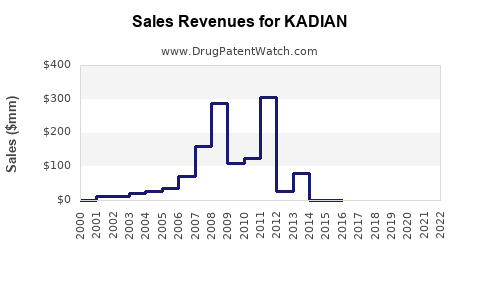
Public company filings do not provide a consistent, audited KADIAN revenue history across its ownership changes. Product-level sales were generally included within broader pharmaceutical or pain portfolios. Any precise annual sales series should therefore be treated cautiously unless sourced directly from internal company reporting or a commercial prescription database.
Which companies owned or marketed KADIAN?
KADIAN changed commercial hands through the consolidation of pharmaceutical companies and specialty-product portfolios. Historical marketing involved companies including Actavis and Allergan-related operations. Ownership and marketing rights should be distinguished from the original development and patent ownership.
The commercial pattern was typical of mature specialty pharmaceuticals:
- An originator or early commercial owner developed the product.
- A larger generic or specialty pharmaceutical company acquired or marketed the brand.
- Portfolio consolidation transferred the product between corporate entities.
- Generic competition reduced the brand’s strategic importance.
- The product became less material to consolidated revenue.
For licensing and transaction analysis, the relevant issue is whether a transaction transferred the NDA, trademarks, formulation rights, manufacturing rights or only distribution rights. Public disclosures do not establish a current standalone licensing platform for KADIAN.
How does KADIAN compare with competing long-acting opioids?
| Product |
Active ingredient |
Form |
Main competitive position |
| KADIAN |
Morphine sulfate |
Extended-release capsule |
Multiparticulate morphine delivery |
| MS Contin |
Morphine sulfate |
Extended-release tablet |
Established branded and generic morphine ER |
| OxyContin |
Oxycodone |
Extended-release tablet |
High historical brand recognition, major litigation exposure |
| Opana ER |
Oxymorphone |
Extended-release tablet |
Smaller opioid franchise, discontinued U.S. marketing |
| Exalgo |
Hydromorphone |
Extended-release tablet |
High-potency opioid for opioid-tolerant patients |
| Duragesic |
Fentanyl |
Transdermal patch |
Non-oral delivery for selected patients |
KADIAN’s main advantage was formulation and dosing flexibility. Its main disadvantages were generic availability, morphine’s low molecular differentiation and the broad decline in chronic opioid prescribing.
What generic launch risks remain for KADIAN?
The principal generic risks are already realized rather than prospective. KADIAN does not face a new first-wave generic cliff comparable with a recently launched specialty drug. Instead, it faces persistent erosion from existing generic morphine ER products.
Remaining commercial risks include:
- Additional generic suppliers competing on price.
- Pharmacy-level substitution.
- Supply disruptions or quota constraints.
- State opioid-prescribing limits.
- Payer exclusion of the branded product.
- Controlled-substance compliance costs.
- Product discontinuation or limited distribution.
A branded relaunch would require a clear clinical or delivery advantage, reliable manufacturing, payer coverage and a regulatory strategy addressing opioid safety. The historical formulation alone would not support a durable premium.
What is the geographic coverage of KADIAN?
KADIAN’s most significant commercial history is in the United States. Morphine sulfate extended-release products are marketed internationally under different brand names, regulatory classifications and controlled-substance rules. KADIAN’s U.S. patent and Orange Book position does not establish equivalent protection elsewhere.
Geographic value is limited by:
- Country-specific opioid controls.
- Different reimbursement systems.
- Local generic approval pathways.
- Import and controlled-substance quotas.
- Varying acceptance of long-acting opioid therapy.
- Local patent expiration and formulation rights.
The U.S. market remains the principal reference point for KADIAN’s commercial and regulatory analysis.
What is the outlook for KADIAN revenue?
KADIAN revenue is unlikely to return to its earlier branded trajectory. The product has three structural constraints: generic competition, a mature active ingredient and persistent regulatory pressure on long-acting opioids.
A plausible commercial outlook is:
| Scenario |
Expected result |
| Base case |
Low-volume mature brand or limited/discontinued commercial presence |
| Upside case |
Niche retention through specialist prescribing or supply differentiation |
| Downside case |
Further decline from discontinuation, payer exclusion or generic substitution |
| Repositioning case |
Limited value only if supported by a new delivery, safety or adherence claim |
The product’s residual value is more likely to arise from an approved NDA, manufacturing know-how, trademarks or portfolio supply arrangements than from patent exclusivity.
Key Takeaways
- KADIAN is an extended-release morphine sulfate capsule for severe persistent pain.
- Its historical differentiation came from multiparticulate controlled-release delivery.
- Core formulation protection no longer provides meaningful commercial exclusivity.
- Generic morphine ER products have removed most pricing power.
- KADIAN is not exposed to biosimilar competition because it is a small-molecule drug.
- Opioid litigation, prescribing restrictions and FDA risk-management obligations reduced category demand.
- Public filings do not disclose a dependable standalone KADIAN revenue series.
- Current commercial value is likely limited to residual brand demand, regulatory assets, manufacturing capability and supply relationships.
- A generic launch threat is no longer the primary event; ongoing generic substitution is the dominant market dynamic.
- The financial outlook is mature to declining, with limited potential for a branded recovery.
FAQs
Is KADIAN still available as a brand-name drug?
KADIAN’s historical FDA approval and labeling should not be equated with broad current commercial availability. Generic extended-release morphine is the principal market alternative, and brand distribution may be limited or discontinued depending on the manufacturer and market period.
Is KADIAN the same as MS Contin?
No. Both contain extended-release morphine sulfate, but they use different dosage forms and release technologies. KADIAN is an extended-release capsule containing multiparticulate pellets, while MS Contin is an extended-release tablet.
Does KADIAN have abuse-deterrent labeling?
KADIAN is not generally identified as an FDA-approved abuse-deterrent opioid formulation. Its controlled-release design does not by itself confer abuse-deterrent labeling.
Can KADIAN be substituted with generic morphine sulfate ER?
Pharmacy substitution depends on the specific approved generic, state law, payer policy and prescribing instructions. Generic extended-release morphine products compete directly with KADIAN but may differ in formulation, strengths and administration instructions.
Does KADIAN have future licensing value?
Any remaining licensing value would likely come from the NDA, brand, manufacturing process, supply rights or niche distribution arrangements. Patent-based licensing value is limited because the principal formulation exclusivity has expired or been commercially overtaken by generic competition.
References
- U.S. Food and Drug Administration. (2023). Kadian (morphine sulfate) extended-release capsules: Prescribing information.
- U.S. Food and Drug Administration. (n.d.). Approved drug products with therapeutic equivalence evaluations: Orange Book.
- U.S. Food and Drug Administration. (n.d.). Drugs@FDA: Kadian.
- U.S. Food and Drug Administration. (2015). Guidance for industry: Abuse-deterrent opioids: Evaluation and labeling.
- U.S. Food and Drug Administration. (2019). Risk evaluation and mitigation strategy for extended-release and long-acting opioid analgesics.