Last Updated: November 8, 2026

JULUCA Drug Patent Profile

« Back to Dashboard


Which patents cover Juluca, and what generic alternatives are available?

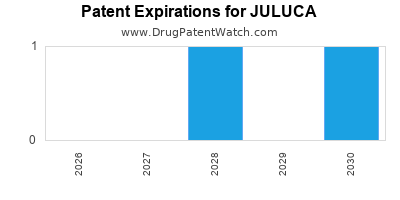
Juluca is a drug marketed by Viiv Hlthcare and is included in one NDA. There are four patents protecting this drug and one Paragraph IV challenge.

The generic ingredient in JULUCA is dolutegravir sodium; rilpivirine hydrochloride. There is one drug master file entry for this compound. One supplier is listed for this compound. Additional details are available on the dolutegravir sodium; rilpivirine hydrochloride profile page.

DrugPatentWatch® Generic Entry Outlook for Juluca

Juluca was eligible for patent challenges on August 12, 2017.

By analyzing the patents and regulatory protections it appears that the earliest date for generic entry will be September 5, 2038. This may change due to patent challenges or generic licensing.

There have been twenty-nine patent litigation cases involving the patents protecting this drug, indicating strong interest in generic launch. Recent data indicate that 63% of patent challenges are decided in favor of the generic patent challenger and that 54% of successful patent challengers promptly launch generic drugs.

Indicators of Generic Entry

< Available with Subscription >

  Start Trial

AI Deep Research
Questions you can ask:
  • What is the 5 year forecast for JULUCA?
  • What are the global sales for JULUCA?
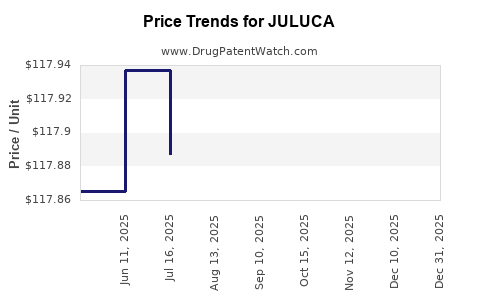
  • What is Average Wholesale Price for JULUCA?
DrugPatentWatch® Estimated Loss of Exclusivity (LOE) Date for JULUCA
Generic Entry Date for JULUCA*:
Constraining patent/regulatory exclusivity:
NDA:
Dosage:

TABLET;ORAL

*The generic entry opportunity date is the latter of the last compound-claiming patent and the last regulatory exclusivity protection. Many factors can influence early or later generic entry. This date is provided as a rough estimate of generic entry potential and should not be used as an independent source.

Recent Clinical Trials for JULUCA

Identify potential brand extensions & 505(b)(2) entrants

SponsorPhase
ViiV HealthcarePhase 1/Phase 2
Janssen Research & Development, LLCPhase 1/Phase 2
Indiana UniversityPhase 4

See all JULUCA clinical trials

Paragraph IV (Patent) Challenges for JULUCA
Tradename Dosage Ingredient Strength NDA ANDAs Submitted Submissiondate
JULUCA Tablets dolutegravir sodium; rilpivirine hydrochloride 50 mg/25 mg 210192 1 2019-11-19

US Patents and Regulatory Information for JULUCA

JULUCA is protected by four US patents.

Based on analysis by DrugPatentWatch, the earliest date for a generic version of JULUCA is ⤷  Start Trial.

This potential generic entry date is based on patent ⤷  Start Trial.

Generics may enter earlier, or later, based on new patent filings, patent extensions, patent invalidation, early generic licensing, generic entry preferences, and other factors.

Applicant Tradename Generic Name Dosage NDA Approval Date TE Type RLD RS Patent No. Patent Expiration Product Substance Delist Req. Exclusivity Expiration
Viiv Hlthcare JULUCA dolutegravir sodium; rilpivirine hydrochloride TABLET;ORAL 210192-001 Nov 21, 2017 RX Yes Yes ⤷  Start Trial ⤷  Start Trial Y Y ⤷  Start Trial
Viiv Hlthcare JULUCA dolutegravir sodium; rilpivirine hydrochloride TABLET;ORAL 210192-001 Nov 21, 2017 RX Yes Yes ⤷  Start Trial ⤷  Start Trial Y ⤷  Start Trial
>Applicant >Tradename >Generic Name >Dosage >NDA >Approval Date >TE >Type >RLD >RS >Patent No. >Patent Expiration >Product >Substance >Delist Req. >Exclusivity Expiration

Expired US Patents for JULUCA

International Patents for JULUCA

When does loss-of-exclusivity occur for JULUCA?

Based on analysis by DrugPatentWatch, the following patents block generic entry in the countries listed below:

Argentina

Patent: 2213
Estimated Expiration: ⤷  Start Trial

Australia

Patent: 18291076
Estimated Expiration: ⤷  Start Trial

Brazil

Patent: 2019027915
Estimated Expiration: ⤷  Start Trial

Canada

Patent: 67147
Estimated Expiration: ⤷  Start Trial

Chile

Patent: 19003889
Estimated Expiration: ⤷  Start Trial

China

Patent: 0958883
Estimated Expiration: ⤷  Start Trial

European Patent Office

Patent: 45003
Estimated Expiration: ⤷  Start Trial

Israel

Patent: 1555
Patent: שילוב שימושים וטיפולים שלו (Combination and uses and treatments thereof)
Estimated Expiration: ⤷  Start Trial

Japan

Patent: 87906
Estimated Expiration: ⤷  Start Trial

Patent: 20525520
Patent: 組み合わせ並びにその使用及びそれによる治療
Estimated Expiration: ⤷  Start Trial

Mexico

Patent: 2599
Patent: COMPRIMIDOS BICAPA QUE COMPRENDEN DOLUTEGRAVIR SÓDICO Y CLORHIDRATO DE RILPIVIRINA (COMBINATION AND USES AND TREATMENTS THEREOF)
Estimated Expiration: ⤷  Start Trial

Russian Federation

Patent: 55710
Estimated Expiration: ⤷  Start Trial

Patent: 19140298
Patent: Комбинация, ее применение и способы лечения с использованием указанной комбинации (COMBINATION, ITS APPLICATION AND METHODS FOR TREATMENT USING SPECIFIED COMBINATION)
Estimated Expiration: ⤷  Start Trial

South Africa

Patent: 1908222
Patent: COMBINATION AND USES AND TREATMENTS THEREOF
Estimated Expiration: ⤷  Start Trial

South Korea

Patent: 2722927
Estimated Expiration: ⤷  Start Trial

Patent: 200024259
Patent: 조합물 및 이의 용도 및 치료
Estimated Expiration: ⤷  Start Trial

Taiwan

Patent: 1919586
Patent: Combination and uses and treatments thereof
Estimated Expiration: ⤷  Start Trial

Patent: 30703
Estimated Expiration: ⤷  Start Trial

United Kingdom

Patent: 1717131
Estimated Expiration: ⤷  Start Trial

Patent: 1719377
Estimated Expiration: ⤷  Start Trial

Patent: 1806490
Estimated Expiration: ⤷  Start Trial

Generics may enter earlier, or later, based on new patent filings, patent extensions, patent invalidation, early generic licensing, generic entry preferences, and other factors.

See the table below for additional patents covering JULUCA around the world.

Country Patent Number Title Estimated Expiration
African Regional IP Organization (ARIPO) 3551 ⤷  Start Trial
Australia 2011209788 ⤷  Start Trial
Australia 2014202404 ⤷  Start Trial
Australia 2014202405 ⤷  Start Trial
Australia 2014202406 ⤷  Start Trial
Australia 2016204987 ⤷  Start Trial
>Country >Patent Number >Title >Estimated Expiration

Supplementary Protection Certificates for JULUCA

Patent Number Supplementary Protection Certificate SPC Country SPC Expiration SPC Description
1419152 C300529 Netherlands ⤷  Start Trial PRODUCT NAME: RILPIVIRINE, DESGEWENST IN DE VORM VAN EEN FARMACEUTISCH AANVAARDBAAR ADDITIEZOUT, IN HET BIJZONDER HET HYDROCHLORIDEZOUT; REGISTRATION NO/DATE: EU/1/11/736/001 20111128
1419152 C300532 Netherlands ⤷  Start Trial PRODUCT NAME: EEN COMBINATIE VAN RILPIVIRINE EN ELKE DOOR HET BASISOCTROOI BESCHERMDE THERAPEUTISCH EQUIVALENTE VORM DAARVAN,; REGISTRATION NO/DATE: EU/1/11/737/001-002 20111128
1419152 PA2012008 Lithuania ⤷  Start Trial PRODUCT NAME: RILPIVIRINUM; REGISTRATION NO/DATE: EU/1/11/736/001 20111128
1419152 PA2012009 Lithuania ⤷  Start Trial PRODUCT NAME: EMTRICITABINUM + RILPIVIRINUM + TENOFOVIRUM DISOPROXILUM; REGISTRATION NO/DATE: EU/1/11/737/001, 2011 11 28 EU/1/11/737/002 20111128
1419152 CA 2012 00021 Denmark ⤷  Start Trial
1419152 CA 2012 00019 Denmark ⤷  Start Trial
>Patent Number >Supplementary Protection Certificate >SPC Country >SPC Expiration >SPC Description

JULUCA Market Dynamics, Patent Exclusivity, and Financial Trajectory

Last updated: October 27, 2026

JULUCA, ViiV Healthcare’s two-drug HIV regimen containing dolutegravir and rilpivirine, has established a durable niche in treatment-experienced adults with virologically suppressed HIV-1. Its commercial profile differs from newer long-acting products such as CABENUVA: JULUCA offers once-daily oral dosing, a lower pill burden than three-drug regimens, and a mature safety record, but it competes against DOVATO, generic single-agent components, and injectable treatment.

JULUCA’s principal commercial risk is gradual substitution within ViiV’s own portfolio rather than an immediate generic cliff. DOVATO offers a broader treatment position for many patients, while CABENUVA targets patients seeking less frequent dosing. JULUCA remains relevant for patients already suppressed on a stable regimen, but growth is constrained by its treatment-experienced label and the shift toward newer two-drug and long-acting therapies.

What is JULUCA and how does it work?

JULUCA is a fixed-dose combination tablet containing:

Component Drug class Strength per tablet
Dolutegravir Integrase strand transfer inhibitor 50 mg
Rilpivirine Non-nucleoside reverse transcriptase inhibitor 25 mg

The product is administered once daily with a meal. FDA approved JULUCA on November 21, 2017, for adults with HIV-1 who are virologically suppressed on a stable antiretroviral regimen, have no history of treatment failure, and have no known or suspected resistance to either component.[1]

The product’s clinical value is regimen simplification. Patients can move from a three-drug regimen to two active agents while maintaining viral suppression. The principal limitation is that JULUCA is not positioned as a broad first-line treatment for all newly diagnosed patients. Prior virologic suppression and the absence of resistance are central to its label.

What is the FDA regulatory status of JULUCA?

JULUCA is FDA approved and marketed in the United States. It is regulated as a small-molecule fixed-dose combination, not as a biologic. Biosimilar approval does not apply.

Key regulatory milestones are:

Event Date
FDA approval November 21, 2017
Active ingredients Dolutegravir and rilpivirine
Dosage form Oral tablet
Indication Virologically suppressed adults with HIV-1
Sponsor ViiV Healthcare
FDA pathway New drug application
Exclusivity type Combination-product regulatory exclusivity and patent protection

The European Commission authorized JULUCA in 2018 following a positive opinion from the European Medicines Agency.[2] The product is also marketed in other jurisdictions under ViiV Healthcare and GSK-associated commercial structures.

FDA approval does not create a separate regulatory category for a two-drug HIV tablet. Generic applicants would generally pursue an abbreviated new drug application if they could demonstrate pharmaceutical equivalence and bioequivalence.

What patents protect JULUCA?

JULUCA’s protection is layered across patents covering its active ingredients, pharmaceutical combinations, formulations, and potentially methods of treatment. The relevant patent estate is more complex than a single product patent because dolutegravir and rilpivirine were developed and patented separately before their combination was approved.

Core patent categories

Patent category Commercial relevance
Dolutegravir compound patents Protect the integrase inhibitor and core active ingredient
Rilpivirine compound patents Protect the reverse transcriptase inhibitor
Combination patents Cover use of dolutegravir with rilpivirine
Pharmaceutical composition patents Cover tablet composition, excipients, and dosage form
Method-of-use patents Cover treatment of HIV in defined patient populations
Manufacturing patents May restrict specific processes or intermediates

Dolutegravir was developed by ViiV and Shionogi. Rilpivirine was developed by Janssen. The commercial combination therefore involves an underlying IP history spanning multiple rights holders and licensing relationships.

Publicly available FDA labeling and patent records identify dolutegravir and rilpivirine as previously approved active ingredients, meaning JULUCA’s commercial exclusivity does not depend only on a new chemical entity patent. The combination may retain protection after earlier component patents expire if later-expiring combination or formulation rights remain enforceable.

A current Orange Book patent table should be used for definitive patent numbers, pediatric adjustments, and expiry calculations. Those entries can change through patent listing corrections, delistings, litigation outcomes, or statutory term adjustments.

When does JULUCA lose exclusivity?

JULUCA’s regulatory exclusivity began with its 2017 FDA approval, but the commercially important date is the latest enforceable patent expiry covering a proposed generic’s product or method of use.

The principal timing considerations are:

  1. Dolutegravir and rilpivirine component patents may expire on different dates.
  2. Combination and formulation patents may extend protection beyond component patents.
  3. Patent term adjustment and patent term extension can change the effective expiry date.
  4. Orange Book-listed method-of-use patents may require a generic applicant to submit a Paragraph IV certification or a section viii statement.
  5. A generic may design around some claims while still needing to address ingredient-related rights.

JULUCA therefore does not have a single reliable “loss of exclusivity” date based solely on the 2017 approval date. Five-year new chemical entity exclusivity is generally not available for a combination containing previously approved active ingredients. Three-year exclusivity may protect certain new clinical investigations supporting approval, but that period has already elapsed.

The commercial exposure is more likely to emerge through staged generic activity than through an immediate all-or-nothing loss of revenue. Separate generic dolutegravir and rilpivirine products can pressure treatment economics before a directly substitutable fixed-dose generic JULUCA product becomes available.

What is the Orange Book status of JULUCA?

JULUCA is an FDA-approved prescription drug whose relevant patent listings are evaluated through the Orange Book. Orange Book-listed patents can trigger certification requirements for abbreviated new drug applications.

A prospective generic applicant may file:

  • Paragraph I certification if no patent information is listed;
  • Paragraph II certification if the listed patent has expired;
  • Paragraph III certification if the applicant will wait until patent expiry;
  • Paragraph IV certification if the applicant believes the patent is invalid, unenforceable, or not infringed; or
  • A section viii statement for a method-of-use patent when the applicant seeks approval only for nonprotected uses.

A Paragraph IV filing can trigger patent litigation under the Hatch-Waxman Act. The filing generally gives the brand company 45 days to sue, and a timely suit can create a 30-month stay of FDA approval, subject to statutory exceptions and litigation developments.[3]

No biosimilar pathway applies to JULUCA. A competitor would need to establish generic equivalence to the fixed-dose tablet or use an alternative regulatory strategy for the individual components.

Which companies are challenging JULUCA?

There is no broadly reported, high-profile public patent challenge to JULUCA comparable to major litigation involving blockbuster small-molecule medicines. Generic manufacturers may still evaluate the product for Paragraph IV filing, but the public record does not establish a major active challenge that has materially changed the product’s U.S. launch timing.

Potential challengers would include large generic manufacturers with HIV manufacturing capability, such as Teva, Viatris, Sandoz, Sun Pharma, Cipla, or specialized antiretroviral suppliers. A direct generic would need to address:

  • Two active pharmaceutical ingredients;
  • Bioequivalence under fed conditions;
  • Food-effect requirements;
  • Tablet stability;
  • Drug-drug interaction considerations;
  • Patent claims covering the combination or formulation;
  • Commercial pricing in a highly managed HIV market.

The absence of a visible challenge does not eliminate generic risk. It can indicate that the addressable market, technical requirements, patent term, or expected launch economics do not yet justify litigation.

How strong is the JULUCA patent estate?

JULUCA has a moderate-to-strong protection profile at the product level but a less durable growth profile than a newly launched long-acting HIV medicine.

Strengths

  • Two active ingredients with established clinical utility.
  • ViiV control of dolutegravir commercialization.
  • Combination-product differentiation from individual generic components.
  • Treatment-experienced indication with an established patient base.
  • Potential formulation and method-of-use barriers.

Weaknesses

  • Both active ingredients were known before JULUCA approval.
  • Separate generic component products can erode pricing.
  • Fixed-dose combination claims may be narrower than compound claims.
  • Treatment population is narrower than the population addressed by broad first-line regimens.
  • Internal competition from DOVATO and CABENUVA can limit pricing power.

The strongest practical barrier is not necessarily a single patent claim. It is the interaction between patent rights, physician familiarity, payer contracting, and the technical requirement to reproduce a two-component tablet with appropriate pharmacokinetic performance.

What formulations are protected by JULUCA patents?

JULUCA is an oral immediate-release fixed-dose tablet. Formulation protection may cover:

  • The presence of dolutegravir and rilpivirine in defined amounts;
  • Excipients and tablet composition;
  • Dissolution characteristics;
  • Stability under storage conditions;
  • Manufacturing processes;
  • Product quality specifications.

The requirement to take JULUCA with a meal is commercially important. Food affects rilpivirine exposure, and proton-pump inhibitors are contraindicated because of acid-reducing effects. A generic formulation must meet the relevant bioequivalence requirements under the FDA’s product-specific expectations.

Formulation patents are more vulnerable than broad compound patents if a competitor can develop a noninfringing composition that delivers equivalent exposure. They still can delay or complicate direct substitution.

How is JULUCA performing financially?

ViiV and GSK report HIV performance at the franchise and product levels, but JULUCA is not generally disclosed with the same financial prominence as the largest HIV products. Its revenue profile has matured, with growth constrained by internal portfolio migration and the decline of older three-drug regimens.

The financial trajectory has four phases:

Phase Market effect
2017-2019 Rapid uptake among suppressed patients seeking two-drug simplification
2020-2021 Broader physician familiarity and expansion of maintenance therapy use
2022-2024 Maturity, with pressure from DOVATO and CABENUVA
2025 onward Gradual erosion risk from portfolio substitution and eventual generic competition

JULUCA remains economically valuable because HIV therapy produces recurring, prescription-based revenue. Patients who remain suppressed often continue therapy for years, creating lower volatility than acute-care medicines. Retention depends on tolerability, adherence, payer access, resistance history, and physician preference.

The product’s revenue ceiling is limited by its label. It is not interchangeable with every antiretroviral regimen, and many patients begin treatment with other ViiV products. DOVATO has a broader strategic role in two-drug therapy, while CABENUVA represents ViiV’s long-acting growth platform.

How does JULUCA compare with DOVATO and CABENUVA?

Product Active ingredients Dosing Strategic role Main competitive issue
JULUCA Dolutegravir/rilpivirine Daily oral Maintenance therapy in suppressed adults Narrower label and mature market
DOVATO Dolutegravir/lamivudine Daily oral Broader two-drug treatment option Internal substitution of JULUCA
CABENUVA Cabotegravir/rilpivirine Monthly or every two months after initiation Long-acting treatment Administration logistics and cost
Triumeq Dolutegravir/abacavir/lamivudine Daily oral Established three-drug regimen Declining use and abacavir considerations

JULUCA has a simpler value proposition than CABENUVA because it does not require clinic-administered injections. It also has a narrower treatment role than DOVATO. The product can therefore retain a stable base without becoming the dominant ViiV two-drug regimen.

What generic entry risks exist for JULUCA?

Generic entry would likely occur in stages.

Scenario 1: No direct fixed-dose generic

Generic manufacturers enter with separate dolutegravir and rilpivirine products. Physicians and payers use those products for selected patients, producing gradual price pressure without immediate automatic substitution to a generic JULUCA tablet.

Scenario 2: Paragraph IV challenge and delayed launch

A generic applicant challenges listed patents, triggering litigation and a potential 30-month stay. Settlement terms could authorize a launch before the latest patent expiry, potentially with a royalty or agreed entry date.

Scenario 3: Authorized generic or licensed competitor

ViiV or a commercial partner launches an authorized generic to retain formulary position and manage price erosion. This protects volume but reduces net price.

Scenario 4: Direct generic launch after patent expiry

A therapeutically equivalent fixed-dose tablet enters once regulatory and patent barriers are cleared. Net sales could decline sharply, although the existing patient base may slow initial switching.

A direct generic is most likely to affect price before it eliminates volume. HIV treatment is heavily influenced by formularies, government programs, rebates, and treatment guidelines. Payers may favor individual generic components if their combined cost is materially below the branded product.

What licensing deals affect JULUCA?

JULUCA reflects multiple underlying rights and commercial relationships:

  • Dolutegravir was developed through ViiV Healthcare and Shionogi collaboration.
  • Rilpivirine originated with Janssen Pharmaceuticals.
  • ViiV commercializes the fixed-dose combination under its HIV portfolio.
  • Regional commercialization and supply arrangements can vary by jurisdiction.

These relationships matter because patent enforcement, royalty obligations, and manufacturing rights may differ by country. They also affect the economics of any settlement or authorized-generic strategy.

What is the geographic coverage of JULUCA?

JULUCA is marketed in the United States, European Union, and other international markets. Patent terms are jurisdiction-specific. A U.S. Paragraph IV filing has no direct legal effect on European, Canadian, Japanese, or emerging-market exclusivity.

The most important variables by geography are:

  • National patent term and supplementary protection rights;
  • Regulatory data exclusivity;
  • Local compulsory-license rules;
  • Tender-based procurement;
  • Government HIV treatment programs;
  • Availability of generic dolutegravir and rilpivirine;
  • Local manufacturing requirements.

Emerging markets may experience generic competition earlier because component products can be supplied through public-health channels or voluntary licensing mechanisms. High-income markets are more likely to preserve branded pricing until patent and regulatory barriers are exhausted.

What manufacturing and intellectual-property barriers protect JULUCA?

JULUCA requires reliable co-formulation of two active ingredients with different physicochemical and pharmacokinetic characteristics. Manufacturing barriers include:

  • Sourcing both active pharmaceutical ingredients;
  • Controlling dose uniformity;
  • Achieving acceptable dissolution for both components;
  • Maintaining stability during shelf life;
  • Demonstrating fed-state bioequivalence;
  • Managing cross-contamination and quality controls;
  • Meeting country-specific HIV product standards.

These barriers are meaningful but not insurmountable for established generic manufacturers. They are more likely to delay entry or reduce the number of competitors than to prevent competition permanently.

What litigation and settlement risks affect JULUCA?

The key legal risks are future Orange Book litigation, patent-term disputes, and settlement agreements with generic applicants. A settlement could produce:

  • An agreed generic entry date;
  • A royalty-bearing license;
  • Restrictions on dosage forms or indications;
  • An authorized-generic arrangement;
  • A waiver of claims in selected jurisdictions.

No major public settlement currently defines JULUCA’s U.S. commercial outlook. The absence of a settlement leaves the launch date dependent on listed patent expiry, future challenges, and FDA review.

Key Takeaways

  • JULUCA is a once-daily dolutegravir/rilpivirine tablet approved for virologically suppressed adults with HIV-1.
  • Its main commercial strength is durable maintenance use and regimen simplification.
  • Its main weakness is internal competition from DOVATO and CABENUVA.
  • JULUCA is a small-molecule product, so biosimilar risk does not apply.
  • Generic risk will likely emerge first through separate dolutegravir and rilpivirine products.
  • The product’s effective loss-of-exclusivity date depends on Orange Book listings, combination patents, formulation rights, and patent-term adjustments.
  • No major public Paragraph IV litigation or settlement currently defines the product’s U.S. outlook.
  • Revenue is likely to mature gradually rather than collapse immediately, unless a direct fixed-dose generic launches with strong formulary access.
  • The patent estate is more defensible as a layered combination and formulation portfolio than as a single new-chemical-entity franchise.

FAQs

Is JULUCA being discontinued?

No. JULUCA remains an approved and marketed HIV treatment. Its mature status does not indicate discontinuation.

Can patients take generic dolutegravir and rilpivirine instead of JULUCA?

Separate generic components may be clinically usable in appropriate patients, but substitution depends on physician judgment, product labeling, payer rules, dosing, food requirements, and resistance history.

Does JULUCA have a biosimilar competitor?

No. JULUCA is a small-molecule fixed-dose combination, so any direct competitor would generally follow a generic drug pathway rather than the biosimilar pathway.

Is JULUCA stronger than DOVATO?

Neither product is universally superior. JULUCA contains rilpivirine and is labeled for virologically suppressed adults, while DOVATO contains lamivudine and has a broader treatment role. Patient history, resistance, renal function, drug interactions, and treatment goals determine selection.

What would cause the fastest JULUCA revenue decline?

The fastest decline would result from a direct fixed-dose generic launch combined with payer-preferred formulary placement, aggressive discounting, and continued migration to DOVATO or CABENUVA.

References

  1. U.S. Food and Drug Administration. (2017). JULUCA (dolutegravir and rilpivirine) prescribing information. FDA.

  2. European Medicines Agency. (2018). Juluca: EPAR - product information. EMA.

  3. U.S. Food and Drug Administration. (n.d.). ANDA submissions - paragraph IV certifications. FDA.

  4. GSK plc. (2024). Annual report 2023. GSK.

  5. ViiV Healthcare. (2024). HIV medicines and product information. ViiV Healthcare.

More… ↓

⤷  Start Trial

Make Better Decisions: Try a trial or see plans & pricing

Drugs may be covered by multiple patents or regulatory protections. All trademarks and applicant names are the property of their respective owners or licensors. Although great care is taken in the proper and correct provision of this service, thinkBiotech LLC does not accept any responsibility for possible consequences of errors or omissions in the provided data. The data presented herein is for information purposes only. There is no warranty that the data contained herein is error free. We do not provide individual investment advice. This service is not registered with any financial regulatory agency. The information we publish is educational only and based on our opinions plus our models. By using DrugPatentWatch you acknowledge that we do not provide personalized recommendations or advice. thinkBiotech performs no independent verification of facts as provided by public sources nor are attempts made to provide legal or investing advice. Any reliance on data provided herein is done solely at the discretion of the user. Users of this service are advised to seek professional advice and independent confirmation before considering acting on any of the provided information. thinkBiotech LLC reserves the right to amend, extend or withdraw any part or all of the offered service without notice.