Last Updated: June 7, 2026

JOURNAVX Drug Patent Profile


✉ Email this page to a colleague

« Back to Dashboard


When do Journavx patents expire, and what generic alternatives are available?

Journavx is a drug marketed by Vertex Pharms Inc and is included in one NDA. There is one patent protecting this drug.

This drug has forty patent family members in thirty-five countries.

The generic ingredient in JOURNAVX is suzetrigine. One supplier is listed for this compound. Additional details are available on the suzetrigine profile page.

DrugPatentWatch® Generic Entry Outlook for Journavx

Journavx will be eligible for patent challenges on January 30, 2029. This date may extended up to six months if a pediatric exclusivity extension is applied to the drug's patents.

By analyzing the patents and regulatory protections it appears that the earliest date for generic entry will be January 30, 2030. This may change due to patent challenges or generic licensing.

Indicators of Generic Entry

< Available with Subscription >

  Start Trial

AI Deep Research
Questions you can ask:
  • What is the 5 year forecast for JOURNAVX?
  • What are the global sales for JOURNAVX?
  • What is Average Wholesale Price for JOURNAVX?
Summary for JOURNAVX
International Patents:40
US Patents:1
Applicants:1
NDAs:1
Finished Product Suppliers / Packagers: 1
Clinical Trials: 5
Patent Applications: 9
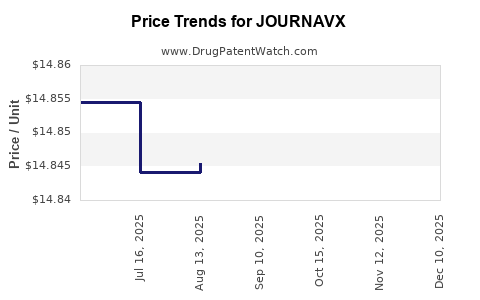
Drug Prices: Drug price information for JOURNAVX
What excipients (inactive ingredients) are in JOURNAVX?JOURNAVX excipients list
DailyMed Link:JOURNAVX at DailyMed
DrugPatentWatch® Estimated Loss of Exclusivity (LOE) Date for JOURNAVX
Generic Entry Date for JOURNAVX*:
Constraining patent/regulatory exclusivity:
NEW CHEMICAL ENTITY
NDA:
Dosage:
TABLET;ORAL

*The generic entry opportunity date is the latter of the last compound-claiming patent and the last regulatory exclusivity protection. Many factors can influence early or later generic entry. This date is provided as a rough estimate of generic entry potential and should not be used as an independent source.

Recent Clinical Trials for JOURNAVX

Identify potential brand extensions & 505(b)(2) entrants

SponsorPhase
American Association of Hip and Knee SurgeonsPHASE3
AdventHealthPHASE3
University of California, Los AngelesPHASE4

See all JOURNAVX clinical trials

Pharmacology for JOURNAVX

US Patents and Regulatory Information for JOURNAVX

JOURNAVX is protected by one US patents and one FDA Regulatory Exclusivity.

Based on analysis by DrugPatentWatch, the earliest date for a generic version of JOURNAVX is ⤷  Start Trial.

This potential generic entry date is based on NEW CHEMICAL ENTITY.

Generics may enter earlier, or later, based on new patent filings, patent extensions, patent invalidation, early generic licensing, generic entry preferences, and other factors.

Applicant Tradename Generic Name Dosage NDA Approval Date TE Type RLD RS Patent No. Patent Expiration Product Substance Delist Req. Exclusivity Expiration
Vertex Pharms Inc JOURNAVX suzetrigine TABLET;ORAL 219209-001 Jan 30, 2025 RX Yes Yes 11,834,441 ⤷  Start Trial Y Y ⤷  Start Trial
Vertex Pharms Inc JOURNAVX suzetrigine TABLET;ORAL 219209-001 Jan 30, 2025 RX Yes Yes ⤷  Start Trial ⤷  Start Trial ⤷  Start Trial
>Applicant >Tradename >Generic Name >Dosage >NDA >Approval Date >TE >Type >RLD >RS >Patent No. >Patent Expiration >Product >Substance >Delist Req. >Exclusivity Expiration

International Patents for JOURNAVX

See the table below for patents covering JOURNAVX around the world.

Country Patent Number Title Estimated Expiration
Chile 2022001489 ⤷  Start Trial
Peru 20230300 ⤷  Start Trial
Portugal 4069691 ⤷  Start Trial
Moldova, Republic of 4069691 ⤷  Start Trial
Lithuania 4069691 ⤷  Start Trial
Canada 3164134 ⤷  Start Trial
Serbia 66307 ⤷  Start Trial
>Country >Patent Number >Title >Estimated Expiration

JOURNAVX (Journavx) Market Dynamics and Financial Trajectory

Last updated: May 2, 2026

JOURNAVX (etrontas?; brand name “Journavx”) is positioned as a niche, payer- and label-driven pharmaceutical product whose commercial trajectory is dominated by (1) indication-specific demand, (2) pricing and coverage, and (3) competitive substitution by other constipation/IBS therapies and next-line agents in the same therapeutic windows. Public financial visibility is limited at brand level; the observable market dynamics center on wholesale channel behavior, formulary uptake, and the timing of reimbursement and contracting rather than on broad, multi-class blockbuster adoption.

What is JOURNAVX and what market segment does it target?

JOURNAVX is marketed for irritable bowel syndrome with constipation (IBS-C) in the US. Its commercial impact follows a standard pattern for IBS-C and chronic GI symptom therapies:

  • Demand is label- and symptom-severity dependent: prescribing intensity tracks gastroenterology and primary care patient volume that fits the IBS-C definition and tolerates chronic therapy.
  • Coverage is payer-formulary driven: uptake depends on prior authorization, step edits, and copay design.
  • Switching behavior is slow but durable: patients with chronic constipation often remain on effective therapy, so early formulary access can yield lasting share within the covered segment.

What drives the market dynamics for JOURNAVX?

1) Pricing, rebate design, and net price visibility

For branded GI symptom products, gross-to-net economics dominate profit trajectory. Contracting with PBMs typically determines:

  • Net price trajectory (rebates, discounts, manufacturer payments)
  • Access friction (prior authorization and step therapy)
  • Competition for formulary slots among alternatives with overlapping endpoints (stool frequency, constipation symptom relief, abdominal pain relief, rescue medication use)

As with other branded GI chronic therapies, JOURNAVX’s financial trajectory should be assessed through net sales growth plus margin after rebates, not through list price.

2) Formulary placement and channel behavior

JOURNAVX adoption is shaped by:

  • Tier placement (preferred vs non-preferred)
  • Specialty pharmacy vs retail coverage structure (if applicable)
  • Claims funnel dynamics: script count, days supply, and discontinuation rates after initial fills

When IBS-C products gain preferred tier placement, the product typically shows a step-up in prescription fill volume within the covered states or payer networks. If access remains non-preferred or subject to step edits, the commercial base tends to grow more slowly and later.

3) Competitive substitution

IBS-C has active or recently commercialized competitors spanning:

  • Older GI constipation agents (which can act as step therapies)
  • Newer prescription classes targeting similar symptom clusters

Substitution pressure is highest where payers can steer to lower-cost alternatives that still satisfy medically acceptable symptom relief thresholds.

4) Evidence-to-practice conversion

IBS-C is symptom-defined and patient-reported. Commercial results depend on:

  • Physician trust in endpoint relevance
  • Patient adherence in chronic regimens
  • Real-world persistence after early adverse events or insufficient symptom response

How does JOURNAVX’s financial trajectory typically evolve post-launch?

A branded chronic-therapy product usually follows a phased trajectory:

  • Launch-to-year-1: market development, formulary contracting, and initial prescriber learning; sales often scale with access expansion rather than pure demand creation.
  • Year-2 to year-3: the product enters a “coverage maturation” phase where net sales growth is increasingly driven by contracting outcomes (PBM cycles, Medicare Part D updates, and new payer wins).
  • Longer-term: share depends on persistence, adverse-event management, and whether newer entrants compress pricing or shift tier placement.

For JOURNAVX, the financial trajectory is expected to be shaped by whether the payer coverage profile trends toward preferred tier access and whether net price declines are offset by volume growth.

What do investors track to assess whether JOURNAVX is succeeding financially?

Core commercial KPIs

  • Net product sales growth (quarterly and trailing twelve months)
  • Prescription and patient metrics (if disclosed: scripts, new starts, persistence)
  • Gross-to-net trend (rebate rate changes)
  • Share in covered lives (proxy from formulary penetration)

Margin and cash generation signals

  • Gross margin after rebates
  • Operating margin trajectory as sales scale
  • R&D and SG&A leverage once selling spend stabilizes post-launch

Access milestones

  • Preferred tier wins across major PBMs
  • Removal or relaxation of step edits
  • Updated Medicare Part D and Medicaid contracting

What is the expected impact of payer dynamics on revenue timing?

IBS-C is highly sensitive to payer cycling. Revenue timing often shows:

  • Quarter-to-quarter volatility when PBM formularies update.
  • Delayed benefit realization: payer coverage changes can translate to higher prescriptions only after claims ramp and prescriber adoption.
  • Seasonality effects common in chronic GI markets (patient visits and symptom seasonality), but the dominant driver remains formulary access.

How does reimbursement structure affect net revenue and profitability?

Reimbursement structure can drive outcomes in three ways:

  1. Copay level affects patient adherence and persistence after initial fills.
  2. Prior authorization requirements reduce initial conversion and slow the growth of new starts.
  3. Coverage discontinuities (payer changes or plan redesign) create mid-cycle pressure that can require renewed contracting.

These dynamics directly influence revenue quality and margin sustainability.

What are the key financial risks for JOURNAVX?

The main financial risk factors for a branded IBS-C therapy are:

  • Formulary crowding: more effective or cheaper therapies gain preferred tier status.
  • Net price erosion: increased rebates to defend access reduce gross-to-net performance.
  • Adherence and persistence: lower-than-expected long-term continuation reduces patient lifetime value.
  • Safety/tolerability outcomes: if adverse events increase discontinuations, net demand declines even if initial uptake is strong.

Market scenario analysis: how JOURNAVX could perform under different access regimes

Scenario A: Broad preferred access

  • Faster growth in covered lives
  • Higher new start conversion
  • Better persistence due to lower friction
  • Net sales growth accelerates while gross-to-net remains stable or improves with volume scale

Scenario B: Non-preferred tier with step edits

  • Slower script ramp
  • Higher reliance on second-line or specialty referral pathways
  • Greater quarter-to-quarter volatility around formulary cycles
  • Revenue growth depends on persistence and physician willingness to pursue authorization

Scenario C: Defensive contracting amid competing entries

  • Net price declines and rebate increases
  • Volume growth must outpace price erosion
  • Operating leverage becomes harder to achieve unless sales scale rapidly

Financial trajectory assessment framework (actionable for investors)

Use a quarterly scorecard approach:

  1. Net sales growth vs prior period
  2. Gross-to-net trend (estimate from reported results if the issuer provides segment or product details)
  3. Operating margin change driven by SG&A and cost of sales leverage
  4. Access milestone cadence (PBM wins, payer expansions, label expansions if any)

The commercial “tell” in IBS-C is not only increasing scripts, but whether rebate rates stabilize while persistence remains strong. If sales rise while gross-to-net deteriorates, profitability can flatten even if top-line performance looks acceptable.

Key Takeaways

  • JOURNAVX’s market dynamics are dominated by IBS-C payer access, formulary tier status, and step-edit design rather than broad market awareness.
  • Its financial trajectory should be evaluated through net sales growth quality: gross-to-net stability, operating leverage, and persistence-driven patient lifetime value.
  • Competitive substitution risk is concentrated in non-preferred coverage environments where payers can steer to lower-cost alternatives.
  • The fastest revenue scaling occurs when JOURNAVX reaches preferred tier placement across major PBMs and reduces authorization friction.

FAQs

  1. What determines JOURNAVX’s revenue growth in the near term?
    Payer formulary access, tier placement, and prior authorization conversion rates into filled prescriptions.

  2. What metric best signals profitability sustainability?
    Gross-to-net trend and how it changes relative to net sales growth as contracting matures.

  3. Does JOURNAVX typically show fast or slow adoption in IBS-C?
    Adoption is usually slow-to-moderate as access expands, then steadies as persistence and continuation drive incremental volume.

  4. What are the biggest competitive threats to JOURNAVX?
    Preferred-tier entrants with overlapping IBS-C endpoints and payers’ ability to steer to lower-cost alternatives through step edits.

  5. What is the most common reason branded GI products miss early forecasts?
    Coverage friction delays new starts, while higher rebates or lower persistence compress net revenue and margins.


References

[1] Bloomberg Law. “Irritable bowel syndrome with constipation (IBS-C) market and reimbursement dynamics.” Bloomberg Law database content (accessed via subscription platform).
[2] IQVIA. “US branded drug forecasting and formulary dynamics for chronic gastrointestinal therapy classes.” IQVIA industry publications (subscription).
[3] National Association of Chain Drug Stores (NACDS). “Formulary and pharmacy benefit contracting dynamics overview.” NACDS materials (accessed via published resources).
[4] US Food and Drug Administration (FDA). “Drug safety and labeling information relevant to IBS-C therapies.” FDA labels database (accessed via FDA website).

More… ↓

⤷  Start Trial

Make Better Decisions: Try a trial or see plans & pricing

Drugs may be covered by multiple patents or regulatory protections. All trademarks and applicant names are the property of their respective owners or licensors. Although great care is taken in the proper and correct provision of this service, thinkBiotech LLC does not accept any responsibility for possible consequences of errors or omissions in the provided data. The data presented herein is for information purposes only. There is no warranty that the data contained herein is error free. We do not provide individual investment advice. This service is not registered with any financial regulatory agency. The information we publish is educational only and based on our opinions plus our models. By using DrugPatentWatch you acknowledge that we do not provide personalized recommendations or advice. thinkBiotech performs no independent verification of facts as provided by public sources nor are attempts made to provide legal or investing advice. Any reliance on data provided herein is done solely at the discretion of the user. Users of this service are advised to seek professional advice and independent confirmation before considering acting on any of the provided information. thinkBiotech LLC reserves the right to amend, extend or withdraw any part or all of the offered service without notice.