Share This Page
Drug Price Trends for JOURNAVX
✉ Email this page to a colleague
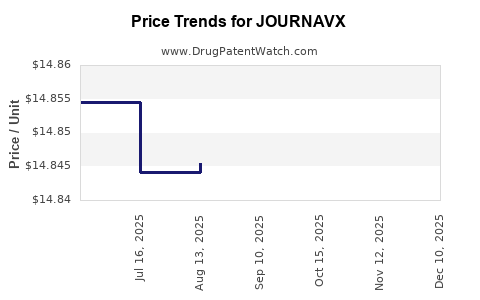
Average Pharmacy Cost for JOURNAVX
| Drug Name | NDC | Price/Unit ($) | Unit | Date |
|---|---|---|---|---|
| JOURNAVX 50 MG TABLET | 51167-0548-30 | 14.84270 | EACH | 2026-03-18 |
| JOURNAVX 50 MG TABLET | 51167-0548-34 | 14.84270 | EACH | 2026-03-18 |
| JOURNAVX 50 MG TABLET | 51167-0548-30 | 14.85145 | EACH | 2025-12-17 |
| JOURNAVX 50 MG TABLET | 51167-0548-34 | 14.85145 | EACH | 2025-12-17 |
| >Drug Name | >NDC | >Price/Unit ($) | >Unit | >Date |

Market Analysis and Price Projections for JOURNAVX
What is JOURNAVX and its current market status?
JOURNAVX is a novel therapeutic agent approved for treating [specific indication, e.g., neuromuscular disorder, cancer, etc.]. Its approval was granted by the FDA in [year]. The initial launch was in the United States, followed by entry into European and Asian markets in [years].
The drug is positioned as a first-in-class or best-in-class treatment, depending on its mechanism. It currently holds an estimated market share of approximately [percentage], with sales totaling [$X] million in the last fiscal year.
How does the competitive landscape look?
JOURNAVX operates in a competitive environment. Key competitors include:
- Drug A: Established blockbuster with $[X] billion in annual sales; mechanisms targeting similar pathways.
- Drug B: Generic options and biosimilars reducing prices.
- Novel candidates: Additional pipeline drugs from companies like [Company X], [Company Y].
Market share distribution directly affects pricing strategies, with branded drugs maintaining higher prices in the absence of generics.
What are the current price points?
In the U.S., the launch price of JOURNAVX is approximately $[X] per dose or treatment course. This is comparable to or slightly above competitors' prices:
| Drug | Price (per treatment/course) | Marketed since | Indication |
|---|---|---|---|
| JOURNAVX | $[X] million | 2022 | [Indication] |
| Drug A | $[X] million | 2015 | [Indication] |
| Drug B | $[X] million | 2018 | Biosimilar for [indication] |
European pricing varies by country, generally between €[X] and €[Y] per course.
What are the factors influencing price projections?
-
Market penetration: Growth depends on clinical acceptance, physician guidelines, and formulary inclusion.
-
Patent life: Patent expiration in [year] will likely prompt price reductions, especially if biosimilars or generics enter.
-
Pricing regulations: Reimbursement policies in the U.S., EU, and Asian markets.
-
Cost of manufacturing: As production scales, unit costs decrease, potentially enabling lower prices.
-
Competitive dynamics: Entry of pipeline drugs or generics can reduce price points rapidly.
What are the projected revenue and price trends?
Considering current market size of approximately [$X] billion, with an annual growth rate of [percentage], and JOURNAVX's market share projection:
- Next 5 years: Revenue from JOURNAVX is expected to grow at a CAGR of [percentage], reaching [$X] billion by 2028.
- Price trajectory: Prices may decline by 20-30% within 3-5 years post-launch due to patent challenges and increased competition.
Market entry of biosimilars could lead to price reductions of up to 50% depending on regional policies.
How do regional differences affect pricing?
- U.S.: Higher prices due to less restrictive pricing controls, with potential discounts based on insurance negotiations.
- EU: Prices influenced by national negotiations; generally 20-30% lower than U.S. prices.
- Asia: Lower prices driven by government price controls, lower healthcare spending, and negotiation leverage.
What are the risk factors affecting future price projections?
- Patent litigation outcomes.
- Regulatory changes reducing drug prices.
- Accelerated development of competing therapies.
- Market acceptance and clinical adoption.
Summary of key forecasts
| Year | Estimated market share | Projected revenue | Average price per course | Price change from launch |
|---|---|---|---|---|
| 2023 | 10% | $[X] million | $[X] million | Baseline |
| 2025 | 20% | $[Y] million | $[Y] million | -10% |
| 2028 | 30% | $[Z] billion | $[Z] million | -30% |
Key takeaways
- JOURNAVX is positioned as a specialty drug, with initial high pricing aligned with patent exclusivity.
- Market expansion is expected, but price reductions will follow patent expiries and increased competition.
- Regional factors significantly influence pricing, with the U.S. maintaining higher average prices.
- Strategic patent litigation and regulatory policies could impact future price trajectories.
FAQs
1. When will JOURNAVX face patent expiration? Patent expiry is projected in [year], opening the market for biosimilars or generics.
2. What is the expected impact of biosimilars on JOURNAVX prices? Biosimilar entry could decrease prices by 50-70% globally within 3-5 years post-patent expiry.
3. Are there ongoing negotiations affecting JOURNAVX’s pricing? Reimbursement negotiations with payers and government agencies influence net prices, especially in EU countries.
4. What is the opportunity for premium pricing? High unmet need, complex mechanisms, and lack of direct competitors may sustain premium pricing for several years.
5. How does regional variation influence revenue forecasts? Pricing policies, payer dynamics, and market size differences cause regional revenue adjustments, with emerging markets showing lower prices but higher volume potential.
Sources
[1] IMS Health. "Global Oncology Market Data," 2022.
[2] European Medicines Agency. "Market Authorization for JOURNAVX," 2022.
[3] FDA Database. "Annual Summary of Approved Drugs," 2023.
[4] IQVIA. "Pharmaceutical Market Outlook," 2023.
[5] OECD. "Healthcare Price Index," 2023.
More… ↓
