Share This Page
JANTOVEN Drug Patent Profile
✉ Email this page to a colleague
When do Jantoven patents expire, and when can generic versions of Jantoven launch?
Jantoven is a drug marketed by Upsher Smith Labs and is included in one NDA.
The generic ingredient in JANTOVEN is warfarin sodium. There is one drug master file entry for this compound. Nineteen suppliers are listed for this compound. Additional details are available on the warfarin sodium profile page.
DrugPatentWatch® Litigation and Generic Entry Outlook for Jantoven
A generic version of JANTOVEN was approved as warfarin sodium by TARO on July 15th, 1999.
AI Deep Research
Questions you can ask:
- What is the 5 year forecast for JANTOVEN?
- What are the global sales for JANTOVEN?
- What is Average Wholesale Price for JANTOVEN?
Summary for JANTOVEN
| US Patents: | 0 |
| Applicants: | 1 |
| NDAs: | 1 |
| Finished Product Suppliers / Packagers: | 1 |
| Raw Ingredient (Bulk) Api Vendors: | 1 |
| Clinical Trials: | 5 |
| Patent Applications: | 8,101 |
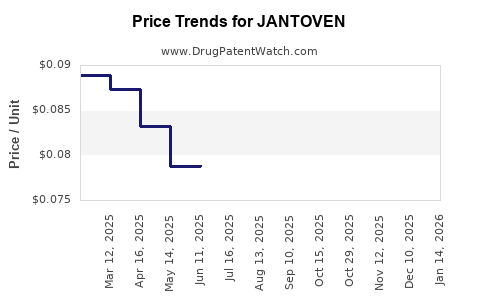
| Drug Prices: | Drug price information for JANTOVEN |
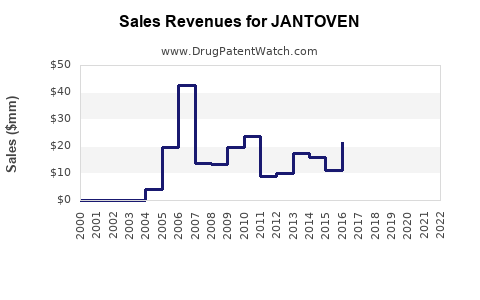
| Drug Sales Revenues: | Drug sales revenues for JANTOVEN |
| DailyMed Link: | JANTOVEN at DailyMed |
Recent Clinical Trials for JANTOVEN
Identify potential brand extensions & 505(b)(2) entrants
| Sponsor | Phase |
|---|---|
| Nicholas Carlson | Phase 4 |
| Danish Heart Foundation | Phase 4 |
| Daiichi Sankyo, Inc. | Phase 1 |
Pharmacology for JANTOVEN
| Drug Class | Vitamin K Antagonist |
| Mechanism of Action | Vitamin K Inhibitors |
US Patents and Regulatory Information for JANTOVEN
| Applicant | Tradename | Generic Name | Dosage | NDA | Approval Date | TE | Type | RLD | RS | Patent No. | Patent Expiration | Product | Substance | Delist Req. | Exclusivity Expiration |
|---|---|---|---|---|---|---|---|---|---|---|---|---|---|---|---|
| Upsher Smith Labs | JANTOVEN | warfarin sodium | TABLET;ORAL | 040416-001 | Oct 2, 2003 | AB | RX | No | No | ⤷ Start Trial | ⤷ Start Trial | ⤷ Start Trial | |||
| Upsher Smith Labs | JANTOVEN | warfarin sodium | TABLET;ORAL | 040416-007 | Oct 2, 2003 | AB | RX | No | No | ⤷ Start Trial | ⤷ Start Trial | ⤷ Start Trial | |||
| Upsher Smith Labs | JANTOVEN | warfarin sodium | TABLET;ORAL | 040416-004 | Oct 2, 2003 | AB | RX | No | No | ⤷ Start Trial | ⤷ Start Trial | ⤷ Start Trial | |||
| Upsher Smith Labs | JANTOVEN | warfarin sodium | TABLET;ORAL | 040416-008 | Oct 2, 2003 | AB | RX | No | No | ⤷ Start Trial | ⤷ Start Trial | ⤷ Start Trial | |||
| Upsher Smith Labs | JANTOVEN | warfarin sodium | TABLET;ORAL | 040416-002 | Oct 2, 2003 | AB | RX | No | No | ⤷ Start Trial | ⤷ Start Trial | ⤷ Start Trial | |||
| >Applicant | >Tradename | >Generic Name | >Dosage | >NDA | >Approval Date | >TE | >Type | >RLD | >RS | >Patent No. | >Patent Expiration | >Product | >Substance | >Delist Req. | >Exclusivity Expiration |
Jantoven is a mature warfarin sodium product with limited pricing power, no meaningful remaining patent exclusivity, and declining structural demand in the U.S. Its commercial value is supported by low-cost supply, established clinical use, anticoagulation-monitoring infrastructure, and demand from patients who cannot use direct oral anticoagulants (DOACs). Standalone Jantoven revenue is not publicly disclosed. The product’s financial trajectory is best assessed through warfarin market trends, manufacturer filings, reimbursement pressure, and substitution by Eliquis, Xarelto, Pradaxa, and Savaysa.
Jantoven Market Dynamics, Patent Status, Competition, and Financial Outlook
What is Jantoven and who manufactures it?
Jantoven is warfarin sodium, an oral vitamin K antagonist used to prevent and treat thromboembolic events. The product is marketed in the United States by Upsher-Smith Laboratories, a subsidiary of Sawai Pharmaceutical Co., Ltd. The product is supplied as tablets in multiple strengths, including 1 mg, 2 mg, 2.5 mg, 3 mg, 4 mg, 5 mg, 6 mg, 7.5 mg, and 10 mg presentations. FDA labeling identifies Jantoven as an anticoagulant requiring individualized dosing and regular INR monitoring (U.S. Food and Drug Administration [FDA], n.d.-a).
Jantoven is a branded generic rather than a protected innovative medicine. Its commercial positioning depends on reliable supply, product familiarity, formulary access, and manufacturing economics rather than patent exclusivity.
| Attribute | Jantoven profile |
|---|---|
| Active ingredient | Warfarin sodium |
| Therapeutic class | Vitamin K antagonist anticoagulant |
| Dosage form | Oral tablet |
| Primary U.S. marketer | Upsher-Smith Laboratories |
| Parent company | Sawai Pharmaceutical Co., Ltd. |
| FDA pathway | Abbreviated New Drug Application and legacy NDA product environment |
| Key monitoring requirement | INR testing |
| Primary competitors | Generic warfarin, Coumadin legacy supply, Eliquis, Xarelto, Pradaxa, Savaysa |
| Patent-driven exclusivity | No material remaining protection |
| Commercial stage | Mature, declining, low-price anticoagulant |
What is the FDA regulatory status of Jantoven?
Jantoven is FDA-approved for indications including prophylaxis and treatment of venous thrombosis and pulmonary embolism, reduction of thromboembolic complications associated with atrial fibrillation and cardiac valve replacement, and reduction of recurrent myocardial infarction risk in selected patients (FDA, n.d.-a).
The product has a narrow therapeutic index. Its label includes boxed warnings concerning major or fatal bleeding, the need for frequent coagulation testing, and the risk of tissue necrosis or gangrene in specific clinical circumstances. Drug interactions, dietary vitamin K intake, hepatic function, genetic factors, and changes in health status can materially alter anticoagulant response.
Jantoven’s FDA status does not create a current competitive barrier. Warfarin products have been available for decades, and FDA-approved generic competition is extensive. Regulatory value lies in maintaining compliant manufacturing, drug-supply continuity, labeling, and quality systems.
What FDA milestones shaped the Jantoven market?
| Period | Market development |
|---|---|
| 1950s | Warfarin enters clinical use as an oral anticoagulant |
| 1980s-1990s | Warfarin becomes a standard therapy for atrial fibrillation, venous thromboembolism, and mechanical valves |
| 2000s | Generic warfarin supply expands; INR-monitoring infrastructure becomes widespread |
| 2010 onward | DOACs gain adoption for nonvalvular atrial fibrillation and venous thromboembolism |
| 2010s-2020s | Warfarin remains important for mechanical heart valves, selected renal patients, cost-sensitive populations, and patients requiring measurable anticoagulation |
| Current market | Mature generic market with declining volume in several indications and continued niche demand |
What patents protect Jantoven?
No material active patent estate is generally associated with Jantoven’s commercial protection. Warfarin sodium is an old small-molecule active ingredient, and the principal composition-of-matter and clinical-use patents expired many years ago.
The relevant intellectual-property position is therefore different from that of a recently launched branded anticoagulant:
| IP category | Jantoven position |
|---|---|
| Active-ingredient patent | Expired |
| Core composition patent | Expired |
| Basic formulation patent | No meaningful current barrier |
| Method-of-use patents | Historical or non-blocking |
| Manufacturing know-how | Potentially relevant to quality and cost, but not a market exclusivity right |
| Orange Book patent protection | No commercially significant listed-patent barrier expected |
| Generic substitution barrier | None of patent significance |
The Orange Book lists FDA-approved products and, where applicable, patents and regulatory exclusivity. For a mature warfarin product, the commercial question is not whether a competitor can legally enter because of a patent. The question is whether a competitor can manufacture and distribute product profitably while meeting FDA quality requirements (FDA, n.d.-b).
What is the Orange Book status of Jantoven?
Jantoven does not have a patent-based Orange Book position comparable to protected products such as Eliquis or newer specialty medicines. Generic warfarin products can compete without waiting for a Jantoven patent expiration date.
Paragraph IV litigation is therefore not a meaningful current risk factor for Jantoven. A Paragraph IV certification is relevant when an ANDA applicant challenges a listed patent. Because warfarin’s central patent barriers expired long ago, market entry is generally governed by FDA approval, manufacturing capacity, supply economics, and commercial contracting.
No major current Paragraph IV litigation is required for a generic manufacturer to compete with warfarin products. The principal competitive activity is substitution among existing generic suppliers rather than patent-led entry.
When does Jantoven lose exclusivity?
Jantoven has already lost effective exclusivity. Warfarin sodium has been generic for decades, and multiple manufacturers supply the U.S. market. The product therefore has no identifiable future loss-of-exclusivity event comparable to a branded drug facing its first generic launch.
Jantoven exclusivity timeline
| Exclusivity factor | Status |
|---|---|
| New chemical entity exclusivity | Expired |
| Orphan-drug exclusivity | Not a current commercial protection |
| Pediatric exclusivity | Not a relevant current barrier |
| Data exclusivity | Expired |
| Composition-of-matter patent | Expired |
| Formulation exclusivity | No material current protection |
| Generic competition | Established |
| Future LOE event | None of commercial significance |
How does Jantoven compare with Eliquis and Xarelto?
Jantoven competes mainly on price and clinical suitability. Eliquis and Xarelto compete on convenience, reduced monitoring, predictable dosing, and strong clinical adoption in nonvalvular atrial fibrillation and venous thromboembolism.
| Factor | Jantoven | Eliquis | Xarelto |
|---|---|---|---|
| Active ingredient | Warfarin | Apixaban | Rivaroxaban |
| Mechanism | Vitamin K antagonist | Direct factor Xa inhibitor | Direct factor Xa inhibitor |
| Routine INR monitoring | Required | Not required | Not required |
| Generic availability | Broad | Emerging or jurisdiction-dependent, depending on market date | Emerging or jurisdiction-dependent, depending on market date |
| Use in mechanical valves | Established role | Not generally used | Not generally used |
| Price position | Low | High relative to warfarin | High relative to warfarin |
| Dose adjustment | INR-guided | Renal, age, weight, and interaction factors | Renal function and indication dependent |
| Main commercial advantage | Low acquisition cost and long clinical history | Convenience and broad guideline adoption | Convenience and broad indication base |
| Main commercial weakness | Monitoring, interactions, variable response | Cost and bleeding risk | Cost, bleeding risk, and dosing considerations |
The American College of Chest Physicians and other clinical bodies continue to recognize warfarin as important in situations where DOACs are unsuitable or not recommended. Mechanical heart valve patients are a major example. Warfarin also remains relevant for some patients with severe renal impairment, substantial drug interactions, cost constraints, or established INR-management arrangements (Kearon et al., 2016; Joglar et al., 2024).
Why is the warfarin market declining?
The core market pressure is therapeutic substitution. DOACs have replaced warfarin for many patients with nonvalvular atrial fibrillation and venous thromboembolism because they generally avoid routine INR monitoring and have more predictable pharmacokinetics.
Demand erosion has several drivers:
- DOAC guideline adoption in eligible atrial fibrillation patients.
- Greater physician and patient preference for fixed-dose oral therapy.
- Expansion of anticoagulation services tied to DOAC prescribing.
- Reduced tolerance for repeated INR visits and dietary restrictions.
- Commercial scale and marketing investment behind Eliquis and Xarelto.
- Hospital protocols that favor DOAC initiation for eligible patients.
The decline is not uniform. Warfarin remains comparatively strong in mechanical heart valve therapy, selected patients with advanced kidney disease, patients with cost-sensitive insurance coverage, and cases requiring a measurable and titratable anticoagulant effect.
What market segments continue to support Jantoven demand?
Mechanical heart valves
Warfarin remains the standard oral anticoagulant for patients with mechanical prosthetic valves. Direct factor Xa inhibitors are not substitutes for this population. This segment gives warfarin a durable clinical base that is less exposed to DOAC substitution.
Cost-sensitive patients
Jantoven and other generic warfarin products have a substantially lower acquisition cost than branded DOACs. Even where DOAC access has improved, copayments, deductibles, and formulary restrictions can preserve demand for warfarin.
Severe renal impairment
DOAC use requires product-specific renal assessment and dose management. Clinicians may select warfarin when renal function, dialysis status, or comorbidities complicate DOAC use.
Patients with stable INR management
Patients who have achieved stable anticoagulation through an anticoagulation clinic may resist switching. Existing monitoring systems, clinician familiarity, and long-term treatment continuity support retention.
Patients requiring measurable anticoagulation
Warfarin’s INR measurement gives clinicians a direct laboratory marker of anticoagulant effect. This remains useful when adherence is uncertain, drug interactions are complex, or rapid dose adjustment is required.
What are Jantoven’s revenue and financial prospects?
Upsher-Smith and Sawai do not generally report Jantoven revenue as a separate public line item. Public filings typically aggregate products or provide broader geographic and business-segment data. A precise standalone Jantoven revenue figure cannot be derived from those disclosures.
The financial trajectory is structurally mature:
| Financial driver | Expected effect on Jantoven |
|---|---|
| Unit demand | Downward in DOAC-exposed indications |
| Average selling price | Low and under pressure |
| Gross margin | Vulnerable to generic competition and manufacturing costs |
| Market share | Stable in protected clinical niches, declining elsewhere |
| Promotional spending | Limited relative to branded anticoagulants |
| Supply interruptions | Can temporarily improve demand and pricing |
| Manufacturing scale | Critical to preserving profitability |
| Revenue visibility | Low because product revenue is not separately disclosed |
| Long-term outlook | Declining or flat-to-down, with niche persistence |
Jantoven can remain profitable despite declining volume if manufacturing costs are low and supply remains reliable. The product does not require the commercial infrastructure of a new branded therapy, but it also lacks the pricing leverage of patented drugs.
The most important financial risk is not an abrupt patent cliff. It is gradual erosion in prescriptions, lower net pricing, and periodic margin compression from generic competition. The most important upside factor is continued demand in segments where DOACs are clinically inappropriate or economically inaccessible.
What generic entry risks exist for Jantoven?
Jantoven already faces generic entry rather than future generic-entry risk. Competitors can market warfarin sodium tablets after receiving FDA approval, subject to applicable regulatory requirements. The major risks are:
- additional low-cost manufacturers entering the market;
- contract and group-purchasing price reductions;
- pharmacy substitution away from the Jantoven label;
- manufacturing shutdowns or quality actions at competing suppliers;
- changes in hospital formularies;
- lower demand caused by DOAC adoption;
- limited ability to recover increased costs through price increases.
Generic warfarin is particularly sensitive to supply concentration. If one or more manufacturers exit, shortages can affect the market. A reliable supplier can gain temporary volume during shortages, but long-term pricing power remains limited because the underlying product is not patent protected.
What manufacturing and intellectual-property barriers affect Jantoven?
Jantoven has no substantial patent barrier, but manufacturing remains operationally important. Warfarin has a narrow therapeutic index, and tablet strength, content uniformity, dissolution, stability, and labeling accuracy are material quality considerations.
Manufacturing barriers include:
- validated API sourcing;
- control of tablet potency across multiple strengths;
- prevention of cross-contamination;
- compliance with current good manufacturing practices;
- reliable packaging and distribution;
- maintenance of FDA-approved specifications;
- management of supply across a broad strength portfolio.
These are execution barriers, not exclusionary IP rights. A company with strong manufacturing economics and regulatory compliance can compete without licensing Jantoven’s technology.
What patent litigation and settlement agreements affect Jantoven?
No major current patent litigation or settlement agreement is central to Jantoven’s market outlook. The absence of active patent protection means the product is not dependent on a negotiated generic-entry date.
The relevant legal exposure is more likely to involve:
- product liability and bleeding-related claims;
- manufacturing or quality enforcement;
- pricing and contracting disputes;
- supply obligations;
- pharmacy substitution and reimbursement policies.
This litigation profile differs from that of newer anticoagulants, where patent litigation, settlement agreements, and authorized generic strategies can determine launch timing.
How strong is the Jantoven patent estate?
Jantoven’s patent estate is weak from an exclusivity perspective because the active ingredient and core therapeutic use are long established. Its defensibility is operational rather than legal.
| Estate dimension | Assessment |
|---|---|
| Composition protection | None of current commercial value |
| Formulation protection | Limited or absent |
| Method-of-use protection | Not a meaningful market barrier |
| Manufacturing patents | Not publicly central to the product’s commercial position |
| Regulatory exclusivity | Expired |
| Brand recognition | Moderate among long-term warfarin prescribers |
| Clinical entrenchment | High in selected indications |
| Commercial defensibility | Low to moderate, based on supply and cost |
What geographic markets matter for Jantoven?
The U.S. remains important because of the size of the anticoagulation population and the continued use of warfarin in mechanical valves and cost-sensitive care. However, Jantoven is a U.S. brand, and its commercial performance should not be equated with global warfarin demand.
Warfarin remains widely used internationally, especially in health systems where generic drug cost is prioritized and INR-monitoring infrastructure is established. The growth of DOACs is also global, but adoption varies with reimbursement, access, clinical guidelines, and healthcare-system economics.
What are the likely generic launch scenarios for Jantoven?
Because generic competition is already established, launch scenarios concern incremental supply rather than first entry.
| Scenario | Market effect |
|---|---|
| Stable supplier base | Gradual volume decline and persistent price pressure |
| New low-cost entrant | Lower prices and potential share loss for branded generic products |
| Competitor shortage | Temporary volume recovery for available suppliers |
| DOAC reimbursement expansion | Faster warfarin decline in eligible patients |
| DOAC price pressure or access restrictions | Increased retention of warfarin in cost-sensitive segments |
| Manufacturing disruption at Jantoven supplier | Potential product-specific loss of prescriptions and substitution |
Key Takeaways
- Jantoven is a mature warfarin sodium product marketed by Upsher-Smith, part of Sawai Pharmaceutical.
- It has no meaningful remaining patent or regulatory exclusivity.
- Paragraph IV litigation and patent settlements are not material drivers of current market access.
- Revenue is not publicly reported as a standalone product figure.
- The market is declining in many atrial fibrillation and venous thromboembolism segments because of Eliquis, Xarelto, and other DOACs.
- Warfarin retains durable demand in mechanical heart valves, selected renal patients, cost-sensitive populations, and patients with stable INR management.
- Financial performance depends on manufacturing cost, supply reliability, reimbursement, and generic pricing rather than patent-protected price.
- Jantoven’s long-term outlook is flat-to-down, with persistent niche demand and limited opportunity for substantial price expansion.
FAQs About Jantoven Market and Financial Outlook
Is Jantoven still commercially relevant?
Yes. Its overall market is mature and declining, but warfarin remains clinically important for mechanical heart valves, selected patients with renal impairment, and patients who require low-cost anticoagulation.
Can generic manufacturers enter the Jantoven market?
Yes. Warfarin sodium is already widely genericized. Entry depends on FDA approval, manufacturing capability, and commercial economics rather than Jantoven patent expiry.
Does Jantoven compete directly with Eliquis?
Yes, but the products do not have identical clinical positioning. Eliquis is preferred for many eligible nonvalvular atrial fibrillation and venous thromboembolism patients, while warfarin remains important for mechanical valves and certain high-risk or cost-sensitive patients.
Is Jantoven included in the FDA Orange Book?
Jantoven is associated with FDA-approved product information, but it does not have a commercially meaningful active patent position comparable to newer branded anticoagulants. The Orange Book does not create a current patent-based barrier to generic warfarin competition.
What is the main investment risk for Jantoven?
The main risk is gradual revenue and margin erosion from DOAC substitution, generic price competition, and declining prescription volume. Supply reliability can support temporary share gains but is unlikely to create durable pricing power.
References
-
American College of Cardiology, American Heart Association, American College of Chest Physicians, Heart Rhythm Society, and Society of Thoracic Surgeons. (2024). 2023 ACC/AHA/ACCP/HRS guideline for the diagnosis and management of atrial fibrillation. Circulation.
-
FDA. (n.d.-a). Jantoven (warfarin sodium) tablets prescribing information. U.S. Food and Drug Administration.
-
FDA. (n.d.-b). Approved drug products with therapeutic equivalence evaluations: Orange Book. U.S. Food and Drug Administration.
-
Kearon, C., Akl, E. A., Ornelas, J., et al. (2016). Antithrombotic therapy for VTE disease: CHEST guideline and expert panel report. Chest, 149(2), 315-352.
-
Sawai Pharmaceutical Co., Ltd. (2024). Annual report and corporate disclosures. Tokyo, Japan: Sawai Pharmaceutical Co., Ltd.
-
Upsher-Smith Laboratories, LLC. (n.d.). Jantoven product information. Minneapolis, MN: Upsher-Smith Laboratories.
More… ↓
