INTRAROSA Drug Patent Profile
✉ Email this page to a colleague
Which patents cover Intrarosa, and what generic alternatives are available?
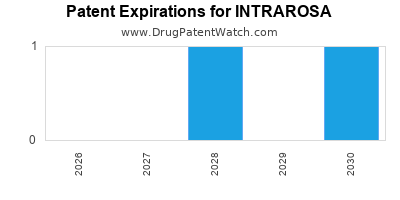
Intrarosa is a drug marketed by Millicent and is included in one NDA. There are three patents protecting this drug.
The generic ingredient in INTRAROSA is prasterone. There is one drug master file entry for this compound. One supplier is listed for this compound. Additional details are available on the prasterone profile page.
DrugPatentWatch® Generic Entry Outlook for Intrarosa
Intrarosa was eligible for patent challenges on November 16, 2020.
By analyzing the patents and regulatory protections it appears that the earliest date
for generic entry will be August 7, 2028. This may change due to patent challenges or generic licensing.
There have been two patent litigation cases involving the patents protecting this drug, indicating strong interest in generic launch. Recent data indicate that 63% of patent challenges are decided in favor of the generic patent challenger and that 54% of successful patent challengers promptly launch generic drugs.
Indicators of Generic Entry
AI Deep Research
Questions you can ask:
- What is the 5 year forecast for INTRAROSA?
- What are the global sales for INTRAROSA?
- What is Average Wholesale Price for INTRAROSA?
Summary for INTRAROSA
| US Patents: | 3 |
| Applicants: | 1 |
| NDAs: | 1 |
| Finished Product Suppliers / Packagers: | 1 |
| Raw Ingredient (Bulk) Api Vendors: | 76 |
| Clinical Trials: | 8 |
| Patent Applications: | 5,103 |
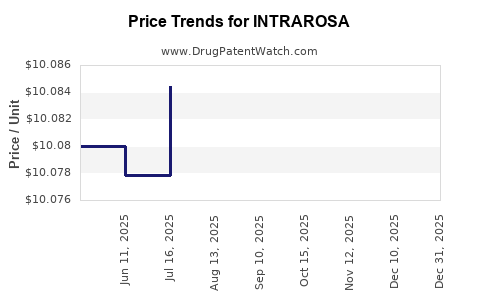
| Drug Prices: | Drug price information for INTRAROSA |
| Patent Litigation and PTAB cases: | See patent lawsuits and PTAB cases for INTRAROSA |
| What excipients (inactive ingredients) are in INTRAROSA? | INTRAROSA excipients list |
| DailyMed Link: | INTRAROSA at DailyMed |
DrugPatentWatch® Estimated Loss of Exclusivity (LOE) Date for INTRAROSA
Generic Entry Date for INTRAROSA*:
Constraining patent/regulatory exclusivity:
NDA:
Dosage:
INSERT;VAGINAL |
*The generic entry opportunity date is the latter of the last compound-claiming patent and the last regulatory exclusivity protection. Many factors can influence early or later generic entry. This date is provided as a rough estimate of generic entry potential and should not be used as an independent source.
Recent Clinical Trials for INTRAROSA
Identify potential brand extensions & 505(b)(2) entrants
| Sponsor | Phase |
|---|---|
| Lee's Pharmaceutical Limited | Phase 3 |
| AMAG Pharmaceuticals, Inc. | Phase 2 |
| University of Arkansas | Phase 2 |
US Patents and Regulatory Information for INTRAROSA
INTRAROSA is protected by three US patents.
Based on analysis by DrugPatentWatch, the earliest date for a generic version of INTRAROSA is ⤷ Start Trial.
This potential generic entry date is based on patent ⤷ Start Trial.
Generics may enter earlier, or later, based on new patent filings, patent extensions, patent invalidation, early generic licensing, generic entry preferences, and other factors.
| Applicant | Tradename | Generic Name | Dosage | NDA | Approval Date | TE | Type | RLD | RS | Patent No. | Patent Expiration | Product | Substance | Delist Req. | Exclusivity Expiration |
|---|---|---|---|---|---|---|---|---|---|---|---|---|---|---|---|
| Millicent | INTRAROSA | prasterone | INSERT;VAGINAL | 208470-001 | Nov 16, 2016 | RX | Yes | Yes | ⤷ Start Trial | ⤷ Start Trial | ⤷ Start Trial | ||||
| Millicent | INTRAROSA | prasterone | INSERT;VAGINAL | 208470-001 | Nov 16, 2016 | RX | Yes | Yes | ⤷ Start Trial | ⤷ Start Trial | Y | ⤷ Start Trial | |||
| Millicent | INTRAROSA | prasterone | INSERT;VAGINAL | 208470-001 | Nov 16, 2016 | RX | Yes | Yes | ⤷ Start Trial | ⤷ Start Trial | Y | ⤷ Start Trial | |||
| >Applicant | >Tradename | >Generic Name | >Dosage | >NDA | >Approval Date | >TE | >Type | >RLD | >RS | >Patent No. | >Patent Expiration | >Product | >Substance | >Delist Req. | >Exclusivity Expiration |
EU/EMA Drug Approvals for INTRAROSA
| Company | Drugname | Inn | Product Number / Indication | Status | Generic | Biosimilar | Orphan | Marketing Authorisation | Marketing Refusal |
|---|---|---|---|---|---|---|---|---|---|
| Endoceutics S.A. | Intrarosa | prasterone | EMEA/H/C/004138Intrarosa is indicated for the treatment of vulvar and vaginal atrophy in postmenopausal women having moderate to severe symptoms., | Authorised | no | no | no | 2018-01-08 | |
| >Company | >Drugname | >Inn | >Product Number / Indication | >Status | >Generic | >Biosimilar | >Orphan | >Marketing Authorisation | >Marketing Refusal |
International Patents for INTRAROSA
When does loss-of-exclusivity occur for INTRAROSA?
Based on analysis by DrugPatentWatch, the following patents block generic entry in the countries listed below:
Argentina
Patent: 8702
Patent: COMPOSICIONES FARMACEUTICAS
Estimated Expiration: ⤷ Start Trial
Patent: 4577
Patent: MÉTODOS PARA TRATAR O REDUCIR LA PROBABILIDAD DE ADQUIRIR SÍNTOMAS O ENFERMEDADES DEBIDAS A LA MENOPAUSIA
Estimated Expiration: ⤷ Start Trial
Patent: 4051
Patent: COMPOSICIONES FARMACÉUTICAS Y SUPOSITORIO VAGINAL
Estimated Expiration: ⤷ Start Trial
Australia
Patent: 08286651
Patent: DHEA compositions for treating menopause
Estimated Expiration: ⤷ Start Trial
Brazil
Patent: 0815353
Patent: Compoições e dhea para o tratamento da menopausa
Estimated Expiration: ⤷ Start Trial
Canada
Patent: 96127
Patent: COMPOSITIONS DE DHEA POUR TRAITER LA MENOPAUSE (DHEA COMPOSITIONS FOR TREATING MENOPAUSE)
Estimated Expiration: ⤷ Start Trial
Patent: 20566
Patent: COMPOSITIONS DE DHEA POUR TRAITER LA MENOPAUSE (DHEA COMPOSITIONS FOR TREATING MENOPAUSE)
Estimated Expiration: ⤷ Start Trial
Chile
Patent: 08002362
Patent: Composicion farmaceutica vaginal que comprende menor igual que 13 mg de dehidroepiandrosterona, sulfato de dehidroepiandrosterona, androst-5-en-3beta, 17 beta-diol o 4androsten-3, 17-diona y un excipiente; kit; uso para tratar sintomas menopausicos como incontinencia urinaria, vaginitis atrofica, sequedad vaginal, dispareunia y disfuncion sexual.
Estimated Expiration: ⤷ Start Trial
China
Patent: 1861152
Patent: DEHA compositions for treating menopause
Estimated Expiration: ⤷ Start Trial
Patent: 2861335
Patent: DHEA compositions for treating menopause
Estimated Expiration: ⤷ Start Trial
Patent: 5412121
Patent: DHEA compositions for treating menopause
Estimated Expiration: ⤷ Start Trial
Patent: 9893526
Patent: 治疗绝经期的DEHA组合物 (DHEA compositions for treating menopause)
Estimated Expiration: ⤷ Start Trial
Colombia
Patent: 60084
Patent: UNA COMPOSICION FARMACEUTICA QUE COMPRENDE UN PRECURSOR DE ESTEROIDE SEXUAL DE DESHIDROEPIANDROSTERONA (DHEA)
Estimated Expiration: ⤷ Start Trial
Costa Rica
Patent: 262
Patent: COMPOSICIONES DE DHEA PARA EL TRATAMIENTO DE LA MENOPAUSIA.
Estimated Expiration: ⤷ Start Trial
Denmark
Patent: 85157
Estimated Expiration: ⤷ Start Trial
Ecuador
Patent: 10010016
Patent: COMPOSICIONES DE DHEA PARA EL TRATAMIENTO DE LA MENOPAUSIA
Estimated Expiration: ⤷ Start Trial
Eurasian Patent Organization
Patent: 0683
Patent: КОМПОЗИЦИИ DHEA ДЛЯ ЛЕЧЕНИЯ МЕНОПАУЗЫ (METHOD FOR TREATING OR REDUCING ACQUIRING SYMPTOMS OR DISEASES IN POSTMENOPAUSAL WOMEN, INTRAVAGINAL COMPOSITION AND SUPPOSITORY USED THEREIN)
Estimated Expiration: ⤷ Start Trial
Patent: 1000312
Patent: СПОСОБ ЛЕЧЕНИЯ ИЛИ УМЕНЬШЕНИЯ РИСКА ВОЗНИКНОВЕНИЯ СИМПТОМОВ ИЛИ ЗАБОЛЕВАНИЙ У ПОСТМЕНОПАУЗНЫХ ЖЕНЩИН, ИНТРАВАГИНАЛЬНАЯ КОМПОЗИЦИЯ И СУППОЗИТОРИЙ, ПРИМЕНЯЕМЫЕ В НЕМ (METHOD FOR TREATING OR REDUCING ACQUIRING SYMPTOMS OR DISEASES IN POSTMENOPAUSAL WOMEN, INTRAVAGINAL COMPOSITION AND SUPPOSITORY USED THEREIN)
Estimated Expiration: ⤷ Start Trial
Patent: 1200369
Patent: ПРИМЕНЕНИЕ ПРЕДШЕСТВЕННИКОВ ПОЛОВЫХ СТЕРОИДНЫХ ГОРМОНОВ В КОМБИНАЦИИ С СЕЛЕКТИВНЫМ МОДУЛЯТОРОМ ЭСТРОГЕНОВЫХ РЕЦЕПТОРОВ ДЛЯ ЛЕЧЕНИЯ ЗАБОЛЕВАНИЙ И СОСТОЯНИЙ У ПОСТМЕНОПАУЗНЫХ ЖЕНЩИН
Estimated Expiration: ⤷ Start Trial
European Patent Office
Patent: 85157
Patent: COMPOSITIONS DE DHEA POUR TRAITER LA MÉNOPAUSE (DHEA COMPOSITIONS FOR TREATING MENOPAUSE)
Estimated Expiration: ⤷ Start Trial
Patent: 41456
Patent: Compositions de DHEA pour traiter la ménopause (DHEA compositions for treating menopose)
Estimated Expiration: ⤷ Start Trial
Hong Kong
Patent: 17639
Patent: 治療絕經期的 組合物 (DEHA COMPOSITIONS FOR TREATING MENOPAUSE DEHA)
Estimated Expiration: ⤷ Start Trial
Israel
Patent: 3747
Patent: שימוש בפרקורסור של סטרויד מין בייצור תרופה למתן 13 מ" ג או פחות למינון יומי דרך הנרתיק לטיפול מחלות נרתיקיות ותכשיר רוקחי נרתיקי המכילה אותה (Use of sex steroid precursor in the manufacture of a medicament for delivering 13 mg or less daily dosage intrvaginally for the treatment of vaginal diseases and a vaginal pharmaceutical composition comprising same)
Estimated Expiration: ⤷ Start Trial
Japan
Patent: 25283
Estimated Expiration: ⤷ Start Trial
Patent: 97292
Estimated Expiration: ⤷ Start Trial
Patent: 10535717
Patent: 閉経を処置するためのDHEA組成物
Estimated Expiration: ⤷ Start Trial
Patent: 13060475
Patent: 閉経を処置するためのDHEA組成物 (DHEA COMPOSITION FOR TREATING MENOPAUSE)
Estimated Expiration: ⤷ Start Trial
Malaysia
Patent: 0490
Patent: DHEA COMPOSITIONS FOR TREATING MENOPOSE
Estimated Expiration: ⤷ Start Trial
Mexico
Patent: 10001627
Patent: COMPOSICIONES DE DHEA PARA EL TRATAMIENTO DE LA MENOPAUSIA. (DHEA COMPOSITIONS FOR TREATING MENOPAUSE.)
Estimated Expiration: ⤷ Start Trial
Morocco
Patent: 694
Patent: التراكيب dhea لعلاج انقطاع الطمث
Estimated Expiration: ⤷ Start Trial
New Zealand
Patent: 3147
Patent: DEHYDROEPIANDROSTERONE COMPOSITIONS FOR TREATING MENOPAUSE
Estimated Expiration: ⤷ Start Trial
Patent: 8270
Patent: DHEA COMPOSITIONS FOR TREATING MENOPAUSE
Estimated Expiration: ⤷ Start Trial
Norway
Patent: 100300
Estimated Expiration: ⤷ Start Trial
Peru
Patent: 090945
Patent: COMPOSICIONES FARMACEUTICAS QUE COMPRENDEN UN PRECURSOR DE ESTEROIDES SEXUALES
Estimated Expiration: ⤷ Start Trial
Patent: 140925
Patent: COMPOSICION FARMACEUTICA QUE COMPRENDE UN PRECURSOR DE ESTEROIDES SEXUALES
Estimated Expiration: ⤷ Start Trial
Philippines
Patent: 013502291
Patent: DHEA COMPOSITIONS FOR TREATING MENOPAUSE
Estimated Expiration: ⤷ Start Trial
Portugal
Patent: 85157
Estimated Expiration: ⤷ Start Trial
Saudi Arabia
Patent: 290494
Patent: مركبات صيدلانية اندروجينية ذات تاثير استروجيني ضعيف (Androgenic Pharmaceuticals With low Estrogenic Effect)
Estimated Expiration: ⤷ Start Trial
Patent: 1320726
Patent: مركبات صيدلانية اندروجينية ذات تاثير استروجيني ضعيف (Androgenic Pharmaceuticals With low Estrogenic Effect)
Estimated Expiration: ⤷ Start Trial
Singapore
Patent: 201601242T
Patent: DHEA COMPOSITIONS FOR TREATING MENOPAUSE
Estimated Expiration: ⤷ Start Trial
Patent: 201902375X
Patent: DHEA COMPOSITIONS FOR TREATING MENOPAUSE
Estimated Expiration: ⤷ Start Trial
Patent: 3702
Patent: DHEA COMPOSITIONS FOR TREATING MENOPAUSE
Estimated Expiration: ⤷ Start Trial
South Africa
Patent: 1000874
Patent: Dhea compositions for treating menopause
Estimated Expiration: ⤷ Start Trial
South Korea
Patent: 1638130
Estimated Expiration: ⤷ Start Trial
Patent: 1680287
Estimated Expiration: ⤷ Start Trial
Patent: 1850125
Estimated Expiration: ⤷ Start Trial
Patent: 100061671
Patent: 폐경기 치료용 DHEA 조성물 (DHEA COMPOSITIONS FOR TREATING MENOPAUSE)
Estimated Expiration: ⤷ Start Trial
Patent: 130103805
Patent: 폐경기 치료용 DHEA 조성물 (DHEA DHEA COMPOSITIONS FOR TREATING MENOPAUSE)
Estimated Expiration: ⤷ Start Trial
Patent: 160032257
Patent: 폐경기 치료용 DHEA 조성물 (DHEA DHEA COMPOSITIONS FOR TREATING MENOPAUSE)
Estimated Expiration: ⤷ Start Trial
Spain
Patent: 88104
Estimated Expiration: ⤷ Start Trial
Taiwan
Patent: 0927136
Patent: Pharmaceutical compositions
Estimated Expiration: ⤷ Start Trial
Patent: 1212922
Patent: DHEA compositions for treating menopause
Estimated Expiration: ⤷ Start Trial
Patent: 1634051
Patent: DHEA compositions for treating menopause
Estimated Expiration: ⤷ Start Trial
Patent: 88328
Estimated Expiration: ⤷ Start Trial
Patent: 65468
Estimated Expiration: ⤷ Start Trial
Patent: 09688
Estimated Expiration: ⤷ Start Trial
Tunisia
Patent: 10000065
Patent: DHEA COMPOSITIONS FOR TREATING MENOPAUSE
Estimated Expiration: ⤷ Start Trial
Ukraine
Patent: 0701
Patent: КОМПОЗИЦІЇ DHEA ДЛЯ ЛІКУВАННЯ МЕНОПАУЗИ (DHEA COMPOSITION FOR PAUSIMENIA TREATMENT)
Estimated Expiration: ⤷ Start Trial
Generics may enter earlier, or later, based on new patent filings, patent extensions, patent invalidation, early generic licensing, generic entry preferences, and other factors.
See the table below for additional patents covering INTRAROSA around the world.
| Country | Patent Number | Title | Estimated Expiration |
|---|---|---|---|
| Argentina | 068702 | COMPOSICIONES FARMACEUTICAS | ⤷ Start Trial |
| Argentina | 104577 | MÉTODOS PARA TRATAR O REDUCIR LA PROBABILIDAD DE ADQUIRIR SÍNTOMAS O ENFERMEDADES DEBIDAS A LA MENOPAUSIA | ⤷ Start Trial |
| Argentina | 114051 | COMPOSICIONES FARMACÉUTICAS Y SUPOSITORIO VAGINAL | ⤷ Start Trial |
| >Country | >Patent Number | >Title | >Estimated Expiration |
Supplementary Protection Certificates for INTRAROSA
| Patent Number | Supplementary Protection Certificate | SPC Country | SPC Expiration | SPC Description |
|---|---|---|---|---|
| 2185157 | C02185157/01 | Switzerland | ⤷ Start Trial | PRODUCT NAME: PRASTERON; REGISTRATION NO/DATE: SWISSMEDIC-ZULASSUNG 67323 19.05.2020 |
| >Patent Number | >Supplementary Protection Certificate | >SPC Country | >SPC Expiration | >SPC Description |
INTRAROSA (prasterone) market dynamics and financial trajectory: sales trends, payer coverage, exclusivity, and competitive pressure
More… ↓
DrugChatter Q&A for INTRAROSA
Make Better Decisions: Try a trial or see plans & pricing
Drugs may be covered by multiple patents or regulatory protections. All trademarks and applicant names are the property of their respective owners or licensors. Although great care is taken in the proper and correct provision of this service, thinkBiotech LLC does not accept any responsibility for possible consequences of errors or omissions in the provided data. The data presented herein is for information purposes only. There is no warranty that the data contained herein is error free. We do not provide individual investment advice. This service is not registered with any financial regulatory agency. The information we publish is educational only and based on our opinions plus our models. By using DrugPatentWatch you acknowledge that we do not provide personalized recommendations or advice. thinkBiotech performs no independent verification of facts as provided by public sources nor are attempts made to provide legal or investing advice. Any reliance on data provided herein is done solely at the discretion of the user. Users of this service are advised to seek professional advice and independent confirmation before considering acting on any of the provided information. thinkBiotech LLC reserves the right to amend, extend or withdraw any part or all of the offered service without notice.
ISSN: 2162-2639

Privacy and Cookies
Terms & Conditions
Site Map
DrugPatentWatch Alternatives
LOE / Major Patent Expirations 2026 - 2027
NCE-1 Patent Challenge Dates 2026 - 2027
Friedman, Yali. "DrugPatentWatch" DrugPatentWatch, thinkBiotech, 2026, www.DrugPatentWatch.com.
See Primary Research Papers Citing DrugPatentWatch