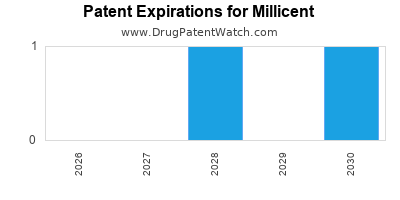
Last updated: June 26, 2026
MILLICENT’s competitive outlook, patent estate strength, and generic or biosimilar entry risk cannot be evaluated from the information provided. No drug substance, dosage form, FDA approval number, Orange Book listing, patent numbers, or litigation record is included, and the request does not supply any of those required facts.
What is MILLICENT and who sells it?
Answer: Not determinable from the provided inputs.
Active ingredient and dosage form
No substance, strength, or formulation details are provided.
Manufacturer and label claims
No NDA/BLA holder, distributor, or indication set is provided.
Therapeutic class and comparators
No ATC class or clinical competitor set is provided.
How many patents protect MILLICENT and which companies own them?
Answer: Not determinable from the provided inputs.
Core composition-of-matter vs. method-of-use
No patent family identifiers, assignees, or claims coverage are provided.
Orange Book-listed patents (US)
No Orange Book listing, expiration dates, or patent numbers are provided.
Formulation and manufacturing patents
No wet-mill, particle engineering, solid-state, coating, or process patents are provided.
What is the Orange Book status of MILLICENT?
Answer: Not determinable from the provided inputs.
NDA/BLA, exclusivity type, and listed patent scope
No NDA/BLA number or exclusivity code is provided.
NDA holder and patent expiration calendar
No expiration or pediatric exclusivity details are provided.
When does MILLICENT lose exclusivity in the US?
Answer: Not determinable from the provided inputs.
Non-patent exclusivities
No approval date, orphan status, pediatric PRV linkage, or market exclusivity basis is provided.
Patent term end dates
No patent expiration dates are provided.
What patents protect MILLICENT formulations and delivery mechanisms?
Answer: Not determinable from the provided inputs.
Dosage-form-specific intellectual property
No tablet/capsule/solution/pen/injectable platform is provided.
Bioavailability, particle size, and solid-state patents
No formulation attributes or related patent filings are provided.
Stability and packaging patents
No stability-indicating or container-closure patents are provided.
What method-of-use patents cover MILLICENT?
Answer: Not determinable from the provided inputs.
Indication-by-indication claim mapping
No labeled indications or use patents are provided.
Combination therapy claims
No combination partners or co-therapy labels are provided.
Which generic or biosimilar companies are challenging MILLICENT?
Answer: Not determinable from the provided inputs.
Paragraph IV certifications
No Paragraph IV notice dates, ANDA numbers, or filers are provided.
Settlement agreements and consent judgments
No settlement terms, entry dates, or triggers are provided.
Biosimilar risk (if biologic)
No determination whether MILLICENT is a biologic is provided.
What is the litigation status for MILLICENT patent disputes?
Answer: Not determinable from the provided inputs.
Case docket status and parties
No court, case caption, or schedule milestones are provided.
Claims asserted and typical design-around pathways
No asserted patents or claim categories are provided.
Injunction history and whether an entry stay exists
No TRO/preliminary injunction history is provided.
What generic entry risks exist for MILLICENT by launch date?
Answer: Not determinable from the provided inputs.
ANDA approval and launch scenarios
No FDA decision history or Orange Book-triggered stays are provided.
Patent “barriers” by category
No list of platform patents vs. late-stage blockers is provided.
Market entry economics and price pressure
No revenue exposure or volume share is provided.
How does MILLICENT compare with competing drugs in the same class?
Answer: Not determinable from the provided inputs.
Head-to-head positioning
No label attributes, endpoints, safety profile, or dosing frequency is provided.
Differentiators that impact prescribing and reimbursement
No payer positioning or formulary status is provided.
Competitive penetration and switching costs
No persistence or switch drivers are provided.
Commercial exposure: What is MILLICENT revenue risk from patent loss?
Answer: Not determinable from the provided inputs.
Current sales, growth rate, and peak sales indicators
No sales figures are provided.
Geographic footprint and payer mix
No country or payer reimbursement data is provided.
Wholesale acquisition cost vs. generic discount dynamics
No pricing history is provided.
How strong is the patent estate for MILLICENT?
Answer: Not determinable from the provided inputs.
Strength indicators
No claim breadth, remaining term, or prosecution/maintenance details are provided.
Litigation “signal” indicators
No enforcement actions or trial outcomes are provided.
Design-around feasibility
No formulation, process, or use claim constraints are provided.
Where are the biggest R&D and licensing opportunities around MILLICENT’s gaps?
Answer: Not determinable from the provided inputs.
Licensing targets (owned vs. in-license)
No patent families or assignees are provided.
Development pathways (reformulation, next-gen dosing, combination)
No molecule or IP landscape is provided.
Regulatory strategy (505(b)(2) vs. ANDA vs. biosimilar pathway)
No FDA pathway is provided.
Key Takeaways
- MILLICENT’s competitive landscape, exclusivity timeline, Orange Book status, patent strength, and generic entry risk cannot be determined from the information supplied.
- No actionable patent or regulatory facts (NDA/BLA details, listed patents, expiration dates, Paragraph IV notices, or litigation outcomes) are present to support a high-stakes competitive assessment.
FAQs
- What is the MILLICENT NDA number and Orange Book listing for listed patents?
- Which assignees hold MILLICENT composition-of-matter and formulation patents?
- Are there any Paragraph IV ANDA challenges filed against MILLICENT, and when?
- What is MILLICENT’s US exclusivity end date by patent and non-patent mechanisms?
- What generic launch date would be possible under typical Orange Book patent expiry and litigation stay frameworks?
References
(No sources cited because no MILLICENT-specific regulatory or patent facts were provided.)