You're using a free limited version of DrugPatentWatch: Upgrade for Complete Access

Last Updated: December 12, 2025

INREBIC Drug Patent Profile


✉ Email this page to a colleague

« Back to Dashboard


Which patents cover Inrebic, and what generic alternatives are available?

Inrebic is a drug marketed by Bristol-myers and is included in one NDA. There are five patents protecting this drug and one Paragraph IV challenge.

This drug has one hundred and seventeen patent family members in forty-two countries.

The generic ingredient in INREBIC is fedratinib hydrochloride. One supplier is listed for this compound. Additional details are available on the fedratinib hydrochloride profile page.

DrugPatentWatch® Generic Entry Outlook for Inrebic

Inrebic was eligible for patent challenges on August 16, 2023.

By analyzing the patents and regulatory protections it appears that the earliest date for generic entry will be June 4, 2032. This may change due to patent challenges or generic licensing.

There has been one patent litigation case involving the patents protecting this drug, indicating strong interest in generic launch. Recent data indicate that 63% of patent challenges are decided in favor of the generic patent challenger and that 54% of successful patent challengers promptly launch generic drugs.

Indicators of Generic Entry

< Available with Subscription >

  Get Started Free

AI Deep Research
Questions you can ask:
  • What is the 5 year forecast for INREBIC?
  • What are the global sales for INREBIC?
  • What is Average Wholesale Price for INREBIC?
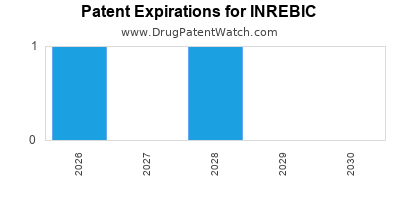
Drug patent expirations by year for INREBIC
Drug Prices for INREBIC

See drug prices for INREBIC

DrugPatentWatch® Estimated Loss of Exclusivity (LOE) Date for INREBIC
Generic Entry Date for INREBIC*:
Constraining patent/regulatory exclusivity:
NDA:
Dosage:
CAPSULE;ORAL

*The generic entry opportunity date is the latter of the last compound-claiming patent and the last regulatory exclusivity protection. Many factors can influence early or later generic entry. This date is provided as a rough estimate of generic entry potential and should not be used as an independent source.

Recent Clinical Trials for INREBIC

Identify potential brand extensions & 505(b)(2) entrants

SponsorPhase
Joseph JurcicPhase 1
Bristol-Myers SquibbPhase 1
H. Lee Moffitt Cancer Center and Research InstitutePhase 2

See all INREBIC clinical trials

Paragraph IV (Patent) Challenges for INREBIC
Tradename Dosage Ingredient Strength NDA ANDAs Submitted Submissiondate
INREBIC Capsules fedratinib hydrochloride 100 mg 212327 1 2023-08-16

US Patents and Regulatory Information for INREBIC

INREBIC is protected by five US patents and one FDA Regulatory Exclusivity.

Based on analysis by DrugPatentWatch, the earliest date for a generic version of INREBIC is ⤷  Get Started Free.

This potential generic entry date is based on patent ⤷  Get Started Free.

Generics may enter earlier, or later, based on new patent filings, patent extensions, patent invalidation, early generic licensing, generic entry preferences, and other factors.

Applicant Tradename Generic Name Dosage NDA Approval Date TE Type RLD RS Patent No. Patent Expiration Product Substance Delist Req. Exclusivity Expiration
Bristol-myers INREBIC fedratinib hydrochloride CAPSULE;ORAL 212327-001 Aug 16, 2019 RX Yes Yes ⤷  Get Started Free ⤷  Get Started Free Y ⤷  Get Started Free
Bristol-myers INREBIC fedratinib hydrochloride CAPSULE;ORAL 212327-001 Aug 16, 2019 RX Yes Yes ⤷  Get Started Free ⤷  Get Started Free ⤷  Get Started Free
>Applicant >Tradename >Generic Name >Dosage >NDA >Approval Date >TE >Type >RLD >RS >Patent No. >Patent Expiration >Product >Substance >Delist Req. >Exclusivity Expiration

International Patents for INREBIC

When does loss-of-exclusivity occur for INREBIC?

Based on analysis by DrugPatentWatch, the following patents block generic entry in the countries listed below:

Australia

Patent: 10363329
Patent: Compositions and methods for treating myelofibrosis
Estimated Expiration: ⤷  Get Started Free

Patent: 11323108
Patent: Compositions and methods for treating myelofibrosis
Estimated Expiration: ⤷  Get Started Free

Brazil

Patent: 2013011184
Patent: composições e métodos para tratamento de mielofibrose
Estimated Expiration: ⤷  Get Started Free

Canada

Patent: 16710
Patent: COMPOSITIONS ET METHODES DE TRAITEMENT DE LA MYELOFIBROSE (COMPOSITIONS AND METHODS FOR TREATING MYELOFIBROSIS)
Estimated Expiration: ⤷  Get Started Free

Patent: 16957
Patent: COMPOSITIONS ET PROCEDES DE TRAITEMENT DE LA MYELOFIBROSE (COMPOSITIONS AND METHODS FOR TREATING MYELOFIBROSIS)
Estimated Expiration: ⤷  Get Started Free

Chile

Patent: 13001252
Patent: Capsula para administracion oral que comprende n-terc-butil-3-[(5-metil-2-{[4-(2-pirrolidin-1-iletoxi)fenil]amino}pirimidin-4-il)amino]bencenosulfonamida, una celulosa microcristalina y estearil fumarato de sodio; forma de dosificacion unitaria; metodo para tratar mielofibrosis; metodo de preparacion; y articulo de preparacion.
Estimated Expiration: ⤷  Get Started Free

China

Patent: 3282036
Patent: Compositions and methods for treating myelofibrosis
Estimated Expiration: ⤷  Get Started Free

Patent: 8125923
Patent: 用于治疗骨髓纤维化的组合物和方法 (Compositions and methods for treating myelofibrosis)
Estimated Expiration: ⤷  Get Started Free

Colombia

Patent: 01724
Patent: Composiciones y métodos para el tratamiento de la mielofibrosis
Estimated Expiration: ⤷  Get Started Free

Croatia

Patent: 0221269
Estimated Expiration: ⤷  Get Started Free

Denmark

Patent: 35282
Estimated Expiration: ⤷  Get Started Free

Dominican Republic

Patent: 013000097
Patent: COMPOSICIONES Y MÉTODOS PARA EL TRATAMIENTO DE LA MIELOFIBROSIS
Estimated Expiration: ⤷  Get Started Free

Ecuador

Patent: 13012658
Patent: COMPOSICIONES Y MÉTODOS PARA EL TRATAMIENTO DE LA MIELOFIBROSIS
Estimated Expiration: ⤷  Get Started Free

European Patent Office

Patent: 35282
Patent: COMPOSITIONS ET MÉTHODES DE TRAITEMENT DE LA MYÉLOFIBROSE (COMPOSITIONS AND METHODS FOR TREATING MYELOFIBROSIS)
Estimated Expiration: ⤷  Get Started Free

Patent: 59216
Patent: COMPOSITIONS DE TRAITEMENT DE LA MYÉLOFIBROSE (COMPOSITIONS FOR TREATING MYELOFIBROSIS)
Estimated Expiration: ⤷  Get Started Free

Hungary

Patent: 60254
Estimated Expiration: ⤷  Get Started Free

Israel

Patent: 6101
Patent: פורמולציות קפסולה של n-טרט-בוטיל-3-[(5 -מתיל-2-{[4-(2 -פירולידין-1-אילאתוקסי(פניל[אמינו{פירימידין-4-איל)אמינו]בנזינסולפונאמיד ושימוש בהן להכנת תרופות לטיפול במיאלופיברוזיס (Capsule formulations of n-tert-butyl-3-[(5-methyl-2-{[4-(2-pyrrolidin-1-ylethoxy)phenyl]amino}pyrimidin-4-yl)amino]benzenesulfonamide and use thereof in the preparation of medicaments for treating myelofibrosis)
Estimated Expiration: ⤷  Get Started Free

Japan

Patent: 33211
Estimated Expiration: ⤷  Get Started Free

Patent: 13541595
Estimated Expiration: ⤷  Get Started Free

Lithuania

Patent: 35282
Estimated Expiration: ⤷  Get Started Free

Malaysia

Patent: 1164
Patent: COMPOSITIONS AND METHODS FOR TREATING MYELOFIBROSIS
Estimated Expiration: ⤷  Get Started Free

Mexico

Patent: 0246
Patent: COMPOSICIONES Y METODOS PARA EL TRATAMIENTO DE LA MIELOFIBROSIS. (COMPOSITIONS AND METHODS FOR TREATING MYELOFIBROSIS.)
Estimated Expiration: ⤷  Get Started Free

Patent: 1913
Patent: COMPOSICIONES Y METODOS PARA EL TRATAMIENTO DE LA MIELOFIBROSIS. (COMPOSITIONS AND METHODS FOR TREATING MYELOFIBROSIS)
Estimated Expiration: ⤷  Get Started Free

Patent: 13005020
Patent: COMPOSICIONES Y METODOS PARA EL TRATAMIENTO DE LA MIELOFIBROSIS. (COMPOSITIONS AND METHODS FOR TREATING MYELOFIBROSIS.)
Estimated Expiration: ⤷  Get Started Free

Morocco

Patent: 723
Patent: COMPOSITIONS ET MÉTHODES DE TRAITEMENT DE LA MYÉLOFIBROSE
Estimated Expiration: ⤷  Get Started Free

New Zealand

Patent: 1363
Patent: Compositions and methods for treating myelofibrosis
Estimated Expiration: ⤷  Get Started Free

Nicaragua

Patent: 1300038
Patent: COMPOSICIONES Y MÉTODOS PARA EL TRATAMIENTO DE LA MIELOFIBROSIS
Estimated Expiration: ⤷  Get Started Free

Peru

Patent: 140389
Patent: COMPOSICIONES Y METODOS PARA EL TRATAMIENTO DE LA MIELOFIBROSIS
Estimated Expiration: ⤷  Get Started Free

Philippines

Patent: 013500924
Patent: COMPOSITIONS AND METHODS FOR TREATING MYELOFIBROSIS
Estimated Expiration: ⤷  Get Started Free

Poland

Patent: 35282
Estimated Expiration: ⤷  Get Started Free

Portugal

Patent: 35282
Estimated Expiration: ⤷  Get Started Free

Russian Federation

Patent: 16262
Patent: КОМПОЗИЦИИ И СПОСОБЫ ЛЕЧЕНИЯ МИЕЛОФИБРОЗА (COMPOSITIONS AND METHODS FOR MYELOFIBROSIS TREATMENT)
Estimated Expiration: ⤷  Get Started Free

Patent: 13126121
Patent: КОМПОЗИЦИИ И СПОСОБЫ ЛЕЧЕНИЯ МИЕЛОФИБРОЗА
Estimated Expiration: ⤷  Get Started Free

San Marino

Patent: 02200453
Estimated Expiration: ⤷  Get Started Free

Serbia

Patent: 996
Patent: KOMPOZICIJE ZA LEČENJE MIJELOFIBROZE (COMPOSITIONS FOR TREATING MYELOFIBROSIS)
Estimated Expiration: ⤷  Get Started Free

Singapore

Patent: 0134
Patent: COMPOSITIONS AND METHODS FOR TREATING MYELOFIBROSIS
Estimated Expiration: ⤷  Get Started Free

Slovenia

Patent: 35282
Estimated Expiration: ⤷  Get Started Free

South Africa

Patent: 1303423
Patent: COMPOSITIONS AND METHODS FOR TREATING MYELOFIBROSIS
Estimated Expiration: ⤷  Get Started Free

South Korea

Patent: 1940979
Estimated Expiration: ⤷  Get Started Free

Patent: 2131241
Estimated Expiration: ⤷  Get Started Free

Patent: 130137647
Patent: COMPOSITIONS AND METHODS FOR TREATING MYELOFIBROSIS
Estimated Expiration: ⤷  Get Started Free

Patent: 180122029
Patent: 골수 섬유증을 치료하기 위한 조성물 및 방법 (COMPOSITIONS AND METHODS FOR TREATING MYELOFIBROSIS)
Estimated Expiration: ⤷  Get Started Free

Patent: 200083676
Patent: 골수 섬유증을 치료하기 위한 조성물 및 방법 (COMPOSITIONS AND METHODS FOR TREATING MYELOFIBROSIS)
Estimated Expiration: ⤷  Get Started Free

Patent: 240029118
Patent: 골수 섬유증을 치료하기 위한 조성물 및 방법 (COMPOSITIONS AND METHODS FOR TREATING MYELOFIBROSIS)
Estimated Expiration: ⤷  Get Started Free

Spain

Patent: 30650
Estimated Expiration: ⤷  Get Started Free

Taiwan

Patent: 31389
Estimated Expiration: ⤷  Get Started Free

Patent: 1306882
Patent: Compositions and methods for treating myelofibrosis
Estimated Expiration: ⤷  Get Started Free

Tunisia

Patent: 13000195
Patent: COMPOSITIONS AND METHODS FOR TREATING MYELOFIBROSIS
Estimated Expiration: ⤷  Get Started Free

Ukraine

Patent: 4076
Patent: КОМПОЗИЦІЯ І СПОСІБ ЛІКУВАННЯ МІЄЛОФІБРОЗУ
Estimated Expiration: ⤷  Get Started Free

Generics may enter earlier, or later, based on new patent filings, patent extensions, patent invalidation, early generic licensing, generic entry preferences, and other factors.

See the table below for additional patents covering INREBIC around the world.

Country Patent Number Title Estimated Expiration
Taiwan I531389 ⤷  Get Started Free
Israel 191167 ⤷  Get Started Free
Canada 2816957 COMPOSITIONS ET PROCEDES DE TRAITEMENT DE LA MYELOFIBROSE (COMPOSITIONS AND METHODS FOR TREATING MYELOFIBROSIS) ⤷  Get Started Free
>Country >Patent Number >Title >Estimated Expiration

Supplementary Protection Certificates for INREBIC

Patent Number Supplementary Protection Certificate SPC Country SPC Expiration SPC Description
1951684 14/2021 Austria ⤷  Get Started Free PRODUCT NAME: FEDRATINIB ODER EIN PHARMAZEUTISCH ANNEHMBARES SALZ DAVON ODER EIN PHARMAZEUTISCH ANNEHMBARES HYDRAT DAVON, INSBESONDERE FEDRATINIB-DIHYDROCHLORID-MONOHYDRAT; REGISTRATION NO/DATE: EU/1/20/1514 (MITTEILUNG) 20210209
1951684 122021000023 Germany ⤷  Get Started Free PRODUCT NAME: FEDRATINIB ODER EIN PHARMAZEUTISCH UNBEDENKLICHES SALZ DAVON ODER EIN PHARMAZEUTISCH UNBEDENKLICHES HYDRAT DAVON, INSBESONDERE FEDRATINIB-DIHYDROCHLORID-MONOHYDRAT; REGISTRATION NO/DATE: EU/1/20/1514 20210208
1951684 CR 2021 00011 Denmark ⤷  Get Started Free PRODUCT NAME: FEDRATINIB ELLER ET FARMACEUTISK ACCEPTABELT SALT DERAF ELLER ET FARMACEUTISK ACCEPTABELT HYDRAT DERAF, ISAER FEDRATINIB-DIHYDROCHLORIDMONOHYDRAT; REG. NO/DATE: EU/1/20/1514 20210209
>Patent Number >Supplementary Protection Certificate >SPC Country >SPC Expiration >SPC Description

Market Dynamics and Financial Trajectory for Inrebic (Fedratinib)

Last updated: July 27, 2025

Introduction

Inrebic (fedratinib) is an oral Janus kinase 2 (JAK2) inhibitor developed by Celgene (now part of Bristol-Myers Squibb following a 2019 acquisition). Approved by the U.S. Food and Drug Administration (FDA) in August 2019 for treatment of intermediate- or high-risk myelofibrosis (MF), Inrebic has positioned itself within the niche of targeted therapies for myeloproliferative neoplasms (MPNs). The drug’s market dynamics are shaped by its clinical efficacy, competitive landscape, regulatory environment, and evolving healthcare strategies, which collectively chart its financial trajectory.


Market Landscape for Myeloproliferative Neoplasms

Myelofibrosis represents a rare, yet impactful, hematologic malignancy characterized by fibrosis of the bone marrow, cytopenias, and splenomegaly, often leading to poor prognosis. The disease's prevalence rates are approximately 1.5-2.5 cases per 100,000 individuals globally, with higher incidence in older populations ([3]). The overall unmet need and limited therapeutic options make this segment attractive for targeted kinase inhibitors like Inrebic.

The global myelofibrosis market was valued at approximately USD 200 million in 2020, with projections to reach USD 300-400 million by the late 2020s, driven by increasing diagnosis rates and novel treatment options ([4]). The critical competitors include Jakafi (ruxolitinib, Novartis), the first JAK1/JAK2 inhibitor approved in 2011, which retains a dominant market share, and emerging therapies like Pacritinib and other novel agents.


Market Dynamics Influencing Inrebic

1. Clinical Differentiation and Therapeutic Positioning

Inrebic’s approval was based on the JAKARTA2 trial demonstrating meaningful spleen reduction and symptom improvement in MF patients, especially those intolerant or resistant to ruxolitinib ([1]). Its specificity for JAK2 offers a potential advantage, although the limited head-to-head data versus Jakafi constrains clinical positioning.

2. Regulatory and Reimbursement Factors

Post-approval, Inrebic faced initial cautious adoption due to safety concerns such as gastrointestinal toxicities and anemia, which require careful management. The drug’s reimbursement landscape hinges on its perceived value relative to Jakafi and emerging competitors, influenced by pricing strategies and negotiations with payers.

3. Competitive Landscape and Market Share

Jakafi, holding approximately 80% of the market, established a dominant position, with sales exceeding USD 1.5 billion in 2021 ([5]). Inrebic’s market penetration remains limited but is expected to grow as clinicians seek alternatives for patients intolerant to ruxolitinib. Early adoption has been incremental, hindered by safety profiles and clinical familiarity.

4. Pipeline and Future Indications

Additional approvals for related indications, such as treatment of polycythemia vera or essential thrombocythemia, could broaden Inrebic’s indications, augmenting its market potential. Ongoing clinical trials aim to establish these uses, with positive results potentially enhancing revenue streams.

5. Pricing and Market Access Strategies

Inrebic’s pricing, aligned with rival therapies, is crucial for adoption. Optimized access and demonstrating clinical benefits over competitors will be pivotal. Value-based pricing models could enhance financial uptake and market share.


Financial Trajectory

Current Revenue Performance

Inrebic’s sales trajectory remains modest, with initial sales figures estimated at USD 50-75 million in 2020, reflecting early-stage market acceptance. Revenues increased modestly in subsequent quarters with wider clinician familiarity and expanded indications.

Growth Drivers

  • Expanding Indications: Approval for additional MPNs could substantially increase prescriptions.
  • Competitive Differentiation: Demonstrating superior efficacy or safety advantages enhances adoption.
  • Market Penetration: Increasing awareness and physician familiarity, especially among ruxolitinib-resistant patients.
  • Pricing Strategies: Value-based negotiations with payers could bolster revenue.

Risks and Challenges

  • Market Dominance of Jakafi: Overcoming Jakafi’s entrenched market position remains difficult.
  • Safety and Tolerability Issues: Managing adverse events will influence prescribing patterns.
  • Pipeline Uncertainties: Success of clinical trials for new indications determines future growth.

Forecast Outlook (2023-2028)

Analysts project Inrebic’s sales could reach USD 200-350 million within five years if it successfully gains share among MF patients resistant or intolerant to Jakafi. A compounded annual growth rate (CAGR) of approximately 10-15% is plausible, contingent upon regulatory approvals, clinical successes, and market acceptance.


Key Market Drivers & Constraints

Drivers Constraints
Growing MF patient population Entrenched Jakafi market leader
Broadened indications Safety/tolerability concerns
Enhanced clinician awareness Competitive pipeline threats
Payer acceptance of value Limited real-world data for Inrebic

Strategic Recommendations

  • Clinical Differentiation: Conduct head-to-head trials comparing Inrebic with Jakafi to establish clear advantages.
  • Pipeline Expansion: Explore approvals for other MPNs to diversify revenue streams.
  • Market Access Optimization: Develop flexible pricing and reimbursement strategies aligned with healthcare system needs.
  • Patient-Centric Approaches: Focus on safety and tolerability improvements to address unmet clinical needs.

Conclusion

Inrebic’s market and financial prospects hinge on its ability to carve out a niche within the established MF treatment paradigm dominated by Jakafi. While current revenues are modest, strategic clinical and commercial initiatives could significantly enhance its trajectory. Success depends on differentiation through efficacy and safety, expanded indications, competitive pricing, and clinician engagement. The drug’s future remains promising should it effectively address existing market gaps and leverage emerging opportunities in MPN management.


Key Takeaways

  • Market Potential: The myelofibrosis market offers growth opportunities, particularly for therapies targeting resistant or intolerant patients.
  • Competitive Positioning: Inrebic must differentiate itself from Jakafi through clinical advantages and expanded indications.
  • Revenue Forecast: Projected to reach USD 200-350 million within five years with strategic market expansion.
  • Challenges: Entrenched competitors, safety profile considerations, and pipeline uncertainties remain significant hurdles.
  • Opportunities: Clinical trials for additional indications and payer strategies could catalyze growth.

FAQs

Q1: How does Inrebic compare to Jakafi in clinical efficacy?
Inrebic demonstrates significant spleen reduction in certain MF patient subsets, especially those resistant or intolerant to Jakafi. However, direct comparative trials are limited, making clinical distinctions reliant on individual trial data.

Q2: What are the main safety concerns associated with Inrebic?
Gastrointestinal toxicities, including nausea and diarrhea, along with hematologic adverse events like anemia, are notable safety considerations impacting patient management.

Q3: Are there plans to expand Inrebic’s indications?
Yes. Ongoing clinical trials aim to evaluate Inrebic for polycythemia vera and essential thrombocythemia, potentially broadening its market footprint.

Q4: How significant is the patent landscape for Inrebic?
Patent protection extends into the mid-2020s, providing exclusivity in key markets, though competition from generics post-patent expiry could impact future revenues.

Q5: What strategies could enhance Inrebic’s market penetration?
Developing head-to-head comparative data, expanding indications, optimizing payer agreements, and improving safety profiles will be critical to increase adoption in a competitive environment.

More… ↓

⤷  Get Started Free

Make Better Decisions: Try a trial or see plans & pricing

Drugs may be covered by multiple patents or regulatory protections. All trademarks and applicant names are the property of their respective owners or licensors. Although great care is taken in the proper and correct provision of this service, thinkBiotech LLC does not accept any responsibility for possible consequences of errors or omissions in the provided data. The data presented herein is for information purposes only. There is no warranty that the data contained herein is error free. We do not provide individual investment advice. This service is not registered with any financial regulatory agency. The information we publish is educational only and based on our opinions plus our models. By using DrugPatentWatch you acknowledge that we do not provide personalized recommendations or advice. thinkBiotech performs no independent verification of facts as provided by public sources nor are attempts made to provide legal or investing advice. Any reliance on data provided herein is done solely at the discretion of the user. Users of this service are advised to seek professional advice and independent confirmation before considering acting on any of the provided information. thinkBiotech LLC reserves the right to amend, extend or withdraw any part or all of the offered service without notice.