Last updated: July 5, 2026
Inderal (propranolol) is a legacy, small-molecule beta blocker with ongoing generic competition in the U.S. and most major markets. Market dynamics are dominated by (1) generic price compression, (2) formulary and interchangeability decisions, and (3) persistent demand for propranolol across indications such as hypertension, migraine prophylaxis, tremor, and certain cardiac and off-label uses. Financial trajectory is therefore driven less by novel IP and more by how quickly generic entrants captured share versus brand resilience in specific dosing forms and channels.
How big is the Inderal market in the US and what drives demand for propranolol?
Featured snippet: Propranolol demand is primarily captured by generic prescriptions; Inderal brand share is structurally limited by long-standing generic availability.
What indications sustain propranolol demand?
Propranolol use is concentrated in established, guideline-supported and clinician-established indications. Demand drivers are stable long-duration therapy patterns and chronic disease management, with episodic spikes tied to seasonal and clinical practice cycles.
Key demand categories include:
- Cardiovascular: angina, rate control in select settings, post-MI adjunct approaches (context dependent), heart failure-related historical uses
- Neurology: migraine prophylaxis
- Movement disorders: essential tremor
- Anxiety/performance symptoms in clinical practice (often off-label or clinician-directed use)
- Thyroid-related indications and other sympathetic hyperactivity uses (often protocol- and clinician-driven)
What patient segments matter most for pricing and volume?
- Chronic users in primary care: high switching likelihood to the lowest-cost interchangeable product
- Neurology and cardiology cohorts: more stable prescribing but still prone to pharmacy-level substitution
- Institutional formularies: tend to standardize on fewer generic SKUs
How do supply, stocking, and dosage-form complexity affect sales?
Inderal’s U.S. commercial footprint has historically depended on dosage forms such as immediate-release tablets and extended-release formulations (where available). Dosage-form availability influences channel stocking and can create temporary localized price differences even after brand-level erosion.
How do generic entry and price compression shape Inderal’s financial trajectory?
Featured snippet: Inderal’s financial trajectory tracks generic substitution intensity and the stability of low-cost competitive supply.
What is the mechanism of brand revenue decline?
For legacy beta blockers, brand declines typically follow a repeatable pattern:
- Generic entry forces payer and pharmacy substitution.
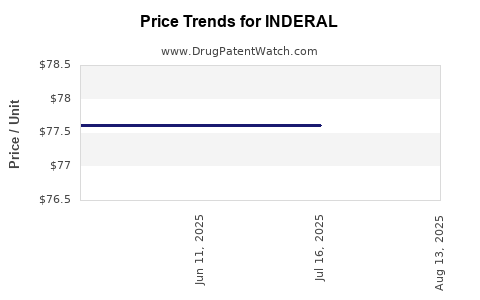
- Net price drops rapidly due to lower WAC and competitive bidding.
- Brand marketing spend declines as share becomes economically irrational to defend.
- Remaining brand residuals persist in niches such as coverage carve-outs, prescriber familiarity, and specific NDC-level formulary lock-in.
What financial metrics reflect this dynamic?
For products like Inderal, the relevant line items are:
- Net sales vs. gross sales shrinkage from rebates and contractual discounts
- Ongoing declines in share and volume
- Margin compression from reduced pricing power
- Increased vulnerability to supply disruptions among major generics, which can temporarily lift prices but usually not reverse long-term brand erosion
When does Inderal lose exclusivity and what does that imply for future revenue?
Featured snippet: Propranolol’s exclusivity has long expired; revenue outlook is therefore largely a function of generic pricing cycles, not ongoing brand exclusivity.
How does exclusivity timing map to financial outcomes?
- Once exclusivity ends, generics drive structural margin compression and share loss.
- Later-manufacturing consolidation among generic firms can reduce the number of low-cost competitors, causing short-lived price firming.
- Any “brand stability” period generally corresponds to (a) slow payer switching or (b) dosage-form gaps that later close when generics expand.
What does this mean for forward-looking revenue?
Inderal’s future revenue is not expected to be IP-protected. Financial trajectory is instead constrained by:
- Ongoing generic competition
- Persistent payer substitution
- Routine replacement of higher-priced SKUs with lower-cost equivalents
What is the Orange Book status of Inderal and how many patents typically cover propranolol products?
Featured snippet: In propranolol, Orange Book protection has historically been sparse for long-market products, with most value captured by generic-equivalent approvals.
What Orange Book listings generally show for legacy small molecules?
For long-established molecules like propranolol, Orange Book listings commonly reflect:
- Limited sets of formulation or method patents, often long expired
- Remaining regulatory exclusivities tied to specific product changes rather than core active ingredient exclusivity
How does Orange Book structure change for different dosage forms?
Each dosage form (immediate-release vs. extended-release, if applicable in the specific market) can have separate NDC-level listings and patent-to-NDC linkages. That structure matters for generic timing at the NDC level even if the active ingredient is broadly genericized.
Which companies compete with Inderal in the US and how does the competitive set affect pricing?
Featured snippet: Competition is dominated by multiple generic manufacturers; pricing is set by the most aggressive wholesale and payer contracting dynamics.
Who typically sits in the competitive set?
The U.S. propranolol market usually includes:
- Large generic houses with broad NDC coverage
- Multiple regional distributors who influence effective channel pricing
- Pharmacy benefit managers that standardize preferred generics
How does multi-manufacturer competition affect gross-to-net economics?
- Increased SKU availability intensifies competition on WAC and contract pricing
- PBM preferred lists concentrate volume on a few top contracting SKUs
- Net price volatility increases with changes in preferred status and rebate structures
What role do PBMs and formularies play?
PBM formularies typically:
- Prefer specific NDCs with best contracted economics
- Drive high substitution rates at prescription fill
- Reduce residual brand or higher-priced generic utilization over time
What Paragraph IV litigation risks exist for Inderal, and are they economically relevant?
Featured snippet: For a legacy beta blocker with long generic availability, Paragraph IV litigation risk is usually not a primary driver of brand valuation.
Why Paragraph IV matters less for Inderal
Paragraph IV is relevant when a manufacturer seeks to launch before patent expiry. For Inderal-style legacy products, most relevant patents have already lapsed, so incentives shift toward:
- Competitive generic pricing and contracting
- Launch timing for additional strengths or dosage forms
- Market-share capture rather than “at-risk” IP timing
When could at-risk launches still matter?
Risk can still arise if:
- A manufacturer targets a still-listed secondary patent tied to a specific NDC
- A new proprietary formulation change creates a narrow window (rare for older products)
In most cases, the economic center of gravity remains generic price competition rather than litigation-driven exclusivity.
How does Inderal compare with other beta blockers in market dynamics and pricing power?
Featured snippet: Legacy beta blockers show similar generic compression; differentiation comes from dosing convenience, formulation availability, and payer preference, not active ingredient novelty.
Competitive comparison drivers
- Formulation: immediate vs extended release, scored tablets vs alternative dosing profiles
- Dosing flexibility: number of strengths and ease of titration
- Substitution patterns: pharmacy-level substitution rates and PBM contracting
- Clinical practice inertia: switching behavior for migraine prophylaxis and tremor
Where propranolol can still win within a crowded beta blocker class
Propranolol can retain share due to:
- Established clinician familiarity
- Long-standing guideline positioning in certain indications (eg, migraine prophylaxis, tremor)
- Availability of multiple generic options that make it easy for payers and pharmacies to stock
What is the regulatory trajectory for Inderal and does it create any brand resurgence path?
Featured snippet: Regulatory events for legacy propranolol products typically do not create brand resurgence because generics already satisfy most demand.
FDA pathway dynamics
For legacy small molecules, most activity is:
- Generic Abbreviated New Drug Applications (ANDAs)
- Changes in manufacturers, NDCs, and labeling updates
- Rare reformulations that may generate limited, short-lived patent estates
How does labeling change affect market share?
- Label updates can shift utilization slightly across indications
- But they rarely reverse generic-driven pricing pressure at scale
Which formulations of propranolol are most relevant to market share and margins?
Featured snippet: Immediate-release and extended-release versions can fragment demand by NDC and payer contracting terms; margin outcomes depend on which SKUs hold preferred status.
What formulation attributes influence contracting?
- Dose strength granularity and titration convenience
- Tablet handling and splitting (where applicable)
- Stability and manufacturability across supply chain
- Distinct NDC-level economics due to different rebate and contracting structures
Extended-release vs immediate-release: what it means commercially
- Extended-release products can maintain marginally better economics when fewer SKUs are preferred, but generics usually close the gap over time.
- Immediate-release products often have broader generic coverage, raising competitive pressure.
How strong is the patent estate for Inderal propranolol products and what does it mean for licensing?
Featured snippet: Patent estates for long-market propranolol products are typically limited or expired; licensing opportunities are therefore more likely tied to niche formulations or manufacturing know-how than core composition claims.
What types of IP can still exist for legacy beta blockers?
- Secondary patents covering specific formulations, polymorphs, or manufacturing methods (if still unexpired)
- Method-of-use patents only where a specific, novel therapeutic claim was successfully patented and not previously invalidated
Why licensing is harder for legacy drugs
Even where residual IP exists, value is constrained by:
- Generic interchangeability
- Payer resistance to pay more for branded IP
- Broad substitution across beta blockers when clinical equivalence is acceptable
What generic entry risks exist for Inderal across dosage forms and strengths?
Featured snippet: The dominant risk to brand economics is continued entry into additional NDCs and strengths that remain under competitive pressure.
Where entry risk concentrates
- Strengths with historically thinner competition
- Dosage forms with fewer preferred generics
- NDCs with frequent supply disruptions that create temporary demand opportunities
How does entry risk translate into financial outcomes?
- Lower net prices and higher pharmacy substitution
- Faster share transitions when PBMs refresh preferred lists
- Reduced brand residual sales for remaining covered NDCs
Key takeaways
- Inderal (propranolol) operates in a structurally genericized market where financial performance is primarily determined by generic price compression and PBM/formulary substitution, not by brand exclusivity.
- Demand is stable because propranolol is embedded in long-established therapeutic use patterns, but revenue trajectory is constrained by high interchangeability.
- Litigation-driven “at-risk” economics are usually not central for legacy propranolol because the core patent landscape has largely expired.
- Competitive outcomes hinge on NDC-level factors: which generics hold preferred status, dosage-form availability, and contracting economics rather than differentiation in drug substance innovation.
FAQs
1) Why does Inderal net sales keep declining even when overall propranolol demand remains steady?
Generic substitution and PBM preferred contracting push prescriptions toward lower-cost interchangeable NDCs, reducing brand volume and net price.
2) Does extended-release propranolol typically hold better pricing than immediate-release in generic markets?
Often there is temporary margin improvement when preferred options are fewer, but generic entry usually expands and compresses pricing over time.
3) Can supply shortages among generic propranolol manufacturers increase Inderal sales?
Short-term disruptions can shift fills, but substitution usually persists across alternatives, limiting brand rebound.
4) How do PBM formularies influence Inderal profitability more than FDA labeling?
Net economics are set largely by rebate terms and preferred-list status; labeling changes usually shift clinical use modestly, not contracting economics at scale.
5) Are there still viable patent or exclusivity levers for new Inderal-like propranolol products?
Value typically exists only in narrow, NDC-specific secondary IP or novel formulation/manufacturing approaches, not in core composition exclusivity for the active ingredient.
References (APA)
- FDA. Orange Book: Approved Drug Products with Therapeutic Equivalence Evaluations. U.S. Food and Drug Administration. https://www.accessdata.fda.gov/scripts/cder/daf/
- FDA. Drugs@FDA: FDA Approved Drug Products. U.S. Food and Drug Administration. https://www.accessdata.fda.gov/scripts/cder/daf/
- FDA. Electronic Orange Book data (public listings and patent-to-NDC linkages). U.S. Food and Drug Administration. https://www.accessdata.fda.gov/scripts/cder/ob/