Last updated: August 10, 2026
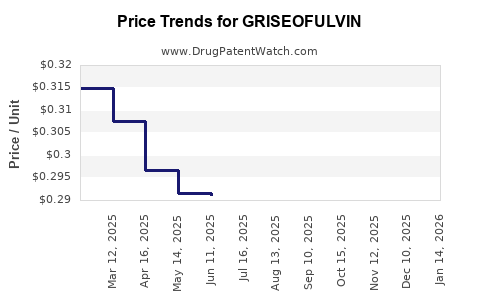
Griseofulvin is a mature, low-cost oral antifungal with no meaningful remaining regulatory exclusivity and no identifiable blocking patent estate for standard products. Its commercial base is stable but narrow, concentrated in dermatophyte infections such as tinea capitis, tinea corporis, and tinea pedis. Generic competition, low pricing, treatment alternatives, and limited prescribing growth constrain revenue. The main commercial opportunity is supply reliability, pediatric formulations, veterinary demand, and niche geographic markets rather than premium pricing.
Griseofulvin Market Dynamics, Patent Landscape, FDA Status, and Financial Trajectory
What is the current market position of griseofulvin?
Griseofulvin is an oral antifungal derived from Penicillium species. It is used primarily against dermatophytes, including Trichophyton, Microsporum, and Epidermophyton. It is not a broad-spectrum antifungal and has limited or no utility against most Candida infections, cryptococcosis, or invasive fungal disease.
The drug is available in several forms:
- Microsize tablets
- Ultramicrosize tablets
- Oral suspension
- Veterinary formulations
- Branded and generic products
Human products include generic griseofulvin tablets and oral suspension, as well as branded products such as Gris-PEG. The commercial market is mature and largely generic. Product differentiation depends on particle size, absorption, dosage form, manufacturing consistency, and distribution rather than active-ingredient exclusivity.
Griseofulvin remains clinically relevant in pediatric tinea capitis, where oral therapy is often required because topical treatment does not adequately penetrate infected hair shafts. Terbinafine, itraconazole, fluconazole, and ketoconazole have reduced its share in some indications, but griseofulvin remains a commonly used treatment, particularly for Microsporum infections and in children.
When does griseofulvin lose exclusivity?
Griseofulvin lost meaningful market exclusivity decades ago. The active ingredient was introduced in the 1950s, and the foundational composition and use patents have expired.
| Exclusivity category |
Current status |
| Original active-ingredient patents |
Expired |
| Original product patents |
Expired |
| FDA new chemical entity exclusivity |
Expired |
| Orphan-drug exclusivity |
None identified |
| Pediatric exclusivity |
No current period |
| Generic competition |
Established |
| Biosimilar protection |
Not applicable |
| Current blocking patent estate |
None identified for standard griseofulvin products |
The relevant commercial question is therefore not when a patent expires. It is whether a manufacturer can maintain an approved, economical product with dependable supply and acceptable bioavailability.
What patents protect griseofulvin products?
No active, commercially significant patent family is known to protect the basic griseofulvin molecule, conventional microsize tablets, ultramicrosize tablets, or standard oral suspension products.
Historical patent protection covered the compound, production methods, formulations, and antifungal uses. Those rights expired after the product entered the market. Any remaining patents that mention griseofulvin would generally relate to narrow formulation, combination, packaging, or manufacturing claims rather than the core market.
Are formulation patents still important for griseofulvin?
Formulation technology has greater practical importance than patent exclusivity. Griseofulvin has poor aqueous solubility and variable absorption. Particle-size reduction improves dissolution and can affect exposure. Microsize and ultramicrosize products were developed to address these properties.
The principal formulation distinctions are:
| Formulation |
Commercial relevance |
Patent position |
| Microsize tablet |
Established generic product |
No meaningful core patent barrier |
| Ultramicrosize tablet |
Lower dose and improved absorption potential |
Historical protection expired |
| Oral suspension |
Important for pediatric use |
No broad blocking patent identified |
| Veterinary suspension or tablet |
Separate commercial channel |
Generally generic and competitive |
| Combination product |
Limited market relevance |
Any protection would be narrow and product-specific |
FDA labeling has historically instructed that ultramicrosize products may require lower doses than microsize products because of differences in absorption and bioavailability. Substitution between products should follow the approved labeling and prescribing information rather than a simple milligram-for-milligram assumption.[1]
What is the FDA regulatory status of griseofulvin?
Griseofulvin is an FDA-approved prescription antifungal. FDA-approved products include oral tablets and oral suspension presentations, depending on the manufacturer and current commercial availability.
The regulatory profile is mature:
- No current new-drug exclusivity applies.
- No biologic license application is involved.
- No biosimilar pathway applies.
- Products are generally approved through legacy NDAs, ANDAs, or historical regulatory pathways.
- The principal FDA issues are manufacturing compliance, product quality, labeling, and supply continuity.
Griseofulvin products are subject to standard FDA requirements for identity, strength, purity, dissolution, stability, and manufacturing controls. Because absorption can vary with particle size and formulation, bioequivalence and product performance are commercially important.
What is the Orange Book status of griseofulvin?
The FDA Orange Book identifies approved drug products and, where applicable, patent and exclusivity information. Griseofulvin products do not have a current Orange Book patent barrier comparable to newer branded drugs.[2]
The practical Orange Book assessment is:
| Orange Book issue |
Griseofulvin position |
| Listed innovator product |
Historical and product-specific |
| Listed patents blocking ANDA approval |
None of broad commercial significance identified |
| 30-month stay exposure |
Low |
| Paragraph IV exposure |
Low because no major active patent estate is evident |
| Generic approval pathway |
Established |
| Regulatory exclusivity |
None currently material |
The absence of a listed patent does not eliminate all litigation risk. A manufacturer could assert an unlisted formulation, process, or trade-secret claim. Those claims would not normally create the same automatic ANDA stay associated with a properly listed Orange Book patent.
How many patents cover griseofulvin?
The relevant number is effectively zero for broad, enforceable protection over the active ingredient and conventional products. Historical patents covered the compound and early products, but those rights are expired.
A modern patent search may still return documents containing the term "griseofulvin." Those documents can include:
- Expired compound patents
- Abandoned applications
- Combination therapies
- Drug-delivery systems
- Veterinary compositions
- Broad antifungal formulations
- Manufacturing or crystallization processes
- Patent families that never reached enforceable claims
Patent-count analysis can therefore overstate competitive barriers. The commercially relevant test is whether a live claim covers a marketed dosage form, a required manufacturing process, or a commercially necessary delivery technology. No such broad barrier is evident for standard griseofulvin products.
Which companies manufacture or market griseofulvin?
The market is fragmented across generic manufacturers, contract manufacturers, specialty distributors, and veterinary suppliers. Brand and generic availability has changed over time as companies have discontinued products, transferred rights, or adjusted portfolios.
Known commercial channels include:
- Generic pharmaceutical manufacturers supplying tablets
- Specialty companies supplying branded or legacy products
- Pediatric-focused distributors supplying oral suspension
- Veterinary manufacturers selling animal-health products
- Wholesalers and compounding pharmacies
Gris-PEG has been associated with Pedinol Pharmacal, although brand ownership, distribution, and availability can change. Current manufacturer participation should be evaluated through FDA product listings and commercial shipment data rather than historical brand references.[3]
No single company appears to control the entire griseofulvin market. That structure limits pricing power and increases the importance of manufacturing continuity.
What is the competitive landscape for griseofulvin?
Griseofulvin competes with both oral and topical antifungals.
| Drug |
Principal competitive advantage |
Main limitation relative to griseofulvin |
| Terbinafine |
Strong activity against many dermatophytes and shorter courses in some infections |
Less attractive in some Microsporum infections |
| Fluconazole |
Convenient dosing and broad clinical familiarity |
Resistance and indication-specific limitations |
| Itraconazole |
Broad antifungal spectrum |
Drug interactions and absorption concerns |
| Ketoconazole |
Historical oral and topical use |
Oral safety limitations |
| Topical azoles |
Low systemic exposure |
Often inadequate for scalp and hair infections |
| Topical terbinafine |
Effective for localized skin disease |
Limited utility for tinea capitis |
| Griseofulvin |
Long pediatric history and established use in tinea capitis |
Long treatment courses and absorption variability |
Clinical guidelines and pediatric practice patterns continue to support griseofulvin for selected dermatophyte infections, especially scalp ringworm.[4] Its position is strongest where clinicians value established pediatric experience and where the infecting species responds well to treatment.
Its position is weaker in adult superficial infections that can be treated with short-course topical therapy or alternative oral agents.
What generic entry risks exist for griseofulvin?
Generic entry risk is already realized rather than prospective. The market has long been open to multiple suppliers.
The key risks for incumbent manufacturers are:
- Price erosion from additional suppliers.
- Product discontinuation because of low margins.
- API supply disruption.
- FDA manufacturing or quality actions.
- Wholesaler concentration.
- Loss of pediatric suspension availability.
- Substitution toward terbinafine or azole products.
- Reduced prescribing because of longer treatment duration.
The primary barrier is operational. Griseofulvin has low unit value, so a supplier needs efficient procurement, validated manufacturing, and reliable distribution. A new entrant may obtain approval but still struggle to achieve sustainable commercial scale.
What generic launch scenarios are plausible?
A new generic launch would probably produce one of three outcomes:
| Scenario |
Likely market effect |
| Tablet-only entrant |
Moderate price pressure with limited clinical disruption |
| Oral-suspension entrant |
Greater impact in pediatrics if supply is constrained |
| Low-cost global supplier |
Rapid price competition but possible channel and quality scrutiny |
A shortage or discontinuation by an incumbent could create a temporary supply opportunity. That opportunity would be volume-driven and would not normally support a durable premium absent a differentiated formulation or preferred distribution position.
What patent litigation affects griseofulvin?
No major current patent litigation is associated with the core griseofulvin market. The drug's age and generic status make branded patent litigation unlikely.
Are there Paragraph IV challenges involving griseofulvin?
Paragraph IV litigation is not a material current issue for standard griseofulvin products. Paragraph IV certifications are used when an ANDA applicant challenges listed patents. Because no major active Orange Book patent estate is associated with conventional griseofulvin, the economic incentive for a high-value Paragraph IV challenge is low.
Any future dispute would more likely involve:
- Bioequivalence
- Formulation performance
- Labeling
- Manufacturing methods
- Trade secrets
- Contract rights
- Product-quality allegations
What licensing deals affect griseofulvin?
No major recent licensing transaction is associated with griseofulvin's core pharmaceutical market. The drug is too mature to attract conventional asset licensing based on compound exclusivity.
Potential transaction structures are more likely to involve:
- Acquisition of an approved product or NDA
- Transfer of manufacturing rights
- Regional distribution agreements
- Veterinary product licensing
- Private-label supply
- Acquisition of a specialty pharmaceutical portfolio
The commercial value of such a transaction would depend on historical prescription volume, product availability, manufacturing cost, FDA compliance, and channel access. It would not be based on a long remaining patent term.
What is the financial trajectory of griseofulvin?
Griseofulvin is a low-revenue, mature pharmaceutical category relative to newer antifungals. Public company filings generally do not report griseofulvin revenue as a separate material line item. Products are often included in broader generic, specialty, or animal-health portfolios.
The financial trajectory has four phases:
1. Innovation and branded growth
The initial market was built around discovery, early clinical adoption, and branded oral therapy. That phase ended many decades ago.
2. Generic commoditization
Multiple suppliers entered after patent expiry. Pricing declined, and the product became dependent on manufacturing efficiency and distribution.
3. Portfolio rationalization
Low margins encouraged companies to discontinue products, consolidate manufacturing, or retain only selected strengths and dosage forms.
4. Stable niche demand
Demand persists because dermatophyte infections remain common and pediatric tinea capitis continues to require oral treatment. Growth is limited by competition, alternative therapy, and the lack of new indications.
A precise global revenue figure should not be inferred from undifferentiated market-research estimates. The public record supports a qualitative conclusion: griseofulvin is a small, mature market with stable clinical demand and limited pricing power.
How strong is the griseofulvin patent estate?
The patent estate is weak from an exclusivity perspective and moderate only from an operational perspective.
| Factor |
Assessment |
| Compound patent protection |
None remaining |
| Formulation exclusivity |
Historical rights expired |
| Orange Book leverage |
Low |
| Paragraph IV leverage |
Low |
| Manufacturing complexity |
Moderate |
| API supply concentration |
Potentially meaningful |
| Pediatric product differentiation |
Moderate |
| Pricing power |
Low |
| Litigation exposure |
Low |
| Commercial durability |
Moderate for niche demand |
The strongest defensible position is not a compound patent. It is a combination of FDA approval, reliable supply, pediatric dosage-form availability, established customer relationships, and low-cost production.
What geographic markets drive griseofulvin demand?
Demand is strongest in regions with:
- High prevalence of dermatophyte infections
- Frequent tinea capitis in children
- Limited access to newer antifungals
- Public-sector purchasing
- Lower treatment budgets
- Continued use of established generic medicines
The United States remains commercially relevant because of pediatric prescribing and FDA-approved products. Emerging markets can have higher epidemiologic need but lower prices, weaker reimbursement, and more fragmented distribution.
Veterinary demand provides a separate channel. It may support volume, but animal-health products do not automatically substitute for human products because labeling, formulation, quality controls, and distribution channels differ.
What manufacturing and intellectual-property barriers affect griseofulvin?
Manufacturing is more important than patent protection. The drug's low solubility makes particle size, crystallinity, dissolution, and content uniformity important quality attributes.
A manufacturer must control:
- API particle-size distribution
- Milling and micronization
- Blend uniformity
- Dissolution performance
- Suspension sedimentation and redispersibility
- Stability
- Packaging integrity
- Cross-contamination controls
For oral suspension, taste, sedimentation, preservative performance, and pediatric dosing accuracy affect market acceptance. These factors can create practical differentiation even when they do not create enforceable exclusivity.
Key Takeaways
- Griseofulvin is a mature generic oral antifungal with no material remaining compound or product exclusivity.
- Standard tablets and oral suspensions face low legal barriers to generic competition.
- The FDA regulatory status is established, with no current NCE, orphan, or biosimilar exclusivity.
- Orange Book patent leverage is low, and Paragraph IV litigation is not a significant current risk.
- The market is small, fragmented, and price-sensitive.
- Pediatric tinea capitis remains the strongest clinical demand center.
- Oral suspension availability is commercially more differentiated than conventional tablets.
- Terbinafine, fluconazole, itraconazole, and topical antifungals constrain growth.
- Manufacturing reliability, API control, and distribution are more important than patent ownership.
- Revenue is likely stable to declining in value terms, with temporary opportunities during shortages or supplier exits.
FAQs
Is griseofulvin still profitable for pharmaceutical manufacturers?
It can be profitable at efficient manufacturing scale, but low prices and generic competition limit margins. Profitability depends on supply reliability, procurement costs, and distribution efficiency.
Does griseofulvin have pediatric exclusivity?
No current pediatric exclusivity period materially protects standard griseofulvin products. Pediatric use remains commercially important because tinea capitis frequently requires oral therapy.
Can a company obtain a new patent on a griseofulvin formulation?
A company could seek patent protection for a genuinely novel formulation, delivery system, combination, or manufacturing process. Any protection would depend on novelty, non-obviousness, written description, enablement, and claim scope.
Is griseofulvin subject to biosimilar competition?
No. Griseofulvin is a small-molecule drug, so competing products follow generic-drug pathways rather than the biosimilar pathway.
What is the best commercial entry point in the griseofulvin market?
A reliable pediatric oral suspension, a differentiated low-cost formulation, or a supply-continuity strategy is more commercially defensible than a conventional tablet launch. The opportunity is operational and distribution-based rather than patent-based.
References
-
U.S. Food and Drug Administration. (n.d.). Griseofulvin ultramicrosize tablets: Prescribing information. DailyMed. https://dailymed.nlm.nih.gov/
-
U.S. Food and Drug Administration. (2025). Approved drug products with therapeutic equivalence evaluations, 45th edition. https://www.fda.gov/drugs/drug-approvals-and-databases/orange-book-data-files
-
Pedinol Pharmacal, Inc. (n.d.). Gris-PEG prescribing information. DailyMed. https://dailymed.nlm.nih.gov/
-
American Academy of Dermatology. (n.d.). Guidelines of care for the management of dermatophyte infections and tinea capitis. https://www.aad.org/endez