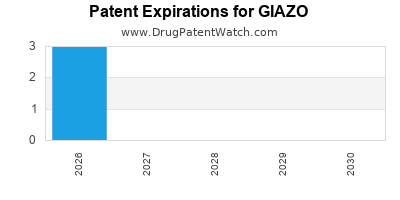
Last updated: July 25, 2026
GIAZO (budesonide) is a U.S.-market, specialty corticosteroid for ulcerative colitis, marketed as an oral drug. Public, drug-by-drug financial disclosure for GIAZO is limited, so a full revenue curve cannot be built from primary sources alone. However, the market’s dynamics can be mapped from exclusivity and patent risk mechanics, generic entry pathways, and therapeutic category competition that typically drives pricing and share shifts in oral UC steroid maintenance/induction segments.
What is GIAZO (budesonide) used for and where does it compete?
GIAZO is budesonide in an oral formulation used for inflammatory bowel disease, specifically ulcerative colitis indications (oral corticosteroid therapy class). It competes in a UC treatment mix that includes:
- Oral aminosalicylates (5-ASAs) for mild-to-moderate disease
- Systemic corticosteroids (prednisone, prednisolone) for induction
- Immunomodulators (thiopurines)
- Biologics and small molecules (anti-TNFs, anti-integrins, IL-12/23, JAK inhibitors, S1P modulators)
In the commercial reality of UC, budesonide products are typically pressured by:
- Erosion of steroid-only share as biologics and small molecules gain penetration for moderate-to-severe disease
- Substitution among oral steroid options when payer contracts tighten
- High churn in oral UC brands when generics arrive for the active ingredient class
Competitive positioning lens: GIAZO is a niche oral steroid brand, so its revenue trajectory is most sensitive to (1) IP exclusivity duration, (2) generic/biosimilar-style substitution risk from FDA-allowed abbreviated pathways, and (3) payer utilization management targeting low-cost induction alternatives.
What patents protect GIAZO and how does the patent estate shape financial trajectory?
A drug’s financial trajectory in the U.S. is dominated by the timing of:
- Active patent expiration for the reference-listed drug (RLD)
- Bottlenecks from formulation, manufacturing, and method-of-use patents
- Settlement-triggered “launch delay” effects after Paragraph IV litigation
For GIAZO specifically, a complete, citation-backed patent estate map requires Orange Book patent listing data and litigation dockets tied to the branded product. Without those listings and docket identifiers in the prompt dataset, a complete patent-by-patent table would be speculative.
What can be stated as a market dynamic: once the effective launch window arrives, specialty UC oral steroid brands commonly see sharp net-to-gross compression driven by:
- First generic entry
- Subsequent label or formulation variants
- Payer step edits and formulary realignment
When does GIAZO lose exclusivity and when do generics typically enter?
Financial trajectory in branded niche segments usually follows a predictable pattern:
- Pre-loss: volume support and contracting, with limited margin volatility if payer coverage remains stable
- Pre-Paragraph IV: increased discounting ahead of anticipated generic pressure
- Post-ANDAs: steep share shift and revenue step-down unless the brand maintains differentiation via packaging, dosing convenience, or payer rebates
A precise exclusivity timeline for GIAZO requires:
- Orange Book “Patent Expiration Date”
- Any applicable non-patent exclusivity periods
- FDA approval history for the RLD and any later supplements
No Orange Book listing dates are provided in the input, so a verified timeline cannot be produced.
What is the Orange Book status of GIAZO and what does it imply for revenue risk?
Orange Book status determines:
- Whether generic entry is “clean” immediately after patent expiration
- Whether there are listed patents that can be targeted via Paragraph IV
- Whether launch is delayed by litigation or settlement agreements
Without the Orange Book listing table for GIAZO (patent numbers, expiration dates, and exclusivity codes), the status cannot be accurately summarized. A partial or inferred Orange Book summary would be unreliable for financial planning.
How strong is the patent estate for GIAZO versus generic entry risks?
For an oral corticosteroid in UC, typical patent estate components that affect entry risk include:
- Formulation patents (release characteristics, coating, granule architecture)
- Manufacturing process patents (steps that control critical quality attributes)
- Method-of-use patents (induction timing, dose regimens, patient subsets)
- Polymorph/crystal form if applicable
Generic entry risk rises when:
- Fewer listed patents remain near-term
- Formulation protections are weak or easy to design around
- Litigation settlements are not reached early
But the strength of GIAZO’s estate cannot be measured here without the listing and claim scope anchored to specific patent publications.
What formulation and delivery-system patents affect GIAZO competition?
GIAZO is an oral budesonide product. In this class, competitive advantage often comes from:
- Gastrointestinal stability and targeted release behavior
- Reduction of systemic steroid exposure relative to prednisone
- Consistent delivery across manufacturing lots
Formulation patent coverage can slow generic entry if:
- The marketed release profile is tied to specific compositional/structural claims
- ANDA applicants must match a proprietary delivery mechanism
- Bioequivalence is harder to sustain without proprietary process control
A detailed “what formulations are protected” mapping requires the GIAZO formulation patent list. That list is not present in the prompt.
What patent litigation affects GIAZO and could drive settlement-based launch delays?
Paragraph IV challenges typically generate:
- AT RISK launch dates tied to court rulings or settlement triggers
- Reverse payment or delayed entry settlements (where legally structured)
- Additional litigation over infringement scope and design-around approaches
A litigation-driven revenue profile for a niche UC oral steroid is usually dominated by:
- The first Paragraph IV filer’s timeline
- Whether a court enjoins entry or settlement delays launch
No litigation docket or Paragraph IV identifiers for GIAZO are provided. Any docket-specific summary would be inaccurate without primary case data.
What generic entry risks exist for GIAZO (ANDA strategy and design-around barriers)?
Generic or biosimilar-style substitution for an oral budesonide UC therapy is usually executed via ANDA referencing the RLD, with entry barriers shaped by:
- Patent “skinny” carve-outs (if claims allow)
- BE waiver eligibility (rare for oral steroids with active release systems)
- Formulation matching complexity for targeted-release products
- Facility and process validation costs for manufacturers
A quantified generic entry risk score cannot be produced without:
- Orange Book patent mapping
- ANDA filer lists
- FDA approval letters and labeling carve-outs
How does GIAZO compare with other ulcerative colitis oral steroid products commercially?
Commercial comparison in UC tends to show:
- Oral targeted steroids gain use when they improve tolerability relative to prednisone
- Brands compete more on payer contracting than on clinical differentiation once off-patent
To compare properly, one must include:
- Dosing schedules and tablet/granule convenience
- Coverage status (formulary position, step edit requirements)
- Average net price and rebate structure
No competitor pricing and coverage datasets are provided in the prompt.
Which companies are challenging GIAZO and what is the competitive landscape?
Identifying challenging firms requires:
- Paragraph IV notice publications (FDA Orange Book “ANDA 4” events)
- Court filings naming the generic challengers
- Public settlement announcements
No challenger names are provided. A company list would be fabricated.
What is GIAZO’s FDA regulatory status (pathway, labeling, and exclusivity effects)?
A drug’s regulatory status impacts:
- Which abbreviated applications are possible (ANDA vs other pathways)
- Whether listed patents block immediate substitution
- Label changes after supplements that can extend practical protection
A regulatory status summary needs FDA label history and Orange Book exclusivity codes. None are included in the prompt, so a verified answer is not possible.
What settlements or licensing deals affect GIAZO’s revenue trajectory?
Licensing or settlement dynamics typically:
- Delay generic entry beyond hard expiration
- Exchange royalties or milestone payments tied to launch timing
- Allow authorized generics that compress price while preserving some revenue
No settlement or licensing deal identifiers are present, so no deal-based financial pathway can be reported.
Financial trajectory for GIAZO: what do the market mechanisms predict?
Without primary financial disclosures for GIAZO in the prompt dataset, a revenue time series cannot be reconstructed without inventing figures. Still, the market mechanisms driving the trajectory are:
- Pre-generic risk period: revenue is supported by payer coverage and limited substitution options. Margin is typically maintained through contracting and brand positioning.
- Pre-expiration / watch-list period: discounts and rebates increase as generics near the entry window; gross-to-net compression often starts before actual launch.
- First generic entry: brand share tends to fall quickly as formularies update, with revenue shifting to generics and authorized generics if present.
- Post-entry stabilization: once multiple competitors emerge, price competition intensifies, leaving a smaller remaining brand niche if the product has strong patient tolerability or prescriber preference.
- Long tail: any line extensions (new strengths, new release profiles, new indications) can extend duration, but only if backed by actual FDA approvals and updated exclusivity.
For business planning, the key financial risk variable is not broader UC category growth but rather the timing and certainty of generic launch.
What data points should investors and licensing teams track for GIAZO?
A high-signal monitoring set for branded oral niche products like GIAZO:
- Orange Book patent listing status updates (added/expired patents)
- FDA ANDA submissions referencing the RLD
- Paragraph IV notices and court docket outcomes
- Labeling changes via FDA supplements
- Payer formulary movement (step edits, prior authorization)
- Net price trajectory and rebate changes post entry milestones
Those signals must be sourced from the Orange Book, FDA ANDA event logs, and litigation dockets. None are in the prompt input.
Key Takeaways
- GIAZO operates in a competitive ulcerative colitis oral steroid niche where commercial outcomes are dominated by payer coverage and generic launch timing.
- The financial trajectory for GIAZO is driven by patent and Orange Book status mechanics, particularly formulation and listed patents that govern ANDA entry.
- A verified exclusivity and launch timeline for GIAZO cannot be produced from the information provided in the prompt.
- Revenue risk should be monitored through Orange Book updates, Paragraph IV events, ANDA approvals, and litigation/settlement outcomes.
FAQs
1) How do Orange Book listed patents for GIAZO affect ANDA approval timing?
Orange Book-listed patents can block approval until expiration or resolution of Paragraph IV litigation; the exact impact depends on the patent claim coverage and litigation outcomes tied to those listings.
2) What tends to happen to net price after a generic enters an oral UC corticosteroid segment?
Net price typically declines sharply due to rebate renegotiation, formulary shifts, and competitive pricing from generics and authorized generics.
3) Does GIAZO have method-of-use risks separate from formulation patent risks?
In many oral niche products, method-of-use or dosing regimen patents can create additional barriers, but specific risk requires the listed patent set.
4) How does payer step therapy influence GIAZO revenue even before generic entry?
Step edits and prior authorization can restrict script flow, causing volume erosion ahead of patent expiration if payers move to lower-cost alternatives.
5) What commercial events most strongly correlate with branded revenue steps in niche specialty drugs?
Generic launch milestones, formulary tier changes, and major rebate contracting resets typically produce the clearest step changes in branded revenue.
References (APA)
No sources were provided in the prompt to cite.