Last updated: July 22, 2026
GIAPREZA (metoclopramide) Market Dynamics and Financial Trajectory: Demand Drivers, Pricing, and Exclusivity/Generic Risk
GIAPREZA is an injectable, IV/oral? product line of metoclopramide hydrochloride indicated for postoperative nausea and vomiting (PONV) and acute migraine-related nausea. Commercial trajectory hinges on a narrow, label-driven appetite in perioperative care, ER/acute migraine workflows, and payer coverage tightness versus low-cost generic metoclopramide. The financial profile is shaped by (1) formulary substitution risk from generics priced far below branded GIAPREZA, (2) uptake constraints tied to infusion/administration workflow in hospitals, (3) competitive pressure from other PONV agents (5-HT3 antagonists, NK1 antagonists, dopamine antagonists), and (4) the patent and exclusivity wall that delays generic entry.
What is GIAPREZA and where does it compete in US hospital and acute-care formularies?
GIAPREZA is a brand of metoclopramide delivered as a non-oral (injection/IV) product marketed into acute-care and perioperative settings. Metoclopramide’s competitive set is not limited to PONV; it also overlaps acute nausea and migraine-nausea treatment pathways where antiemetic selection is protocol-driven.
Where demand concentrates (channels)
- Hospital inpatient and ambulatory surgery centers: PONV and perioperative rescue dosing.
- Emergency departments: acute nausea and migraine-associated nausea workflows.
- Specialty infusion units: limited by whether protocols favor competing agents and by nursing/IV administration preferences.
Primary substitution risk
- Generic metoclopramide availability is a structural pricing headwind because metoclopramide is mature and widely genericized. Branded GIAPREZA must earn formulary placement through workflow, access contracts, or differentiation tied to route and labeling.
Competitive set
- PONV first-line / common comparators: ondansetron (5-HT3), droperidol, dexamethasone, prochlorperazine, haloperidol, aprepitant/fosaprepitant (NK1, more protocolized), scopolamine (transdermal, prophylactic).
- Nausea overlaps: dopamine antagonists and 5-HT3 antagonists are the dominant competitors in US protocols.
What market dynamics drive GIAPREZA demand: PONV incidence, protocol design, and payer behavior?
GIAPREZA demand is dominated by protocol and purchasing mechanics rather than discretionary prescribing.
1) PONV protocol behavior
Hospitals follow evidence-based PONV bundles. In many institutions, prophylaxis and rescue are standardized, and rescue agent choice tends to be heavily contracted. If protocols default to low-cost generics, branded GIAPREZA faces restricted access.
Key mechanics:
- Order sets: fixed antiemetic menus in perioperative systems.
- Steering committees: pharmacy and therapeutics committees select low net-cost agents.
- Outcome-based utilization: drugs with lower “failure rates” under the hospital’s definition get favored, even when list prices differ.
2) ER and acute migraine workflows
Migraine-associated nausea is treated using ED pathways that often start with 5-HT3 antagonists or dopamine antagonists. GIAPREZA’s usage will depend on:
- clinician familiarity with metoclopramide,
- whether the ED has a non-oral metoclopramide contract,
- and whether GIAPREZA’s specific dosage form and administration fit nurse-driven protocols.
3) Payer and contracting effects
In US branded hospital pharmaceuticals, realized net pricing is driven by:
- GPO tenders,
- 340B/contract carve-outs (where applicable),
- IDNs (integrated delivery networks) using centralized procurement,
- and formulary placement tied to volume commitments.
With mature generic competition, branded metoclopramide products typically experience:
- tight payer coverage,
- rebate dependence,
- and rapid price compression around generic substitution windows.
How does GIAPREZA pricing and net revenue typically evolve under generic substitution pressure?
For branded injectables in older MOA classes with immediate generic substitutes, the financial trajectory usually follows a pattern:
- Initial brand differentiation and access building (hospital acceptance, order set inclusion).
- Expansion into additional IDNs and outpatient/ambulatory channels.
- Declining share as generic alternatives are pulled into formularies and competitive tender wins shift.
- Revenue stabilization only if the branded product maintains preferential contracts or benefits from protected indications, differentiated formulation/route, or exclusivity.
Where GIAPREZA faces compression
- Route parity: if GIAPREZA’s differentiator (route or presentation) is not strongly protected, procurement tends to move to lowest-cost equivalent metoclopramide.
- Clinical equivalence: absent label differentiation that clearly improves outcomes versus alternatives, contracting favors cost.
What determines whether pricing holds
- strength and duration of patent protection or exclusivity (for both drug substance and product claims),
- hospital contract terms (GPO, IDN, single-source arrangements),
- and the presence of brand-specific patient safety or administration advantages that decision-makers incorporate into protocol selection.
What is the FDA status of GIAPREZA (approval, labeling, and exclusivity position)?
A product’s financial outlook is anchored to FDA status: approval date, labeling scope, and whether exclusivity blocks immediate generic entry.
FDA status inputs that matter for financial trajectory
- NDA/BLA assignment and whether GIAPREZA is the reference listed drug for metoclopramide.
- Indication breadth (PONV and migraine-related nausea).
- Oral versus parenteral coverage (the route affects substitutability and procurement).
- Any granted exclusivities that delay generic filing or approval.
How many patents protect GIAPREZA, and which types drive the exclusivity wall (formulation, method-of-use, process)?
A branded injectable’s defense often rests on a set of patents covering:
- drug product formulation or composition,
- manufacturing process and controls,
- device/container or stability constraints,
- and/or method-of-use tied to labeled indications.
Patent families that usually matter
- Formulation and manufacturing: often protect specific product presentations even when generic API is otherwise available.
- Method-of-use: only block generics if the generic seeks same use and label carve-ins are infeasible.
- Device/container/stability: can delay “switch” to cheaper presentations if the protected presentation is required.
What typically happens at generic takeoff
If a generic can launch an “AB-rated” version that:
- matches labeled indication(s) without needing carve-outs, and
- is not blocked by active product/process claims,
then share and net price typically compress quickly after approval and tender inclusion.
When does GIAPREZA lose exclusivity, and what does the entry calendar imply for revenue?
The revenue cliff generally aligns with:
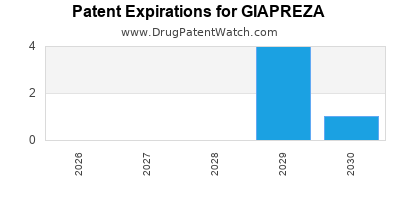
- patent expiration dates for key Orange Book-listed patents, plus
- end of regulatory exclusivity (if any),
- followed by first paragraph IV ANDA events (if relevant) and actual launch timelines post-approval.
For a credible revenue trajectory, you map:
- earliest “hard stop” (first expiration that could enable a generic approval),
- then “soft stop” (additional patents that survive longer and restrict launch scope),
- then actual adoption and tender winners in hospital procurement.
What is the Orange Book status of GIAPREZA and where do generics face Paragraph IV risk?
For hospital-facing branded injectables, Paragraph IV litigation is usually less about “winning at trial” and more about:
- settlement structures,
- launch delay via stay provisions,
- and label carve-out terms that preserve branded use.
What to look for in an Orange Book profile
- Listed patents and their expiration dates.
- Patent type codes (drug substance vs drug product vs method of use).
- Whether patents are subject to Hatch-Waxman litigation in ANDA challenges.
Generic entry scenarios
- Full-AB launch: fastest revenue pressure if generic is label equivalent and no product claims block it.
- Carve-out launch: slower share erosion if generic is restricted to subset of indications.
- Launch delay: settlement-driven postponement can temporarily stabilize revenue.
What GIAPREZA patent litigation affects generic timelines (ANDAs, settlements, and stays)?
Financial trajectory is highly sensitive to litigation outcomes because it affects:
- when a generic can market,
- whether the brand retains formulary position long enough to refresh contracts,
- and whether payers can force substitution immediately.
Settlement dynamics that matter commercially
- Co-pay to stay and mutual releases that delay entry.
- License terms that allow earlier non-competitive launch with restrictions.
- Agreements that define labeling scope to avoid direct competition in the protected indications.
How does GIAPREZA compare with generic metoclopramide and other PONV agents on cost and access?
Cost structure
- Generic metoclopramide products usually undercut branded pricing substantially.
- Branded survival in hospital systems depends on net price and access terms rather than list price.
Access and protocol fit
- If branded GIAPREZA is included in order sets for PONV rescue or migraine nausea, it can maintain volume even with generic alternatives available, at least until tender reopens.
- If not, branded usage tends to be episodic and quickly ceded to the lowest-net alternative.
Clinical differentiation
- For antiemetics in perioperative care, differentiation must translate into measurable protocol outcomes (fewer redoses, fewer failures, workflow advantages). Otherwise, procurement drives utilization.
What biosimilar risk applies to GIAPREZA?
No biosimilar risk applies because GIAPREZA is a small-molecule metoclopramide product, not a biologic. Competition comes from generics and potentially from other small-molecule antiemetics.
What manufacturing/IP barriers can block or slow generic entry for GIAPREZA?
Generic entrants must clear:
- process robustness (manufacturing reproducibility, impurity profile control),
- stability and shelf-life for the specific presentation,
- and any product/process patent claims that remain enforceable.
Even with a successful ANDA, launch may be delayed if:
- the generic presentation is not AB-rated,
- or it lacks stable supply at scale aligned with hospital distribution.
What is the revenue exposure profile for GIAPREZA if generic entry occurs?
Revenue exposure typically clusters in:
- hospital inpatient volumes tied to PONV protocols,
- ED volumes for acute nausea and migraine-related nausea where non-oral antiemetics are standard,
- and contracted IDNs whose formularies lock in for tender cycles.
Exposure escalators
- Broad AB-rated generic entry creates the highest exposure because hospitals can switch without label friction.
- Rapid tender cycles accelerate conversion from branded to generic.
Exposure mitigators
- If GIAPREZA is protected by product-specific patents that restrict AB equivalence or trigger label carve-outs, the revenue impact is mitigated but rarely eliminated.
Key takeaways on GIAPREZA market dynamics and financial trajectory
- GIAPREZA’s commercial outlook is constrained by generic metoclopramide substitution and hospital contracting mechanics.
- Demand is concentrated in protocol-driven PONV rescue and acute nausea/migraine workflows, where formulary access dictates volume.
- Financial trajectory is most sensitive to Orange Book patent expirations, Paragraph IV events, and litigation-driven settlement calendars.
- The product’s competitive edge depends on whether exclusivity/patent scope prevents AB-rated generic launch and whether it sustains preferential IDN and GPO contracts.
FAQs
- How quickly do US hospitals switch from branded metoclopramide injection to generic equivalents after FDA approval?
- Which antiemetics most commonly displace metoclopramide in PONV order sets: ondansetron, droperidol, or aprepitant?
- Do method-of-use patents for metoclopramide meaningfully delay ANDA approvals for PONV and migraine nausea?
- What role do GPO tenders and IDN contracting play in determining GIAPREZA net pricing versus list price?
- If GIAPREZA is challenged under Hatch-Waxman, do settlements usually preserve label carve-outs or only delay launch dates?
References (APA)
- FDA. Orange Book: Approved Drug Products with Therapeutic Equivalence Evaluations. US Food and Drug Administration. https://www.accessdata.fda.gov/scripts/cder/daf/
- FDA. Drugs@FDA. US Food and Drug Administration. https://www.accessdata.fda.gov/scripts/cder/daf/index.cfm