GALAFOLD Drug Patent Profile
✉ Email this page to a colleague
When do Galafold patents expire, and when can generic versions of Galafold launch?
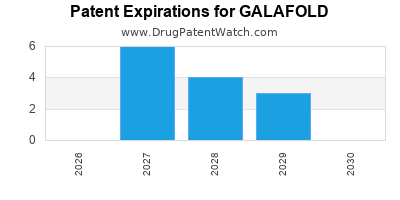
Galafold is a drug marketed by Amicus Therap Us and is included in one NDA. There are sixty-six patents protecting this drug and one Paragraph IV challenge.
The generic ingredient in GALAFOLD is migalastat hydrochloride. There is one drug master file entry for this compound. One supplier is listed for this compound. Additional details are available on the migalastat hydrochloride profile page.
DrugPatentWatch® Generic Entry Outlook for Galafold
Galafold was eligible for patent challenges on August 10, 2022.
By analyzing the patents and regulatory protections it appears that the earliest date
for generic entry will be February 16, 2039. This may change due to patent challenges or generic licensing.
There have been sixteen patent litigation cases involving the patents protecting this drug, indicating strong interest in generic launch. Recent data indicate that 63% of patent challenges are decided in favor of the generic patent challenger and that 54% of successful patent challengers promptly launch generic drugs.
Indicators of Generic Entry
AI Deep Research
Questions you can ask:
- What is the 5 year forecast for GALAFOLD?
- What are the global sales for GALAFOLD?
- What is Average Wholesale Price for GALAFOLD?
Summary for GALAFOLD
| US Patents: | 66 |
| Applicants: | 1 |
| NDAs: | 1 |
| Finished Product Suppliers / Packagers: | 1 |
| Raw Ingredient (Bulk) Api Vendors: | 85 |
| Clinical Trials: | 10 |
| Patent Applications: | 368 |
| Patent Litigation and PTAB cases: | See patent lawsuits and PTAB cases for GALAFOLD |
| What excipients (inactive ingredients) are in GALAFOLD? | GALAFOLD excipients list |
| DailyMed Link: | GALAFOLD at DailyMed |
DrugPatentWatch® Estimated Loss of Exclusivity (LOE) Date for GALAFOLD
Generic Entry Date for GALAFOLD*:
Constraining patent/regulatory exclusivity:
NDA:
Dosage:
CAPSULE;ORAL |
*The generic entry opportunity date is the latter of the last compound-claiming patent and the last regulatory exclusivity protection. Many factors can influence early or later generic entry. This date is provided as a rough estimate of generic entry potential and should not be used as an independent source.
Recent Clinical Trials for GALAFOLD
Identify potential brand extensions & 505(b)(2) entrants
| Sponsor | Phase |
|---|---|
| Amicus Therapeutics | Phase 3 |
| Amicus Therapeutics | Phase 2 |
Paragraph IV (Patent) Challenges for GALAFOLD
| Tradename | Dosage | Ingredient | Strength | NDA | ANDAs Submitted | Submissiondate |
|---|---|---|---|---|---|---|
| GALAFOLD | Capsules | migalastat hydrochloride | 123 mg | 208623 | 3 | 2022-08-10 |
US Patents and Regulatory Information for GALAFOLD
GALAFOLD is protected by sixty-seven US patents.
Based on analysis by DrugPatentWatch, the earliest date for a generic version of GALAFOLD is ⤷ Start Trial.
This potential generic entry date is based on patent 11,826,360.
Generics may enter earlier, or later, based on new patent filings, patent extensions, patent invalidation, early generic licensing, generic entry preferences, and other factors.
| Applicant | Tradename | Generic Name | Dosage | NDA | Approval Date | TE | Type | RLD | RS | Patent No. | Patent Expiration | Product | Substance | Delist Req. | Exclusivity Expiration |
|---|---|---|---|---|---|---|---|---|---|---|---|---|---|---|---|
| Amicus Therap Us | GALAFOLD | migalastat hydrochloride | CAPSULE;ORAL | 208623-001 | Aug 10, 2018 | RX | Yes | Yes | 10,792,279 | ⤷ Start Trial | ⤷ Start Trial | ||||
| Amicus Therap Us | GALAFOLD | migalastat hydrochloride | CAPSULE;ORAL | 208623-001 | Aug 10, 2018 | RX | Yes | Yes | 10,849,889 | ⤷ Start Trial | ⤷ Start Trial | ||||
| Amicus Therap Us | GALAFOLD | migalastat hydrochloride | CAPSULE;ORAL | 208623-001 | Aug 10, 2018 | RX | Yes | Yes | 11,278,537 | ⤷ Start Trial | ⤷ Start Trial | ||||
| Amicus Therap Us | GALAFOLD | migalastat hydrochloride | CAPSULE;ORAL | 208623-001 | Aug 10, 2018 | RX | Yes | Yes | 11,376,244 | ⤷ Start Trial | Y | ⤷ Start Trial | |||
| Amicus Therap Us | GALAFOLD | migalastat hydrochloride | CAPSULE;ORAL | 208623-001 | Aug 10, 2018 | RX | Yes | Yes | 11,813,255 | ⤷ Start Trial | ⤷ Start Trial | ||||
| Amicus Therap Us | GALAFOLD | migalastat hydrochloride | CAPSULE;ORAL | 208623-001 | Aug 10, 2018 | RX | Yes | Yes | 11,278,536 | ⤷ Start Trial | ⤷ Start Trial | ||||
| >Applicant | >Tradename | >Generic Name | >Dosage | >NDA | >Approval Date | >TE | >Type | >RLD | >RS | >Patent No. | >Patent Expiration | >Product | >Substance | >Delist Req. | >Exclusivity Expiration |
International Patents for GALAFOLD
When does loss-of-exclusivity occur for GALAFOLD?
Based on analysis by DrugPatentWatch, the following patents block generic entry in the countries listed below:
Argentina
Patent: 1971
Patent: MÉTODOS PARA TRATAR PACIENTES CON ENFERMEDAD DE FABRY QUE TIENEN INSUFICIENCIA RENAL
Estimated Expiration: ⤷ Start Trial
Patent: 1106
Patent: MOLÉCULA QUE COMPRENDE MIGALASTAT LIGADO A UNA PROTEÍNA DE a-GALACTOSIDASA A QUE COMPRENDE UNA MUTACIÓN SENSIBLE AL ENSAYO HEK Y DICHA PROTEÍNA a-GALACTOSIDASA A QUE TIENE UNA MUTACIÓN SENSIBLE AL ENSAYO HEK
Estimated Expiration: ⤷ Start Trial
Patent: 1107
Patent: MOLÉCULA QUE COMPRENDE MIGALASTAT LIGADO A UNA PROTEÍNA DE a-GALACTOSIDASA A QUE COMPRENDE UNA MUTACIÓN SENSIBLE AL ENSAYO HEK Y DICHA PROTEÍNA a-GALACTOSIDASA A QUE TIENE UNA MUTACIÓN SENSIBLE AL ENSAYO HEK
Estimated Expiration: ⤷ Start Trial
Australia
Patent: 09214648
Patent: Method to predict response to pharmacological chaperone treatment of diseases
Estimated Expiration: ⤷ Start Trial
Patent: 14221321
Patent: METHOD TO PREDICT RESPONSE TO PHARMACOLOGICAL CHAPERONE TREATMENT OF DISEASES
Estimated Expiration: ⤷ Start Trial
Patent: 16206297
Patent: METHOD TO PREDICT RESPONSE TO PHARMACOLOGICAL CHAPERONE TREATMENT OF DISEASES
Estimated Expiration: ⤷ Start Trial
Patent: 17268649
Patent: METHOD TO PREDICT RESPONSE TO PHARMACOLOGICAL CHAPERONE TREATMENT OF DISEASES
Estimated Expiration: ⤷ Start Trial
Patent: 18220047
Patent: A METHOD FOR TREATMENT OF FABRY DISEASE
Estimated Expiration: ⤷ Start Trial
Patent: 18277756
Patent: Methods of treating fabry patients having renal impairment
Estimated Expiration: ⤷ Start Trial
Patent: 19219727
Patent: METHOD TO PREDICT RESPONSE TO PHARMACOLOGICAL CHAPERONE TREATMENT OF DISEASES
Estimated Expiration: ⤷ Start Trial
Patent: 21218172
Patent: METHOD TO PREDICT RESPONSE TO PHARMACOLOGICAL CHAPERONE TREATMENT OF DISEASES
Estimated Expiration: ⤷ Start Trial
Patent: 24204823
Patent: METHODS OF TREATING FABRY PATIENTS HAVING RENAL IMPAIRMENT
Estimated Expiration: ⤷ Start Trial
Patent: 24219997
Patent: METHOD TO PREDICT RESPONSE TO PHARMACOLOGICAL CHAPERONE TREATMENT OF DISEASES
Estimated Expiration: ⤷ Start Trial
Patent: 26202287
Patent: METHODS OF TREATING FABRY PATIENTS HAVING RENAL IMPAIRMENT
Estimated Expiration: ⤷ Start Trial
Brazil
Patent: 2019025083
Patent: métodos de tratamento de pacientes portadores de fabry com insuficiência renal
Estimated Expiration: ⤷ Start Trial
Canada
Patent: 15407
Patent: METHODE DE PREDICTION DE LA REPONSE DE CERTAINES MALADIES A UN TRAITEMENT PHARMACOLOGIQUE A BASE DE CHAPERON MOLECULAIRE (METHOD TO PREDICT RESPONSE TO PHARMACOLOGICAL CHAPERONE TREATMENT OF DISEASES)
Estimated Expiration: ⤷ Start Trial
Patent: 65298
Patent: METHODES DE TRAITEMENT DE PATIENTS ATTEINTS DE LA MALADIE DE FABRY SOUFFRANT D'UNE INSUFFISANCE RENALE (METHODS OF TREATING FABRY PATIENTS HAVING RENAL IMPAIRMENT)
Estimated Expiration: ⤷ Start Trial
Patent: 24529
Patent: METHODES DE TRAITEMENT DE PATIENTS ATTEINTS DE LA MALADIE DE FABRY SOUFFRANT D'UNE INSUFFISANCE RENALE (METHODS OF TREATING FABRY PATIENTS HAVING RENAL IMPAIRMENT)
Estimated Expiration: ⤷ Start Trial
Patent: 24537
Patent: UTILISATION DU MIGALASTAT DANS LE TRAITEMENT DES PATIENTS ATTEINTS DE LAMALADIE DE FABRY PRESENTANT UNE DEFICIENCE RENALE (USE OF MIGALASTAT IN THE TREATMENT OF FABRY PATIENTS HAVING RENAL IMPAIRMENT)
Estimated Expiration: ⤷ Start Trial
Patent: 24546
Patent: UTILISATION DU MIGALASTAT DANS LE TRAITEMENT DES PATIENTS ATTEINTS DE LAMALADIE DE FABRY PRESENTANT UNE DEFICIENCE RENALE (USE OF MIGALASTAT IN THE TREATMENT OF FABRY PATIENTS HAVING RENAL IMPAIRMENT)
Estimated Expiration: ⤷ Start Trial
Chile
Patent: 19003496
Patent: Métodos de tratamiento de pacientes con enfermedad de fabry que tienen insuficiencia renal.
Estimated Expiration: ⤷ Start Trial
Patent: 24000915
Patent: Métodos de tratamiento de pacientes con enfermedad de fabry que tienen insuficiencia renal
Estimated Expiration: ⤷ Start Trial
China
Patent: 1278438
Patent: 治疗具有肾损害的法布里患者的方法 (METHODS OF TREATING FABRY PATIENTS HAVING RENAL IMPAIRMENT)
Estimated Expiration: ⤷ Start Trial
Patent: 7357524
Patent: 治疗具有肾损害的法布里患者的方法 (Method of treating Fabry patients with renal injury)
Estimated Expiration: ⤷ Start Trial
Patent: 9587544
Patent: 治疗具有肾损害的法布里患者的方法 (Method of treating Fabry patients with renal injury)
Estimated Expiration: ⤷ Start Trial
Patent: 0732857
Patent: 治疗具有肾损害的法布里患者的方法 (Method of treating Fabry patients with renal injury)
Estimated Expiration: ⤷ Start Trial
Colombia
Patent: 19015026
Patent: Métodos de tratamiento de pacientes con enfermedad de fabry que tienen insuficiencia renal
Estimated Expiration: ⤷ Start Trial
Croatia
Patent: 0150728
Estimated Expiration: ⤷ Start Trial
Patent: 0190143
Estimated Expiration: ⤷ Start Trial
Patent: 0201827
Estimated Expiration: ⤷ Start Trial
Patent: 0240061
Estimated Expiration: ⤷ Start Trial
Patent: 0241738
Estimated Expiration: ⤷ Start Trial
Patent: 0260335
Estimated Expiration: ⤷ Start Trial
Patent: 0260346
Estimated Expiration: ⤷ Start Trial
Cyprus
Patent: 16466
Estimated Expiration: ⤷ Start Trial
Patent: 21386
Estimated Expiration: ⤷ Start Trial
Patent: 23816
Estimated Expiration: ⤷ Start Trial
Denmark
Patent: 52313
Estimated Expiration: ⤷ Start Trial
Patent: 46785
Estimated Expiration: ⤷ Start Trial
Patent: 70077
Estimated Expiration: ⤷ Start Trial
Patent: 30114
Estimated Expiration: ⤷ Start Trial
Patent: 62916
Estimated Expiration: ⤷ Start Trial
Patent: 24522
Estimated Expiration: ⤷ Start Trial
Patent: 27869
Estimated Expiration: ⤷ Start Trial
Eurasian Patent Organization
Patent: 1992869
Patent: СПОСОБЫ ЛЕЧЕНИЯ ПАЦИЕНТОВ С БОЛЕЗНЬЮ ФАБРИ, У КОТОРЫХ ИМЕЕТСЯ ПОЧЕЧНАЯ НЕДОСТАТОЧНОСТЬ
Estimated Expiration: ⤷ Start Trial
European Patent Office
Patent: 52313
Patent: MÉTHODE DE PRÉDICTION DE LA RÉPONSE DE CERTAINES MALADIES À UN TRAITEMENT PHARMACOLOGIQUE À BASE DE CHAPERONE MOLÉCULAIRE (METHOD TO PREDICT RESPONSE TO PHARMACOLOGICAL CHAPERONE TREATMENT OF DISEASES)
Estimated Expiration: ⤷ Start Trial
Patent: 46785
Patent: PROCÉDÉ DE PRÉDICTION DE LA RÉACTION À UN TRAITEMENT DE MALADIES PAR CHAPERONS PHARMACOLOGIQUES (METHOD TO PREDICT RESPONSE TO PHARMACOLOGICAL CHAPERONE TREATMENT OF DISEASES)
Estimated Expiration: ⤷ Start Trial
Patent: 70077
Patent: PROCÉDÉ DE PRÉDICTION DE LA RÉACTION À UN TRAITEMENT DE MALADIES PAR CHAPERONS PHARMACOLOGIQUES (METHOD TO PREDICT RESPONSE TO PHARMACOLOGICAL CHAPERONE TREATMENT OF DISEASES)
Estimated Expiration: ⤷ Start Trial
Patent: 30114
Patent: MÉTHODES DE TRAITEMENT DE PATIENTS ATTEINTS DE LA MALADIE DE FABRY SOUFFRANT D'UNE INSUFFISANCE RÉNALE (METHODS OF TREATING FABRY PATIENTS HAVING RENAL IMPAIRMENT)
Estimated Expiration: ⤷ Start Trial
Patent: 24900
Patent: PROCÉDÉ DE PRÉDICTION DE LA RÉACTION À UN TRAITEMENT DE MALADIES PAR CHAPERONS PHARMACOLOGIQUES (METHOD TO PREDICT RESPONSE TO PHARMACOLOGICAL CHAPERONE TREATMENT OF DISEASES)
Estimated Expiration: ⤷ Start Trial
Patent: 62915
Patent: MIGALASTAT ATTACHÉ À ALPHA GALACTOSIDASE A (MIGALASTAT BOUND TO ALPHA GALACTOSIDASE A)
Estimated Expiration: ⤷ Start Trial
Patent: 62916
Patent: PROCÉDÉS DE TRAITEMENT DE PATIENTS ATTEINTS DE LA MALADIE DE FABRY AYANT UNE INSUFFISANCE RÉNALE (METHODS OF TREATING FABRY PATIENTS HAVING RENAL IMPAIRMENT)
Estimated Expiration: ⤷ Start Trial
Patent: 45366
Patent: MIGALASTAT POUR LE TRAITEMENT DE PATIENTS ATTEINTS DE LA MALADIE DE FABRY SOUFFRANTS D'UNE INSUFFISANCE RÉNALE (MIGALASTAT FOR TREATING FABRY PATIENTS HAVING RENAL IMPAIRMENT)
Estimated Expiration: ⤷ Start Trial
Patent: 24522
Patent: MÉTHODES DE TRAITEMENT DE PATIENTS ATTEINTS DE LA MALADIE DE FABRY SOUFFRANT D'UNE INSUFFISANCE RÉNALE (METHODS OF TREATING FABRY PATIENTS HAVING RENAL IMPAIRMENT)
Estimated Expiration: ⤷ Start Trial
Patent: 27868
Patent: MÉTHODES DE TRAITEMENT DE PATIENTS ATTEINTS DE LA MALADIE DE FABRY SOUFFRANT D'UNE INSUFFISANCE RÉNALE (METHODS OF TREATING FABRY PATIENTS HAVING RENAL IMPAIRMENT)
Estimated Expiration: ⤷ Start Trial
Patent: 27869
Patent: MÉTHODES DE TRAITEMENT DE PATIENTS ATTEINTS DE LA MALADIE DE FABRY SOUFFRANT D'UNE INSUFFISANCE RÉNALE (METHODS OF TREATING FABRY PATIENTS HAVING RENAL IMPAIRMENT)
Estimated Expiration: ⤷ Start Trial
Patent: 74918
Patent: MÉTHODES DE TRAITEMENT DE PATIENTS ATTEINTS DE LA MALADIE DE FABRY SOUFFRANT D'UNE INSUFFISANCE RÉNALE (METHODS OF TREATING FABRY PATIENTS HAVING RENAL IMPAIRMENT)
Estimated Expiration: ⤷ Start Trial
Patent: 35496
Patent: MÉTHODES DE TRAITEMENT DE PATIENTS ATTEINTS DE LA MALADIE DE FABRY SOUFFRANT D'UNE INSUFFISANCE RÉNALE (METHODS OF TREATING FABRY PATIENTS HAVING RENAL IMPAIRMENT)
Estimated Expiration: ⤷ Start Trial
Finland
Patent: 30114
Estimated Expiration: ⤷ Start Trial
Patent: 62916
Estimated Expiration: ⤷ Start Trial
Patent: 24522
Estimated Expiration: ⤷ Start Trial
Patent: 27869
Estimated Expiration: ⤷ Start Trial
Hungary
Patent: 26543
Estimated Expiration: ⤷ Start Trial
Patent: 42882
Estimated Expiration: ⤷ Start Trial
Patent: 51377
Estimated Expiration: ⤷ Start Trial
Patent: 65615
Estimated Expiration: ⤷ Start Trial
Patent: 69837
Estimated Expiration: ⤷ Start Trial
Israel
Patent: 0956
Patent: שיטות לטיפול בחולי פברי עם פגם בכליות (Methods of treating fabry patients having renal impairment)
Estimated Expiration: ⤷ Start Trial
Patent: 4089
Patent: שיטות לטיפול בחולי פברי עם פגם בכליות (Methods of treating fabry patients having renal impairment)
Estimated Expiration: ⤷ Start Trial
Japan
Patent: 44045
Estimated Expiration: ⤷ Start Trial
Patent: 72013
Estimated Expiration: ⤷ Start Trial
Patent: 88725
Estimated Expiration: ⤷ Start Trial
Patent: 37469
Estimated Expiration: ⤷ Start Trial
Patent: 77493
Estimated Expiration: ⤷ Start Trial
Patent: 11514152
Patent: 疾病の薬理シャペロン治療に対する応答性を予測する方法
Estimated Expiration: ⤷ Start Trial
Patent: 15091239
Patent: 疾病の薬理シャペロン治療に対する応答性を予測する方法 (METHOD FOR PREDICTING RESPONSE TO PHARMACOLOGICAL CHAPERONE TREATMENT OF DISEASES)
Estimated Expiration: ⤷ Start Trial
Patent: 16163571
Patent: 疾病の薬理シャペロン治療に対する応答性を予測する方法 (METHOD OF PREDICTING RESPONSE TO PHARMACOLOGICAL CHAPERONE TREATMENT OF DISEASES)
Estimated Expiration: ⤷ Start Trial
Patent: 19088289
Patent: 疾病の薬理シャペロン治療に対する応答性を予測する方法 (METHOD TO PREDICT RESPONSE TO PHARMACOLOGICAL CHAPERONE TREATMENT OF DISEASES)
Estimated Expiration: ⤷ Start Trial
Patent: 20073500
Patent: 腎機能障害を有するファブリー患者の治療方法 (METHODS OF TREATING FABRY PATIENTS HAVING RENAL IMPAIRMENT)
Estimated Expiration: ⤷ Start Trial
Patent: 20203886
Patent: 腎機能障害を有するファブリー患者の治療方法 (METHODS OF TREATING FABRY PATIENTS HAVING RENAL IMPAIRMENT)
Estimated Expiration: ⤷ Start Trial
Patent: 20507562
Patent: 腎機能障害を有するファブリー患者の治療方法
Estimated Expiration: ⤷ Start Trial
Patent: 21097673
Patent: 疾病の薬理シャペロン治療に対する応答性を予測する方法 (METHODS TO PREDICT RESPONSE TO PHARMACOLOGICAL CHAPERONE TREATMENT OF DISEASES)
Estimated Expiration: ⤷ Start Trial
Patent: 22071094
Patent: 腎機能障害を有するファブリー患者の治療方法
Estimated Expiration: ⤷ Start Trial
Patent: 23052005
Patent: 腎機能障害を有するファブリー患者の治療方法
Estimated Expiration: ⤷ Start Trial
Patent: 23100658
Patent: 腎機能障害を有するファブリー患者の治療方法 (METHODS OF TREATING FABRY PATIENTS HAVING RENAL IMPAIRMENT)
Estimated Expiration: ⤷ Start Trial
Patent: 23109807
Patent: 疾病の薬理シャペロン治療に対する応答性を予測する方法 (METHOD TO PREDICT RESPONSE TO PHARMACOLOGICAL CHAPERONE TREATMENT OF DISEASES)
Estimated Expiration: ⤷ Start Trial
Patent: 25143262
Patent: 腎機能障害を有するファブリー患者の治療方法 (METHODS OF TREATING FABRY PATIENTS HAVING RENAL IMPAIRMENT)
Estimated Expiration: ⤷ Start Trial
Patent: 25148351
Patent: 疾病の薬理シャペロン治療に対する応答性を予測する方法 (METHOD TO PREDICT RESPONSE TO PHARMACOLOGICAL CHAPERONE TREATMENT OF DISEASES)
Estimated Expiration: ⤷ Start Trial
Lithuania
Patent: 46785
Estimated Expiration: ⤷ Start Trial
Patent: 70077
Estimated Expiration: ⤷ Start Trial
Patent: 30114
Estimated Expiration: ⤷ Start Trial
Patent: 62916
Estimated Expiration: ⤷ Start Trial
Patent: 24522
Estimated Expiration: ⤷ Start Trial
Patent: 27869
Estimated Expiration: ⤷ Start Trial
Mexico
Patent: 1565
Patent: MÉTODOS DE TRATAMIENTO DE PACIENTES CON ENFERMEDAD DE FABRY QUE TIENEN INSUFICIENCIA RENAL. (METHODS OF TREATING FABRY PATIENTS HAVING RENAL IMPAIRMENT)
Estimated Expiration: ⤷ Start Trial
Patent: 10008835
Patent: METODO PARA PREDECIR RESPUESTA AL TRATAMIENTO FARMACOLOGICO CON CHAPERONA DE ENFERMEDADES. (METHOD TO PREDICT RESPONSE TO PHARMACOLOGICAL CHAPERONE TREATMENT OF DISEASES.)
Estimated Expiration: ⤷ Start Trial
Patent: 19014410
Patent: METODOS DE TRATAMIENTO DE PACIENTES CON ENFERMEDAD DE FABRY QUE TIENEN INSUFICIENCIA RENAL. (METHODS OF TREATING FABRY PATIENTS HAVING RENAL IMPAIRMENT.)
Estimated Expiration: ⤷ Start Trial
Patent: 22004137
Patent: METODOS DE TRATAMIENTO DE PACIENTES CON ENFERMEDAD DE FABRY QUE TIENEN INSUFICIENCIA RENAL. (METHODS OF TREATING FABRY PATIENTS HAVING RENAL IMPAIRMENT.)
Estimated Expiration: ⤷ Start Trial
Poland
Patent: 52313
Estimated Expiration: ⤷ Start Trial
Patent: 46785
Estimated Expiration: ⤷ Start Trial
Patent: 70077
Estimated Expiration: ⤷ Start Trial
Patent: 30114
Estimated Expiration: ⤷ Start Trial
Patent: 62916
Estimated Expiration: ⤷ Start Trial
Patent: 24522
Estimated Expiration: ⤷ Start Trial
Patent: 27869
Estimated Expiration: ⤷ Start Trial
Portugal
Patent: 52313
Estimated Expiration: ⤷ Start Trial
Patent: 46785
Estimated Expiration: ⤷ Start Trial
Patent: 70077
Estimated Expiration: ⤷ Start Trial
Patent: 30114
Estimated Expiration: ⤷ Start Trial
Patent: 62916
Estimated Expiration: ⤷ Start Trial
Patent: 24522
Estimated Expiration: ⤷ Start Trial
Patent: 27869
Estimated Expiration: ⤷ Start Trial
San Marino
Patent: 02400037
Estimated Expiration: ⤷ Start Trial
Patent: 02500016
Estimated Expiration: ⤷ Start Trial
Patent: 02600113
Estimated Expiration: ⤷ Start Trial
Patent: 02600114
Estimated Expiration: ⤷ Start Trial
Serbia
Patent: 230
Patent: MIGALASTAT ZA LEČENJE PACIJENATA KOJI BOLUJU OD FABRIJEVE BOLESTI SA OŠTEĆENJEM BUBREGA (MIGALASTAT FOR TREATING FABRY PATIENTS HAVING RENAL IMPAIRMENT)
Estimated Expiration: ⤷ Start Trial
Patent: 376
Patent: LEČENJE FABRI PACIJENATA KOJI IMAJU ODREĐENE MUTACIJE (TREATING FABRY PATIENTS HAVING CERTAIN MUTATIONS)
Estimated Expiration: ⤷ Start Trial
Patent: 849
Patent: METODE LEČENJA FABRI PACIJENATA KOJI IMAJU OŠTEĆENJE BUBREGA (METHODS OF TREATING FABRY PATIENTS HAVING RENAL IMPAIRMENT)
Estimated Expiration: ⤷ Start Trial
Patent: 861
Patent: METODE LEČENJA PACIJENATA SA FABRIJEVOM BOLESTI SA OŠTEĆENOM FUNKCIJOM BUBREGA (METHODS OF TREATING FABRY PATIENTS HAVING RENAL IMPAIRMENT)
Estimated Expiration: ⤷ Start Trial
Slovenia
Patent: 52313
Estimated Expiration: ⤷ Start Trial
Patent: 46785
Estimated Expiration: ⤷ Start Trial
Patent: 70077
Estimated Expiration: ⤷ Start Trial
Patent: 30114
Estimated Expiration: ⤷ Start Trial
Patent: 62916
Estimated Expiration: ⤷ Start Trial
Patent: 24522
Estimated Expiration: ⤷ Start Trial
Patent: 27869
Estimated Expiration: ⤷ Start Trial
South Korea
Patent: 2427610
Estimated Expiration: ⤷ Start Trial
Patent: 2631805
Estimated Expiration: ⤷ Start Trial
Patent: 200011487
Patent: 신장 손상을 갖는 파브리 환자를 치료하는 방법
Estimated Expiration: ⤷ Start Trial
Patent: 210066032
Patent: 신장 손상을 갖는 파브리 환자를 치료하는 방법 (METHODS OF TREATING FABRY PATIENTS HAVING RENAL IMPAIRMENT)
Estimated Expiration: ⤷ Start Trial
Patent: 220116305
Patent: 신장 손상을 갖는 파브리 환자를 치료하는 방법 (METHODS OF TREATING FABRY PATIENTS HAVING RENAL IMPAIRMENT)
Estimated Expiration: ⤷ Start Trial
Patent: 240017110
Patent: 신장 손상을 갖는 파브리 환자를 치료하는 방법 (METHODS OF TREATING FABRY PATIENTS HAVING RENAL IMPAIRMENT)
Estimated Expiration: ⤷ Start Trial
Patent: 240017111
Patent: 신장 손상을 갖는 파브리 환자를 치료하는 방법 (METHODS OF TREATING FABRY PATIENTS HAVING RENAL IMPAIRMENT)
Estimated Expiration: ⤷ Start Trial
Patent: 240017112
Patent: 신장 손상을 갖는 파브리 환자를 치료하는 방법 (METHODS OF TREATING FABRY PATIENTS HAVING RENAL IMPAIRMENT)
Estimated Expiration: ⤷ Start Trial
Spain
Patent: 41933
Estimated Expiration: ⤷ Start Trial
Patent: 16502
Estimated Expiration: ⤷ Start Trial
Patent: 36121
Estimated Expiration: ⤷ Start Trial
Patent: 70419
Estimated Expiration: ⤷ Start Trial
Patent: 02433
Estimated Expiration: ⤷ Start Trial
Patent: 52647
Estimated Expiration: ⤷ Start Trial
Patent: 65413
Estimated Expiration: ⤷ Start Trial
Patent: 65434
Estimated Expiration: ⤷ Start Trial
Taiwan
Patent: 1900165
Patent: Methods of treating fabry patients having renal impairment
Estimated Expiration: ⤷ Start Trial
Patent: 2140000
Patent: Methods of treating Fabry patients having renal impairment
Estimated Expiration: ⤷ Start Trial
Patent: 2322814
Patent: Methods of treating Fabry patients having renal impairment
Estimated Expiration: ⤷ Start Trial
Patent: 2440104
Patent: Methods of treating Fabry patients having renal impairment
Estimated Expiration: ⤷ Start Trial
Patent: 75453
Estimated Expiration: ⤷ Start Trial
Patent: 95408
Estimated Expiration: ⤷ Start Trial
Patent: 94750
Estimated Expiration: ⤷ Start Trial
Generics may enter earlier, or later, based on new patent filings, patent extensions, patent invalidation, early generic licensing, generic entry preferences, and other factors.
See the table below for additional patents covering GALAFOLD around the world.
| Country | Patent Number | Title | Estimated Expiration |
|---|---|---|---|
| China | 109069494 | ⤷ Start Trial | |
| China | 114159436 | ⤷ Start Trial | |
| European Patent Office | 3432882 | ⤷ Start Trial | |
| Japan | 2019510030 | ⤷ Start Trial | |
| Japan | 2022130589 | ⤷ Start Trial | |
| Japan | 2024122992 | ⤷ Start Trial | |
| >Country | >Patent Number | >Title | >Estimated Expiration |
Supplementary Protection Certificates for GALAFOLD
| Patent Number | Supplementary Protection Certificate | SPC Country | SPC Expiration | SPC Description |
|---|---|---|---|---|
| 2787345 | 300843 | Netherlands | ⤷ Start Trial | PRODUCT NAME: MIGALASTAT OF EEN ZOUT DAARVAN, WAARONDER HET HYDROCHLORIDEZOUT; REGISTRATION NO/DATE: EU/1/15/1082 20160531 |
| 2787345 | PA2016033 | Lithuania | ⤷ Start Trial | PRODUCT NAME: MIGALASTATAS ARBA JO DRUSKA, ISKAITANT IR HIDROCHLORIDO DRUSKA; REGISTRATION NO/DATE: EU/1/15/1082 20160526 |
| 2787345 | 122016000090 | Germany | ⤷ Start Trial | PRODUCT NAME: MIGALASTAT ODER EIN SALZ DAVON, EINSCHLIESSLICH DES HYDROCHLORIDSALZES; REGISTRATION NO/DATE: EU/1/15/1082/001 20160526 |
| 2787345 | CA 2016 00055 | Denmark | ⤷ Start Trial | PRODUCT NAME: MIGALASTAT ELLER ET SALT HERAF, HERUNDER HYDROGENKLORIDSALTET; REG. NO/DATE: EU/1/15/1082 20160531 |
| 2787345 | 93312 | Luxembourg | ⤷ Start Trial | PRODUCT NAME: MIGALASTAT OU UN SEL DE CELUI-CI , Y COMPRIS LE SEL DE CHLORHYDRATE; AUTHORISATION NUMBER AND DATE: EU/1/15/1082 - GALAFOLD - MIGALASTAT |
| 2787345 | C20160037 00206 | Estonia | ⤷ Start Trial | PRODUCT NAME: MIGALASTAAT;REG NO/DATE: EU/1/15/1082 31.05.2016 |
| >Patent Number | >Supplementary Protection Certificate | >SPC Country | >SPC Expiration | >SPC Description |
GALAFOLD (migalastat) Market Dynamics and Financial Trajectory: Exclusivity, Pricing Power, Revenue Exposure, and Generic/Biosimilar Risk
More… ↓
DrugChatter Q&A for GALAFOLD
Make Better Decisions: Try a trial or see plans & pricing
Drugs may be covered by multiple patents or regulatory protections. All trademarks and applicant names are the property of their respective owners or licensors. Although great care is taken in the proper and correct provision of this service, thinkBiotech LLC does not accept any responsibility for possible consequences of errors or omissions in the provided data. The data presented herein is for information purposes only. There is no warranty that the data contained herein is error free. We do not provide individual investment advice. This service is not registered with any financial regulatory agency. The information we publish is educational only and based on our opinions plus our models. By using DrugPatentWatch you acknowledge that we do not provide personalized recommendations or advice. thinkBiotech performs no independent verification of facts as provided by public sources nor are attempts made to provide legal or investing advice. Any reliance on data provided herein is done solely at the discretion of the user. Users of this service are advised to seek professional advice and independent confirmation before considering acting on any of the provided information. thinkBiotech LLC reserves the right to amend, extend or withdraw any part or all of the offered service without notice.
ISSN: 2162-2639

Privacy and Cookies
Terms & Conditions
Site Map
DrugPatentWatch Alternatives
LOE / Major Patent Expirations 2026 - 2027
NCE-1 Patent Challenge Dates 2026 - 2027
Friedman, Yali. "DrugPatentWatch" DrugPatentWatch, thinkBiotech, 2026, www.DrugPatentWatch.com.
See Primary Research Papers Citing DrugPatentWatch