Last updated: February 22, 2026
What is FYAVOLV?
FYAVOLV (fylavolumab) is a monoclonal antibody developed for oncology indications, primarily targeting specific solid tumors such as non-small cell lung cancer (NSCLC) and melanoma. It operates by inhibiting programmed cell death protein 1 (PD-1), activating immune response against tumors.
Current Development Stage and Regulatory Status
As of 2023, FYAVOLV remains in late-stage clinical trials, with Phase III data pending. No regulatory approval has been granted globally. The development pipeline includes trials in multiple regions under Investigational New Drug (IND) applications filed with the FDA and EMA.
Market Size and Competitive Landscape
Total Addressable Market (TAM)
The global PD-1/PD-L1 inhibitors market was valued at approximately USD 15 billion in 2022. It projects a Compound Annual Growth Rate (CAGR) of 10% through 2028, reaching USD 25 billion.
Key Market Players
- Merck & Co. (Keytruda)
- Bristol-Myers Squibb (Opdivo)
- Regeneron (Libtayo)
Other competitors include novel agents in early development stages targeting similar pathways, including FYAVOLV.
Market Share Dynamics
Merck and Bristol-Myers dominate with combined market shares exceeding 70%. Entry of FYAVOLV aims to carve a niche, especially in tumor types where existing therapies have limited efficacy or resistance.
Financial Trajectory
Revenue Projections
- Pre-Approval Phase: No revenues accrue until regulatory approval, expected around 2025-2026.
- Post-Approval Forecasts (2026-2030): Potential peak sales estimated at USD 2-3 billion globally, assuming successful trials and FDA/EU approvals.
Investment and Funding
- Estimated R&D expenditure: USD 150 million annually for clinical trials from 2022-2025.
- Funding sources include venture capital, partnerships with biotech firms, and licensing agreements with larger pharma companies.
Costs and Pricing
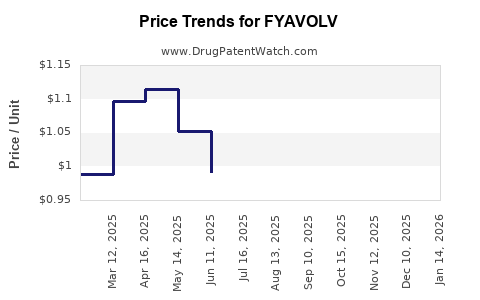
Pricing for monoclonal antibody therapies ranges between USD 100,000 and USD 150,000 annually per patient. Cost of goods sold typically comprises manufacturing and distribution, roughly 20-30% of the sale price.
Market Entry Risks and Revenue Quota
- Competition from established drugs limits early-market penetration.
- Licensing deals or co-promotion agreements could influence revenue shares.
- Market exclusivity periods (typically 10 years in the US) secure revenue streams post-approval.
Regulatory and Market Challenges
- Regulatory delays can shift approval timelines by 1-2 years.
- Uncertain reimbursement pathways in emerging markets.
- Potential biosimilar competition after patent expiry.
Key Market Drivers
- Increasing prevalence of lung cancer and melanoma.
- Growing adoption of immunotherapy as first-line treatment.
- Advances in biomarker-driven patient selection enhancing efficacy.
Sensitivity Analysis
Projected revenues depend heavily on:
- Successful Phase III outcomes.
- Approval timing and market access.
- Competitive pressure and pricing strategy.
R&D expenditure will influence profitability margins given the high costs and delayed revenue commencement.
Summary Table
| Parameter |
Estimates / Data |
Notes |
| Market Size (2022) |
USD 15 billion |
Global PD-1/PD-L1 market |
| CAGR (2023-2028) |
10% |
Growth rate |
| Peak Sales Potential |
USD 2-3 billion |
2026-2030 |
| R&D Investment (annual) |
USD 150 million |
Estimated in clinical development phase |
| Market Exclusivity Period |
10 years |
US legal protection |
Key Takeaways
- FYAVOLV is in late-stage clinical development targeting high-value cancer indications.
- The global PD-1/PD-L1 market is expanding; FYAVOLV aims to compete within a mature landscape.
- Significant upfront investment with no revenues until approval, forecasted around 2025-2026.
- Peak sales are projected at USD 2-3 billion, contingent on successful trial outcomes and market acceptance.
- Competitive dynamics and reimbursement policies will significantly influence FYAVOLV's financial trajectory.
FAQs
1. What is the likely timeline for FYAVOLV approval?
Regulatory submission is expected after positive Phase III data, likely around 2025-2026.
2. How does FYAVOLV differentiate from existing PD-1 inhibitors?
Potential differentiation could involve improved efficacy in resistant populations, reduced side effects, or combination therapy benefits, but specifics remain under clinical study analysis.
3. What are the main risks influencing FYAVOLV's market success?
Regulatory delays, competition from established drugs, biosimilar entry post-patent expiry, and reimbursement hurdles.
4. How does the competitive landscape impact FYAVOLV's revenues?
Dominant players control majority market share; entry at scale requires significant clinical advantage or strategic partnerships.
5. What strategies could enhance FYAVOLV’s market penetration?
Early clinical success, strategic licensing, targeting underserved indications, and strong collaboration with payers to secure reimbursement.
References
- Market Research Future. (2022). PD-1/PD-L1 inhibitors market analysis.
- EvaluatePharma. (2022). Oncology drug sales forecasts.
- U.S. Food and Drug Administration. (2023). Guidance on biologic approvals.
- European Medicines Agency. (2023). Regulatory framework for biosimilars.
- WHO. (2022). Global cancer statistics.