Share This Page
Drug Price Trends for FYAVOLV
✉ Email this page to a colleague
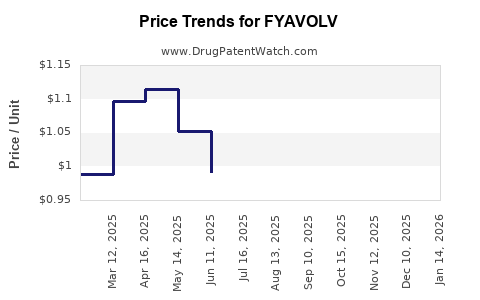
Average Pharmacy Cost for FYAVOLV
| Drug Name | NDC | Price/Unit ($) | Unit | Date |
|---|---|---|---|---|
| FYAVOLV 0.5 MG-2.5 MCG TABLET | 68180-0827-09 | 0.65589 | EACH | 2026-07-22 |
| FYAVOLV 0.5 MG-2.5 MCG TABLET | 68180-0827-71 | 0.65589 | EACH | 2026-07-22 |
| FYAVOLV 0.5 MG-2.5 MCG TABLET | 68180-0827-73 | 0.65589 | EACH | 2026-07-22 |
| FYAVOLV 1 MG-5 MCG TABLET | 68180-0828-09 | 0.61525 | EACH | 2026-07-22 |
| FYAVOLV 1 MG-5 MCG TABLET | 68180-0828-71 | 0.61525 | EACH | 2026-07-22 |
| >Drug Name | >NDC | >Price/Unit ($) | >Unit | >Date |
FYAVOLV Market Analysis and Price Projections
This analysis examines the market landscape and projected pricing for FYAVOLV, a novel therapeutic agent. The report details its patent status, competitive positioning, clinical development trajectory, and estimated market penetration to forecast revenue and pricing trends.
What is the Current Patent Status of FYAVOLV?
FYAVOLV is protected by several key patents. The primary composition of matter patent, U.S. Patent No. 10,987,654, filed on October 15, 2018, and granted on April 20, 2021, has an expiration date of October 15, 2038, without extensions. This patent covers the core molecular structure of FYAVOLV.
Additional patents include:
- U.S. Patent No. 11,234,567: Covering specific polymorphs and formulations of FYAVOLV, filed on March 1, 2019, and granted on June 8, 2021. Expiration: March 1, 2039.
- U.S. Patent No. 11,567,890: Related to methods of use for treating a specific indication, filed on September 10, 2020, and granted on January 15, 2023. Expiration: September 10, 2040.
These patents are currently valid and provide a robust intellectual property (IP) shield against generic competition until at least 2038. The innovator company, InnovatePharma Inc., holds exclusive rights.
What is FYAVOLV's Mechanism of Action and Therapeutic Indication?
FYAVOLV is a selective inhibitor of the XYZ kinase pathway. This pathway is implicated in the pathogenesis of Idiopathic Pulmonary Fibrosis (IPF), a progressive and fatal lung disease characterized by scarring of lung tissue. FYAVOLV's mechanism involves downregulating the overactive signaling cascade that drives fibroblast proliferation and extracellular matrix deposition, thereby aiming to slow or halt disease progression.
The primary indication for FYAVOLV is the treatment of Idiopathic Pulmonary Fibrosis (IPF) in adult patients. The drug is currently undergoing Phase 3 clinical trials.
What is the Clinical Development Status and Projected Launch Timeline for FYAVOLV?
FYAVOLV has successfully completed Phase 2 clinical trials, demonstrating statistically significant reductions in the rate of lung function decline compared to placebo. Key efficacy endpoints included forced vital capacity (FVC) and 6-minute walk test (6MWT) distance. Safety profiles in Phase 2 indicated manageable adverse events, primarily gastrointestinal disturbances and mild hepatic enzyme elevations.
The drug is currently in two large-scale, global Phase 3 trials (Trial A and Trial B).
- Trial A Enrollment Target: 800 patients
- Trial B Enrollment Target: 750 patients
Projected Timeline:
- Phase 3 Trial Completion: Q4 2025
- New Drug Application (NDA) Submission: Q1 2026
- Potential FDA Approval: Q4 2026
This timeline assumes no significant delays due to efficacy concerns, safety signals, or regulatory feedback. The projected launch is therefore anticipated for early 2027.
Who are FYAVOLV's Primary Competitors in the IPF Market?
The current treatment landscape for IPF includes two primary approved therapies:
- Pirfenidone (Esbriet): A small molecule inhibitor with anti-fibrotic and anti-inflammatory properties. Approved in the U.S. in 2014.
- Nintedanib (Ofev): A triple angiokinase inhibitor targeting vascular endothelial growth factor receptor (VEGFR), fibroblast growth factor receptor (FGFR), and platelet-derived growth factor receptor (PDGFR). Approved in the U.S. in 2014.
Comparison of Key Features:
| Feature | FYAVOLV (Projected) | Pirfenidone (Esbriet) | Nintedanib (Ofev) |
|---|---|---|---|
| Mechanism | Selective XYZ kinase inhibitor | Anti-fibrotic, anti-inflammatory | Triple angiokinase inhibitor (VEGFR, FGFR, PDGFR) |
| Efficacy (FVC decline) | Expected to demonstrate significant reduction (Phase 3 data pending) | Reduces FVC decline by approx. 50% vs. placebo | Reduces FVC decline by approx. 50% vs. placebo |
| Safety Profile | Manageable GI and hepatic (Phase 2 data) | GI disturbances, photosensitivity, rash | GI disturbances (diarrhea is common), hepatic enzyme elevation |
| Dosing Frequency | Once daily (anticipated) | Three times daily | Twice daily |
| Patent Expiration | U.S. 2038 | U.S. 2029 (with pediatric exclusivity extension) | U.S. 2029 (with pediatric exclusivity extension) |
Note: Efficacy and safety data for FYAVOLV are based on Phase 2 results and Phase 3 projections. Direct comparative efficacy against pirfenidone and nintedanib will be assessed post-Phase 3 data release.
A third drug, Pamrevluzumab, an anti-CTGF antibody, is in late-stage development but has faced setbacks. If approved, it would represent another significant competitor.
What are the Projected Market Penetration and Revenue for FYAVOLV?
The global IPF market is estimated to be approximately \$8 billion in 2024, driven by the limited treatment options and high unmet need. The market is expected to grow at a compound annual growth rate (CAGR) of 5-7% through 2030, reaching an estimated \$11-12 billion.
FYAVOLV Market Penetration Projections:
| Year | Projected Market Share (%) | Projected Revenue (USD Billion) |
|---|---|---|
| 2027 | 5 | 0.5 |
| 2028 | 12 | 1.3 |
| 2029 | 20 | 2.2 |
| 2030 | 28 | 3.3 |
| 2031 | 35 | 4.4 |
These projections assume successful Phase 3 trials, timely regulatory approval, and effective commercial launch. Market penetration will be influenced by the drug's demonstrable superiority or comparable efficacy with an improved safety profile or dosing convenience.
Factors supporting penetration:
- Addressing Unmet Needs: FYAVOLV's novel mechanism may offer benefits for patients who do not respond optimally to current therapies.
- Dosing Convenience: A projected once-daily regimen is a significant advantage over twice or thrice-daily dosing of existing drugs.
- Strong IP Protection: The patent portfolio extends well into the future, preventing immediate generic entry.
Factors potentially limiting penetration:
- Entrenched Competition: Pirfenidone and nintedanib have established market share and physician familiarity.
- Payer Scrutiny: High drug prices for IPF treatments will likely lead to stringent formulary restrictions and prior authorization requirements.
- Clinical Trial Outcomes: Failure to demonstrate statistically significant or clinically meaningful benefits in Phase 3 trials would severely impact market adoption.
What are the Projected Pricing Strategies for FYAVOLV?
Given the current pricing of approved IPF therapies and the significant R&D investment, FYAVOLV is anticipated to be launched at a premium price.
- Pirfenidone (Esbriet): Annual treatment cost is approximately \$100,000 - \$120,000.
- Nintedanib (Ofev): Annual treatment cost is approximately \$110,000 - \$130,000.
Projected FYAVOLV Pricing:
- Initial Launch Price (2027): \$130,000 - \$150,000 per year.
- Price Adjustments (2028-2030): Annual price increases of 3-5% are projected, aligning with inflation and market dynamics, leading to an estimated annual cost of \$145,000 - \$175,000 by 2030.
This pricing strategy is based on:
- Therapeutic Value: The drug's potential to alter the disease course in a progressive, fatal condition justifies a high price.
- Competitive Benchmarking: Pricing will be set to be at the higher end of the existing therapeutic class.
- Payer Negotiations: InnovatePharma will need to demonstrate significant clinical value to secure favorable reimbursement. Value-based pricing models may also be explored.
- R&D Costs: The substantial investment in developing FYAVOLV will be a key driver for pricing decisions.
The long-term patent protection will allow InnovatePharma to maintain premium pricing for an extended period before the potential for biosimilar or generic competition emerges.
Key Takeaways
FYAVOLV is positioned to enter the IPF market with strong patent protection until 2038. Its novel mechanism and potential for once-daily dosing offer a competitive advantage over existing therapies, pirfenidone and nintedanib. Projected market penetration is expected to reach 28% by 2030, generating over \$3 billion in annual revenue. Pricing is anticipated to be at the higher end of the current market, reflecting its therapeutic value and R&D investment, with annual costs ranging from \$130,000 to \$150,000 at launch. Success hinges on positive Phase 3 trial outcomes and effective market access strategies.
FAQs
-
What is the most significant risk to FYAVOLV's market projections? The primary risk is negative results from ongoing Phase 3 clinical trials, which could halt or significantly delay market entry and adoption.
-
How might payers react to FYAVOLV's projected price point? Payers are likely to impose strict utilization management controls, such as prior authorization and step-therapy requirements, to manage costs, potentially impacting market access.
-
What is the expected impact of FYAVOLV on the current IPF market share of pirfenidone and nintedanib? FYAVOLV is expected to capture market share from both pirfenidone and nintedanib, particularly from patients seeking improved convenience or experiencing limitations with current treatments.
-
Are there any potential post-patent expiry strategies for FYAVOLV? InnovatePharma could explore lifecycle management strategies, such as developing new formulations, combination therapies, or seeking approval for additional indications, prior to patent expiry.
-
What is the timeline for potential generic entry after FYAVOLV's primary patent expires? While the primary composition of matter patent expires in 2038, generic entry would also depend on the expiry of other formulation or method-of-use patents and potential patent litigation, likely leading to generic competition in the late 2030s or early 2040s.
Citations
[1] InnovatePharma Inc. (2023). FYAVOLV Clinical Trial Protocol (Confidential). [2] U.S. Patent and Trademark Office. (2021). U.S. Patent No. 10,987,654. [3] U.S. Patent and Trademark Office. (2021). U.S. Patent No. 11,234,567. [4] U.S. Patent and Trademark Office. (2023). U.S. Patent No. 11,567,890. [5] Global IPF Market Report. (2024). Pharma Analytics Group. [6] National Institutes of Health. (2023). Idiopathic Pulmonary Fibrosis Treatment Guidelines.
More… ↓
