Last updated: August 14, 2026
Fotivda (tivozanib) is a targeted therapy for advanced renal cell carcinoma (RCC) with a narrow but commercially durable position in later-line treatment. AVEO Oncology launched Fotivda in the United States in 2021 after FDA approval for adults with relapsed or refractory advanced RCC who received at least two prior systemic therapies. U.S. product revenue increased from approximately $31 million in 2021 to roughly $59 million in 2022 and more than $90 million in 2023, driven by prescription growth, payer coverage, and repeat use in the heavily pretreated RCC population [1, 2].
LG Chem acquired AVEO in 2023 for approximately $566 million in cash, giving Fotivda a global owner with oncology expansion ambitions and access to larger commercial infrastructure [3]. The principal commercial risks are the drug's later-line label, competition from combination immunotherapy and targeted regimens, a finite U.S. orphan-exclusivity period, and potential generic entry after the core patent estate expires.
What is Fotivda and how does tivozanib work?
Fotivda is the brand name for tivozanib hydrochloride, an oral vascular endothelial growth factor receptor (VEGFR) tyrosine kinase inhibitor. It selectively inhibits VEGFR-1, VEGFR-2, and VEGFR-3, pathways involved in tumor angiogenesis [4].
| Attribute |
Fotivda |
| Active ingredient |
Tivozanib hydrochloride |
| Dosage form |
Oral capsules |
| Strengths |
0.89 mg and 1.34 mg |
| Standard schedule |
1.34 mg once daily for 21 consecutive days followed by 7 days off |
| FDA indication |
Relapsed or refractory advanced RCC after at least two prior systemic therapies |
| FDA approval date |
March 10, 2021 |
| Sponsor at approval |
AVEO Oncology |
| Current global owner |
LG Chem |
| Primary market |
United States |
| Therapeutic category |
VEGFR tyrosine kinase inhibitor |
The drug's clinical differentiation is its high selectivity for VEGFR and relatively limited off-target kinase activity compared with some older multi-kinase inhibitors. The commercial value proposition is prolonged disease control with a tolerability profile that can support continued treatment in patients who have already received multiple therapies.
What clinical evidence supports Fotivda's market position?
The FDA approval was based primarily on the phase 3 TIVO-3 trial, which compared tivozanib with sorafenib in patients with relapsed or refractory advanced RCC after at least two prior systemic regimens.
| TIVO-3 outcome |
Fotivda |
Sorafenib |
| Median progression-free survival |
5.6 months |
3.9 months |
| Hazard ratio for progression or death |
0.73 |
Reference |
| Objective response rate |
18% |
8% |
| Median overall survival |
Approximately 16.5 months |
Approximately 19.3 months |
The primary efficacy advantage was progression-free survival rather than overall survival. The label limits Fotivda to patients who have received at least two prior systemic therapies, placing it behind first-line immunotherapy combinations and many second-line targeted options [4, 5].
The label creates a defined niche but also caps the addressable population. Physicians commonly use Fotivda after prior exposure to immune checkpoint inhibitors and VEGF-directed therapy. The product is therefore positioned as a sequential treatment option rather than a broad first-line competitor.
How large is the Fotivda market?
Fotivda addresses a subset of the U.S. advanced RCC market. The relevant population includes patients who progress after multiple prior systemic therapies and remain fit enough to receive additional oral treatment.
U.S. RCC incidence exceeds 80,000 cases annually, but only a fraction develop metastatic disease, and fewer reach the third-line or later setting. The commercial opportunity is therefore measured in thousands of treated patients rather than the much larger population receiving first-line immunotherapy.
Key market drivers include:
- Growth in the number of patients receiving sequential RCC therapies.
- Longer treatment duration before progression.
- Greater use of oral targeted agents after immune checkpoint inhibitor failure.
- Expansion of specialty-pharmacy access.
- Physician familiarity with tivozanib's tolerability and dosing schedule.
- Potential use in selected earlier-line combinations or sequencing strategies.
The main constraints are the small later-line population, treatment switching caused by progression, competition from established products, and the limited ability to expand volume without an earlier-line indication.
What is the Fotivda revenue trajectory?
AVEO's public filings show rapid revenue growth after the U.S. launch. The product moved from launch-stage revenue to the company's principal commercial asset within two years.
| Year |
Approximate Fotivda U.S. net product revenue |
Commercial position |
| 2021 |
$31 million |
Partial-year launch |
| 2022 |
$59 million |
First full commercial year |
| 2023 |
More than $90 million |
Scale-up before and after LG Chem acquisition |
The increase from 2021 to 2022 was approximately 90%. Growth from 2022 to 2023 was more than 50% based on AVEO's reported commercial results [1, 2].
Revenue expansion reflected several factors:
- More patients entering later-line treatment after prior immunotherapy and VEGF therapy.
- Increased physician awareness of the TIVO-3 data.
- Improved reimbursement and access following launch-stage contracting.
- Increased prescription duration and repeat refills.
- A focused commercial model targeting community and academic RCC prescribers.
Fotivda's revenue base is strategically important because it gives LG Chem a commercial oncology platform in the United States. The acquisition also shifted the product from a single-asset biotechnology company into a broader global pharmaceutical portfolio.
Why did LG Chem acquire AVEO and Fotivda?
LG Chem announced its acquisition of AVEO for approximately $566 million in cash, or $15 per share, in 2023. The transaction provided LG Chem with:
- A U.S.-approved oncology product.
- A commercial organization in the United States.
- A specialty-pharmaceutical sales infrastructure.
- Clinical development capabilities in oncology.
- A platform for licensing and developing additional cancer therapies.
The acquisition price represented a strategic premium over AVEO's standalone market value. For LG Chem, the transaction reduced the development risk associated with building a U.S. oncology business from scratch. For Fotivda, the deal increased access to capital for lifecycle management, geographic expansion, and potential combination studies [3].
The investment case depends on whether LG Chem can extend Fotivda's commercial life beyond the existing later-line RCC indication. Without label expansion, the product remains a specialty asset with meaningful but limited revenue scalability.
What drugs compete with Fotivda in renal cell carcinoma?
Fotivda competes with both targeted agents and immunotherapy combinations. Its most direct late-line competitors include Cabometyx, Lenvima-based regimens, and other VEGF or HIF-2α targeted treatments.
| Product |
Active ingredient |
Manufacturer |
Typical RCC role |
| Fotivda |
Tivozanib |
LG Chem / AVEO |
Later-line advanced RCC |
| Cabometyx |
Cabozantinib |
Exelixis |
First-line combination and later-line use |
| Lenvima |
Lenvatinib |
Eisai |
Combination with pembrolizumab or everolimus |
| Welireg |
Belzutifan |
Merck |
Advanced RCC after prior therapy |
| Opdivo |
Nivolumab |
Bristol Myers Squibb |
Immunotherapy combinations and later-line use |
| Keytruda |
Pembrolizumab |
Merck |
First-line combination therapy |
| Inlyta |
Axitinib |
Pfizer |
VEGF-targeted therapy, including combination use |
| Votrient |
Pazopanib |
Novartis |
Earlier-line and targeted RCC treatment |
Fotivda's strongest commercial differentiator is not broad efficacy across all RCC lines. It is the combination of later-line activity, oral administration, selective VEGFR inhibition, and a dosing schedule that includes a planned one-week break.
Cabometyx has a larger and earlier-line commercial position. Lenvima benefits from combination use with pembrolizumab. Welireg competes directly for patients who have received prior PD-1 or PD-L1 therapy and a VEGF-TKI. Fotivda must retain relevance through treatment sequencing, tolerability, and physician preference.
What patents protect Fotivda?
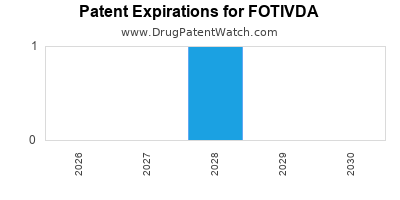
The U.S. Fotivda patent estate centers on tivozanib hydrochloride and related pharmaceutical compositions. Public patent databases identify U.S. Patent No. 8,481,557 as a core patent associated with tivozanib hydrochloride monohydrate, with an expiration date reported in March 2030, subject to applicable patent-term adjustments and extensions [6].
| Patent |
Subject matter |
Reported U.S. expiration |
| U.S. 8,481,557 |
Tivozanib hydrochloride and related solid-state or pharmaceutical subject matter |
March 2030 |
| U.S. 9,340,614 |
Tivozanib-related composition or therapeutic subject matter |
Approximately 2030, based on public patent records |
The commercially relevant protections include:
- Active pharmaceutical ingredient and salt protection.
- Solid-state or crystalline-form protection.
- Pharmaceutical composition claims.
- Method-of-treatment claims for RCC.
- Manufacturing and formulation claims, where enforceable.
The Orange Book remains the controlling source for patents listed against the approved product. Patent term, listing status, pediatric extensions, terminal disclaimers, and claim scope determine the practical generic-entry date. Patent litigation records and FDA Orange Book listings should be evaluated together because a patent may be relevant to commercial entry even when it does not cover every aspect of the approved product [7].
When does Fotivda lose exclusivity?
Fotivda's U.S. regulatory exclusivity began with FDA approval on March 10, 2021. Because the product received orphan-drug designation for the approved RCC indication, the seven-year orphan exclusivity period is expected to run through March 10, 2028, unless altered by statutory circumstances [4, 8].
The exclusivity framework is:
| Protection |
Date or period |
| FDA approval |
March 10, 2021 |
| Orphan exclusivity |
Seven years from approval |
| Expected orphan-exclusivity end |
March 10, 2028 |
| Core patent expiration |
Approximately March 2030 |
| Likely practical generic-entry window |
After applicable patent barriers expire or are successfully challenged |
Orphan exclusivity prevents FDA approval of the same drug for the same orphan indication, subject to statutory exceptions. It does not block every competing product or every different indication. Patent protection may continue after orphan exclusivity ends.
A generic applicant could file an abbreviated new drug application with a Paragraph IV certification against listed patents before patent expiration. The filing could trigger patent litigation and a potential 30-month stay of FDA approval under the Hatch-Waxman framework [9].
Are there known Paragraph IV challenges or Fotivda patent settlements?
No widely reported, commercially consequential Paragraph IV litigation or settlement has established a near-term U.S. generic launch for Fotivda. The principal risk period begins after orphan exclusivity ends in 2028, when an ANDA applicant could challenge the listed patents.
A first filer with a successful Paragraph IV challenge could obtain 180 days of generic exclusivity. A settlement could instead establish a licensed entry date before patent expiration. The economics of a challenge will depend on:
- Net annual sales at the time of filing.
- Remaining patent term.
- The number of listed patents.
- The scope of composition and method claims.
- The cost of developing the generic capsule.
- The size of the later-line RCC market.
- Whether the entrant can substitute at the pharmacy level.
Because Fotivda is a relatively low-volume specialty product, generic competition may be slower than for high-volume primary-care drugs. The product's limited patient population reduces potential revenue for a challenger, but high specialty pricing can preserve attractive gross-margin economics.
What formulation and manufacturing barriers affect generic entry?
Tivozanib capsules are commercially simpler than complex biologics, injectables, or drug-device combinations. Generic development should therefore be technically feasible through the ANDA pathway if the applicant can match the reference product's active ingredient, dosage form, strength, dissolution profile, and bioequivalence requirements.
Potential barriers include:
- Salt or polymorph selection.
- Control of crystalline form.
- Impurity specifications.
- Stability and moisture control.
- Low-dose content uniformity.
- Bioequivalence across the 0.89 mg and 1.34 mg strengths.
- Manufacturing scale and specialty distribution economics.
These barriers are meaningful but unlikely to create a permanent barrier equivalent to biologic manufacturing complexity. The primary defense is expected to come from patent claims, regulatory exclusivity, brand loyalty, and commercial contracting rather than manufacturing difficulty alone.
Does Fotivda face biosimilar risk?
Fotivda has no biosimilar risk because tivozanib is a chemically synthesized small molecule, not a biologic. Competitive entry would occur through the ANDA generic pathway rather than the Biologics Price Competition and Innovation Act pathway.
The relevant post-exclusivity threat is therefore generic substitution. Unlike a biosimilar, an approved tivozanib generic may be substitutable under state pharmacy laws if it receives an AB rating and meets applicable FDA requirements.
What licensing deals and geographic rights affect Fotivda?
AVEO licensed tivozanib from originator partners for development and commercialization in selected territories. The drug was approved in the European Union in 2017 under the Fotivda name for adults with relapsed or refractory advanced RCC after at least two prior systemic therapies [10].
The U.S. and European labels differ in commercial positioning. The U.S. approval is tied to at least two prior systemic therapies. European use has historically been framed around advanced RCC after prior VEGF-directed treatment. Regional reimbursement decisions and national health-technology assessments determine actual access.
LG Chem's ownership creates an opportunity to consolidate rights, expand commercial coverage, and pursue additional partnerships. The value of any regional license depends on the remaining patent term, local reimbursement, prior-treatment requirements, and the presence of competing VEGFR inhibitors.
What is the FDA and Orange Book status of Fotivda?
The FDA approved Fotivda as an oral capsule for adults with relapsed or refractory advanced RCC after at least two prior systemic therapies. The product is listed in the FDA Orange Book as a prescription drug with associated patent information [4, 7].
The FDA status does not include:
- A first-line RCC indication.
- A pediatric RCC indication.
- A biologics license.
- A biosimilar reference-product designation.
- A broad solid-tumor indication.
The regulatory strategy is therefore centered on maintaining the approved RCC franchise and generating evidence for earlier-line or combination use.
How strong is the Fotivda patent estate?
The patent estate is commercially useful but not structurally unassailable. A core patent term extending to about 2030 provides several years of protection after the expected end of orphan exclusivity. That timing gives the owner an opportunity to negotiate a generic settlement or pursue lifecycle patents.
Patent strength is highest where claims cover:
- The active tivozanib salt.
- A specific crystalline form.
- The approved capsule composition.
- Treatment of RCC using the approved regimen.
Patent strength is lower where claims depend on broad treatment methods that overlap with prior VEGFR inhibitor art or where an ANDA applicant can design around a formulation claim.
The key strategic issue is the gap between regulatory exclusivity ending in 2028 and core patent expiration around 2030. That two-year period is likely to attract Paragraph IV activity if U.S. revenue remains material.
What generic-launch scenarios exist for Fotivda?
Three scenarios are commercially plausible.
Scenario 1: No early challenge
Generic companies wait until core patents expire. The first generic launch occurs around 2030, followed by price erosion as additional manufacturers enter.
Scenario 2: Paragraph IV challenge after 2028
One or more ANDA applicants challenge the listed patents after orphan exclusivity ends. Litigation could delay approval, produce a settlement, or result in an at-risk launch if the challenger believes the patents are invalid or not infringed.
Scenario 3: Authorized generic or settlement launch
LG Chem could license an early entrant or launch an authorized generic to capture part of the post-exclusivity market. This strategy could reduce the revenue impact of third-party generic substitution while accelerating market transition.
The highest-risk period for brand revenue is likely the first two years after orphan exclusivity ends, even if patents remain in force, because Paragraph IV litigation can change the effective entry timetable.
What is the revenue exposure to Fotivda for LG Chem?
Fotivda is a small product relative to large multinational oncology franchises, but it is strategically important to LG Chem's U.S. pharmaceutical expansion. Its revenue provides a commercial base, while the acquisition's return depends on sustained growth and pipeline development.
A simple exposure framework is:
| Value driver |
Effect on Fotivda |
| U.S. prescription growth |
Increases near-term revenue |
| Later-line-only label |
Limits total addressable market |
| Combination or earlier-line approval |
Could materially expand revenue |
| Patent expiration near 2030 |
Defers full generic erosion |
| Orphan exclusivity ending in 2028 |
Opens regulatory challenge risk |
| Welireg and Cabometyx competition |
Pressures share and treatment sequencing |
| Global licensing and reimbursement |
Determines non-U.S. contribution |
| Specialty pricing |
Supports revenue per patient but invites payer scrutiny |
The asset is unlikely to become a broad blockbuster without a successful label expansion. Its more probable role is a durable specialty oncology product with peak value determined by U.S. penetration, treatment duration, and lifecycle management.
Key Takeaways
- Fotivda is an oral tivozanib product for relapsed or refractory advanced RCC.
- FDA approval occurred on March 10, 2021, with seven years of orphan exclusivity expected through March 10, 2028.
- U.S. revenue grew from about $31 million in 2021 to more than $90 million in 2023.
- LG Chem acquired AVEO for approximately $566 million in 2023.
- The principal competitors are Cabometyx, Lenvima combinations, Welireg, Opdivo-based regimens, and Inlyta.
- Core U.S. patent protection is publicly reported to extend to approximately March 2030.
- Fotivda faces generic, not biosimilar, risk.
- The key commercial question is whether LG Chem can expand the drug beyond its later-line RCC label before orphan exclusivity ends.
- A Paragraph IV challenge after 2028 could accelerate generic-entry negotiations or litigation.
- Without an earlier-line or combination indication, Fotivda is likely to remain a focused specialty oncology asset rather than a broad RCC franchise.
FAQs
What is the active ingredient in Fotivda?
Fotivda contains tivozanib hydrochloride, an oral selective VEGFR tyrosine kinase inhibitor.
Is Fotivda approved for first-line kidney cancer treatment?
No. The U.S. label covers adults with relapsed or refractory advanced RCC after at least two prior systemic therapies.
Is Fotivda available outside the United States?
Yes. Fotivda received European Union approval in 2017 for advanced RCC following prior VEGF-directed therapy, subject to national reimbursement and prescribing rules.
Can Fotivda be used with immunotherapy?
The FDA-approved label does not establish Fotivda as an approved immunotherapy combination. Combination use requires supporting clinical evidence and regulatory approval.
Which company owns Fotivda now?
LG Chem owns AVEO Oncology, the company that developed and commercialized Fotivda in the United States.
References
-
AVEO Oncology, Inc. (2022). Annual report on Form 10-K for the year ended December 31, 2021. U.S. Securities and Exchange Commission.
-
AVEO Oncology, Inc. (2023). Annual report on Form 10-K for the year ended December 31, 2022. U.S. Securities and Exchange Commission.
-
LG Chem Ltd. (2023). LG Chem completes acquisition of AVEO Oncology. https://www.lgchem.com
-
U.S. Food and Drug Administration. (2021). FDA approves tivozanib for relapsed or refractory advanced renal cell carcinoma. https://www.fda.gov
-
Motzer, R. J., Hutson, T. E., Glen, H., et al. (2021). Tivozanib versus sorafenib in patients with advanced renal cell carcinoma who have received at least two prior systemic therapies. The Lancet Oncology, 22(1), 95-106.
-
U.S. Patent No. 8,481,557. (2013). Tivozanib hydrochloride and pharmaceutical compositions. U.S. Patent and Trademark Office.
-
U.S. Food and Drug Administration. (2024). Approved drug products with therapeutic equivalence evaluations, Orange Book. https://www.accessdata.fda.gov/scripts/cder/ob/
-
U.S. Food and Drug Administration. (2024). Orphan drug designation and exclusivity. https://www.fda.gov
-
U.S. Food and Drug Administration. (2024). Hatch-Waxman amendments and abbreviated new drug applications. https://www.fda.gov
-
European Medicines Agency. (2017). Fotivda: EPAR product information. https://www.ema.europa.eu