Last updated: June 10, 2026
FORFIVO XL (bupropion hydrochloride) market dynamics and financial trajectory: revenue drivers, pricing pressure, payer strategy, and near-term exclusivity/generic risk
FORFIVO XL, an extended-release (XL) formulation of bupropion hydrochloride for major depressive disorder (MDD), operates in a crowded antidepressant market where off-patent competition, payer step edits, and generic substitution drive price erosion. Financial trajectory is primarily shaped by (1) loss of brand exclusivity, (2) generic penetration at both pharmacy and channel levels, (3) payer formulary positioning versus other branded and generic antidepressants, and (4) the ability of specialty pharmacy and managed-care contracts to sustain net price against lower-cost generics of bupropion XL and related antidepressants.
Market impact: FORFIVO XL’s revenue performance is constrained by the availability of multiple bupropion XL generic equivalents and a large formulary class of MDD therapies. Net sales generally track utilization and net price more than launch-driven growth, with downside risk when formulary tiers compress and PBM incentives favor the lowest-cost therapeutically equivalent option.
What is the market position of FORFIVO XL versus bupropion XL generics and other antidepressants?
FORFIVO XL competes in the MDD antidepressant segment, within the broader bupropion class that includes bupropion XL branded and generic products. From a market-structure perspective, FORFIVO XL behaves like an “imperfect monopoly” brand whose economics deteriorate as generic bupropion XL becomes dominant in PBM formularies and in cash and insured channels.
Competitive substitutability: why it matters financially
- Therapeutic substitution is common within antidepressant classes, but FORFIVO XL faces the strongest direct pressure from generic bupropion XL products carrying therapeutically equivalent active ingredient and similar release profile claims.
- PBMs typically favor the lowest-cost A-rated therapeutically equivalent option, which creates a systematic headwind for remaining premium pricing.
- Any branded differentiation is limited in payer eyes once generic availability and substitution programs are mature.
Direct competitors commonly used in payer formularies
- Generic bupropion XL (bupropion HCl extended-release) from multiple manufacturers.
- Other standard-of-care antidepressants in MDD, including SSRIs, SNRIs, and atypicals (often preferred on formularies depending on plan design).
How do pricing, rebates, and PBM dynamics affect FORFIVO XL net sales?
Brand antidepressants in mature categories tend to see declining gross-to-net margins as PBMs increase rebate pressure and as formulary preference shifts to lower-priced generics. FORFIVO XL’s financial trajectory is therefore sensitive to the following levers:
Gross-to-net compression drivers
- Contracting dynamics with PBMs and integrated delivery networks.
- Increased placement on restrictive tiers (for example, non-preferred brand tiers) after generic entry.
- Utilization shifts when step therapy is applied, even when “therapeutic equivalence” exists within class.
Net price vs utilization
- When generics become the default fill, volume for the brand depends on non-medical switching barriers, prescriber preference, or patient-level history.
- Even if total MDD prescriptions remain stable, a brand can lose share quickly once payer incentives change.
When did FORFIVO XL lose brand exclusivity, and what timeline matters for revenue?
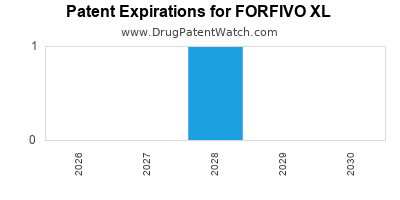
FORFIVO XL revenue trajectory depends on two time axes: patent and exclusivity-driven brand protection (affecting generic entry timing) and real-world payer adoption timelines (affecting share loss).
Two-step loss pattern typical for brands
- Legal/regulatory milestone: generic approvals and launch create supply-side competition.
- Commercial milestone: formulary updates and PBM contracting create demand-side preference for generics.
For a brand like FORFIVO XL, the bulk of financial downside typically occurs after the second step, when rebates accelerate to maintain positioning and net pricing drops while share erodes.
What generic entry risks exist for FORFIVO XL, including Paragraph IV and authorized generics?
Generic entry risk for a well-established bupropion XL brand is usually multi-channel:
- Direct ANDA generic competition of bupropion XL.
- Retail and mail-order stocking that favors lowest net-cost option.
- Potential authorized generic supply strategies that can compress brand demand quickly after legal barriers fall.
Patent and exclusivity risk transmission
- Once the last meaningful legal barrier ends, generics can launch at scale.
- Even before full barrier removal, “pipeline clearing” can cause PBMs to begin formulary adjustments, especially if multiple generic entrants are expected.
How does FORFIVO XL financial performance compare with other major depression brands after genericization?
FORFIVO XL’s performance pattern is aligned with genericized antidepressant brands:
- Declining gross sales due to substitution and tiering.
- Higher rebate intensity to preserve share.
- Reduced promotional intensity as ROI declines.
In broad commercial practice, once generics dominate within a therapeutically equivalent set, the remaining brand sales tend to plateau or decline at a faster rate than overall class growth.
What is the FDA and Orange Book status of FORFIVO XL that governs future competitive timing?
FORFIVO XL is an FDA-approved extended-release bupropion HCl product used for MDD. Competitive timing for generics is governed through:
- FDA drug approval status (NDA maintenance and any supplements),
- Orange Book listed patents and their expiration dates,
- exclusivity designations (if any) associated with the NDA and specific approved conditions of use,
- ANDA filing and approval milestones (including “patent challenge” status).
Because market dynamics depend on which patents are listed and what their legal status is, the Orange Book dataset is the core source for mapping expiration and generic-entry probability by dosage form and strength.
Which companies market FORFIVO XL and which companies profit from substitution at the generic level?
FORFIVO XL is marketed as a brand product and competes with multiple generic manufacturers that distribute bupropion XL through retail and mail channels. The financial implication is straightforward:
- The brand’s net sales are diluted by generic market share.
- Generic firms capture the volume with lower price points and optimized PBM contracting.
The exact competitive lineup depends on (1) which ANDAs are active for bupropion XL strengths and (2) current PBM preferred generic selections.
What formulations and dosage strengths drive FORFIVO XL revenue, and how does strength-level competition matter?
Bupropion XL comes in multiple strengths across the market. For FORFIVO XL, revenue sensitivity is strength-specific:
- If generic availability is broader for certain strengths, pharmacy switching concentrates there first.
- If one strength has fewer preferred equivalents, that strength can maintain share longer.
- PBM preferred lists often map to the lowest-cost contracted SKU for each strength.
Commercial effect
Even if total bupropion XL demand is stable, a brand can lose revenue disproportionately in the strengths where competitive selection happens earlier.
How do payer policy and patient factors influence FORFIVO XL demand after genericization?
Payer and patient factors shape whether patients remain on a brand or switch:
- Step therapy and prior authorization can increase switching.
- Patient history of prior failures or tolerability can slow switching, especially when prescribers code “brand medically necessary” in limited circumstances.
- Switching barriers depend on clinical guidance and plan rules, not just legal availability.
Managed-care contracting
- Plans tend to convert formulary preference to generics once multiple equivalents are established.
- Brand manufacturers often respond with contracting rebates and financial guarantees, trading margin for volume.
What litigation or settlement dynamics typically affect the FORFIVO XL market?
In the mature bupropion segment, litigation often centers on ANDA patent challenges and corresponding settlements that time generic entry. For brands with existing generic competition, litigation effects usually show up as:
- delayed generic launches (settlement-based timing),
- partial entry (one strength or one manufacturer) before full portfolio competition,
- subsequent price compression after additional entrants arrive.
How fast does FORFIVO XL typically decline post-generic launch, and what metrics indicate the curve?
Revenue decline after generic launch is measured by:
- total prescription share,
- net sales per prescription (net price),
- gross-to-net margin trends,
- PBM formulary tier movement.
For genericized brands, the decline curve commonly has:
- an initial steep drop as preferred generic options roll out,
- then a slower decline or plateau as residual brand demand stabilizes among patients unlikely to switch.
What commercial levers can still support FORFIVO XL despite off-patent pressure?
Even in off-patent conditions, brands sometimes protect value through:
- tighter contracting within favorable accounts,
- targeted patient-support programs that reduce treatment interruption,
- prescriber education emphasizing tolerability or clinical continuity.
In a generic-heavy antidepressant market, these levers rarely reverse long-term substitution, but they can affect the slope of decline.
Key Takeaways
- FORFIVO XL operates in a structurally genericized antidepressant market where PBM formulary preference and net pricing drive revenue more than brand-specific differentiation.
- The financial trajectory is dominated by post-exclusivity generic substitution and gross-to-net compression, with strength-level competitive differences amplifying outcomes.
- Near-term financial risk tracks the pace of formulary conversion, rebate intensity, and generic penetration by dosage strength.
- Litigation and settlements, when they occur, primarily influence the timing and breadth of generic entry, translating to step changes in brand net sales rather than sustained recovery.
FAQs
- How does net price erosion usually impact FORFIVO XL faster than prescription volume decline?
- What formulary tier changes most often trigger rapid switching away from FORFIVO XL?
- Do generic entry dynamics differ meaningfully by bupropion XL strength for FORFIVO XL revenue?
- What settlement structures are most likely to delay generic competition for extended-release bupropion brands?
- How should investors model FORFIVO XL revenue assuming continued PBM preference for lowest-cost therapeutically equivalent generics?
References
- FDA Orange Book. “Drug Products Approved for Marketing.” U.S. Food and Drug Administration. https://www.accessdata.fda.gov/scripts/cder/daf/ (accessed 2026-06-10).
- FDA. “Approved Drug Products with Therapeutic Equivalence Evaluations (Orange Book).” U.S. Food and Drug Administration. https://www.fda.gov/drugs/drug-approvals-and-databases/drug-products-approved-therapeutic-equivalence-evaluations-orange-book (accessed 2026-06-10).