Last updated: August 24, 2026
FLYRCADO, flurpiridaz F 18 injection, is GE HealthCare's FDA-approved PET myocardial perfusion imaging agent. FDA approved it on September 27, 2024, for adults with suspected or known coronary artery disease. Its commercial case depends on converting myocardial perfusion imaging from predominantly SPECT to PET, expanding PET access beyond existing cardiac centers, and establishing a reliable radiopharmaceutical distribution network.[1]
The product has meaningful technical advantages over existing PET and SPECT options, but its near-term revenue remains launch-dependent. GE HealthCare has not reported standalone FLYRCADO sales, product-specific guidance, or a confirmed peak-sales target in public financial filings. The financial trajectory is therefore best assessed through procedure conversion, reimbursement, manufacturing scale, and competitive adoption.
What is FLYRCADO and what clinical market does it target?
FLYRCADO is a fluorine-18-labeled radiopharmaceutical used for PET myocardial perfusion imaging, or PET MPI. It is designed to identify areas of reduced myocardial blood flow during rest and pharmacologic stress imaging.
| Attribute |
FLYRCADO |
| Active ingredient |
Flurpiridaz F 18 |
| Drug class |
Diagnostic radiopharmaceutical |
| Imaging modality |
PET myocardial perfusion imaging |
| FDA approval |
September 27, 2024 |
| Sponsor |
GE HealthCare |
| Indication |
Adults with suspected or known coronary artery disease |
| Radioisotope |
Fluorine-18 |
| Physical half-life |
Approximately 110 minutes |
| Commercial status |
U.S. launch preparation and phased availability |
| Primary market |
Cardiac PET imaging |
| Main alternatives |
Rubidium-82 PET, N-13 ammonia PET, Tc-99m SPECT agents |
FLYRCADO is the first FDA-approved PET myocardial perfusion imaging agent identified in GE HealthCare's launch materials. Its clinical value is linked to PET's higher spatial resolution, lower radiation exposure in many protocols, quantitative myocardial blood-flow capability, and shorter imaging times compared with conventional SPECT in suitable settings.[2]
How large is the FLYRCADO addressable market?
The primary addressable market is the U.S. myocardial perfusion imaging market, which remains dominated by SPECT. PET MPI has a smaller installed base because it requires PET or PET/CT equipment, radiopharmacy access, trained staff, and payer familiarity.
Market expansion drivers
FLYRCADO can expand the PET MPI market through four channels:
- Conversion of existing SPECT MPI procedures to PET MPI.
- Use in hospitals that lack practical access to Rubidium-82 generators.
- Regional distribution from centralized fluorine-18 production sites.
- Greater use of quantitative myocardial blood-flow assessment in coronary microvascular disease and complex coronary artery disease.
The isotope's approximately 110-minute half-life is materially longer than the approximately 76-second half-life of Rubidium-82. That difference supports centralized production and regional shipment, while Rubidium-82 typically requires an on-site generator.[3]
Market constraints
The commercial opportunity is limited by:
- The installed base of SPECT cameras and existing technologist expertise.
- Capital requirements for PET/CT access.
- Nuclear pharmacy and cyclotron capacity.
- Hospital workflow changes.
- Local reimbursement and payer authorization.
- Competition from established Tc-99m agents and Rubidium-82.
- The need for stress-testing infrastructure and pharmacologic stress agents.
FLYRCADO's addressable market is therefore larger than the current cardiac PET market but smaller than the full U.S. MPI procedure pool in the early launch years.
When does FLYRCADO lose exclusivity?
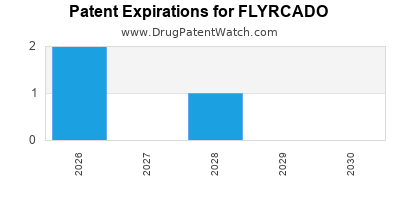
No publicly confirmed FLYRCADO patent expiration date or product-specific FDA regulatory exclusivity end date is included in GE HealthCare's principal public launch disclosures. FLYRCADO is a small-molecule diagnostic radiopharmaceutical rather than a biologic, so biosimilar exclusivity rules do not apply.
The relevant exclusivity layers are:
| Exclusivity layer |
FLYRCADO status |
| FDA approval |
Approved September 27, 2024 |
| New chemical entity exclusivity |
Product-specific status not publicly identified in the cited FDA materials |
| Orphan-drug exclusivity |
No orphan designation is identified in the approval materials |
| Patent exclusivity |
Underlying composition, radiochemistry, use, and manufacturing rights may exist; confirmed expiration dates are not identified in the cited sources |
| Regulatory exclusivity for a biologic |
Not applicable |
| Generic pathway |
Potentially available through an abbreviated or suitability-based pathway, subject to product-specific FDA requirements |
Because FLYRCADO is a radiopharmaceutical, effective competition may arrive later than a theoretical patent expiry. A competitor must reproduce the active radiolabeled compound, establish validated radiochemical manufacturing, demonstrate quality and stability, secure distribution capacity, and obtain access to imaging sites.
What patents protect FLYRCADO?
The protectable technology is likely to include several patent categories:
Flurpiridaz composition patents
These patents may cover the nonradioactive precursor, the radiolabeled compound, chemical intermediates, or specific stereochemical forms. The commercial value of these claims depends on whether a competitor can design around the claimed molecular structure.
Radiochemistry and manufacturing patents
Manufacturing claims can cover precursor preparation, fluorine-18 incorporation, purification, formulation, sterile filtration, release testing, and automated synthesis systems. These patents may create practical barriers even when composition claims are narrow.
Method-of-use patents
Potential claims may cover PET MPI protocols, rest-stress imaging, myocardial blood-flow quantification, patient selection, or use in coronary artery disease. Method-of-use claims generally have weaker enforcement economics than composition claims because infringement depends on clinical use and labeling.
Formulation and delivery patents
Relevant claims can include injectable formulations, pH control, stabilizers, container systems, dose ranges, and radiochemical purity requirements. Their commercial strength depends on whether competing products require the same formulation parameters.
No confirmed FLYRCADO patent numbers, Orange Book patent listings, or expiration dates are established in the cited public sources. FDA approval alone does not establish the scope or duration of GE HealthCare's patent estate.
What is the Orange Book status of FLYRCADO?
FLYRCADO is FDA approved as a prescription diagnostic radiopharmaceutical. The Orange Book is relevant to approved drug products, but the commercial impact of any listing depends on whether GE HealthCare has submitted patents for publication and whether those patents cover the approved product, its use, or an approved formulation.
No publicly confirmed Orange Book patent listing is identified in the FDA approval announcement or GE HealthCare's principal launch materials. The absence of a cited listing in those documents does not establish that no patent rights exist. It indicates that patent status must be separated from FDA approval status.
Are there Paragraph IV challenges to FLYRCADO?
No public Paragraph IV certification or ANDA litigation against FLYRCADO is identified in the cited sources.
A Paragraph IV challenge would require a generic applicant to certify that relevant listed patents are invalid, unenforceable, or not infringed. For FLYRCADO, a challenger would face technical and operational requirements beyond ordinary oral-solid generics:
- Access to fluorine-18 production.
- A validated radiochemistry process.
- Short shelf-life distribution.
- Sterile injectable manufacturing.
- Comparable imaging performance.
- Site-specific delivery and dose controls.
- FDA approval of the proposed generic product.
These requirements reduce the probability of rapid generic entry, although they do not eliminate it.
What FDA regulatory status does FLYRCADO have?
FDA approved FLYRCADO under the drug approval pathway for diagnostic radiopharmaceuticals. Its label covers PET MPI in adults with suspected or known coronary artery disease.[1]
The approval provides GE HealthCare with several commercial advantages:
- FDA-recognized efficacy and safety for the labeled indication.
- A standardized product for U.S. PET MPI protocols.
- A basis for hospital formulary adoption.
- A reference product for future competitive development.
- Potential support for payer and provider education.
The approval does not guarantee national reimbursement or immediate access. Hospitals must still establish radiopharmaceutical procurement, imaging protocols, billing procedures, and quality controls.
How does FLYRCADO compare with Rubidium-82 and SPECT agents?
| Product category |
Strength |
Limitation |
Competitive effect on FLYRCADO |
| FLYRCADO, flurpiridaz F 18 |
Regional distribution, PET resolution, quantitative flow potential |
Requires fluorine-18 supply and PET access |
Direct growth platform |
| Rubidium-82 |
Very short imaging cycle and established cardiac PET use |
Requires on-site generator and high capital commitment |
Strong competitor at established PET sites |
| N-13 ammonia |
High-quality PET myocardial imaging |
Short half-life requires on-site cyclotron |
Limited geographic reach |
| Tc-99m SPECT agents |
Broad availability and installed equipment base |
Lower spatial resolution and longer workflows than PET in many settings |
Main incumbent barrier |
| Stress agents |
Established pharmacologic protocols |
Do not replace the perfusion tracer |
Complementary products |
FLYRCADO's strongest competitive position is against SPECT in hospitals that already have PET/CT access but lack an efficient cardiac PET tracer supply chain. Its position is weaker against Rubidium-82 in centers with existing generators, trained staff, and established reimbursement.
What licensing deals and commercial partnerships affect FLYRCADO?
GE HealthCare controls the commercial launch and has described plans to work with nuclear pharmacies and healthcare providers to establish availability. Public materials reviewed for this analysis do not identify a major third-party licensing transaction that transfers FLYRCADO commercialization rights.
The commercial model is likely to depend on a network rather than a conventional pharmaceutical wholesaling system. Important counterparties include:
- Cyclotron operators.
- Radiopharmacies.
- Hospital PET centers.
- Imaging equipment providers.
- Pharmacy distributors.
- Payers and radiology benefit managers.
Distribution density will influence utilization more than traditional retail pharmacy reach. A site that cannot receive doses within the usable radiochemical window cannot adopt the product regardless of clinical interest.
What patent litigation affects FLYRCADO?
No public patent litigation, Paragraph IV case, or settlement agreement involving FLYRCADO is identified in the cited sources.
The principal future litigation risks are likely to involve:
- Patent disputes over flurpiridaz composition or precursor chemistry.
- Challenges to radiolabeling and manufacturing claims.
- Method-of-use disputes involving PET MPI protocols.
- ANDA litigation if a generic applicant relies on an Orange Book-listed patent.
- Contract disputes involving regional manufacturing or distribution rights.
The risk profile is lower before broad commercial adoption because potential challengers have limited near-term revenue incentive. It could increase if FLYRCADO captures a meaningful share of cardiac PET procedures.
What is the financial trajectory for FLYRCADO?
GE HealthCare has not disclosed FLYRCADO revenue separately. The product was approved in late 2024, and the company indicated that commercial availability would follow manufacturing scale-up and site readiness. Accordingly, reported revenue was effectively pre-launch in 2024, with the first material sales contribution expected after commercial deployment.[4]
Base-case trajectory
| Period |
Expected commercial phase |
Financial implication |
| 2024 |
FDA approval and launch preparation |
No meaningful standalone revenue |
| 2025 |
Initial U.S. rollout |
Early revenue from selected PET centers |
| 2026-2027 |
Expansion of radiopharmacy and hospital coverage |
Accelerating procedure volume if reimbursement and supply stabilize |
| 2028 onward |
Broader PET MPI adoption |
Potentially recurring diagnostic pharmaceutical revenue with equipment pull-through |
Revenue drivers
FLYRCADO revenue will be determined by:
- Number of active PET MPI sites.
- Procedures per site.
- Dose price and net realized price.
- Percentage of cardiac PET exams using FLYRCADO.
- Radiopharmacy distribution coverage.
- Payer reimbursement.
- Repeat use by high-volume cardiology practices.
The product can generate recurring per-procedure revenue, but it will not have the prescription-refill economics of a chronic therapy. Revenue is tied to imaging volume and hospital scheduling.
Margin profile
Radiopharmaceutical margins can be attractive after manufacturing scale is achieved, but early margins may be pressured by:
- Low initial batch utilization.
- Expedited logistics.
- Failed or unused doses.
- Quality-control requirements.
- Regional manufacturing infrastructure.
- Training and market-development spending.
The product's financial leverage should improve as dose volumes rise within established production and distribution routes.
How strong is the FLYRCADO commercial position?
FLYRCADO has a strong product-level position and a moderate launch-execution position.
| Factor |
Assessment |
| Clinical differentiation |
Strong |
| FDA status |
Strong |
| PET market growth potential |
Moderate to strong |
| Existing installed-base advantage |
Limited because SPECT remains dominant |
| Distribution complexity |
High |
| Generic substitution risk in the near term |
Low |
| Patent transparency |
Limited in current public disclosures |
| Reimbursement risk |
Moderate |
| Revenue visibility |
Low before broad commercialization |
| Strategic value to GE HealthCare |
High because it links pharmaceuticals, imaging equipment, and service workflows |
GE HealthCare can capture value across the imaging ecosystem. Greater FLYRCADO use may support PET/CT utilization, scanner placement, service contracts, and cardiac imaging workflow adoption. That broader strategic effect may be more important than initial product sales.
What generic launch risks exist for FLYRCADO?
Near-term generic launch risk is low because of the technical and logistical requirements of fluorine-18 radiopharmaceuticals. Medium-term risk is higher if:
- The FDA pathway permits a relatively direct generic comparison.
- Key composition patents are weak or absent.
- Large radiopharmacy operators enter the market.
- Reimbursement becomes standardized.
- FLYRCADO achieves high procedure volume.
A competitor could also use a different PET tracer rather than copy flurpiridaz. That creates product competition without requiring a Paragraph IV challenge.
What geographic markets are most important for FLYRCADO?
The United States is the priority market because it is the first FDA-approved market and has a large installed base of cardiac imaging centers. Early adoption should favor:
- Large academic medical centers.
- Integrated delivery networks.
- High-volume cardiology hospitals.
- Regions with strong cyclotron and nuclear pharmacy infrastructure.
- Centers already operating PET/CT but not Rubidium-82 generators.
International expansion will depend on country-specific approvals, radiopharmaceutical distribution, reimbursement, and local PET adoption. The same half-life advantage that supports U.S. regional distribution can support selected international markets, but local manufacturing or import infrastructure may be required.
Key Takeaways
- FLYRCADO is flurpiridaz F 18, an FDA-approved PET myocardial perfusion imaging agent.
- FDA approval occurred on September 27, 2024.
- Its principal commercial opportunity is conversion of SPECT MPI procedures to PET MPI.
- The approximately 110-minute fluorine-18 half-life supports regional distribution but still requires tightly managed radiopharmacy logistics.
- GE HealthCare has not disclosed standalone FLYRCADO revenue or product-specific sales guidance.
- Initial revenue is expected to be modest during site activation, with greater upside tied to PET center expansion and payer adoption.
- Rubidium-82 is the strongest direct PET competitor; Tc-99m SPECT agents are the largest incumbent barrier.
- No public Paragraph IV challenge, patent litigation, or settlement agreement is identified in the cited sources.
- Biosimilar risk does not apply because FLYRCADO is a small-molecule diagnostic radiopharmaceutical.
- The commercial patent estate and Orange Book listing require separate verification from the FDA approval record.
FAQs About FLYRCADO
Is FLYRCADO a treatment or a diagnostic drug?
FLYRCADO is a diagnostic radiopharmaceutical. It is used during PET myocardial perfusion imaging to evaluate myocardial blood flow and coronary artery disease.
Who manufactures FLYRCADO?
GE HealthCare is the sponsor and commercial developer identified in the FDA approval and company launch materials.
Can FLYRCADO replace Rubidium-82?
FLYRCADO can compete with Rubidium-82 in cardiac PET, particularly where hospitals want regional tracer distribution without installing a Rubidium-82 generator. It is more likely to expand PET access than eliminate Rubidium-82 use.
Does FLYRCADO have biosimilar competition?
No. Biosimilar regulation applies to biologic products. FLYRCADO is a fluorine-18-labeled small-molecule diagnostic radiopharmaceutical.
What is the biggest risk to FLYRCADO sales?
The largest risk is slower-than-expected PET MPI adoption caused by limited PET capacity, reimbursement friction, radiopharmacy constraints, and the entrenched use of SPECT.
References
- U.S. Food and Drug Administration. (2024). FDA approves first PET drug for myocardial perfusion imaging.
- GE HealthCare. (2024). GE HealthCare receives FDA approval for Flyrcado, the first and only FDA-approved PET myocardial perfusion imaging agent.
- U.S. Food and Drug Administration. (2024). Flyrcado prescribing information: Flurpiridaz F 18 injection.
- GE HealthCare. (2024). 2024 annual report and investor disclosures.