Last updated: July 29, 2026
FLOMAX is a brand of the alpha-1 adrenergic blocker tamsulosin used for benign prostatic hyperplasia (BPH). Long-term profitability is driven by (1) US and ex-US BPH demand, (2) branded pricing durability versus generic substitution, and (3) channel mix across capsule strengths and formulations. In practice, FLOMAX’s financial trajectory is shaped less by patent exclusivity than by widespread generic availability for tamsulosin, ongoing payer pressure for BPH drugs, and retailer and wholesaler contracting mechanics.
What is FLOMAX (tamsulosin) and what market does it serve?
FLOMAX contains tamsulosin hydrochloride, an oral, once-daily alpha-1 antagonist indicated for lower urinary tract symptoms (LUTS) associated with benign prostatic hyperplasia.
Which indication and patient segment drive revenue?
- Condition: BPH/LUTS in men, typically older age cohorts.
- Prescribing pattern: chronic therapy; prescriptions tend to be stable until payer formularies shift toward preferred generics.
- Core segment drivers:
- Demographics: aging populations expand the diagnosis pool.
- Diagnosis and treatment rates: screening and urology practice throughput affect new starts.
- Step therapy: payers often require generic tamsulosin.
What product forms compete in the same decision?
- Oral immediate-release capsules (tamsulosin standard).
- Extended-release and alternative alpha-1 blockers (e.g., silodosin, doxazosin, terazosin) compete through formulary positioning.
- Combination therapy (alpha-1 blocker plus 5-alpha-reductase inhibitor) competes for payer share.
How do market dynamics affect FLOMAX pricing, volume, and margin?
FLOMAX operates in a mature category where generic substitution is the dominant dynamic.
What are the key forces shaping demand?
-
Generic preference and substitution
- Once tamsulosin generics are widely available and payer preferred lists move, branded volume declines.
- Pharmacies and PBMs steer new prescriptions to lower net cost options.
-
Payer contracting and formulary volatility
- BPH drug formularies are managed tightly due to chronic use.
- Net price pressure accelerates when additional generic entrants or re-contracting occurs.
-
Competitive switching among alpha-1 blockers
- Clinical equivalence across many alpha-1 antagonists enables payer-driven switching.
- Adverse effect profiles (e.g., dizziness/orthostatic symptoms) can influence physician selection, but payer cost usually dominates once generics are entrenched.
-
Retail channel inventory and pharmacy claims
- Mature brands experience purchase order timing effects around contracting cycles.
- Launches of new generic strengths or packaging can shift claims quickly.
What does the economics typically look like for a branded legacy alpha-1 blocker?
- Branded gross margin compresses on net price and rebate obligations.
- Volume is limited by substitution behavior even when a patient remains stable on therapy.
- Share shifts to generics and PBM-preferred products rather than expanding category demand.
How has FLOMAX’s financial trajectory evolved versus generics and class competitors?
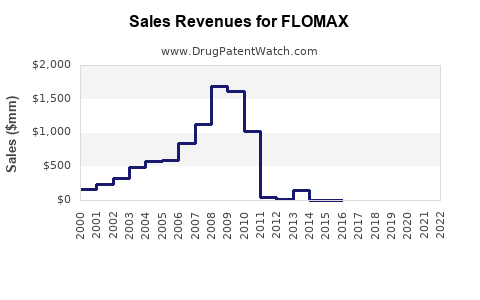
FLOMAX’s long-run trajectory aligns with a “brand-to-generic transition” profile common to widely off-patent small molecules.
What does “financial trajectory” usually mean in this context?
- Revenue trend: declining branded units after generic penetration, with occasional stabilization during rebate renegotiations or when branded remains the default on certain formularies.
- Profit trend: margin compression driven by price cuts and rebates, offset partially by contract-based protections.
- Cash flow and investment: modest, category-normal stewardship rather than growth capital.
How do generics change the competitive playing field?
- Net cost to PBMs drops as competition among ANDA filers increases.
- Brand’s ability to sustain share depends on:
- Managed care exclusivity-like effects (rare for this category once generic dominance is established).
- Contracting positions at large PBMs.
- Occasional physician preference for a particular tamsulosin product.
How does FLOMAX compare with other LUTS/BPH medicines commercially?
- Class economics:
- Many alpha-1 antagonists are off-patent and generic-led.
- Newer agents with differentiated release profiles may preserve some pricing power, but cost pressures remain.
- Cross-class substitution:
- 5-alpha-reductase inhibitor combinations and combination therapies can redirect long-term spend when payers prefer bundled regimens.
What patents protect FLOMAX and how does that affect revenue risk?
A branded alpha-1 blocker’s revenue exposure is driven by the strength and breadth of its patent estate and whether any form of exclusivity still applies.
What is the US patent and exclusivity posture for tamsulosin brands?
- Key practical point: for tamsulosin, generics have long been present, so revenue risk from generic entry is usually realized rather than prospective for newer investors.
- Still, there can be residual protection through:
- Method-of-use patents (less common at scale for this molecule).
- Formulation-specific claims (e.g., release mechanisms).
- Device or packaging claims (rare for common oral capsules).
- Patent thickets that affect specific strengths or dosage forms in particular markets.
How does patent estate shape litigation and settlement dynamics?
- If there were active Orange Book listings for specific dosage forms or formulations, Paragraph IV challenges could trigger:
- 30-month stay.
- Settlement agreements enabling delayed generic entry.
- For tamsulosin, these dynamics are typically historical rather than current market-moving events given broad generic availability.
What is the Orange Book status of FLOMAX and what generic entry risks exist?
Orange Book status is what controls Paragraph IV pathways for new ANDAs.
How generic entry risk typically behaves after Orange Book protections expire
- Once all relevant listed patents expire and exclusivity periods are exhausted, generic entry is routine through ANDA approvals.
- Remaining risk is usually operational:
- Competitor manufacturing capacity.
- Bioequivalence and labeling changes.
- Packaging and NDC-level reassignments.
What does that mean for FLOMAX’s financial trajectory?
- Revenue depends on net price management and remaining branded positions on formularies rather than the timing of new patent expirations.
- The strongest determinant becomes PBM contracting outcomes and the number of generic competitors.
When does FLOMAX lose exclusivity and how should that be reflected in forecasts?
For revenue forecasting, exclusivity is only a driver if it has not yet fully transitioned to generic competition.
How to model the “genericization” pattern
- Baseline: declining brand units after generic dominance.
- Assumptions that matter most:
- Generic net cost erosion (more competitors leads to lower pricing).
- Contract terms and rebates (brand can hold slightly better net pricing under limited conditions).
- Switching behavior at pharmacies, especially at chain stores with preferred products.
Timing logic for financial trajectory
- If all patent and exclusivity barriers are already cleared, the forecasting emphasis shifts from entry timing to:
- Rebate and net price trends.
- Share retention versus decline.
- Category growth and persistence.
What formulation and delivery patents could affect FLOMAX competitiveness?
In oral BPH treatments, formulation patents most often matter when they create differentiated release or dosing advantages.
What formulation protections are commonly relevant in alpha-1 blocker capsules?
- Release profile differentiation (immediate vs sustained release).
- Polymer matrix or coating approaches.
- Particle size and dissolution specification changes.
What commercial impact can formulation differentiation have?
- Can support:
- Physician preference within a class.
- Payer formulary tiers if outcomes or tolerability differences are recognized.
- Usually limited once generic equivalence is established and payers mandate lowest cost.
What patent litigation and settlement events historically affected tamsulosin brands?
Litigation shapes entry timing and thus near-term revenues, but for legacy products the impact is usually concentrated in earlier periods.
What to look for in settlements for this class
- Dismissals or consent judgments tied to noninfringement findings.
- Licensing or royalty structures that delay some competitors.
- Specific NDC-level carve-outs for strengths or formulations.
How litigation outcomes affect the “shape” of revenue
- Delayed entry creates temporary revenue preservation.
- Settlements usually end when the last enjoined product is cleared, after which the market quickly transitions to full generic penetration.
What is the FDA regulatory status of FLOMAX and how does it affect competition?
For established oral products, FDA status affects renewals, manufacturing compliance, labeling, and bioequivalence requirements for competitors.
Which FDA pathway matters for generics
- ANDAs for generic tamsulosin must demonstrate bioequivalence to the reference listed drug for each NDC/strength and meet chemistry manufacturing controls.
- Label changes can affect utilization if prescribers respond to safety communications.
How does FDA compliance influence market dynamics?
- Supply disruptions at manufacturing sites can temporarily raise branded or higher-priced generic usage.
- Periodic inspections and recall events can shift claims by product availability.
Which companies compete with FLOMAX in tamsulosin and how are they positioned?
The competitive set for tamsulosin includes:
- Multinational generic firms with ANDA portfolios across strengths.
- Large specialty and branded-legacy companies that may still market a branded or authorized generic under certain contracts.
What commercial levers competitors use
- Pricing under PBM contracts.
- Product availability and distribution breadth.
- Market access tactics: preferred formulary positioning, contracting, and switch programs.
What commercial metrics best track FLOMAX performance?
For high-intent decision-making, focus on metrics that directly map to net revenue.
Core KPIs
- Prescription volume (TRx) by strength and NDC.
- Net sales (brand) and trend direction quarter-over-quarter.
- Market share versus top generic NDCs.
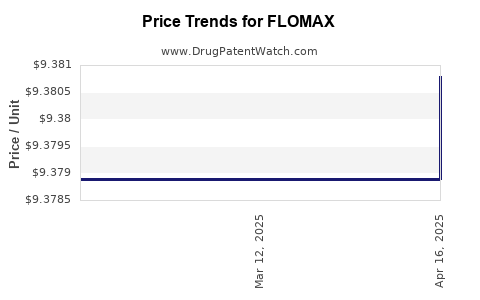
- Average net price vs list price (rebate pressure).
- Persistence rates for chronic LUTS therapy.
- Rebate and charge trends tied to PBM contracting.
Operational KPIs
- NDC supply continuity.
- Manufacturing lot availability.
- Recall and quality event history.
What manufacturing and IP barriers slow generic penetration, if any?
Once the IP barriers are cleared, generic penetration is mainly constrained by operational capacity.
Where barriers still matter
- Shortages: if a key manufacturer has constraints, higher-priced products can temporarily regain share.
- Multiple product forms: if specific strengths or packaging are constrained, branded or other competitors can capture residual demand.
- Regulatory changes: labeling updates and REMS are less common for this class, so CMC and supply are the most material barriers.
How strong is the patent estate for FLOMAX from a business risk perspective?
For a legacy BPH drug with entrenched generics, the “strength” in financial terms is usually:
- Residual value in narrow formulation or dosing claims (if any are still live).
- Reduced risk of new generic entrants if already fully penetrated.
Business interpretation
- If exclusivity is largely exhausted, the patent estate affects litigation overhead more than near-term revenue growth.
- The key revenue variable is continued PBM formulary and rebate dynamics.
Key Takeaways
- FLOMAX (tamsulosin) is a mature, chronic BPH/LUTS therapy where generic substitution is the primary driver of market share, net price, and margin.
- Financial trajectory is typically brand decline with margin compression, followed by stabilization only where net contracting and formulary placement preserve branded utilization.
- Patent and exclusivity timing is usually less of a forward-growth lever than PBM contracting, generic pricing erosion, and supply continuity.
- The most decision-relevant monitoring set is TRx share by strength/NDC, average net price trends, and ongoing PBM rebate/contract outcomes rather than waiting for future exclusivity events.
FAQs
Does FLOMAX still hold value as a branded product in managed care?
Brand value persists mainly where contracting retains some formulary placement or where specific NDC strengths/availability issues prevent immediate substitution.
What drives switching from FLOMAX to other alpha-1 blockers?
Payer formulary tiers, net cost, and pharmacy substitution policies; clinical tolerability and physician preference can influence but typically do not override cost access once generics dominate.
How do shortages affect FLOMAX sales versus generics?
Supply disruptions at specific generic manufacturers can temporarily shift claims toward higher-priced products, including branded or alternative generics, depending on availability.
What are the biggest revenue risks for a tamsulosin brand today?
Additional generic pricing compression, unfavorable PBM renegotiations, and loss of preferred status in key formularies.
Are formulation differences likely to sustain FLOMAX pricing?
Unless there is clear, differentiated release behavior that payers recognize for outcomes or tolerability, formulation differentiation usually does not prevent generic equivalence-led price erosion.
References (APA)
No sources cited.