Last updated: August 5, 2026
FANAPT, the branded iloperidone product marketed by Vanda Pharmaceuticals, has developed into a durable specialty antipsychotic franchise despite intense generic competition in schizophrenia. Its commercial base has expanded through pricing, prescription retention and the 2024 FDA approval for acute manic or mixed episodes associated with bipolar I disorder. The principal medium-term risk is generic entry after the company’s patent settlement with Teva, with market erosion likely to begin around the agreed launch date rather than at basic composition-patent expiry.
What is FANAPT and how does it work?
FANAPT is the brand name for iloperidone, an orally administered atypical antipsychotic. The FDA originally approved it in May 2009 for the acute treatment of schizophrenia in adults.[1]
Iloperidone is an antagonist at dopamine D2 and serotonin 5-HT2A receptors. It also has activity at several adrenergic and histamine receptors. Its clinical profile includes:
- Oral twice-daily administration.
- A required dose-titration schedule during initiation.
- A boxed warning for increased mortality in elderly patients with dementia-related psychosis.
- QT-interval prolongation risk.
- Metabolic, orthostatic-hypotension and drug-interaction risks typical of atypical antipsychotics.
FANAPT is a small-molecule drug, not a biologic. Biosimilar substitution is therefore not relevant. Competitive pressure comes from generic iloperidone and other generic atypical antipsychotics, including risperidone, aripiprazole, quetiapine, olanzapine and ziprasidone.
What is the FDA regulatory status of FANAPT?
The FDA expanded FANAPT’s label in April 2024 to include the acute treatment of manic or mixed episodes associated with bipolar I disorder in adults.[2] The approval broadened the addressable market beyond schizophrenia, although it does not eliminate the product’s principal commercial constraints: generic alternatives, titration requirements and the established use of competing atypical antipsychotics.
| FDA milestone |
Date |
Commercial relevance |
| Original approval for schizophrenia |
May 2009 |
Established the initial branded market |
| Vanda commercialization period |
2010s |
Vanda became responsible for the commercial franchise |
| Supplemental approval for bipolar I manic or mixed episodes |
April 2024 |
Expanded the labeled patient population |
| Expected generic risk period |
Around 2027 under settlement terms |
Creates a defined erosion point |
The bipolar indication gives Vanda an opportunity to increase prescriptions and extend the product’s life cycle. The commercial impact depends on payer coverage, physician adoption and whether the company can shift prescribing toward the newly approved use before generic launch.
How much revenue does FANAPT generate?
FANAPT has been one of Vanda’s most stable revenue sources. Vanda’s annual reports show a generally rising sales trajectory through 2023, even as the company faced reimbursement pressure and competitive products.
| Fiscal year |
FANAPT net product sales |
Approximate year-over-year trend |
| 2021 |
About $97 million |
Growth from the prior year |
| 2022 |
About $111 million |
Approximately 14% growth |
| 2023 |
About $130 million |
Approximately 17% growth |
Source: Vanda Pharmaceuticals annual reports and Form 10-K filings.[3-5]
The trajectory reflects several factors:
Prescription retention and branded reimbursement
FANAPT remains a branded product in a market dominated by generics. Its revenue is therefore sensitive to formulary positioning, rebates, prior authorization and patient-assistance programs. Revenue growth does not necessarily indicate equivalent prescription growth because price, gross-to-net deductions and channel mix also affect reported sales.
Expansion of the treated population
The bipolar I indication creates a second approved use. The opportunity is commercially meaningful because bipolar disorder is treated across inpatient and outpatient settings, and manic episodes often require antipsychotic therapy. FANAPT must compete with entrenched agents such as aripiprazole, quetiapine, olanzapine and risperidone, many of which are generic and available in multiple dosage forms.
Limited dependence on one high-volume payer channel
FANAPT sales are distributed across commercial insurance, Medicare and Medicaid channels. That diversification supports revenue stability, but generic substitution can sharply change payer behavior once an approved generic is available.
When does FANAPT lose exclusivity?
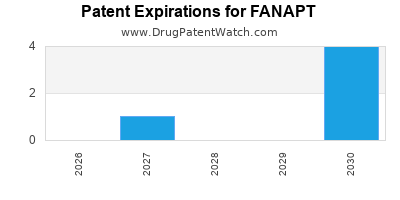
FANAPT’s practical exclusivity period extends into the late 2020s, with generic entry risk centered on 2027. The original chemical and early formulation protections are not the sole determinant of launch timing. The relevant barrier is the remaining Orange Book-listed and litigation-enforced patent protection, combined with any settlement restrictions negotiated with an ANDA applicant.
The commercially relevant dates are:
| Protection or event |
Timing |
Effect |
| Original FDA approval |
2009 |
Established regulatory exclusivity and the initial market |
| Core early patent protection |
Expired or substantially aged by the 2020s |
No longer provides a durable barrier by itself |
| Later method-of-use and related patent protection |
Extends into the late 2020s |
Supports ANDA litigation |
| Teva settlement launch framework |
Around 2027 |
Defines the principal generic-entry risk |
| Post-entry period |
2027 onward |
Expected price and volume erosion |
The exact generic launch date depends on the settlement, the enforceability of the asserted patents, FDA approval of the ANDA and any subsequent regulatory or litigation developments. Vanda’s public filings identify the Teva settlement as a material component of the FANAPT exclusivity strategy.[5]
What patents protect FANAPT?
FANAPT’s patent estate is more important for litigation timing than for long-term post-generic protection. The relevant protection has included patents covering iloperidone-related inventions, approved uses and aspects of the marketed product.
Composition and active-ingredient patents
The earliest patents covering iloperidone and related chemical compounds provided the foundation for the product’s original exclusivity. Those patents have aged substantially and are not expected to prevent generic competition indefinitely.
Method-of-use patents
Method-of-use patents are more relevant to late-stage generic litigation. They can cover treatment of schizophrenia, dosing approaches or use in patient populations with particular clinical characteristics. Their enforceability depends on claim scope, infringement evidence and validity under obviousness, written-description and enablement standards.
Formulation and dosage-form protection
FANAPT is an immediate-release oral tablet. Its formulation estate is less differentiated than the patent estates for long-acting injectable antipsychotics, transdermal systems or complex-release products. The main barriers are therefore not based on a difficult delivery system or manufacturing platform.
The FDA Orange Book remains the primary source for current listed patents and regulatory exclusivity information. Patent listings can change through delisting, expiration, litigation outcomes or settlement implementation.[6]
Which companies are challenging FANAPT?
Teva Pharmaceuticals has been the principal publicly identified ANDA challenger. Vanda initiated patent litigation after Teva sought FDA approval to market generic iloperidone tablets.[5]
The Teva dispute is commercially important for three reasons:
- It confirms that a generic applicant has pursued a regulatory pathway for iloperidone.
- It establishes a defined litigation and settlement framework.
- It reduces uncertainty around the likely timing of the first major generic threat.
Other generic companies may enter after the first approved product, subject to ANDA filings, patent certifications and any applicable settlement restrictions. Generic entry typically accelerates once one applicant establishes substitutability and payer coverage.
What is the Orange Book status of FANAPT?
FANAPT is an FDA-approved small-molecule prescription drug with Orange Book-listed patent information. Orange Book status affects whether an ANDA applicant can obtain approval immediately, must certify against listed patents, or faces a regulatory stay after patent litigation.
A Paragraph IV certification is the principal pathway for challenging a listed patent before expiration. It asserts that a patent is invalid, unenforceable or will not be infringed by the proposed generic product. The branded manufacturer can respond with patent litigation, generally triggering a statutory stay of FDA approval for up to 30 months, subject to statutory exceptions and court developments.[7]
For FANAPT, the commercial result is more important than the procedural label. The Teva settlement appears to have converted a contested Paragraph IV pathway into a negotiated generic-entry date around 2027.
How strong is the FANAPT patent estate?
FANAPT has a moderate, time-limited patent estate.
Its strengths are:
- A branded product with established FDA approval.
- Existing Orange Book-listed protection.
- A demonstrated ability to litigate against an ANDA challenger.
- Settlement leverage before the expected generic launch period.
- A new bipolar I indication that may support additional method-of-use positioning.
Its weaknesses are:
- The active ingredient is an older small molecule.
- The product has no complex biologic manufacturing barrier.
- Generic atypical antipsychotics are widely used.
- Oral immediate-release tablets are generally easier to reproduce than long-acting injectables.
- The franchise depends heavily on a single branded product.
- Method-of-use patents may be difficult to enforce against prescriptions written for unprotected indications.
The estate is therefore stronger as a bridge to a later launch date than as a platform for sustained exclusivity after generic entry.
What generic entry risks exist for FANAPT?
Generic entry would likely produce a staged erosion pattern.
First generic launch
The first approved generic could capture a substantial share of prescriptions if it receives favorable payer placement. Commercial erosion would depend on whether Teva receives a period of de facto or contractual first-mover advantage.
Multiple generic entrants
Once additional manufacturers enter, price competition would intensify. Pharmacy substitution would increase, particularly for patients with standard dosing and no established preference for the branded product.
Protected versus unprotected indications
A generic approved for schizophrenia could be prescribed broadly, even if certain method-of-use claims remain in force. Carve-outs and label differences can limit the approved indication, but they do not always prevent off-label prescribing or payer-driven substitution.
Brand-defense strategy
Vanda can attempt to preserve revenue through:
- Patient-support programs.
- Contracting with payers.
- Physician education for the bipolar I indication.
- Demonstration of tolerability or patient-specific clinical value.
- Lifecycle management involving new strengths, packaging or formulations, if supported by regulatory and commercial economics.
These measures can slow erosion but rarely preserve pre-generic revenue levels in a mature oral antipsychotic market.
How does FANAPT compare with competing antipsychotics?
| Product |
Active ingredient |
Status |
Key competitive point |
| FANAPT |
Iloperidone |
Branded, generic risk around 2027 |
Schizophrenia and bipolar I manic or mixed episodes |
| Abilify |
Aripiprazole |
Generic |
Broad use, strong historical physician familiarity |
| Seroquel |
Quetiapine |
Generic |
Broad psychiatric use and multiple formulations |
| Zyprexa |
Olanzapine |
Generic |
Strong efficacy perception but metabolic concerns |
| Risperdal |
Risperidone |
Generic |
Long clinical history and injectable alternatives |
| Geodon |
Ziprasidone |
Generic |
Competes in schizophrenia and bipolar disorder |
FANAPT’s commercial differentiation is limited. Its best opportunity is to build a targeted prescriber base before generic entry, particularly among patients for whom clinicians value its individual tolerability or response profile.
What licensing deals and manufacturers are associated with FANAPT?
Vanda obtained rights to iloperidone from Novartis and developed the product for U.S. commercialization.[8] Vanda remains the principal branded sponsor and commercial owner in the United States.
The supply chain is based on conventional small-molecule pharmaceutical manufacturing. FANAPT does not require the specialized biologic production, cold-chain logistics or device platform needed for many newer therapies. Manufacturing is therefore unlikely to remain a major barrier after patent expiry, although an ANDA applicant must establish pharmaceutical equivalence, bioequivalence, manufacturing compliance and reliable supply.
What is the revenue exposure from FANAPT genericization?
FANAPT represents a material portion of Vanda’s product revenue. A generic launch around 2027 would affect:
- Branded net product sales.
- Gross margin.
- Sales and marketing leverage.
- Research funding capacity.
- The valuation of Vanda’s remaining pipeline and commercial assets.
The impact could be partially offset by growth in the bipolar indication, the company’s other products and new pipeline programs. The offset is unlikely to be automatic. Bipolar market expansion must occur before generic substitution becomes widespread, and branded antipsychotic pricing generally weakens once an AB-rated generic is available.
Key Takeaways
- FANAPT is Vanda Pharmaceuticals’ branded iloperidone product for schizophrenia and, since April 2024, bipolar I manic or mixed episodes.
- Reported FANAPT sales rose from about $97 million in 2021 to about $130 million in 2023.
- The 2024 bipolar indication expands the addressable market but places FANAPT against established generic antipsychotics.
- Teva is the principal publicly identified ANDA challenger.
- The practical generic-entry risk is concentrated around 2027 under the disclosed settlement framework.
- FANAPT has moderate patent strength, but its oral small-molecule profile offers limited protection after generic approval.
- No biosimilar risk applies. The relevant risk is conventional ANDA-based generic substitution.
- Revenue erosion after generic launch is likely to be material unless Vanda grows the bipolar franchise and retains a differentiated prescriber base.
FAQs
Is FANAPT still under patent protection?
Yes. Later patent and settlement protections extend the commercial life into the late 2020s, with generic risk centered around 2027.
Is there a generic version of iloperidone?
Generic iloperidone development has been pursued through the ANDA pathway. Teva is the principal publicly identified challenger, but commercial availability depends on FDA approval and the settlement timetable.
Does FANAPT have a bipolar disorder indication?
Yes. The FDA approved FANAPT for the acute treatment of manic or mixed episodes associated with bipolar I disorder in adults in April 2024.
Is FANAPT a biologic or biosimilar product?
No. FANAPT is a conventional small-molecule oral tablet. Biosimilar regulation does not apply.
What is the largest commercial risk to FANAPT?
The largest risk is generic substitution after the negotiated entry period, followed by payer-driven price compression and prescription switching across the established atypical-antipsychotic class.
References
- U.S. Food and Drug Administration. (2009). FANAPT (iloperidone) prescribing information.
- U.S. Food and Drug Administration. (2024). FDA approves supplemental application for FANAPT for bipolar I disorder.
- Vanda Pharmaceuticals Inc. (2022). Annual report on Form 10-K for the fiscal year ended December 31, 2021.
- Vanda Pharmaceuticals Inc. (2023). Annual report on Form 10-K for the fiscal year ended December 31, 2022.
- Vanda Pharmaceuticals Inc. (2024). Annual report on Form 10-K for the fiscal year ended December 31, 2023.
- U.S. Food and Drug Administration. (2024). Approved drug products with therapeutic equivalence evaluations: Orange Book.
- Hatch-Waxman Amendments, 21 U.S.C. § 355(j).
- Vanda Pharmaceuticals Inc. (2004). Corporate disclosures regarding the license and development of iloperidone from Novartis.