You're using a free limited version of DrugPatentWatch: Upgrade for Complete Access

Last Updated: December 15, 2025

EXEM FOAM KIT Drug Patent Profile


✉ Email this page to a colleague

« Back to Dashboard


Which patents cover Exem Foam Kit, and what generic alternatives are available?

Exem Foam Kit is a drug marketed by Giskit and is included in one NDA. There are three patents protecting this drug.

This drug has six patent family members in six countries.

The generic ingredient in EXEM FOAM KIT is air polymer-type a. There are thirty-seven drug master file entries for this compound. One supplier is listed for this compound. Additional details are available on the air polymer-type a profile page.

DrugPatentWatch® Generic Entry Outlook for Exem Foam Kit

Exem Foam Kit was eligible for patent challenges on November 7, 2023.

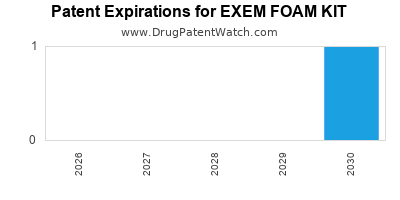
By analyzing the patents and regulatory protections it appears that the earliest date for generic entry will be October 15, 2030. This may change due to patent challenges or generic licensing.

Indicators of Generic Entry

< Available with Subscription >

  Get Started Free

AI Deep Research
Questions you can ask:
  • What is the 5 year forecast for EXEM FOAM KIT?
  • What are the global sales for EXEM FOAM KIT?
  • What is Average Wholesale Price for EXEM FOAM KIT?
Summary for EXEM FOAM KIT
International Patents:6
US Patents:3
Applicants:1
NDAs:1
Finished Product Suppliers / Packagers: 1
DailyMed Link:EXEM FOAM KIT at DailyMed
Drug patent expirations by year for EXEM FOAM KIT
DrugPatentWatch® Estimated Loss of Exclusivity (LOE) Date for EXEM FOAM KIT
Generic Entry Date for EXEM FOAM KIT*:
Constraining patent/regulatory exclusivity:
NDA:
Dosage:
FOAM;INTRAUTERINE

*The generic entry opportunity date is the latter of the last compound-claiming patent and the last regulatory exclusivity protection. Many factors can influence early or later generic entry. This date is provided as a rough estimate of generic entry potential and should not be used as an independent source.

US Patents and Regulatory Information for EXEM FOAM KIT

EXEM FOAM KIT is protected by three US patents.

Based on analysis by DrugPatentWatch, the earliest date for a generic version of EXEM FOAM KIT is ⤷  Get Started Free.

This potential generic entry date is based on patent 9,034,300.

Generics may enter earlier, or later, based on new patent filings, patent extensions, patent invalidation, early generic licensing, generic entry preferences, and other factors.

Applicant Tradename Generic Name Dosage NDA Approval Date TE Type RLD RS Patent No. Patent Expiration Product Substance Delist Req. Exclusivity Expiration
Giskit EXEM FOAM KIT air polymer-type a FOAM;INTRAUTERINE 212279-001 Nov 7, 2019 RX Yes Yes 9,034,300 ⤷  Get Started Free Y ⤷  Get Started Free
Giskit EXEM FOAM KIT air polymer-type a FOAM;INTRAUTERINE 212279-001 Nov 7, 2019 RX Yes Yes 9,259,494 ⤷  Get Started Free Y ⤷  Get Started Free
Giskit EXEM FOAM KIT air polymer-type a FOAM;INTRAUTERINE 212279-001 Nov 7, 2019 RX Yes Yes 9,849,199 ⤷  Get Started Free Y ⤷  Get Started Free
>Applicant >Tradename >Generic Name >Dosage >NDA >Approval Date >TE >Type >RLD >RS >Patent No. >Patent Expiration >Product >Substance >Delist Req. >Exclusivity Expiration

International Patents for EXEM FOAM KIT

When does loss-of-exclusivity occur for EXEM FOAM KIT?

Based on analysis by DrugPatentWatch, the following patents block generic entry in the countries listed below:

Denmark

Patent: 88211
Estimated Expiration: ⤷  Get Started Free

European Patent Office

Patent: 88211
Patent: Composition et procédé d'imagerie médicale de cavités corporelles (Composition and method for medical imaging of body cavities)
Estimated Expiration: ⤷  Get Started Free

Netherlands

Patent: 03660
Estimated Expiration: ⤷  Get Started Free

Poland

Patent: 88211
Estimated Expiration: ⤷  Get Started Free

Spain

Patent: 29564
Estimated Expiration: ⤷  Get Started Free

Generics may enter earlier, or later, based on new patent filings, patent extensions, patent invalidation, early generic licensing, generic entry preferences, and other factors.

See the table below for additional patents covering EXEM FOAM KIT around the world.

Country Patent Number Title Estimated Expiration
Denmark 2488211 ⤷  Get Started Free
World Intellectual Property Organization (WIPO) 2011046437 ⤷  Get Started Free
Netherlands 2003660 ⤷  Get Started Free
Poland 2488211 ⤷  Get Started Free
European Patent Office 2488211 Composition et procédé d'imagerie médicale de cavités corporelles (Composition and method for medical imaging of body cavities) ⤷  Get Started Free
Poland 2488211 ⤷  Get Started Free
>Country >Patent Number >Title >Estimated Expiration

Market Dynamics and Financial Trajectory for the Pharmaceutical Drug: EXEM FOAM KIT

Last updated: July 27, 2025


Introduction

The pharmaceutical landscape is characterized by rapid innovation, evolving regulatory frameworks, and shifting patient needs. The emergence of advanced delivery systems, such as topical foam kits, significantly impacts treatment paradigms and commercial strategies. The EXEM FOAM KIT, a topical foam formulation, exemplifies this trend, offering a novel approach to delivering active pharmaceutical ingredients (APIs) efficiently and conveniently. This article analyzes the current market dynamics and forecasts the financial trajectory of EXEM FOAM KIT, providing insights pivotal for stakeholders in the pharma industry.


Overview of EXEM FOAM KIT

EXEM FOAM KIT is a topical foam formulation designed to optimize drug delivery for targeted dermatological or mucosal applications. Its formulation aims to enhance bioavailability, improve patient compliance, and reduce systemic side effects relative to traditional dosage forms such as creams, gels, or injections. The kit typically comprises pre-filled foam dispensers, ensuring standardized dosages and ease of use.

The drug’s indication spectrum varies, encompassing conditions like inflammatory dermatoses, localized infections, or hormonal treatments, depending on the API incorporated. The foam delivery platform aligns with current preferences for minimally invasive, user-friendly treatment options, filling a niche within dermatology and other therapeutic segments.


Market Dynamics

1. Growing Demand for Topical Delivery Systems

The global dermatology market is projected to reach approximately $25 billion by 2026 [1], driven by rising skin disease prevalence, increased awareness, and demand for localized treatment. Topical formulations like foams are increasingly preferred over traditional preparations due to their rapid absorption, reduced mess, and improved patient compliance.

Foam formulations have garnered FDA approval for several APIs, notably corticosteroids and antifungals [2], highlighting their clinical acceptance. The EXEM FOAM KIT capitalizes on this growth, offering a targeted, non-invasive modality aligned with patient preferences.

2. Technological Advancements and Formulation Innovation

Innovation in foam technology, including improved surfactants and encapsulation techniques, has enabled better stability and enhanced drug penetration [3]. The EXEM FOAM KIT benefits from these advancements, delivering consistent dosing and improved pharmacokinetics. Regulatory bodies are increasingly supportive of such formulations, provided efficacy and safety are demonstrated, lowering barriers to approval and commercialization.

3. Competitive Landscape

Key competitors include established topical foam products like Enstilar, Elocon, and Olux [4], with market players investing heavily in R&D and branding. The EXEM FOAM KIT's differentiation hinges on unique API combinations, delivery efficiency, and patient-centric features such as ease of use or portability.

Emerging biosimilars or novel APIs may pose future competition, emphasizing the importance of patent strategies and clinical differentiation.

4. Regulatory and Reimbursement Environment

Regulatory approval pathways for topical foam products are well-established, yet manufacturer obligations toward safety and bioequivalence remain rigorous [5]. Reimbursement policies influence market penetration, especially in regions with universal healthcare. Countries like the U.S. and Europe offer favorable reimbursement for innovative dermatological treatments, boosting commercial potential for products like EXEM FOAM KIT.

5. Market Penetration and Adoption Barriers

Despite advantages, barriers persist, including manufacturing costs, patent expirations of rival products, and market fragmentation. Educating healthcare providers about clinical benefits and cost-effectiveness remains critical for widespread adoption.


Financial Trajectory Analysis

1. Revenue Projections

The financial success of EXEM FOAM KIT depends upon multiple factors: regulatory approvals, patent holdings, pricing strategies, and market penetration. Assuming the product targets prevalent conditions such as psoriasis, atopic dermatitis, or fungal infections, the potential patient population ranges in millions globally.

Based on current market data, topical foam products command premium pricing due to convenience and efficacy. With an initial conservative penetration rate of 5% of the dermatological treatment market in developed regions, projected revenues could reach into hundreds of millions within the first 3-5 years post-launch.

In mature markets, expanding into emerging economies—with rising healthcare spending—could significantly enhance revenues. The global dermatology market is projected to grow at a CAGR of around 7.2% from 2021 to 2028 [1], directly affecting the product’s financial trajectory.

2. Cost Structures and Profit Margins

Development costs include formulation R&D, clinical trials, regulatory submissions, and manufacturing setup. Post-launch, costs stabilize around production, marketing, and distribution. The variable nature of these expenses requires precise forecasting.

Profit margins for topical specialty drugs typically hover between 30-50% due to high R&D, regulatory, and marketing investments [6]. If EXEM FOAM KIT captures a significant market segment, economies of scale and streamlined manufacturing could bolster margins.

3. Market Entry and Growth Strategies

Strategic partnerships, licensing deals, and direct-to-consumer marketing can accelerate market adoption. Emphasizing clinical data demonstrating superior efficacy and tolerability is vital for convincing physicians and payers.

Phased geographic expansion, starting with high-income markets—such as the U.S., Europe, and Japan—followed by emerging economies, aligns with typical growth trajectories. Each phase’s revenue contribution depends on regulatory success and market acceptance.

4. Long-Term Financial Outlook

Over 10 years, the product’s cumulative revenue could surpass $1 billion if it sustains market relevance. Factors influencing long-term prospects include patent life, competitive innovations, and regulatory changes.

A potential decline post-patent expiry offers avenues for generic development, possibly reducing prices but maintaining volume-based revenues. Continuous formulation enhancements could preserve market share and profitability.


Market Risks and Opportunities

Risks:

  • Regulatory delays or rejections could hinder commercialization.
  • Entrance of competitors with superior or cheaper products.
  • Reimbursement challenges in certain healthcare systems.
  • Patient and physician acceptance barriers.

Opportunities:

  • Expanding API indications to broader dermatological or systemic conditions.
  • Incorporating digital health tools, such as adherence tracking.
  • Developing combination therapies within the foam platform.

Conclusion

The EXEM FOAM KIT occupies a promising niche within the dermatological and topical drug delivery market. Its growth trajectory hinges on technological innovation, strategic market entry, regulatory navigation, and competitive positioning. With the global shift toward patient-friendly, minimally invasive therapies, the product’s financial outlook appears positive, with significant upside potential for early movers and strategic partners.


Key Takeaways

  • The global dermatology market's expansion, driven by patient demand for convenient therapies, underpins the growth potential of topical foam formulations like EXEM FOAM KIT.
  • Technological advances and regulatory support facilitate market entry; however, differentiation through efficacy, safety, and user convenience remains critical.
  • Revenue projections indicate the potential for multi-hundred-million-dollar revenues within the first five years, contingent on effective marketing and clinical validation.
  • Long-term success depends on patent strategy, continued innovation, and navigating competitive and reimbursement landscapes.
  • Strategic expansion and technological enhancements can sustain the product’s market relevance and profitability.

FAQs

1. What therapeutic indications are suitable for EXEM FOAM KIT?
Primarily dermatological conditions such as psoriasis, eczema, and fungal infections. Its formulation can be customized with various APIs to target specific indications.

2. How does the foam delivery platform improve patient compliance?
Foams are easier to apply, less messy, and absorb quickly, encouraging adherence particularly among children and elderly patients.

3. What are the main regulatory considerations for topical foam formulations?
Demonstrating bioequivalence, safety, and efficacy through clinical trials; complying with formulation stability and device safety standards; and adhering to regional registration procedures.

4. How does patent protection influence the financial trajectory of EXEM FOAM KIT?
Strong patent protection ensures market exclusivity, enabling premium pricing and safeguarding revenue streams for at least 10-15 years. Patent expiry could open markets for generics, affecting long-term profitability.

5. What competitive strategies should companies pursue for this product?
Invest in clinical data generation, differentiate via formulation advantages, develop strategic partnerships, and pursue targeted marketing to healthcare providers emphasizing patient benefits.


References

[1] MarketWatch, "Global Dermatology Market Size," 2022.
[2] U.S. Food & Drug Administration, "Approved Topical Foam Products," 2021.
[3] Journal of Pharmaceutical Sciences, "Advances in Foam Formulation Technology," 2020.
[4] MarketDataForecast, "Topical Dermatology Drugs Market," 2022.
[5] EMA Guidelines, "Topical and Transdermal Drug Development," 2021.
[6] Deloitte, "Financial Profiles of Branded Topical Drugs," 2019.

More… ↓

⤷  Get Started Free

Make Better Decisions: Try a trial or see plans & pricing

Drugs may be covered by multiple patents or regulatory protections. All trademarks and applicant names are the property of their respective owners or licensors. Although great care is taken in the proper and correct provision of this service, thinkBiotech LLC does not accept any responsibility for possible consequences of errors or omissions in the provided data. The data presented herein is for information purposes only. There is no warranty that the data contained herein is error free. We do not provide individual investment advice. This service is not registered with any financial regulatory agency. The information we publish is educational only and based on our opinions plus our models. By using DrugPatentWatch you acknowledge that we do not provide personalized recommendations or advice. thinkBiotech performs no independent verification of facts as provided by public sources nor are attempts made to provide legal or investing advice. Any reliance on data provided herein is done solely at the discretion of the user. Users of this service are advised to seek professional advice and independent confirmation before considering acting on any of the provided information. thinkBiotech LLC reserves the right to amend, extend or withdraw any part or all of the offered service without notice.