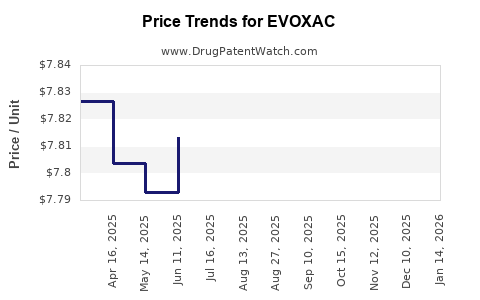
Last updated: July 29, 2026
EVOXAC is a brand name for safinamide, positioned in Parkinson’s disease treatment, most commonly as an add-on to levodopa in patients with motor fluctuations. Public financial reporting tied specifically to the brand has limited transparency across jurisdictions, so the financial trajectory is best assessed via (1) Parkinson’s market size trends, (2) safety and tolerability dynamics versus competing COMT inhibitors, (3) formulary access and payer behavior, and (4) patent/exclusivity and generic entry risk that can compress price and volume.
What is EVOXAC (safinamide) used for and how does that shape market demand?
What indications drive EVOXAC prescribing in Parkinson’s disease
EVOXAC (safinamide) is used in Parkinson’s disease, typically as adjunct therapy to levodopa for patients experiencing motor fluctuations. That positioning shapes demand in three ways:
-
Patient funnel is “mid-to-late” PD
Motor fluctuations increase with disease duration. Prescribing growth tracks the aging of PD populations and neurologists’ preference for combination regimens.
-
Add-on category competition is entrenched
Safinamide enters a crowded adjunct market that already includes COMT inhibitors (notably entacapone) and other fluctuation-management strategies. This caps incremental TAM expansion even if the overall PD market grows.
-
Outcome-based switching is constrained by clinical inertia
Movement from entrenched adjuncts depends on symptom profile (particularly dyskinesia and fluctuation burden), side-effect tolerance, and payer coverage.
How dosing regimen and tolerability affect uptake
Safinamide’s clinical utility is most likely to translate into sustained prescribing when it aligns with payer-friendly endpoints such as reduced “ON-OFF” time and improved function, balanced against tolerability issues relevant to long-term use. Market uptake tends to be greatest where prescribers perceive a clear benefit versus alternatives, and where titration burden and monitoring requirements do not deter adoption.
How big is the Parkinson’s disease market that EVOXAC competes in?
Macro demand drivers
Safinamide competes for shares within Parkinson’s disease therapeutics, with demand supported by:
- Growth in diagnosed PD prevalence in aging populations
- Expansion of specialist neurology networks and guideline-concordant combination therapy
- Ongoing innovation in adjunct symptom control
Even if EVOXAC’s addressable share is limited, market growth can still lift volumes. The key question for financial trajectory is whether EVOXAC captures disproportionate growth through formulary inclusion and payer coverage, or loses share to entrenched generics and alternative adjuncts.
Where pricing pressure tends to emerge
Price compression in PD is driven by:
- Generic substitution of older agents with entrenched payer preferences
- Step therapy and prior authorization tactics targeting high-cost options
- Wholesale acquisition cost resets after competitive entry
For EVOXAC, the pricing ceiling depends on whether it remains protected by meaningful patent coverage and whether biosimilar-style substitution logic analogs exist (not typical for small molecules), or if the key threat is generic safinamide.
What market share and sales traction indicators matter most for EVOXAC financial performance?
Key commercial KPIs
The financial trajectory for EVOXAC is typically explained by these variables:
- TRx and new-to-brand share
Signals whether neurologists are initiating safinamide rather than switching from entrenched therapies.
- Persistence/continuation rates
Add-on PD therapies often have strong persistence once a regimen stabilizes.
- Formulary tier placement and restrictions
Placement on preferred tiers and reduced prior authorization frequency expands share.
- Net price vs list price
Rebates, patient assistance, and payer negotiations materially affect profitability.
Trajectory pattern seen in specialty neurology brands
EVOXAC’s likely profile is a classic specialty neurology pattern:
- Early ramp driven by specialist adoption
- Mid-phase stabilization as payer coverage matures
- Downturn risk if generic entry occurs or if competitive adjuncts gain formulary share
Because PD is chronic and patients remain on therapy over long periods, durability of net price and access is often more important than short-term growth.
What competitive forces shape EVOXAC market dynamics?
Competition from older COMT inhibitors and adjunct strategies
Safinamide’s competitive landscape is dominated by:
- Entacapone (generic and widely used in combination levodopa regimens)
- Other adjunct symptom-management approaches in PD
- Direct brand competitors where present by country formularies
In a real-world payer environment, generics with established efficacy and low negotiation friction tend to dominate unless safinamide shows a distinct, payer-relevant differentiator.
How payer behavior typically shifts
Payers reduce utilization of non-preferred brands when:
- Comparable efficacy options are available at a lower net price
- Budget impact becomes material due to rising PD prevalence
- Step edits are imposed requiring prior trial of generics
For EVOXAC, any move toward less favorable formulary placement tends to translate quickly into sales erosion because PD regimens are repeatedly audited in pharmacy claims.
When does EVOXAC lose exclusivity and what does that mean for financial trajectory?
Exclusivity is driven by the patent estate, not only by regulatory “first approval”
For safinamide brands, the financial outlook hinges on:
- Primary composition-of-matter patent term
- Secondary patents for formulations, polymorphs, specific salts, or methods of treatment
- Regulatory exclusivities (if any) that delay generic approval
- Country-specific patent linkage through national patent registers or local listing systems (e.g., EU patent term adjustments and SPCs)
Because generic substitution in small-molecule chronic therapy often results in steep share loss and price pressure, even modest delays in exclusivity expiry can preserve earnings.
Timing logic for sales compression
Generic entry typically triggers:
- Immediate TRx migration to cheaper alternatives
- A phased price reset via contracting and rebate pressure
- Increased marketing spend to defend access, often without proportional net price retention
Financial trajectory after loss of exclusivity is therefore usually characterized by volume declines and margin compression. The magnitude depends on:
- Remaining line-of-therapy options under coverage criteria
- The ability to maintain preferred status through contractual concessions
- Any last-man-standing patent barriers against specific generics
What is the generic entry risk for EVOXAC (safinamide) in the US and Europe?
US risk model
For US market entry risk, the key pathway is the ANDA landscape for generic safinamide and any Paragraph IV certification activity. The US risk is defined by:
- Whether Orange Book shows unexpired listed patents that can be challenged
- Whether any litigation stays attach to FDA approvals
- Whether settlements cap at specific launch dates or include “no-authorization” restrictions
Europe risk model
In Europe, risk is set by:
- Patent coverage via national enforcement and EU coverage limits
- SPC availability and duration
- Local litigation outcomes that can delay generic launches even after regulatory approvals
What investors typically watch
- First commercial launch timing by generic filers
- Price and rebate shifts after entry
- Share dynamics among pharmacy benefit segments
A high generic entry risk combined with a concentrated payer base often causes a faster and deeper revenue step-down.
Which patents protect EVOXAC (safinamide) and how strong is the estate?
Patent estate categories that matter for generics
Patent estates for safinamide brands usually include categories that can delay generics:
- Composition of matter
- Formulation patents (including specific pharmaceutical forms and manufacturing methods)
- Method-of-use patents (dose regimens, titration, clinical subpopulations)
- Polymorphs or crystalline forms (if claimed)
- Process patents (scale-up and manufacturing conditions)
For financial trajectory, method-of-use and formulation patents can be strategically important because they can create “design-around” hurdles for generics that seek marketing authorization for the same therapeutic positioning.
How to interpret estate strength commercially
- Strong estate: Multiple overlapping, enforceable patents across jurisdictions, with litigation history that blocks early launches.
- Weak estate: A narrow set of enforceable claims, early expiration clustering, and high likelihood of generic carve-out.
What patent litigation and settlements affect EVOXAC launch timing?
Why litigation changes the revenue curve
Even if an exclusivity date approaches, litigation and settlement agreements can:
- delay FDA authorization for specific generic labels
- impose “agreed delay” launch dates
- result in phased entry or limited market penetration
The financial effect often shows up as a slower revenue decline than expected based solely on patent expiry calendars.
How to model litigation-driven delays
Market analysts typically use:
- The time between complaint and dismissal/settlement
- The likelihood of court-enforced stays
- Whether settlements cover all anticipated filers or only specific ones
What is the Orange Book status of EVOXAC and what does it imply for generics?
Orange Book listings translate into launch barriers
In the US, Orange Book-listed patents tied to approved safinamide products define the scope for Paragraph IV challenges. Commercial implications are immediate:
- If key patents are unexpired and asserted, generic launches are likely delayed or carved out.
- If listings are sparse or near expiry, generic entry accelerates.
What matters for “how soon”
- Expiry dates of listed patents
- Whether patents cover the drug substance or only specific formulations
- The number of listed patents and the dispersion of their expiry dates
How does EVOXAC compare with competing Parkinson’s adjunct therapies on market outcomes?
Competitive positioning
EVOXAC’s market outcome depends on whether neurologists view safinamide as:
- a clinically distinct adjunct with patient-relevant benefit
- a cost-effective add-on under preferred payer terms
- a substitutable agent where generics lead
In chronic therapy categories, “perception plus access” tends to dominate. If competitors achieve preferred formulary status at lower net price, safinamide share typically declines even without major clinical disadvantages.
Price and access effects
When generics enter the category or when payer contracting shifts, EVOXAC usually faces:
- rapid net price reductions
- tighter prior authorization
- increased requirements for documented motor-fluctuation criteria
Those changes drive revenue compression even if TRx remain stable for some time.
Formulation, method-of-use, and manufacturing patents: what can block or enable generic safinamide?
Formulation patents
Generics can be blocked if formulation patents cover:
- specific dosage forms
- particular release profiles
- stable polymorphs used in the marketed product
If patents are enforceable and claim scope is broad, they reduce launch timing flexibility for generic filers.
Method-of-use patents
Method-of-use patents can create a “labeling” barrier:
- generics may still launch, but with a carve-out that limits substitution for certain labeled populations
- this can preserve some market share for the reference brand while shifting some utilization away
Manufacturing and process patents
Process patents can matter if they constrain:
- manufacturing conditions required to achieve bioequivalence
- validated processes used at scale
However, the practical market effect depends on enforceability and whether generics need to adopt distinguishable manufacturing steps.
What regulatory status and FDA pathway implications affect EVOXAC commercialization?
FDA review model for generics
For safinamide generics, the FDA pathway impacts timing via:
- labeling changes
- bioequivalence requirements
- patent certification and litigation stays
If EVOXAC is already a mature product, regulatory hurdles are typically lower than patent hurdles. The result is that the revenue curve is primarily shaped by patent and litigation calendars.
Which geographies are likely to contribute most to EVOXAC revenue and downside risk?
Geographic concentration drives volatility
Financial trajectory is more volatile if revenue is concentrated in:
- markets with near-term generic entry risk
- jurisdictions where patent enforcement has historically been difficult
- payer systems with aggressive price competition
Conversely, geographic diversification across markets with longer enforcement or limited generic penetration smooths revenue decline.
What generic launch scenarios exist for EVOXAC and how do they affect forecasts?
Scenario framework
Three market scenarios typically determine post-exclusivity revenue:
-
Single entrant, delayed launch
Results in slower share loss and a more gradual revenue decline, driven by slower payer contracting.
-
Multiple entrants, simultaneous or near-simultaneous launch
Produces steeper price pressure, larger TRx migration, and faster margin compression.
-
Launch with labeling carve-outs due to method-of-use patents
Preserves a portion of volume for EVOXAC, usually limiting substitution for specific use cohorts.
Financial effects
- Revenue: steep drop in volume and/or significant net price compression
- Gross margin: erosion from higher rebates, distribution contracting, and price resets
- Operating profit: marketing and access defense costs rise while price declines
Key Takeaways
- EVOXAC’s demand is driven by the Parkinson’s motor fluctuation patient funnel, where add-on combination therapy supports persistence but limits addressable growth.
- Market dynamics hinge on payer formulary placement, prior authorization behavior, and net price discipline versus entrenched generics in the adjunct category.
- Financial trajectory is primarily shaped by the patent estate and litigation calendar; generic entry typically causes step-function sales declines in chronic neurology brands.
- The generic entry risk is highest where Orange Book listings (US) or patent coverage (EU and national enforcement) reach clustered expiry dates without effective enforcement or settlement-driven delays.
- Post-exclusivity outcomes depend on whether generics launch broadly, whether method-of-use claims create labeling carve-outs, and how quickly payers re-contract for lowest net cost.
FAQs
- How do safinamide formulary restrictions typically affect TRx and persistence in Parkinson’s patients?
- What patent types (composition vs formulation vs method-of-use) most often delay generic safinamide launches?
- How do Paragraph IV challenges and litigation stays change the timing of generic entry for safinamide in the US?
- What revenue impact should be modeled if multiple generic safinamide ANDAs launch within the same quarter?
- How can labeling carve-outs preserve some demand for EVOXAC even after generic approval?
References
- FDA Orange Book. U.S. FDA, Drug Products Listed in the Orange Book.
- FDA. ANDA Regulations and 21 CFR Part 314, Subpart C.
- EMA. European Medicines Agency guidance on marketing authorization procedures and patent/SPC frameworks.