Share This Page
ESTARYLLA Drug Patent Profile
✉ Email this page to a colleague
Which patents cover Estarylla, and what generic alternatives are available?
Estarylla is a drug marketed by Xiromed and is included in one NDA.
The generic ingredient in ESTARYLLA is ethinyl estradiol; norgestimate. There is one drug master file entry for this compound. Eighteen suppliers are listed for this compound. Additional details are available on the ethinyl estradiol; norgestimate profile page.
AI Deep Research
Questions you can ask:
- What is the 5 year forecast for ESTARYLLA?
- What are the global sales for ESTARYLLA?
- What is Average Wholesale Price for ESTARYLLA?
Summary for ESTARYLLA
| US Patents: | 0 |
| Applicants: | 1 |
| NDAs: | 1 |
| Finished Product Suppliers / Packagers: | 3 |
| Raw Ingredient (Bulk) Api Vendors: | 5 |
| Patent Applications: | 735 |
| Drug Prices: | Drug price information for ESTARYLLA |
| Drug Sales Revenues: | Drug sales revenues for ESTARYLLA |
| DailyMed Link: | ESTARYLLA at DailyMed |
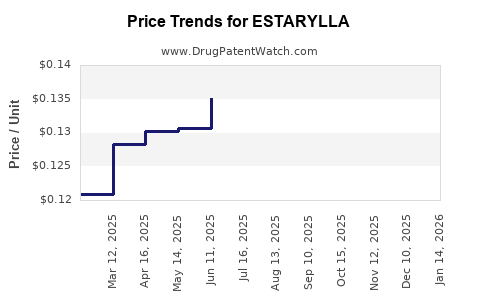
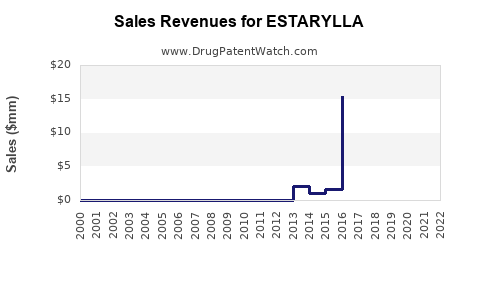
US Patents and Regulatory Information for ESTARYLLA
| Applicant | Tradename | Generic Name | Dosage | NDA | Approval Date | TE | Type | RLD | RS | Patent No. | Patent Expiration | Product | Substance | Delist Req. | Exclusivity Expiration |
|---|---|---|---|---|---|---|---|---|---|---|---|---|---|---|---|
| Xiromed | ESTARYLLA | ethinyl estradiol; norgestimate | TABLET;ORAL-28 | 090794-001 | Jan 30, 2013 | AB | RX | No | No | ⤷ Start Trial | ⤷ Start Trial | ⤷ Start Trial | |||
| >Applicant | >Tradename | >Generic Name | >Dosage | >NDA | >Approval Date | >TE | >Type | >RLD | >RS | >Patent No. | >Patent Expiration | >Product | >Substance | >Delist Req. | >Exclusivity Expiration |
Estarylla Market Dynamics and Financial Trajectory
Estarylla is a low-cost generic combined oral contraceptive containing norgestimate 0.25 mg and ethinyl estradiol 0.035 mg. Its commercial position is determined by generic pricing, pharmacy substitution, payer formularies, manufacturer supply, and contraceptive demand rather than patent exclusivity. Estarylla has no meaningful remaining originator patent barrier, no standalone public revenue disclosure, and limited ability to sustain premium pricing.
What is Estarylla and who markets it?
Estarylla is a 28-day oral contraceptive with 21 active tablets and seven inactive tablets. Each active tablet contains norgestimate and ethinyl estradiol. The product is therapeutically equivalent to the reference product Ortho-Cyclen, subject to FDA generic-drug standards.[1]
| Attribute | Estarylla profile |
|---|---|
| Active ingredients | Norgestimate 0.25 mg; ethinyl estradiol 0.035 mg |
| Dosage form | Oral film-coated tablet |
| Product type | Generic combination oral contraceptive |
| Reference product | Ortho-Cyclen |
| Therapeutic class | Combined hormonal contraceptive |
| U.S. regulatory pathway | Abbreviated New Drug Application |
| Manufacturer/labeler | Xiromed LLC |
| Prescription status | Prescription-only |
| Biosimilar exposure | None |
| Orange Book position | Generic product; no originator-style exclusivity |
Xiromed is the U.S. labeler and distributor identified in the product labeling. The product is part of a broader generic contraceptive market in which multiple manufacturers supply therapeutically equivalent products.[1]
What is Estarylla’s FDA regulatory status?
Estarylla is an FDA-approved generic oral contraceptive. Its approval does not depend on new clinical efficacy trials comparable to those required for an innovator product. The ANDA pathway requires pharmaceutical equivalence and bioequivalence to the reference product.[2]
The product has no biologic component and is not subject to biosimilar substitution rules. Its main regulatory risks relate to manufacturing compliance, product quality, labeling updates, pharmacovigilance, and supply continuity.
FDA approval and exclusivity
Estarylla does not have meaningful new-drug exclusivity. Generic oral contraceptive products generally enter after the reference product’s regulatory and patent protections have expired or become commercially irrelevant.
| Regulatory protection | Estarylla status |
|---|---|
| New chemical entity exclusivity | None |
| Orphan-drug exclusivity | None |
| Pediatric exclusivity | No product-specific benefit identified |
| 180-day generic exclusivity | No current strategic significance identified |
| Reference-product exclusivity | Expired for the underlying contraceptive combination |
| Biosimilar interchangeability | Not applicable |
The product’s commercial protection is therefore operational rather than legal. Reliable manufacturing, purchasing contracts, pharmacy availability, and formulary placement have greater economic importance than patent rights.
What patents protect Estarylla?
No material patent estate protects Estarylla as a branded commercial asset. The underlying norgestimate and ethinyl estradiol combination has been marketed for decades, and the relevant originator patents associated with Ortho-Cyclen-era products expired long before Estarylla’s current generic-market participation.
Estarylla is not an innovative formulation with a publicly significant composition-of-matter patent. The active ingredients are established pharmaceutical compounds, and the combination has extensive prior-art coverage.
Orange Book listings
The Orange Book is primarily relevant to the reference product and patents asserted against ANDA applicants. Estarylla itself does not have the profile of a patent-protected branded product with listed method-of-use or formulation patents that would delay generic entry.
| Patent category | Estarylla exposure |
|---|---|
| Composition-of-matter patents | Expired or commercially irrelevant |
| Combination-product patents | Expired or commercially irrelevant |
| Extended-cycle formulation patents | Not central to Estarylla |
| Delivery-device patents | None; Estarylla is a conventional tablet |
| Method-of-use patents | No material product-specific barrier identified |
| Manufacturing patents | Potentially relevant at supplier level, but not a market-exclusivity barrier |
| Orange Book litigation risk | Low |
When did Estarylla lose exclusivity?
Estarylla did not lose exclusivity in the conventional sense because it entered the market as a generic. The relevant exclusivity loss occurred at the reference-product level, when Ortho-Cyclen’s patent and regulatory protections ceased to prevent generic competition.
Norgestimate and ethinyl estradiol oral contraceptives have been available from multiple generic suppliers for years. As a result, Estarylla’s market trajectory began in a mature, competitive category rather than during a protected launch period.
How many patents cover Estarylla?
No meaningful number of active, commercially blocking patents has been publicly associated with Estarylla as a product. Any patent analysis must distinguish between:
- Patents covering the active ingredients, which are long expired.
- Patents covering the reference product, which no longer prevent ordinary generic competition.
- Supplier manufacturing patents, which may protect production processes without blocking competing manufacturers.
- Patents covering alternative contraceptive regimens or delivery systems, which do not cover Estarylla’s conventional tablet.
This distinction matters because a manufacturing patent held by a contract manufacturer would not normally give Estarylla a market monopoly.
What is Estarylla’s competitive landscape?
Estarylla competes in a crowded oral-contraceptive market. Direct competition includes generic norgestimate/ethinyl estradiol products marketed under different names, including products equivalent to Ortho-Cyclen and Previfem-type regimens. Indirect competition includes other combined oral contraceptives, progestin-only pills, long-acting reversible contraceptives, contraceptive patches, vaginal rings, emergency contraception, and over-the-counter oral contraceptive products.
Direct product comparison
| Product category | Main commercial distinction | Estarylla impact |
|---|---|---|
| Generic norgestimate/ethinyl estradiol | Same active combination or close therapeutic equivalent | Direct price and supply competition |
| Brand oral contraceptives | Higher marketing and brand recognition | Limited where formularies favor generics |
| Progestin-only pills | Different estrogen-risk profile and dosing characteristics | Expands substitution options |
| Long-acting reversible contraception | Higher upfront product and procedure cost | Competes for patients seeking longer duration |
| Transdermal and vaginal delivery | Different administration and adherence profile | Competes on convenience |
| Over-the-counter oral contraceptives | Lower access barriers for eligible users | May expand category demand while shifting channel economics |
The primary competitive variables are acquisition cost, rebate structure, wholesaler availability, pharmacy inventory, and prescriber familiarity. Clinical differentiation is limited because generic products must meet bioequivalence requirements.
How does Estarylla generate revenue?
Estarylla generates revenue through prescription sales to wholesalers, retail pharmacies, mail-order pharmacies, health systems, and managed-care channels. The economic model is typical of a mature generic:
- Low average selling price compared with branded contraceptives.
- High price sensitivity among payers and pharmacies.
- Limited direct-to-consumer marketing.
- Heavy dependence on formulary placement and automatic generic substitution.
- Revenue volatility caused by supply interruptions and contract wins or losses.
- Margin pressure when several manufacturers compete for the same product category.
No public filing identifies Estarylla’s standalone net sales, gross profit, market share, or unit volume. Xiromed does not report Estarylla as a separately disclosed public operating segment. Product-level revenue therefore cannot be reliably calculated from public company filings.
Financial trajectory
Estarylla’s likely financial trajectory follows the standard lifecycle of a mature generic:
| Period | Financial characteristic |
|---|---|
| Market entry | Revenue growth from initial distribution and pharmacy adoption |
| Early competition | Price declines as additional equivalent products become available |
| Mature phase | Stable but low-margin prescription volume |
| Supply-constrained periods | Temporary price and revenue increases if competitors experience shortages |
| Long-term phase | Margin erosion, contract turnover, or discontinuation risk |
The main upside is volume expansion through payer coverage and pharmacy substitution. The main downside is price compression and loss of distribution contracts. A durable revenue increase would require higher market share, a supply shortage affecting competitors, or an advantageous procurement agreement rather than patent-backed pricing power.
What generic entry risks exist for Estarylla?
Generic entry risk is already realized. Estarylla is itself a generic product, so the relevant risk is additional equivalent competition.
Key risks
- Price erosion: Additional suppliers can reduce wholesale acquisition prices and reimbursement.
- Formulary displacement: Payers can prefer another manufacturer’s equivalent product.
- Supply interruption: Active pharmaceutical ingredient, packaging, quality, or manufacturing issues can remove product from channels.
- Low switching costs: Pharmacies can substitute among approved equivalents when contracts and inventory permit.
- Contraceptive-method substitution: Patients and prescribers can shift to progestin-only products, intrauterine systems, implants, patches, rings, or over-the-counter options.
- Regulatory enforcement: Manufacturing deficiencies or labeling failures can create recalls and distribution interruptions.
Because the product has no meaningful patent moat, market share depends on execution and supply reliability.
What patent litigation affects Estarylla?
No major active patent litigation is publicly associated with Estarylla as a standalone product. The historical litigation environment involved reference oral contraceptives, generic ANDA filings, and patent certifications. Those disputes are no longer a central commercial barrier to Estarylla’s current sales.
Paragraph IV challenges
Paragraph IV litigation is relevant when a generic applicant certifies that an Orange Book-listed patent is invalid, unenforceable, or not infringed. For the mature norgestimate/ethinyl estradiol category, the commercial significance of new Paragraph IV disputes is low because the underlying products have faced generic competition for many years.
There is no identified current settlement agreement that grants Estarylla a protected launch window or restricts competing generic entry. Any historical settlement involving an earlier generic applicant would not automatically create current exclusivity for Estarylla.
What manufacturing and geographic barriers affect Estarylla?
The main barriers are manufacturing and distribution barriers, not geographic patent rights. U.S. sales depend on FDA-compliant production and importation, while international sales may involve separate registrations, local brand names, different reimbursement rules, and national regulatory requirements.
Geographic coverage
| Market | Commercial implication |
|---|---|
| United States | FDA-approved generic market with substantial substitution |
| European Union | Separate national or centralized regulatory requirements; Estarylla branding may not apply |
| Canada | Separate Health Canada authorization and reimbursement structure |
| Emerging markets | Greater price sensitivity and varied contraceptive access |
| Contract-manufacturing jurisdictions | Potential exposure to export controls, inspections, and supply-chain disruption |
A manufacturer with multiple qualified sites and reliable API sourcing has a stronger commercial position than a supplier dependent on one plant or one external source.
How strong is Estarylla’s patent estate?
Estarylla’s patent estate is weak because the product is a mature generic with no material exclusivity mechanism. Its commercial defensibility is better described as moderate-to-low operational defensibility.
| Asset | Strength |
|---|---|
| Composition patent | None of current commercial value |
| Formulation patent | None of current commercial value |
| Method-of-use patent | None of current commercial value |
| Regulatory exclusivity | None of current commercial value |
| Manufacturing know-how | Potentially useful but nonexclusive |
| Distribution relationships | Potentially important |
| Brand recognition | Limited relative to originator products |
| Supply reliability | Potentially decisive |
The product can remain commercially viable despite a weak patent estate if the manufacturer maintains competitive cost, high fill rates, and favorable pharmacy access.
What is the outlook for Estarylla revenue?
The base-case outlook is stable-to-declining revenue per unit with possible volume stability. The product is unlikely to produce a branded-drug revenue trajectory because it lacks premium pricing, exclusivity, and proprietary differentiation.
Base-case scenario
- Unit demand remains supported by established contraceptive use.
- Net prices decline gradually under generic competition.
- Revenue depends on prescription volume and channel access.
- Gross margins remain exposed to procurement and manufacturing costs.
- No major patent event changes the market.
Upside scenario
Revenue improves if competing products face shortages, a distributor expands coverage, or Estarylla gains preferred formulary status. The improvement would likely be volume-driven and temporary unless supported by durable contracts.
Downside scenario
Revenue declines if another supplier undercuts pricing, a payer removes the product from preferred status, or manufacturing disruption causes pharmacy substitution. Because switching costs are low, lost share can be difficult to recover.
Key Takeaways
- Estarylla is a mature generic combined oral contraceptive containing norgestimate and ethinyl estradiol.
- Its commercial reference product is Ortho-Cyclen.
- The relevant originator patent and exclusivity barriers are expired.
- Estarylla has no material current patent moat, formulation exclusivity, or method-of-use protection.
- No significant active patent litigation or Paragraph IV settlement is publicly associated with its current commercial position.
- Standalone revenue, profit, and market-share figures are not publicly disclosed.
- Financial performance depends on generic volume, net pricing, payer contracts, wholesaler access, and manufacturing reliability.
- The most likely long-term trajectory is stable or declining revenue per unit, with temporary upside from competitor shortages or distribution gains.
- Biosimilar risk is not applicable because Estarylla is a small-molecule tablet.
- Manufacturing capacity and supply continuity are more important than intellectual-property protection.
FAQs About Estarylla Market and Exclusivity
Is Estarylla a brand-name or generic birth-control pill?
Estarylla is a generic combined oral contraceptive. It contains the same active ingredients and strengths as the Ortho-Cyclen reference product.
Does Estarylla have patent protection?
Estarylla has no material current patent protection that creates market exclusivity. The underlying active ingredients and reference-product protections are long expired.
Can a pharmacy substitute another norgestimate and ethinyl estradiol product for Estarylla?
Pharmacy substitution depends on FDA therapeutic-equivalence designation, state law, payer rules, prescriber instructions, and product availability. Approved equivalent products are commonly substituted in generic markets.
Is Estarylla affected by the FDA’s biosimilar pathway?
No. Estarylla is a chemically synthesized oral tablet, not a biologic. Biosimilar rules do not apply.
What could increase Estarylla’s commercial value?
The most likely drivers are increased prescription volume, preferred formulary placement, reliable supply during competitor shortages, expanded wholesaler distribution, and lower manufacturing costs. Patent-based price increases are not a realistic driver.
References
- DailyMed. (n.d.). Estarylla: Norgestimate and ethinyl estradiol tablet, film coated. U.S. National Library of Medicine.
- U.S. Food and Drug Administration. (2024). Approved drug products with therapeutic equivalence evaluations. FDA.
- U.S. Food and Drug Administration. (2024). Orange Book: Approved drug products with therapeutic equivalence evaluations. FDA.
- U.S. Food and Drug Administration. (2024). Abbreviated new drug application process. FDA.
- U.S. Food and Drug Administration. (2024). Drugs@FDA: FDA-approved drugs database. FDA.
More… ↓
