ENSACOVE Drug Patent Profile
✉ Email this page to a colleague
Which patents cover Ensacove, and when can generic versions of Ensacove launch?
Ensacove is a drug marketed by Xcovery and is included in one NDA. There are four patents protecting this drug.
This drug has sixty-seven patent family members in twenty-one countries.
The generic ingredient in ENSACOVE is ensartinib hydrochloride. One supplier is listed for this compound. Additional details are available on the ensartinib hydrochloride profile page.
DrugPatentWatch® Generic Entry Outlook for Ensacove
Ensacove will be eligible for patent challenges on December 18, 2028. This date may extended up to six months if a pediatric exclusivity extension is applied to the drug's patents.
By analyzing the patents and regulatory protections it appears that the earliest date
for generic entry will be November 29, 2031. This may change due to patent challenges or generic licensing.
Indicators of Generic Entry
AI Deep Research
Questions you can ask:
- What is the 5 year forecast for ENSACOVE?
- What are the global sales for ENSACOVE?
- What is Average Wholesale Price for ENSACOVE?
Summary for ENSACOVE
| International Patents: | 67 |
| US Patents: | 4 |
| Applicants: | 1 |
| NDAs: | 1 |
| Finished Product Suppliers / Packagers: | 1 |
| What excipients (inactive ingredients) are in ENSACOVE? | ENSACOVE excipients list |
| DailyMed Link: | ENSACOVE at DailyMed |
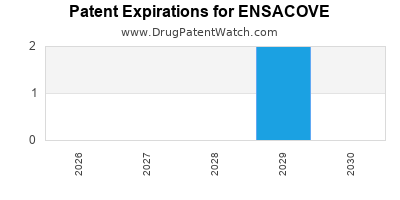
DrugPatentWatch® Estimated Loss of Exclusivity (LOE) Date for ENSACOVE
Generic Entry Date for ENSACOVE*:
Constraining patent/regulatory exclusivity:
NDA:
Dosage:
CAPSULE;ORAL |
*The generic entry opportunity date is the latter of the last compound-claiming patent and the last regulatory exclusivity protection. Many factors can influence early or later generic entry. This date is provided as a rough estimate of generic entry potential and should not be used as an independent source.
US Patents and Regulatory Information for ENSACOVE
ENSACOVE is protected by four US patents and one FDA Regulatory Exclusivity.
Based on analysis by DrugPatentWatch, the earliest date for a generic version of ENSACOVE is ⤷ Start Trial.
This potential generic entry date is based on patent 9,126,947.
Generics may enter earlier, or later, based on new patent filings, patent extensions, patent invalidation, early generic licensing, generic entry preferences, and other factors.
| Applicant | Tradename | Generic Name | Dosage | NDA | Approval Date | TE | Type | RLD | RS | Patent No. | Patent Expiration | Product | Substance | Delist Req. | Exclusivity Expiration |
|---|---|---|---|---|---|---|---|---|---|---|---|---|---|---|---|
| Xcovery | ENSACOVE | ensartinib hydrochloride | CAPSULE;ORAL | 218171-001 | Dec 18, 2024 | RX | Yes | No | 10,899,744 | ⤷ Start Trial | Y | ⤷ Start Trial | |||
| Xcovery | ENSACOVE | ensartinib hydrochloride | CAPSULE;ORAL | 218171-002 | Dec 18, 2024 | RX | Yes | Yes | 9,296,724 | ⤷ Start Trial | Y | ⤷ Start Trial | |||
| Xcovery | ENSACOVE | ensartinib hydrochloride | CAPSULE;ORAL | 218171-001 | Dec 18, 2024 | RX | Yes | No | 9,126,947 | ⤷ Start Trial | Y | ⤷ Start Trial | |||
| Xcovery | ENSACOVE | ensartinib hydrochloride | CAPSULE;ORAL | 218171-002 | Dec 18, 2024 | RX | Yes | Yes | 9,126,947 | ⤷ Start Trial | Y | ⤷ Start Trial | |||
| Xcovery | ENSACOVE | ensartinib hydrochloride | CAPSULE;ORAL | 218171-001 | Dec 18, 2024 | RX | Yes | No | 9,296,724 | ⤷ Start Trial | Y | ⤷ Start Trial | |||
| Xcovery | ENSACOVE | ensartinib hydrochloride | CAPSULE;ORAL | 218171-001 | Dec 18, 2024 | RX | Yes | No | 8,551,995 | ⤷ Start Trial | Y | ⤷ Start Trial | |||
| Xcovery | ENSACOVE | ensartinib hydrochloride | CAPSULE;ORAL | 218171-002 | Dec 18, 2024 | RX | Yes | Yes | 10,899,744 | ⤷ Start Trial | Y | ⤷ Start Trial | |||
| >Applicant | >Tradename | >Generic Name | >Dosage | >NDA | >Approval Date | >TE | >Type | >RLD | >RS | >Patent No. | >Patent Expiration | >Product | >Substance | >Delist Req. | >Exclusivity Expiration |
International Patents for ENSACOVE
When does loss-of-exclusivity occur for ENSACOVE?
Based on analysis by DrugPatentWatch, the following patents block generic entry in the countries listed below:
Australia
Patent: 11311814
Estimated Expiration: ⤷ Start Trial
Brazil
Patent: 2013008523
Patent: compostos de piridazina carboxamida substituídos
Estimated Expiration: ⤷ Start Trial
Canada
Patent: 13607
Patent: COMPOSES SUBSTITUES DE PYRIDAZINE CARBOXAMIDE (SUBSTITUTED PYRIDAZINE CARBOXAMIDE COMPOUNDS)
Estimated Expiration: ⤷ Start Trial
China
Patent: 3298806
Patent: Substituted pyridazine carboxamide compounds
Estimated Expiration: ⤷ Start Trial
Eurasian Patent Organization
Patent: 4809
Patent: ЗАМЕЩЕННЫЕ СОЕДИНЕНИЯ ПИРИДАЗИНКАРБОКСАМИДА (SUBSTITUTED PYRIDAZINE CARBOXAMIDE COMPOUNDS)
Estimated Expiration: ⤷ Start Trial
Patent: 1390520
Patent: ЗАМЕЩЕННЫЕ СОЕДИНЕНИЯ ПИРИДАЗИНКАРБОКСАМИДА (SUBSTITUTED PYRIDAZINE CARBOXAMIDE COMPOUNDS)
Estimated Expiration: ⤷ Start Trial
European Patent Office
Patent: 25176
Patent: COMPOSÉS SUBSTITUÉS DE 6-AMINO-PYRIDAZIN-3-YLE CARBOXAMIDE COMME MODULATEURS DE PROTÉINE KINASES (SUBSTITUTUTED 6-AMINO-PYRIDAZIN-3-YL-CARBOXAMIDE COMPOUNDS AS PROTEIN KINASE MODULATORS)
Estimated Expiration: ⤷ Start Trial
Japan
Patent: 23062
Estimated Expiration: ⤷ Start Trial
Patent: 35078
Estimated Expiration: ⤷ Start Trial
Patent: 13539765
Patent: 置換ピリダジンカルボキサミド化合物
Estimated Expiration: ⤷ Start Trial
Patent: 16216475
Patent: 置換ピリダジンカルボキサミド化合物 (SUBSTITUTED PYRIDAZINE CARBOXAMIDE COMPOUNDS)
Estimated Expiration: ⤷ Start Trial
Poland
Patent: 25176
Estimated Expiration: ⤷ Start Trial
South Korea
Patent: 1886812
Estimated Expiration: ⤷ Start Trial
Patent: 130141514
Patent: 치환된 피리다진 카복사미드 화합물 (SUBSTITUTED PYRIDAZINE CARBOXAMIDE COMPOUNDS)
Estimated Expiration: ⤷ Start Trial
Spain
Patent: 10226
Estimated Expiration: ⤷ Start Trial
Generics may enter earlier, or later, based on new patent filings, patent extensions, patent invalidation, early generic licensing, generic entry preferences, and other factors.
See the table below for additional patents covering ENSACOVE around the world.
| Country | Patent Number | Title | Estimated Expiration |
|---|---|---|---|
| Australia | 2017274110 | ⤷ Start Trial | |
| Brazil | 112018074612 | ⤷ Start Trial | |
| Canada | 3026142 | ⤷ Start Trial | |
| China | 109195964 | ⤷ Start Trial | |
| Eurasian Patent Organization | 201892687 | ⤷ Start Trial | |
| European Patent Office | 3470410 | ⤷ Start Trial | |
| Spain | 2981015 | ⤷ Start Trial | |
| >Country | >Patent Number | >Title | >Estimated Expiration |
More… ↓
Make Better Decisions: Try a trial or see plans & pricing
Drugs may be covered by multiple patents or regulatory protections. All trademarks and applicant names are the property of their respective owners or licensors. Although great care is taken in the proper and correct provision of this service, thinkBiotech LLC does not accept any responsibility for possible consequences of errors or omissions in the provided data. The data presented herein is for information purposes only. There is no warranty that the data contained herein is error free. We do not provide individual investment advice. This service is not registered with any financial regulatory agency. The information we publish is educational only and based on our opinions plus our models. By using DrugPatentWatch you acknowledge that we do not provide personalized recommendations or advice. thinkBiotech performs no independent verification of facts as provided by public sources nor are attempts made to provide legal or investing advice. Any reliance on data provided herein is done solely at the discretion of the user. Users of this service are advised to seek professional advice and independent confirmation before considering acting on any of the provided information. thinkBiotech LLC reserves the right to amend, extend or withdraw any part or all of the offered service without notice.
ISSN: 2162-2639

Privacy and Cookies
Terms & Conditions
Site Map
DrugPatentWatch Alternatives
LOE / Major Patent Expirations 2026 - 2027
NCE-1 Patent Challenge Dates 2026 - 2027
Friedman, Yali. "DrugPatentWatch" DrugPatentWatch, thinkBiotech, 2026, www.DrugPatentWatch.com.
See Primary Research Papers Citing DrugPatentWatch