You're using a free limited version of DrugPatentWatch: Upgrade for Complete Access

Last Updated: December 19, 2025

EMBEDA Drug Patent Profile


✉ Email this page to a colleague

« Back to Dashboard


When do Embeda patents expire, and what generic alternatives are available?

Embeda is a drug marketed by Alpharma Pharms and is included in one NDA. There are nine patents protecting this drug and four Paragraph IV challenges.

This drug has seventy-four patent family members in twenty-three countries.

The generic ingredient in EMBEDA is morphine sulfate; naltrexone hydrochloride. There are twenty-three drug master file entries for this compound. Additional details are available on the morphine sulfate; naltrexone hydrochloride profile page.

DrugPatentWatch® Generic Entry Outlook for Embeda

By analyzing the patents and regulatory protections it appears that the earliest date for generic entry will be June 19, 2027. This may change due to patent challenges or generic licensing.

There are four Paragraph IV patent challenges for this drug. This may lead to patent invalidation or a license for generic production.

Indicators of Generic Entry

< Available with Subscription >

  Get Started Free

AI Deep Research
Questions you can ask:
  • What is the 5 year forecast for EMBEDA?
  • What are the global sales for EMBEDA?
  • What is Average Wholesale Price for EMBEDA?
Summary for EMBEDA
International Patents:74
US Patents:9
Applicants:1
NDAs:1
Clinical Trials: 7
Drug Prices: Drug price information for EMBEDA
What excipients (inactive ingredients) are in EMBEDA?EMBEDA excipients list
DailyMed Link:EMBEDA at DailyMed
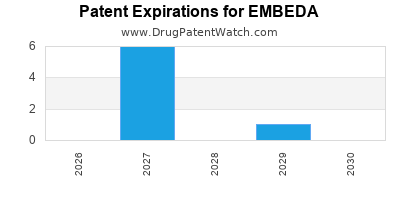
Drug patent expirations by year for EMBEDA
Drug Prices for EMBEDA

See drug prices for EMBEDA

DrugPatentWatch® Estimated Loss of Exclusivity (LOE) Date for EMBEDA
Generic Entry Date for EMBEDA*:
Constraining patent/regulatory exclusivity:
NDA:
Dosage:
CAPSULE, EXTENDED RELEASE;ORAL

*The generic entry opportunity date is the latter of the last compound-claiming patent and the last regulatory exclusivity protection. Many factors can influence early or later generic entry. This date is provided as a rough estimate of generic entry potential and should not be used as an independent source.

Recent Clinical Trials for EMBEDA

Identify potential brand extensions & 505(b)(2) entrants

SponsorPhase
PfizerPhase 1
PfizerPhase 4
PfizerPhase 3

See all EMBEDA clinical trials

Paragraph IV (Patent) Challenges for EMBEDA
Tradename Dosage Ingredient Strength NDA ANDAs Submitted Submissiondate
EMBEDA Extended-release Capsules morphine sulfate; naltrexone hydrochloride 20 mg/0.8 mg 022321 1 2018-08-16
EMBEDA Extended-release Capsules morphine sulfate; naltrexone hydrochloride 30 mg/1.2 mg 50 mg/2 mg 80 mg/3.2 mg 022321 1 2010-05-28
EMBEDA Extended-release Capsules morphine sulfate; naltrexone hydrochloride 60 mg/2.4 mg 022321 1 2010-05-25
EMBEDA Extended-release Capsules morphine sulfate; naltrexone hydrochloride 100 mg/4 mg 022321 1 2010-05-03

US Patents and Regulatory Information for EMBEDA

EMBEDA is protected by nine US patents.

Based on analysis by DrugPatentWatch, the earliest date for a generic version of EMBEDA is ⤷  Get Started Free.

This potential generic entry date is based on patent 8,846,104.

Generics may enter earlier, or later, based on new patent filings, patent extensions, patent invalidation, early generic licensing, generic entry preferences, and other factors.

Applicant Tradename Generic Name Dosage NDA Approval Date TE Type RLD RS Patent No. Patent Expiration Product Substance Delist Req. Exclusivity Expiration
Alpharma Pharms EMBEDA morphine sulfate; naltrexone hydrochloride CAPSULE, EXTENDED RELEASE;ORAL 022321-005 Aug 13, 2009 DISCN Yes No 8,685,444 ⤷  Get Started Free Y ⤷  Get Started Free
Alpharma Pharms EMBEDA morphine sulfate; naltrexone hydrochloride CAPSULE, EXTENDED RELEASE;ORAL 022321-004 Aug 13, 2009 DISCN Yes No 8,846,104 ⤷  Get Started Free Y ⤷  Get Started Free
Alpharma Pharms EMBEDA morphine sulfate; naltrexone hydrochloride CAPSULE, EXTENDED RELEASE;ORAL 022321-006 Aug 13, 2009 DISCN Yes No 7,682,633 ⤷  Get Started Free ⤷  Get Started Free
Alpharma Pharms EMBEDA morphine sulfate; naltrexone hydrochloride CAPSULE, EXTENDED RELEASE;ORAL 022321-005 Aug 13, 2009 DISCN Yes No 8,846,104 ⤷  Get Started Free Y ⤷  Get Started Free
Alpharma Pharms EMBEDA morphine sulfate; naltrexone hydrochloride CAPSULE, EXTENDED RELEASE;ORAL 022321-006 Aug 13, 2009 DISCN Yes No 7,682,634 ⤷  Get Started Free Y ⤷  Get Started Free
Alpharma Pharms EMBEDA morphine sulfate; naltrexone hydrochloride CAPSULE, EXTENDED RELEASE;ORAL 022321-004 Aug 13, 2009 DISCN Yes No 8,685,443 ⤷  Get Started Free ⤷  Get Started Free
>Applicant >Tradename >Generic Name >Dosage >NDA >Approval Date >TE >Type >RLD >RS >Patent No. >Patent Expiration >Product >Substance >Delist Req. >Exclusivity Expiration

Expired US Patents for EMBEDA

Applicant Tradename Generic Name Dosage NDA Approval Date Patent No. Patent Expiration
Alpharma Pharms EMBEDA morphine sulfate; naltrexone hydrochloride CAPSULE, EXTENDED RELEASE;ORAL 022321-006 Aug 13, 2009 5,378,474 ⤷  Get Started Free
Alpharma Pharms EMBEDA morphine sulfate; naltrexone hydrochloride CAPSULE, EXTENDED RELEASE;ORAL 022321-005 Aug 13, 2009 8,685,444 ⤷  Get Started Free
Alpharma Pharms EMBEDA morphine sulfate; naltrexone hydrochloride CAPSULE, EXTENDED RELEASE;ORAL 022321-005 Aug 13, 2009 5,202,128 ⤷  Get Started Free
Alpharma Pharms EMBEDA morphine sulfate; naltrexone hydrochloride CAPSULE, EXTENDED RELEASE;ORAL 022321-006 Aug 13, 2009 8,685,444 ⤷  Get Started Free
Alpharma Pharms EMBEDA morphine sulfate; naltrexone hydrochloride CAPSULE, EXTENDED RELEASE;ORAL 022321-002 Aug 13, 2009 5,202,128 ⤷  Get Started Free
Alpharma Pharms EMBEDA morphine sulfate; naltrexone hydrochloride CAPSULE, EXTENDED RELEASE;ORAL 022321-004 Aug 13, 2009 8,685,443 ⤷  Get Started Free
>Applicant >Tradename >Generic Name >Dosage >NDA >Approval Date >Patent No. >Patent Expiration

International Patents for EMBEDA

When does loss-of-exclusivity occur for EMBEDA?

Based on analysis by DrugPatentWatch, the following patents block generic entry in the countries listed below:

Australia

Patent: 07261451
Estimated Expiration: ⤷  Get Started Free

Patent: 13257508
Estimated Expiration: ⤷  Get Started Free

Patent: 16238844
Estimated Expiration: ⤷  Get Started Free

Patent: 18201915
Estimated Expiration: ⤷  Get Started Free

Austria

Patent: 52829
Estimated Expiration: ⤷  Get Started Free

Brazil

Patent: 0714039
Estimated Expiration: ⤷  Get Started Free

Canada

Patent: 55835
Estimated Expiration: ⤷  Get Started Free

China

Patent: 1677963
Estimated Expiration: ⤷  Get Started Free

Cyprus

Patent: 12868
Estimated Expiration: ⤷  Get Started Free

Patent: 18077
Estimated Expiration: ⤷  Get Started Free

Patent: 18982
Estimated Expiration: ⤷  Get Started Free

Patent: 19334
Estimated Expiration: ⤷  Get Started Free

Denmark

Patent: 34975
Estimated Expiration: ⤷  Get Started Free

Patent: 84346
Estimated Expiration: ⤷  Get Started Free

Patent: 26932
Estimated Expiration: ⤷  Get Started Free

Patent: 19378
Estimated Expiration: ⤷  Get Started Free

European Patent Office

Patent: 34975
Estimated Expiration: ⤷  Get Started Free

Patent: 84346
Estimated Expiration: ⤷  Get Started Free

Patent: 26932
Estimated Expiration: ⤷  Get Started Free

Patent: 19378
Estimated Expiration: ⤷  Get Started Free

Hong Kong

Patent: 73980
Estimated Expiration: ⤷  Get Started Free

Hungary

Patent: 31590
Estimated Expiration: ⤷  Get Started Free

Patent: 32156
Estimated Expiration: ⤷  Get Started Free

Patent: 33058
Estimated Expiration: ⤷  Get Started Free

Israel

Patent: 5834
Estimated Expiration: ⤷  Get Started Free

Patent: 5150
Estimated Expiration: ⤷  Get Started Free

Japan

Patent: 66102
Estimated Expiration: ⤷  Get Started Free

Patent: 09541320
Estimated Expiration: ⤷  Get Started Free

Mexico

Patent: 08016372
Patent: COMPOSICIONES FARMACEUTICAS. (PHARMACEUTICAL COMPOSITIONS.)
Estimated Expiration: ⤷  Get Started Free

New Zealand

Patent: 3757
Patent: Coated multilayer oral dosage forms of naltrexone hydrochloride
Estimated Expiration: ⤷  Get Started Free

Poland

Patent: 34975
Estimated Expiration: ⤷  Get Started Free

Patent: 84346
Estimated Expiration: ⤷  Get Started Free

Patent: 26932
Estimated Expiration: ⤷  Get Started Free

Patent: 19378
Estimated Expiration: ⤷  Get Started Free

Portugal

Patent: 34975
Estimated Expiration: ⤷  Get Started Free

Patent: 84346
Estimated Expiration: ⤷  Get Started Free

Patent: 26932
Estimated Expiration: ⤷  Get Started Free

Patent: 19378
Estimated Expiration: ⤷  Get Started Free

Russian Federation

Patent: 45077
Patent: ФАРМАЦЕВТИЧЕСКИЕ КОМПОЗИЦИИ (PHARMACEUTICAL COMPOSITIONS)
Estimated Expiration: ⤷  Get Started Free

Patent: 09101082
Patent: ФАРМАЦЕВТИЧЕСКИЕ КОМПОЗИЦИИ
Estimated Expiration: ⤷  Get Started Free

Slovenia

Patent: 34975
Estimated Expiration: ⤷  Get Started Free

Patent: 84346
Estimated Expiration: ⤷  Get Started Free

Patent: 26932
Estimated Expiration: ⤷  Get Started Free

Patent: 19378
Estimated Expiration: ⤷  Get Started Free

South Africa

Patent: 0810501
Patent: PHARMACEUTICAL COMPOSITIONS
Estimated Expiration: ⤷  Get Started Free

South Korea

Patent: 1486228
Estimated Expiration: ⤷  Get Started Free

Patent: 090037885
Patent: PHARMACEUTICAL COMPOSITIONS
Estimated Expiration: ⤷  Get Started Free

Patent: 140079441
Patent: PHARMACEUTICAL COMPOSITIONS
Estimated Expiration: ⤷  Get Started Free

Patent: 150029762
Patent: Pharmaceutical compositions
Estimated Expiration: ⤷  Get Started Free

Spain

Patent: 85612
Estimated Expiration: ⤷  Get Started Free

Patent: 00141
Estimated Expiration: ⤷  Get Started Free

Patent: 22576
Estimated Expiration: ⤷  Get Started Free

Patent: 36657
Estimated Expiration: ⤷  Get Started Free

Generics may enter earlier, or later, based on new patent filings, patent extensions, patent invalidation, early generic licensing, generic entry preferences, and other factors.

See the table below for additional patents covering EMBEDA around the world.

Country Patent Number Title Estimated Expiration
South Korea 20090037885 PHARMACEUTICAL COMPOSITIONS ⤷  Get Started Free
Spain 2600141 ⤷  Get Started Free
Japan 2009541320 ⤷  Get Started Free
Australia 617573 ⤷  Get Started Free
European Patent Office 2484346 ⤷  Get Started Free
Slovenia 2484346 ⤷  Get Started Free
>Country >Patent Number >Title >Estimated Expiration

Market Dynamics and Financial Trajectory for EMBEDA: An In-Depth Analysis

Last updated: July 31, 2025

Introduction

EMBEDA (morphine sulfate and naltrexone hydrochloride extended-release capsules) is a prescription opioid used for managing severe pain in patients requiring around-the-clock treatment. The product’s unique formulation aims to mitigate opioid-induced constipation, a common side effect, by incorporating an antagonist (naltrexone). Since its approval by the FDA in 2011, EMBEDA’s market performance has been shaped by evolving regulatory landscapes, societal attitudes towards opioids, and the competitive environment. This analysis dissects the current market dynamics and forecasted financial trajectory for EMBEDA, providing insights crucial for stakeholders, investors, and policymakers.

Regulatory and Legal Landscape

The opioid epidemic has profoundly influenced the regulatory environment surrounding products like EMBEDA. The U.S. Department of Justice and FDA have intensified scrutiny on opioid marketing and prescribing practices. Consequently, EMBEDA faces stringent regulations designed to prevent misuse and diversion. The Drug Enforcement Administration (DEA) classifies it as a Schedule II controlled substance, which imposes significant prescribing and dispensing restrictions.

Legal actions, including lawsuits against companies involved in deceptive marketing of opioids, have further constrained market expansion. Purdue Pharma’s bankruptcies and widespread settlements underscore the heightened sensitivity and risk aversion in the market, impacting newer formulations like EMBEDA. Regulatory trends thus favor formulations that emphasize safety and abuse-deterrence mechanisms.

Market Demand and Prescribing Trends

The demand for EMBEDA remains aligned with the broader opioid analgesics market, driven primarily by patients with chronic and intractable pain. However, prescribers exhibit increased caution due to opioid-related adverse events and the availability of alternative therapies. The CDC’s guidelines for prescribing opioids for chronic pain emphasize cautious use, limiting unwarranted prescription and dosing.

Despite restrictions, there is still a considerable patient population with limited options, particularly those suffering from severe, persistent pain where opioids remain the most effective treatment. The introduction of abuse-deterrent formulations (ADFs), like EMBEDA with its integrated naltrexone component, appeals to clinicians seeking safer options and regulatory approval criteria focusing on abuse reduction.

Competitive Landscape

EMBEDA faces competition from other extended-release opioids and abuse-deterrent formulations. Notable rivals include:

  • OxyContin (oxycodone ER): Without abuse-deterrent features, but with a significant market share.
  • Arymo ER (morphine sulfate): A morphine-based product with abuse-deterrent technology.
  • Embeda’s direct competitors: Alternative formulations delivering similar safety profiles, including OIC (opioid-induced constipation) mitigating agents.

The landscape has shifted toward abuse-deterrent opioids, further emphasizing EMBEDA’s positioning as a safer analgesic option. Nonetheless, the market remains fragmented, with generic formulations eroding branded drug revenues. The patent landscape, with patent expirations for some formulations, impacts pricing and profitability.

Market Penetration and Sales Data

Sales data for EMBEDA, as reported by IQVIA and other pharma analytics firms, indicate modest growth with fluctuations influenced by prescriber familiarity, insurance coverage, and regulatory constraints. Post-approval, EMBEDA experienced initial uptake, but sales plateaued amid safety concerns and competition.

Key factors influencing sales include:

  • Reimbursement policies: Insurers increasingly favor lower-cost generics and alternative pain management options.
  • Physician preferences: Prescribers’ cautious attitude toward opioids limits penetration.
  • Patient acceptance: The product's abuse-deterrent features positively influence patient and prescriber confidence but are not sufficient alone to dominate the market.

Financial Trajectory and Future Outlook

Revenue Forecasts

Analysts project that EMBEDA’s revenue trajectory will remain subdued in the short to medium term, primarily due to:

  • Patent expirations and generic entry: Reduced pricing power and profit margins.
  • Regulatory headwinds: Ongoing scrutiny limits aggressive marketing.
  • Market saturation: Limited incremental demand growth.

However, niche segments—patients with contraindications to other opioids or those highly concerned about misuse—may sustain a baseline revenue stream. The adoption of newer abuse-deterrent formulations or expansion into international markets could bolster future sales.

Impact of Patent and Market Exclusivity

EMBEDA’s original patent protection has expired or is nearing expiration, increasing exposure to generics. The generic landscape typically results in a sharp decline in branded drug revenues, replacing branded sales with lower-cost alternatives. Manufacturers might seek to extend exclusivity through formulation patents or licensing deals.

Cost and Investment Considerations

Manufacturing costs for EMBEDA are influenced by the complexity of extended-release and abuse-deterrent technologies. Ongoing R&D investments in improved formulations or combination therapies could redefine its market position.

Market Opportunities and Challenges

Opportunities:

  • Expansion into pain management niches emphasizing safety.
  • Developing combination therapies integrating non-opioid analgesics.
  • International expansion where opioid regulation is less restrictive.

Challenges:

  • Rising regulatory and legal constraints.
  • Competition from non-opioid pain therapies.
  • Stigmatization of opioids affecting prescriber and patient acceptance.

Conclusion

EMBEDA’s market dynamics are characterized by cautious growth amid regulatory and legal headwinds, stiffening competition, and patent expirations. Its financial trajectory hinges on strategic positioning within pain management, leveraging abuse-deterrent benefits, and capturing niche markets less affected by broader societal concerns. Stakeholders must continuously monitor regulatory developments and market trends to optimize investment decisions and pharmaceutical strategies.


Key Takeaways

  • EMBEDA’s market success is constrained by regulatory scrutiny, patent expirations, and uniform competition.
  • Its abuse-deterrent formulation offers a competitive edge but is insufficient alone to drive aggressive growth.
  • The opioid landscape's shifting regulatory environment necessitates adaptive strategies focused on safety and alternative therapies.
  • Future revenue streams depend on international expansion, niche market targeting, and technological innovations.
  • Investors should consider the risks associated with patent cliffs, legal liabilities, and societal attitudes towards opioids.

FAQs

1. What are the primary factors influencing EMBEDA’s market demand?
Prescribing trends, regulatory constraints, safety concerns, and availability of alternative pain management therapies significantly influence demand.

2. How does the patent landscape affect EMBEDA’s financial prospects?
Patent expirations open the market to generics, reducing revenues and profits for the branded product unless protected by secondary patents or formulations.

3. What role do regulatory agencies play in EMBEDA’s market trajectory?
Regulatory agencies impose restrictions to prevent misuse, which can limit prescribing, impact sales, and determine product approval status.

4. Can EMBEDA gain market share with improved formulations or new indications?
Potentially, especially if it demonstrates superior safety, efficacy, or offers novel indications, but market penetration remains challenging amid competition and societal headwinds.

5. What are the key challenges facing EMBEDA’s future growth?
Legal liabilities, societal stigma around opioids, patent expirations, and competition from non-opioid drugs pose significant hurdles to growth.


References:

[1] IQVIA. (2022). Pharmaceutical Market Reports.

[2] U.S. Food and Drug Administration (FDA). (2011). EMBEDA approval documentation.

[3] CDC. (2021). Guideline for Prescribing Opioids for Chronic Pain.

[4] DEA. (2022). Schedule of Controlled Substances.

[5] MarketWatch. (2023). Opioid Market Trends and Outlook.

More… ↓

⤷  Get Started Free

Make Better Decisions: Try a trial or see plans & pricing

Drugs may be covered by multiple patents or regulatory protections. All trademarks and applicant names are the property of their respective owners or licensors. Although great care is taken in the proper and correct provision of this service, thinkBiotech LLC does not accept any responsibility for possible consequences of errors or omissions in the provided data. The data presented herein is for information purposes only. There is no warranty that the data contained herein is error free. We do not provide individual investment advice. This service is not registered with any financial regulatory agency. The information we publish is educational only and based on our opinions plus our models. By using DrugPatentWatch you acknowledge that we do not provide personalized recommendations or advice. thinkBiotech performs no independent verification of facts as provided by public sources nor are attempts made to provide legal or investing advice. Any reliance on data provided herein is done solely at the discretion of the user. Users of this service are advised to seek professional advice and independent confirmation before considering acting on any of the provided information. thinkBiotech LLC reserves the right to amend, extend or withdraw any part or all of the offered service without notice.