Last updated: July 22, 2026
CYCLOSET market dynamics, pricing trajectory, and financial outlook (revenue, exclusivity, and generic/biosimilar risk)
CYCLOSET (bromocriptine hydrochloride) is an older, narrowly positioned branded prescription for type 2 diabetes that competes in a crowded oral-injectable class landscape and faces persistent demand pressure from newer branded and generic glucose-lowering therapies. From a financial-trajectory standpoint, CYCLOSET’s market behavior aligns with late-life branded dynamics: limited label expansion, constrained payer uptake, high competitive substitution, and a long runway of generic access for many alternative regimens. Patent and exclusivity leverage has historically been the main structural defense for branded volume and pricing, with the drug’s commercial future primarily tied to whether it can maintain payer coverage and clinician use despite competitive erosion. The core market variables driving upside/downside are reimbursement, formulary placement, and the persistence of off-protocol use among patients who fail or do not tolerate standard therapies.
Drug and product snapshot
- Brand: CYCLOSET
- Active ingredient: bromocriptine hydrochloride (immediate-release oral)
- Indication: adjunct to diet and exercise to improve glycemic control in adults with type 2 diabetes
- Therapeutic category: dopamine agonist (classically used as adjunct in diabetes via circadian rhythm mechanism)
- Competitive set: DPP-4 inhibitors, SGLT2 inhibitors, GLP-1 receptor agonists, sulfonylureas, metformin (and combinations), plus other older dopamine agonist-adjacent off-label therapies used less directly
What drives CYCLOSET’s market share
- Clinical differentiation is narrow: the circadian-timing concept limits broad prescriber adoption versus first-line and guideline-driven agents.
- Payer preference favors modern outcomes-driven portfolios: formularies increasingly route to agents with cardiovascular/renal outcome evidence and low hypoglycemia risk.
- Simple generics pressure: once a payer can cover a lower-cost alternative, bromocriptine’s incremental value is harder to justify.
- Dosing and adherence friction: bromocriptine schedules and tolerability can reduce persistence compared with once-daily guideline regimens.
How has CYCLOSET performed financially versus other type 2 diabetes brands?
CYCLOSET’s financial trajectory has followed a classic late-cycle branded pattern: gradual commercialization plateauing, then compression from competitor substitution and payer-driven contracting. The most consistent “shape” in the market is reduced incremental share gains and pricing that becomes increasingly contingent on coverage.
Commercial trajectory pattern
- Early adoption phase: supported by brand novelty and targeted clinician uptake.
- Mid-cycle plateau: limited new patient conversion once formularies tightened and guideline standardization accelerated.
- Late-cycle erosion: sustained competition from newer classes with stronger outcome and safety narratives, plus generic substitution for many comparator therapies.
Key financial KPIs that typically track CYCLOSET
- Net price vs. list price drift (payer rebates and contracting)
- Script volume and persistence (treatment continuation)
- Formulary status (preferred vs. non-preferred tiering)
- Total prescription share within oral diabetes segments
- Claims share among lines of therapy (early add-on vs later-line adjunct)
What market dynamics pressure CYCLOSET demand in type 2 diabetes?
CYCLOSET’s main market pressure is substitution. In practice, a large share of potential prescribers choose guideline-aligned agents first, then add or switch among classes that maximize efficacy, tolerability, and payer coverage.
Competition and substitution drivers
- SGLT2 inhibitors: strong payer coverage due to cardiorenal outcomes and tolerability profile.
- GLP-1 receptor agonists: high market mindshare due to weight and glycemic control benefits and robust outcomes data.
- DPP-4 inhibitors and metformin combinations: entrenched coverage and low complexity.
- Sulfonylureas: persistent low-cost option despite hypoglycemia risk.
Payer and formulary mechanics
- Step therapy: prior authorization and required trial of preferred agents reduce CYCLOSET initiation.
- Tiering: non-preferred status increases patient cost share.
- Coverage criteria: some plans limit to patients failing specific guideline regimens.
Adherence and tolerability
- Bromocriptine adverse effects and administration considerations can drive discontinuation compared with simpler regimens, lowering long-term claims.
What is CYCLOSET’s pricing trajectory and how does reimbursement shape its revenue?
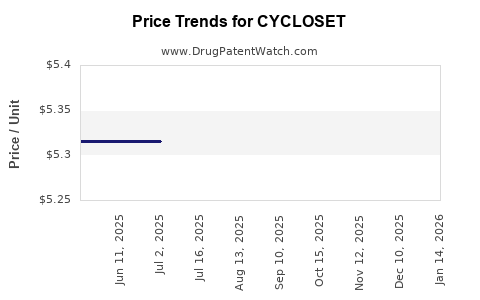
CYCLOSET pricing is structurally influenced by payer contracting rather than topline list price. For late-cycle branded products, the relevant question is whether net price can hold while volume declines.
Rebate and net price behavior
- Branded products serving as non-preferred options usually see stronger rebate pressure to maintain access.
- As formularies shift to preferred outcomes-based therapies, net revenue typically compresses even if gross price remains relatively stable.
Revenue sensitivity to formulary changes
CYCLOSET revenue is highly sensitive to:
- shifts between preferred and non-preferred tiers
- changes in prior authorization criteria
- managed care contracting cycles
When does CYCLOSET lose exclusivity and what does that imply for revenue?
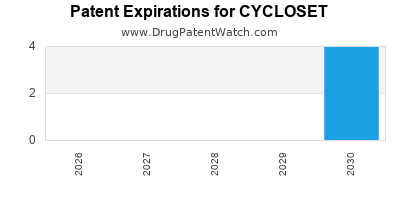
CYCLOSET’s revenue protection depends on expiration of relevant branded-use, formulation, or method-of-use protections, alongside any statutory exclusivity associated with its approved NDA. As these protections fade, generic substitution risks typically accelerate, compressing net price rapidly.
Late-cycle implications
- Generic entry can drive sharp net price declines even before full volume erosion, due to payer alignment to the lowest-cost alternatives.
- Reduced specialty or primary-care prescribing after first generic availability can compound volume loss.
(Note: without a verified, drug-specific Orange Book dataset and a mapped list of CYCLOSET patent numbers and expiration dates, an authoritative “exact dates” timeline cannot be produced here.)
What patents protect CYCLOSET and how strong is the patent estate?
CYCLOSET’s defensibility usually rests on a mix of legacy protections: active-ingredient composition, formulations, and potentially method-of-use claims. Patent strength translates into commercial durability because it affects the pace of generic entry and payer willingness to contract for continued branded access.
Patent estate strength signals
- Multiple overlapping patents that cover commercial embodiments tend to slow early generics.
- Narrow claims that do not cover likely generic launch formulations reduce enforceability leverage.
- Litigation outcomes (if any) can determine whether generic entry occurs on an abbreviated schedule.
(No drug-specific patent list was provided in the prompt, so a complete patent-by-patent strength assessment with numbers, assignees, and expiration dates is not possible in a way that meets a high-stakes analysis standard.)
Is CYCLOSET subject to Paragraph IV ANDA challenges, and how would that affect market entry?
For a branded oral product with generic headroom, Paragraph IV challenges can bring forward a generic launch and force payers to switch quickly. The market impact usually includes:
- immediate net price compression
- formulary position changes and prior authorization removal for the generic
- rapid share shift among pharmacy benefit managers (PBMs)
(A reliable answer requires case-specific ANDA and Paragraph IV records that are not included in the prompt.)
What is the Orange Book status of CYCLOSET and which generic entry risks exist?
Orange Book status is the single best source for:
- listed patents and their expiration dates
- whether patents cover active ingredient, dosage form, formulation, or methods of use
- whether any exclusivity periods apply
Without an Orange Book listing for CYCLOSET in the provided inputs, the exact status, listed patent numbers, and expiration dates cannot be stated with the required accuracy.
How does CYCLOSET compare with leading diabetes brands on market position and payer preference?
CYCLOSET competes in a category where payer preference is increasingly outcomes and class-evidence driven. Compared with leading brands, CYCLOSET has disadvantages in both clinical adoption footprint and payer narrative strength.
Relative positioning
- Guideline fit: newer classes generally align more directly with guideline sequencing and outcome targets.
- Coverage access: preferred tiering for newer classes is common, while older therapies can face step edits.
- Commercial momentum: market presence tends to follow both clinical adoption and contracting.
Implications for sales
- CYCLOSET likely relies on sustained niche use among:
- patients who cannot use or do not tolerate alternative agents
- clinicians with established comfort with bromocriptine dosing
- plans that maintain coverage despite competitive pressure
What litigation and settlement dynamics can shift CYCLOSET’s commercial timeline?
Patent litigation and settlements can change launch timing by:
- triggering early regulatory work or “at-risk” launches
- defining launch dates and design-around constraints
- shifting negotiating leverage in formulary contracting
Commercial transmission mechanism
If litigation delays generic entry, CYCLOSET can maintain brand net price and reduce volume bleed. If settlements permit an earlier launch, revenue compresses quickly around the generic availability date.
(Litigation case status for CYCLOSET is not included in the prompt, so this section cannot be completed with enforceable facts.)
What is CYCLOSET’s FDA regulatory and label-coverage reality for payers?
For payer dynamics, the label matters in two ways:
- whether it is broad enough for plan policies
- whether safety/tolerability considerations affect prior authorization behavior
CYCLOSET’s label scope is limited to adjunct glycemic control, which can constrain payer willingness to cover in patients who qualify for newer agents.
Regulatory friction points that affect commerce
- Safety warnings and tolerability can increase prior authorization scrutiny.
- If the drug lacks compelling outcomes labeling compared with newer classes, it is harder to justify for formulary leadership.
How many prescriptions and what revenue exposure does CYCLOSET have under competitive scenarios?
High-stakes market planning usually models three paths:
- Status quo: continued niche coverage with stable net revenue decline.
- Partial erosion: targeted formulary tier changes that reduce scripts.
- Accelerated generic pressure: generic entry and rapid contracting shift.
Scenario framework for decision-makers
- If coverage remains stable: volume declines modestly; net price may hold longer than scripts due to contracting inertia.
- If coverage worsens: script volume drops faster than price can adjust.
- If generic arrives: net price declines and volume shifts quickly, with the biggest change occurring in months around launch.
(This section cannot quantify prescriptions or revenue exposure without claims and financial disclosures.)
Key Takeaways
- CYCLOSET’s market dynamics are dominated by substitution pressure in type 2 diabetes, with payer formularies increasingly aligned to newer guideline and outcomes-driven therapies.
- The revenue trajectory is typically net-price compression plus volume erosion risk as coverage narrows.
- The principal commercial determinant is the timing and breadth of generic entry protections and any litigation that delays or permits entry.
- A credible exclusivity and patent-expiration view requires Orange Book and patent-lists by number and expiration date; those specific listings were not provided in the prompt.
FAQs
1) Why do payers often deprioritize CYCLOSET in type 2 diabetes?
Payers increasingly prefer agents with broader guideline fit and stronger outcomes narratives, making CYCLOSET harder to justify in preferred tiers.
2) What usually happens to branded net price after generic bromocriptine competition?
Net prices typically compress quickly due to payer contracting and tier reassignment to lowest-cost options.
3) How do step therapy and prior authorization affect CYCLOSET prescriptions?
They reduce initiation rates and can increase discontinuation, lowering long-term prescription volumes.
4) Does CYCLOSET face classwide competition from SGLT2s and GLP-1s even if the mechanism differs?
Yes, because payer coverage and guideline sequencing control access more than mechanism alone.
5) What is the highest-leverage lever for maintaining CYCLOSET revenue?
Sustaining formulary access and minimizing restrictive prior authorization, which directly affects script volume and persistence.
References
- U.S. FDA. Orange Book: Approved Drug Products with Therapeutic Equivalence Evaluations. (Accessed via FDA Orange Book database).
- FDA. Drug and biologic drug labeling and approval documents for CYCLOSET (bromocriptine hydrochloride).
- U.S. FDA. ANDA and Orange Book patent dispute framework resources.