Last updated: August 6, 2026
Cresemba, the branded formulation of isavuconazonium sulfate, has developed into a durable hospital antifungal franchise with growth driven by invasive aspergillosis, mucormycosis, oral-to-intravenous treatment flexibility, and demand for alternatives to voriconazole and amphotericin B. Basilea Pharmaceutica reported Cresemba sales of CHF 218.8 million in 2024, up from approximately CHF 190 million in 2023. The franchise remains commercially relevant, but its long-term risk profile is shifting from market adoption to patent duration and generic-entry timing.
What is Cresemba and what is it approved to treat?
Cresemba is a prodrug of isavuconazole, a triazole antifungal. The intravenous formulation is administered as isavuconazonium sulfate and is converted rapidly to active isavuconazole in plasma.
The U.S. Food and Drug Administration approved Cresemba in March 2015 for adults with:
- Invasive aspergillosis
- Invasive mucormycosis
The drug is available as oral capsules and an intravenous formulation. The FDA label supports loading followed by once-daily maintenance dosing, with the oral and intravenous forms considered interchangeable on a milligram-equivalent basis.[1]
Cresemba competes in a high-acuity hospital market where treatment selection depends on pathogen, organ function, drug interactions, route of administration, susceptibility data, and institutional protocols. It is used both as primary therapy and as an alternative when clinicians seek to avoid toxicities or interactions associated with competing agents.
How does Cresemba compare with competing antifungal drugs?
Cresemba's commercial position is based on clinical utility rather than broad outpatient volume. Its primary competitors include voriconazole, posaconazole, liposomal amphotericin B, and, in selected settings, isavuconazole alternatives under hospital formulary control.
| Drug |
Active ingredient |
Main role |
Commercial advantage |
Main limitation |
| Cresemba |
Isavuconazonium sulfate |
Invasive aspergillosis and mucormycosis |
Oral and IV formulations; no cyclodextrin vehicle in IV formulation; generally fewer QT concerns than some azoles |
Higher price than generic azoles |
| Vfend and generics |
Voriconazole |
Invasive aspergillosis |
Extensive clinical experience and low generic cost |
Drug interactions, visual effects, hepatotoxicity, therapeutic drug monitoring |
| Noxafil and generics |
Posaconazole |
Prophylaxis and treatment applications |
Strong prophylaxis position; multiple formulations |
Absorption and interaction issues vary by formulation |
| AmBisome |
Liposomal amphotericin B |
Severe invasive fungal disease |
Broad antifungal activity |
IV-only administration, nephrotoxicity, infusion burden |
| Rezzayo |
Rezafungin |
Candidemia and invasive candidiasis |
Once-weekly IV dosing |
Not a direct approved substitute for Cresemba's aspergillosis and mucormycosis indications |
The pivotal SECURE trial compared isavuconazole with voriconazole in invasive mold disease and established noninferiority for all-cause mortality, with a different adverse-event profile.[2] The VITAL study provided supportive evidence in mucormycosis, a smaller but clinically important market with limited treatment options.[3]
Cresemba's strongest practical advantages are its once-daily maintenance schedule, oral and IV availability, and an IV formulation that does not use the cyclodextrin vehicle associated with intravenous voriconazole. Its main commercial disadvantage is price relative to generic voriconazole and other generic triazoles.
What is the financial trajectory of Cresemba?
Basilea's reported Cresemba product sales have increased steadily as the drug has gained use in the United States and international markets.
| Year |
Cresemba sales reported by Basilea |
Approximate growth |
| 2020 |
CHF 102 million |
N/A |
| 2021 |
CHF 129 million |
26% |
| 2022 |
CHF 163 million |
26% |
| 2023 |
Approximately CHF 190 million |
Approximately 17% |
| 2024 |
CHF 218.8 million |
Approximately 15% |
Sources: Basilea annual and full-year financial releases.[4-8]
Cresemba has become Basilea's principal commercial product. In 2024, the medicine accounted for roughly two-thirds of Basilea's product sales when measured against the company's reported Cresemba and Zevtera revenues. That concentration creates operating leverage but also increases exposure to patent expiry, pricing pressure, and changes in hospital antifungal protocols.
What drives Cresemba revenue growth?
The main growth drivers are:
- Increased recognition and treatment of invasive mold infections.
- Greater use in patients who cannot tolerate voriconazole or amphotericin B.
- Adoption of oral-to-IV treatment sequencing.
- Expansion of hospital formulary coverage.
- Increased use in high-risk immunocompromised patients, including transplant and oncology populations.
- International commercialization and distributor expansion.
The product also benefits from the clinical complexity of invasive fungal disease. Physicians often prioritize treatment reliability and tolerability over acquisition cost when mortality risk is high. That dynamic supports branded pricing despite generic competition elsewhere in the antifungal market.
How exposed is Basilea to Cresemba revenue?
Cresemba is Basilea's central revenue asset. Its financial importance is greater than its absolute sales level suggests because the company has a relatively focused commercial portfolio. Any erosion in Cresemba sales would affect:
- Royalty and product-sales income
- Funding for Zevtera commercialization
- Research and development capacity
- Debt repayment and cash generation
- Strategic licensing flexibility
A gradual decline after generic entry would be manageable if Zevtera continues to grow. A rapid loss of U.S. exclusivity would create a sharper revenue shock because the United States is the principal commercial market and Astellas has a major role in U.S. commercialization.
When does Cresemba lose regulatory exclusivity?
Cresemba received five-year new chemical entity exclusivity after its March 2015 approval. That period ended in March 2020. The drug also received orphan-drug protection associated with its approved invasive mucormycosis indication, extending market exclusivity for that orphan indication into 2022.
Regulatory exclusivity does not equal patent protection. After the FDA exclusivity periods expired, an ANDA applicant could pursue approval subject to Cresemba's remaining listed patents and any applicable Paragraph IV certification.
The key commercial question is therefore not whether Cresemba's FDA exclusivity has ended. It has. The question is whether the remaining patent estate prevents an approved generic from launching.
What patents protect Cresemba?
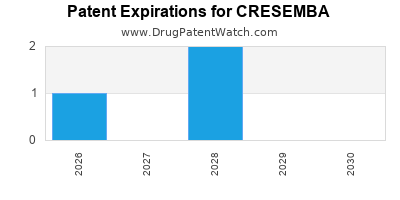
The Cresemba patent estate includes compound, prodrug, formulation, and related pharmaceutical-technology claims. Publicly associated U.S. patent records include the following core patents:
| U.S. patent |
General subject matter |
Reported expiration timing |
| 7,189,858 |
Triazole compound technology associated with isavuconazole |
March 2025 |
| 8,236,935 |
Isavuconazonium-related pharmaceutical technology |
June 2027 |
| 8,703,647 |
Pharmaceutical composition and formulation technology |
May 2030 |
| 9,750,703 |
Later-issued formulation or use-related protection |
Extends beyond the earliest compound patent |
| 9,950,019 |
Later-issued Cresemba-related protection |
Extends beyond the earliest compound patent |
The FDA Orange Book and USPTO records should be read together because terminal disclaimers, patent-term adjustments, pediatric extensions, claim scope, and listing status can affect the commercial date applicable to a particular generic product.[9,10]
The earliest compound protection has reached or approached expiry, but later formulation and pharmaceutical-composition patents may remain relevant. This structure creates a material distinction between:
- A generic that copies only the active ingredient and seeks a conventional capsule approval.
- A generic that seeks approval for the same oral and IV presentations and must address formulation or product-specific patents.
- A generic that launches after carving out one or more protected methods of use.
What formulations are protected by Cresemba patents?
Cresemba's commercial protection is more significant at the product level than the active-molecule level. The franchise includes:
- Delayed-release oral capsules
- Intravenous administration
- Isavuconazonium sulfate prodrug technology
- Pharmaceutical compositions designed to deliver isavuconazole
- Dosing and treatment methods connected with invasive fungal infections
Formulation patents can delay practical competition even when the basic compound patent has expired. They may also permit a generic applicant to enter with a narrower product label, a different presentation, or a skinny label that excludes protected indications.
The IV formulation is strategically important. Hospitals may prefer Cresemba when they need a triazole with an IV option but wish to avoid intravenous voriconazole's vehicle-related concerns. A generic that does not replicate the same IV technology would compete only partially.
Are generic companies challenging Cresemba under Paragraph IV?
No publicly identified U.S. Paragraph IV litigation had produced a confirmed market entry date for Cresemba through the end of 2024. The absence of a publicly visible launch does not eliminate future ANDA risk. The most likely sequence is:
- An ANDA applicant files with Paragraph IV certifications against one or more Orange Book patents.
- The patent holder or exclusive licensee files suit within 45 days.
- FDA approval is stayed for up to 30 months, subject to statutory exceptions.
- The parties litigate patent validity, infringement, claim construction, and potential launch rights.
- The case ends through judgment, settlement, license, or authorized generic arrangement.
For investors, the first meaningful public signal would be a patent-litigation docket, a Hatch-Waxman complaint, or a Basilea or Astellas disclosure identifying an ANDA challenge.
What is the Orange Book status of Cresemba?
Cresemba is an FDA-approved small-molecule drug listed in the Orange Book rather than a biologic listed in the Purple Book. Its regulatory pathway is an NDA, not a biologics license application.
The Orange Book is relevant because:
- Listed patents can be certified against in an ANDA.
- A Paragraph IV filing can trigger patent litigation.
- A 30-month stay can delay approval.
- Method-of-use patents may be addressed through labeling carve-outs.
- Patent listing disputes can affect the timing and scope of generic approval.
Cresemba has no biosimilar pathway. Biosimilar risk is therefore immaterial. The relevant threat is conventional generic substitution through an ANDA.
What generic launch scenarios exist for Cresemba?
The likely launch scenarios are:
Scenario 1: No generic before later patent expiry
If later formulation and composition patents withstand challenge, Cresemba may remain protected in its full commercial form until the late 2020s or beyond. Sales would continue to grow, but at a slower rate as hospital purchasing departments intensify price scrutiny.
Scenario 2: Authorized or licensed generic entry
Basilea or Astellas could license a generic manufacturer or agree to an authorized generic launch. This would protect some franchise economics while reducing the incentive for an uncontrolled first-filer launch.
Scenario 3: Partial generic entry
A generic could enter with a narrower label or only one dosage form. This would create initial price pressure without immediately replacing Cresemba across the entire hospital market.
Scenario 4: At-risk launch
A generic applicant could launch before final patent resolution. That would expose the applicant to damages and injunction risk but could accelerate market disruption if the relevant patents were later invalidated or found not infringed.
The most commercially important variable is whether a generic can match both oral and IV products. Capsule-only competition would likely produce slower erosion than a full-line generic.
What patent litigation and settlement risks affect Cresemba?
The principal litigation risks are conventional Hatch-Waxman disputes:
- Obviousness challenges against later formulation patents
- Anticipation challenges based on earlier azole and prodrug disclosures
- Written-description and enablement challenges
- Noninfringement arguments based on different excipients or manufacturing steps
- Skinny-label disputes involving invasive aspergillosis or mucormycosis
- Orange Book listing challenges
A settlement could allow a generic launch before the latest patent expiration. The financial impact would depend on the negotiated launch date, royalty structure, authorized-generic rights, and whether the agreement covers capsules, IV product, or both.
No confirmed public Cresemba settlement had established a generic entry date through the end of 2024.
How strong is the Cresemba patent estate?
Cresemba's patent estate is moderately strong at the franchise level and weaker at the basic-molecule level.
Its strengths are:
- Multiple patent categories rather than a single compound patent
- Protection covering both the prodrug and product formulation
- A hospital product with meaningful IV differentiation
- Regulatory complexity that raises the cost of a full-line generic
- Potential for method-of-use and label-based litigation
Its weaknesses are:
- The earliest compound protection has expired or reached its terminal period.
- FDA exclusivity has ended.
- The active ingredient belongs to a mature triazole class.
- Generic antifungal manufacturers have established development capabilities.
- Hospital buyers can switch to lower-cost alternatives when clinical differentiation is limited.
- Later patents may face obviousness and claim-scope challenges.
The estate is more defensible against immediate full-product substitution than against gradual price erosion.
Which companies compete with or challenge Cresemba?
The competitive landscape includes several groups.
Direct branded and generic antifungal competitors
Generic manufacturers of voriconazole and posaconazole are the largest economic competitors because they offer substantially lower acquisition costs. Gilead Sciences remains associated with AmBisome, while Pfizer's legacy Vfend and Noxafil franchises have shaped treatment protocols and physician familiarity.
Hospital-focused antifungal competitors
Scynexis's Brexafemme and Cidara's rezafungin-related programs address different portions of the antifungal market. Melinta's Rezzayo is approved for candidemia and invasive candidiasis, not Cresemba's approved mold indications, but it competes for hospital antifungal budgets and infectious-disease attention.
Potential ANDA filers
Generic companies with antifungal manufacturing and ANDA experience, including large U.S. and Indian manufacturers, are the most plausible future Cresemba challengers. A confirmed challenger cannot be identified without a public FDA filing, litigation complaint, or company disclosure.
What licensing deals support Cresemba's commercialization?
Basilea entered into a license and commercialization agreement with Astellas covering Cresemba in North America. Astellas has been the principal commercial partner in the United States, while Basilea has retained or developed rights in other territories through its own organization and regional partners.[11]
The agreement gives Basilea access to Astellas's U.S. hospital infrastructure without requiring Basilea to build a large North American sales force. The tradeoff is shared economics and dependence on a partner's commercial priorities.
Basilea's broader strategy has been to use regional licensing and partnerships to expand Cresemba while retaining economics in selected markets. This approach reduces infrastructure costs but makes reported sales geography and net revenue less transparent than a fully integrated commercial model.
What is Cresemba's FDA regulatory and market outlook?
The FDA approval is established, and the principal regulatory issue is lifecycle protection rather than approval risk. Cresemba has no known biosimilar exposure and does not depend on a pending supplemental indication for its current commercial viability.
The market outlook is favorable in the near term because:
- Invasive fungal infections remain concentrated in high-risk hospital populations.
- Mucormycosis has limited treatment alternatives.
- Cresemba offers an oral and IV sequence.
- Generic voriconazole has clinical limitations that preserve branded demand.
- Hospital antifungal treatment is specialist-driven and less commoditized than many primary-care drug classes.
The medium-term outlook is more constrained. Growth should decelerate as the product matures, payers and hospitals negotiate harder, and generic manufacturers assess the later patent estate.
How does Cresemba's market outlook compare with Zevtera?
Cresemba is the larger and more mature Basilea asset. Zevtera, or ceftobiprole, is an antibacterial product with a separate commercial profile and a broader potential U.S. hospital opportunity after FDA approval for expanded indications in 2024.[12]
| Factor |
Cresemba |
Zevtera |
| Therapeutic area |
Invasive fungal disease |
Hospital antibacterial therapy |
| Commercial maturity |
Established global franchise |
Earlier U.S. commercial expansion |
| Main demand driver |
High-risk immunocompromised patients |
Serious bacterial infections |
| Generic risk |
Increasing as patents mature |
More dependent on launch execution and patent duration |
| Strategic role |
Current cash engine |
Growth diversification |
| Key risk |
ANDA entry and price erosion |
Hospital adoption, stewardship, and launch costs |
Cresemba funds Basilea's current operating model. Zevtera offers diversification but requires greater commercial execution. The two products expose Basilea to different hospital purchasing and clinical-adoption dynamics.
What is the investment outlook for Cresemba revenue?
Cresemba remains a valuable cash-generating asset, but valuation should emphasize the timing and scope of generic entry rather than assume indefinite growth.
A practical revenue framework is:
- Near term: continued low- to mid-teens growth may be achievable if U.S. demand and international expansion remain strong.
- Middle term: growth is likely to slow as the installed base matures and hospital systems negotiate price.
- Post-generic: erosion could range from gradual to severe depending on whether entry is capsule-only, IV-inclusive, licensed, or at risk.
- Portfolio offset: Zevtera growth may reduce, but not eliminate, Cresemba concentration risk.
The most important diligence indicators are quarterly Basilea Cresemba sales, Astellas U.S. performance, new Orange Book listings, ANDA litigation, hospital formulary wins, and the geographic split between direct sales and royalties.
Key Takeaways
- Cresemba is a hospital antifungal franchise based on isavuconazonium sulfate.
- FDA approval covers invasive aspergillosis and invasive mucormycosis in adults.
- Basilea reported Cresemba sales of CHF 218.8 million in 2024.
- The drug's growth has been supported by oral and IV flexibility and a differentiated tolerability profile.
- FDA exclusivity has expired, so patent protection determines generic timing.
- The earliest compound protection has expired or reached its terminal period, while later formulation and composition patents remain commercially relevant.
- No confirmed public U.S. Paragraph IV settlement or generic launch date had been identified through the end of 2024.
- Cresemba has no biosimilar risk because it is a small-molecule NDA product.
- A capsule-only generic would likely cause slower erosion than a full oral-and-IV competitor.
- Cresemba remains Basilea's primary cash engine, while Zevtera is the company's principal diversification asset.
FAQs
What is the active ingredient in Cresemba?
Cresemba contains isavuconazonium sulfate, a prodrug that is converted to the active antifungal isavuconazole.
Is Cresemba stronger than voriconazole?
Cresemba was noninferior to voriconazole for mortality in the SECURE trial. Its value comes from a different tolerability and interaction profile, not from a universal claim of superior antifungal efficacy.
Can hospitals substitute generic voriconazole for Cresemba?
They can do so clinically in appropriate patients, but substitution depends on indication, susceptibility, drug interactions, organ function, therapeutic drug monitoring, institutional protocols, and physician judgment.
Does Cresemba have pediatric approval?
The principal FDA Cresemba approval is for adults. Pediatric use requires separate regulatory consideration and is not equivalent to the approved adult indication.
What event would most likely trigger a Cresemba valuation reset?
A public Paragraph IV complaint, an ANDA approval, a patent settlement establishing an early launch date, or evidence that a generic can enter with both oral and IV presentations would have the greatest likely impact.
References
-
U.S. Food and Drug Administration. (2024). Cresemba prescribing information. FDA.
-
Maertens, J. A., Raad, I. I., Marr, K. A., Patterson, T. F., Kontoyiannis, D. P., Cornely, O. A., Bow, E. J., Rahav, G., Neofytos, D., Aoun, M., Baddley, J. W., Giladi, M., Heinz, W. J., Herbrecht, R., Hope, W. W., Karthaus, M., Lee, D. G., Lortholary, O., Morrison, V. A., ... Ullmann, A. J. (2016). Isavuconazole versus voriconazole for primary treatment of invasive mould disease. The Lancet, 387(10020), 760-769.
-
Marty, F. M., Ostrosky-Zeichner, L., Cornely, O. A., Mullane, K. M., Perfect, J. R., Thompson, G. R., III, Alangaden, G. J., Brown, J. M., Fredricks, D. N., Heinz, W. J., Herbrecht, R., Kanj, S. S., Kohno, S., Maertens, J. A., Melhem, N. M., Oren, I., Pappas, P. G., Ráčil, Z., Rahav, G., ... Schlamm, H. T. (2016). Isavuconazole for treatment of invasive fungal diseases caused by Mucorales. Clinical Infectious Diseases, 63(10), 1345-1351.
-
Basilea Pharmaceutica Ltd. (2021). Annual report 2020. Basilea.
-
Basilea Pharmaceutica Ltd. (2022). Annual report 2021. Basilea.
-
Basilea Pharmaceutica Ltd. (2023). Annual report 2022. Basilea.
-
Basilea Pharmaceutica Ltd. (2024). Annual report 2023. Basilea.
-
Basilea Pharmaceutica Ltd. (2025). Full-year 2024 financial results. Basilea.
-
U.S. Food and Drug Administration. (2024). Approved drug products with therapeutic equivalence evaluations: Orange Book. FDA.
-
U.S. Patent and Trademark Office. (2024). Patent Center and Patent Examination Data System records for isavuconazonium and isavuconazole patents. USPTO.
-
Astellas Pharma Inc. (2010). License agreement for isavuconazole with Basilea Pharmaceutica. Astellas.
-
U.S. Food and Drug Administration. (2024). Zevtera approval announcement and prescribing information. FDA.