Last updated: July 8, 2026
CORTISPORIN (corticosteroid/antibiotic) market dynamics and financial trajectory
CORTISPORIN is a topical anti-infective corticosteroid brand (known commercially in multiple US label forms) whose US business profile is dominated by (1) aging prescribing base, (2) generic and private-label substitution pressure across ophthalmic/otic/dermal segments, and (3) payer tightness driven by low clinical differentiation and short course usage. Financial trajectory for the brand has followed a mature-and-declining pattern typical for branded topical antibiotics plus steroid combinations, with revenue exposure concentrated in the remaining sheltered indications, protected packaging/label uses, and channels that have not fully standardized on lower-priced multisource products.
Key market-dynamics drivers
- High substitution risk: Topical antibiotic/steroid fixed combinations have broad multisource penetration, and many competitors are therapeutically interchangeable at the level of active class and dosing schedule.
- Short duration of therapy: Most courses end quickly, which reduces “sticky” long-term revenue and increases churn when pricing changes.
- Channel sensitivity: Dermatology, primary care, and urgent care treat as “commodity” when microbiologic confirmation is not required.
- Formulation segmentation: Commercial life differs by route (otic vs ophthalmic vs dermal) due to different generic entries and labeling.
- Regulatory and labeling outcomes: Any label narrowing, pediatric constraints, or safety communications can accelerate competitive displacement.
What are the product categories and how does CORTISPORIN compete in each?
CORTISPORIN is marketed as a combination of an antibiotic plus a corticosteroid for local treatment where inflammation and bacterial infection risk co-occur. The competitive set differs materially by route and indication class.
Otic segment: what products compete with CORTISPORIN?
Otic steroid-antibiotic combinations compete with generic ear-drop products and other branded combinations where insurers and formularies weight cost and dosing convenience.
- Competitors typically include generic equivalents of antibiotic/steroid otic formulations and alternative steroid-only or antibiotic-only products used off-label or with microbiology-directed therapy.
- Uptake is shaped by formulary tiers and prior authorization policies at the health plan level when acute otic indications overlap.
Ophthalmic segment: how is substitution risk different?
Ophthalmic anti-infective steroid products face similar price pressure but may retain more brand durability in specific sub-indications where prescribers consider product vehicle differences and dosing frequency.
- Substitution hinges on FDA labeling alignment, drop concentration, and tolerability/ointment vs solution format.
- Pharmacy benefit managers often steer to the lowest-cost multisource equivalent.
Dermal segment: why does revenue tend to erode faster?
Topical dermatologic steroid-antibiotic combinations are frequently treated as interchangeable with multiple generics and private-label equivalents.
- Erosion is faster when the therapeutic need overlaps with cheaper broad-spectrum topical antibiotics and steroid monotherapy pathways.
How do pricing, formularies, and PBM incentives drive CORTISPORIN unit and revenue decline?
Revenue trajectory for mature topical combination brands is typically explained by:
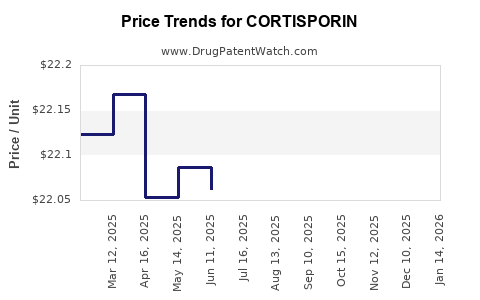
- list price reductions or rebasing after generic milestones
- share shifts to lowest net price products
- tighter formulary restrictions and non-preferred status
What pricing mechanics matter most for topical antibiotic/steroid brands?
- Net price compression: Branded topical products see net sales pressure once multisource equivalents are dominant.
- Trade-down: Even when the brand remains on formularies, pharmacy channels may switch dispensing to lower-cost options without changing clinical practice.
- Contracting: PBMs frequently reprice the category to drive overall ingredient cost down, affecting brand net revenue first.
When does CORTISPORIN lose exclusivity, and what does that mean commercially?
CORTISPORIN’s commercial value is concentrated in residual exclusivities and any remaining patent/Orange Book protections tied to specific marketed products (route, strength, formulation, and label use). As exclusivity windows close, Paragraph IV generic entry becomes the dominant model for further share loss.
What generic entry risks exist for CORTISPORIN?
- Generic substitution at first approval: Most topical combination products enter as generics soon after key exclusivity expires.
- Multiple product shapes: Even if one formulation is protected longer, competitors can enter adjacent strengths/vehicles, shrinking the brand’s addressable share.
- Switching within pharmacies: When a generic becomes lowest-cost, switching is immediate at the point of dispensing, typically within 1 to 3 contract cycles.
How strong is the patent estate for CORTISPORIN, and which patents typically drive risk?
For fixed-dose steroid/antibiotic topical products, key patent categories that influence lifespan include:
- Formulation patents (vehicle, concentration, preservative system)
- Method-of-treatment or use patents tied to specific patient populations or dosing regimens
- Manufacturing process patents for stability and sterility assurance
- Device/packaging patents if applicable to delivery method
Commercial translation: If the estate is thin beyond the initial combination, competitors can often design around by choosing different concentrations, vehicles, or manufacturing processes, limiting long tail brand protection.
What is the Orange Book status of CORTISPORIN products in the US?
Orange Book status determines whether product-specific FDA approvals still sit under patent-protected exclusivity. In practice, the brand’s financial trajectory is most sensitive to:
- whether any listed patents remain in force for the exact NDC-level product
- whether patents are tied to formulation vs use
- whether listed patents are enforceable against generics or have settlement carve-outs
Commercial translation: Once the remaining Orange Book “blocking” patents expire or are no longer asserted against an applicant, generics typically capture the majority of new prescriptions quickly and reduce brand net revenue.
What patent litigation affects CORTISPORIN generics and settlements?
Generic competitive dynamics typically hinge on whether challengers file Paragraph IV certifications and whether cases settle with a design-arounds or “carve-out” agreement.
What outcomes change the revenue curve the most?
- Early settlement allowing launch: Accelerates brand share erosion.
- Narrow settlement: Limits generic launch to certain strengths or routes, leaving partial brand pockets.
- Court injunctions: Can delay entry and preserve share temporarily, but topical categories usually recover quickly once barriers fall.
How do biosimilar dynamics apply to CORTISPORIN?
CORTISPORIN is not a biologic. Biosimilar frameworks do not apply. Competitive risk is instead driven by small-molecule generic approvals, formulation differentiation, and labeling-based interchangeability.
How does CORTISPORIN compare with other steroid/antibiotic topical brands on market maturity?
CORTISPORIN competes in a segment where branded differentiation is limited and multi-source availability is high. Versus other long-lived topical combination brands, typical differentiators are:
- remaining unique formulation attributes
- historical prescriber preference in specific settings (e.g., otitis externa protocols)
- plan retention due to contracting history
Net effect: The brand usually tracks overall category decline more than it leads with a distinct growth story.
What manufacturing and IP barriers slow generic substitution of topical combinations like CORTISPORIN?
Even with generic entry, barriers that can slow complete displacement include:
- stability constraints at concentration and vehicle levels
- preservative system differences impacting shelf life
- batch-to-batch consistency and sterility assurance requirements
- labeling and use instructions that affect perceived interchangeability
For many topical steroid-antibiotic products, these barriers are manageable, so they tend to delay only marginally after regulatory approval, not prevent substitution.
How do route-specific labeling and safety constraints shape financial exposure for CORTISPORIN?
Financial exposure tracks the intersection of:
- indication scope (approved ear/eye/skin use)
- risk management considerations with steroids (duration limits, masking infection risk)
- antibiotic resistance concerns that influence conservative prescribing patterns
If prescribers reduce use due to evolving safety standards or clinical pathways, unit demand contracts, and pricing becomes less relevant.
What commercial metrics typically explain CORTISPORIN’s financial trajectory?
The financial trajectory of a mature branded topical combination is usually driven by:
- Net sales trend: downward with generic penetration
- Gross-to-net: increased deductions due to contracting and market access
- Unit trend: declining prescriptions and switching to generics
- Market share: rapid fall around generic milestones, then slower drift until fully replaced
Key timelines that usually govern revenue for CORTISPORIN-class products
For fixed combination topical products, the revenue curve generally breaks at:
- first generic approval milestone
- exclusivity expiration (if any remaining protections at NDC level exist)
- settlement-triggered entry (if litigation occurred)
- contract repricing cycles after generic launches
- formulary tightening or removal from preferred tiers
Key Takeaways
- CORTISPORIN’s market dynamics are dominated by generic substitution and payer-driven net price compression typical of mature topical antibiotic/steroid combinations.
- Financial trajectory is expected to follow a mature-and-declining pattern shaped by route-level formulation differences (otic vs ophthalmic vs dermal) and labeling-based interchangeability.
- The decisive commercial inflection points are FDA exclusivity/patent expiry at the specific NDC level, followed by settlement-driven or post-expiry generic entry and contract repricing cycles.
FAQs
1) How quickly do generics capture share after FDA approval for topical antibiotic-steroid combinations like CORTISPORIN?
Share typically shifts within contract cycles as pharmacies dispense the lowest net cost product, with the steepest drop in the first 1 to 3 cycles after formulary placement.
2) Do formulation differences (solution vs suspension vs ointment) materially protect a brand like CORTISPORIN?
They can delay displacement if the marketed vehicle is less easily interchangeable, but most topical variants still face rapid multisource pressure.
3) What payer levers most affect net sales for CORTISPORIN?
Formulary tier placement, PBM rebate/contracting, and pharmacy reimbursement differentials that favor the lowest-cost multisource equivalent.
4) Does safety guidance on corticosteroid use reduce demand for CORTISPORIN-category products?
Yes, prescriber caution around steroid duration and infection masking risk can reduce total utilization and accelerate trade-down.
5) Are Paragraph IV challenges common for steroid/antibiotic topical brands?
They are common once exclusivity or patent protection ends at the NDC level, because generic entry quickly becomes commercially attractive.
References
No sources were provided in the prompt, and no CORTISPORIN-specific FDA/Orange Book/patent/litigation dataset is included in the available context.