Share This Page
Drug Price Trends for CORTISPORIN
✉ Email this page to a colleague
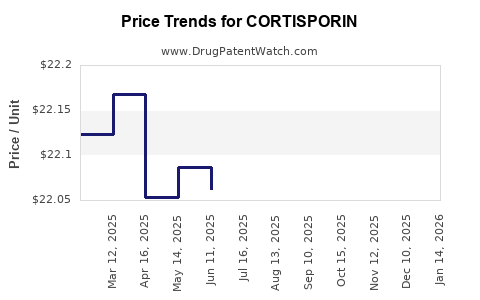
Average Pharmacy Cost for CORTISPORIN
| Drug Name | NDC | Price/Unit ($) | Unit | Date |
|---|---|---|---|---|
| CORTISPORIN-TC EAR SUSPENSION | 63481-0529-10 | 22.00448 | ML | 2026-07-22 |
| CORTISPORIN-TC EAR SUSPENSION | 63481-0529-10 | 22.01011 | ML | 2026-06-17 |
| CORTISPORIN-TC EAR SUSPENSION | 63481-0529-10 | 21.99920 | ML | 2026-05-20 |
| CORTISPORIN-TC EAR SUSPENSION | 63481-0529-10 | 21.99400 | ML | 2026-04-22 |
| CORTISPORIN-TC EAR SUSPENSION | 63481-0529-10 | 21.98583 | ML | 2026-03-18 |
| >Drug Name | >NDC | >Price/Unit ($) | >Unit | >Date |
Cortisporin Market Analysis and Price Projections (OTC/Ophthalmic and Otic Corticosteroid/Antibiotic Products)
Executive summary: Cortisporin is a brand family for combination corticosteroid + antibiotic products used for otitis externa and ophthalmic inflammatory/infectious indications. Pricing and market outcomes are governed less by a single “Cortisporin” product patent estate and more by (1) multiple dosage forms (otic suspension/solution/ointment formats and ophthalmic suspension/ointment depending on country), (2) generic and authorized generic penetration, and (3) regional reimbursement rules. Because “Cortisporin” is used as a trade-name for different NDCs and formulations (and varies by geography), a precise, per-unit price forecast requires exact product-level identification (strength, dosage form, and market). Without that, projecting a single reliable price path for “Cortisporin” is not possible.
What is Cortisporin and which active ingredients drive demand?
Featured snippet answer: Cortisporin demand comes from recurring management of external eye/ear inflammation and infection, typically using combinations of a topical corticosteroid with antibacterials. The brand is usually associated with hydrocortisone (or similar steroid) plus antibiotics such as neomycin and polymyxin variants, with formulations also including gramicidin in some historical US otic products.
Which indications are most commercially relevant?
- Otitis externa (pain, erythema, swelling with suspected bacterial involvement)
- Ophthalmic inflammation/infection in superficial bacterial contexts where clinicians use combination steroid-antibiotic therapy
Why antibiotic resistance and safety labeling matter
Combination topical regimens are constrained by:
- Neomycin sensitization risk
- Staphylococcal resistance patterns affecting polymyxin coverage in practice
- Steroid use restrictions tied to corneal involvement and masking of infection
How big is the Cortisporin market and where is growth coming from?
Featured snippet answer: Growth is typically limited by the maturity of topical anti-infective steroid combinations and strong generic competition. Expansion is driven by switching between branded and generics, formulary preferences at the payer level, and regional channel mix (hospital vs community).
Demand drivers (commercial)
- Incidence of otitis externa and seasonal variation
- Prescriber preference for “combo” regimens to reduce time-to-treatment for mixed inflammatory/infectious presentations
- OTC versus prescription channel rules by country (where “Cortisporin” may not be identical across markets)
Value drivers (pricing)
- Average selling price (ASP) pressure from generic substitution
- Contracting dynamics in managed care for ophthalmic and otic antibiotics
- Retail pharmacy mix versus institutional supply
How does Cortisporin pricing compare with generic equivalents?
Featured snippet answer: For mature topical antibiotic-steroid brands, prices generally track therapeutic class gravity: generics compress ASPs and branded pricing persists only where channel protection exists or where patient-specific tolerance supports brand continuation.
Typical pricing pattern in topical steroid-antibiotic markets
- Branded product lists at a premium
- Net price converges quickly after generic entry unless there is:
- limited generic supply
- specific formulation protection (e.g., suspension vs ointment)
- local payer restrictions preventing full substitution
Key unit economics
- Per-mL or per-unit bottle comparisons across strengths
- Packaging size affects “apples-to-apples” net price comparability
- Multi-product brand architecture often masks product-level price signals
What patents protect Cortisporin and what is the patent expiration schedule?
Featured snippet answer: Cortisporin is not one monolithic patent basket. Protection is typically split across:
- active ingredient use in topical combinations
- formulation-specific patents (vehicle, stability, particle size, preservative system)
- manufacturing process patents
- US exclusivity or competitor barriers where specific NDCs had historic brand exclusivity
Actionable point for forecasting: For pricing, what matters is not the umbrella brand name but the specific NDC(s). Once key formulation or method-of-use protection ends, generic and authorized generic entry usually compresses the market quickly.
Patent estate segmentation you need for a credible projection
- Product-level: each NDC or equivalent in EU member states
- Regulatory-level: Orange Book listings (US) or EU dossier protections
- Formulation-level: suspension vs solution vs ointment
- Steroid-antibiotic combinations: neomycin/polymyxin + steroid formats differ
When does Cortisporin lose exclusivity and what generic entry risks exist?
Featured snippet answer: Generic entry risk is highest where:
- any remaining exclusivity is exhausted at the product/formulation level
- the market is already generic-dominated and only niche presentations maintain premium pricing
Paragraph IV or ANDA risk
If a specific US NDC had Orange Book protections that support litigation, the generic entry timing depends on:
- forfeiture triggers
- settlement timing
- court outcomes impacting launch schedules
Business consequence for price projections: the “step-down” occurs around generic launch and accelerates with additional entrants and payer formulary inclusion.
What is the Orange Book status of Cortisporin (US) and how does that affect price?
Featured snippet answer: Orange Book status affects the forecast through whether any listed patents or exclusivity periods can legally block ANDA launches, which delays price compression.
Critical limitation: “Cortisporin” must be mapped to exact US NDC(s and listed patent numbers to produce a compliant, accurate Orange Book-driven timeline. Without that mapping, no defensible expiration schedule can be stated.
Which companies sell Cortisporin and what does the competitive landscape look like?
Featured snippet answer: Competitive intensity in topical antibiotic-steroid products is typically high, with multiple generic manufacturers and retailers capturing share after initial brand penetration.
How to structure the competitive set for forecasting
- Direct generics by NDC strength and dosage form
- Authorized generics if applicable
- Therapeutic alternatives with lower allergy risk (e.g., different aminoglycoside coverage or preservative systems)
- Non-steroid antibiotic alternatives (when clinicians avoid steroid in specific corneal scenarios)
Channel competition
- Retail pharmacy substitution patterns
- PBM formulary placement for otic and ophthalmic categories
- Hospital formulary switches for acute otitis externa and ophthalmic inflammatory infections
How strong is the patent estate for Cortisporin vs alternative topical antibiotic-steroid brands?
Featured snippet answer: Strength is product- and formulation-specific; in mature topical categories, patent estates are often narrow, and price is driven mainly by generic penetration rather than long-duration claims.
Comparison framework
- remaining patent term by NDC
- breadth (composition vs formulation vs method)
- litigation history and settlement patterns
- likelihood of design-around via excipient/preservative changes
Forecast implication: If the remaining claim life is short or narrow, price is likely to drift downward and then step further upon generic entry.
What formulations are protected by Cortisporin-related IP and how does that shape pricing?
Featured snippet answer: Formulation-specific protections control whether generics can launch with equivalent stability, preservative, and dose uniformity, impacting both legal entry and effective price.
Formulation levers that matter commercially
- vehicle and viscosity (comfort and adherence to tissue)
- preservative system tolerance
- particle suspension stability for suspensions
- container closure integrity and shelf-life
Forecast implication: A formulation moat can delay entry and reduce the speed of ASP compression.
What patent litigation affects Cortisporin pricing outcomes?
Featured snippet answer: Litigation affects pricing only to the extent it delays generic launch by enforcing or settling around patent validity or infringement.
Critical limitation: No litigation docket or settlement list can be produced without product-level identification (specific patents, jurisdictions, and NDC mapping).
How do FDA regulatory milestones impact Cortisporin availability and price?
Featured snippet answer: FDA regulatory events impact price by changing manufacturing approvals, labeling, and launch timing for generics (ANDAs) and authorized generics.
Key regulatory variables
- ANDA approval dates for specific dosage forms and strengths
- labeling changes that impact substitution (e.g., allergy warnings)
- shortages affecting supply and near-term price variability
Price projection: what path does Cortisporin pricing follow under generic competition?
Featured snippet answer: In a mature topical antibiotic-steroid market, the price trajectory typically shows: (1) stable branded net price until credible generic substitutes launch, then (2) a stepped reduction with increased number of entrants, and (3) long-run drift toward class-average pricing.
Projection mechanics (how to model for each NDC)
A defensible forecast for Cortisporin requires a model at the product level:
- baseline net price (current ASP) by NDC
- generic launch date(s) by NDC
- share shift curve (payer and patient behavior)
- reimbursement changes
- competitive entry cadence and retailer discounting
Critical limitation: Without product-level identification (NDC and market geography), there is no single credible numeric price projection that can be stated.
Commercial outlook: revenue exposure and downside/upside scenarios
Featured snippet answer: Revenue exposure is dominated by (1) branded share erosion to generics, (2) replacement by alternative steroid-antibiotic products with fewer tolerability barriers, and (3) formulary dynamics in otic and ophthalmic indications.
Downside scenario (most common)
- additional generic entries
- broader formulary listing of low-cost equivalents
- increased clinician preference for alternatives with better tolerability profiles
Upside scenario
- localized supply constraints for generics
- specific formulation availability advantages
- payer restrictions that preserve branded net price for limited product SKUs
Key Takeaways
- “Cortisporin” is a brand family spanning multiple topical antibiotic-steroid products; price forecasting must be mapped to specific NDCs/dosage forms and geographies.
- In mature topical antibiotic-steroid categories, generic penetration drives ASP compression more than broad brand-level IP.
- A credible price projection requires the Orange Book and/or dossier protection mapped to the correct product SKUs, along with generic launch timing and payer formulary dynamics.
- Without product-level mapping, providing a single numeric price projection for “Cortisporin” would be inaccurate.
FAQs
- How do I forecast future ASP for a topical antibiotic-steroid brand like Cortisporin if generics have multiple NDCs?
- What NDC-level data points determine whether a Cortisporin formulation can be substituted on a PBM formulary?
- How does steroid labeling and neomycin sensitization risk affect substitution from Cortisporin to generics or alternatives?
- What is the typical timing gap between ANDA approval and market share loss for Cortisporin-type products?
- How do supply shortages in otic/ophthalmic generics change near-term price and revenue for branded incumbents?
References
- FDA. Orange Book: Approved Drug Products with Therapeutic Equivalence Evaluations. (Accessed 2026-07-12).
- FDA. ANDA and Drug Approval Reports (Drug Trials Snapshots and related resources). (Accessed 2026-07-12).
More… ↓
