COPIKTRA Drug Patent Profile
✉ Email this page to a colleague
When do Copiktra patents expire, and what generic alternatives are available?
Copiktra is a drug marketed by Secura and is included in one NDA. There are six patents protecting this drug.
The generic ingredient in COPIKTRA is duvelisib. There is one drug master file entry for this compound. One supplier is listed for this compound. Additional details are available on the duvelisib profile page.
DrugPatentWatch® Generic Entry Outlook for Copiktra
Copiktra was eligible for patent challenges on September 24, 2022.
By analyzing the patents and regulatory protections it appears that the earliest date
for generic entry will be September 24, 2032. This may change due to patent challenges or generic licensing.
Indicators of Generic Entry
AI Deep Research
Questions you can ask:
- What is the 5 year forecast for COPIKTRA?
- What are the global sales for COPIKTRA?
- What is Average Wholesale Price for COPIKTRA?
Summary for COPIKTRA
| US Patents: | 6 |
| Applicants: | 1 |
| NDAs: | 1 |
| Finished Product Suppliers / Packagers: | 1 |
| Raw Ingredient (Bulk) Api Vendors: | 69 |
| Clinical Trials: | 12 |
| Drug Prices: | Drug price information for COPIKTRA |
| What excipients (inactive ingredients) are in COPIKTRA? | COPIKTRA excipients list |
| DailyMed Link: | COPIKTRA at DailyMed |
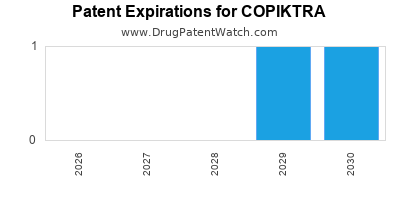

DrugPatentWatch® Estimated Loss of Exclusivity (LOE) Date for COPIKTRA
Generic Entry Date for COPIKTRA*:
Constraining patent/regulatory exclusivity:
NDA:
Dosage:
CAPSULE;ORAL |
*The generic entry opportunity date is the latter of the last compound-claiming patent and the last regulatory exclusivity protection. Many factors can influence early or later generic entry. This date is provided as a rough estimate of generic entry potential and should not be used as an independent source.
Recent Clinical Trials for COPIKTRA
Identify potential brand extensions & 505(b)(2) entrants
| Sponsor | Phase |
|---|---|
| CSPC ZhongQi Pharmaceutical Technology Co., Ltd. | Phase 1/Phase 2 |
| Emory University | Early Phase 1 |
| Novartis | Early Phase 1 |
US Patents and Regulatory Information for COPIKTRA
COPIKTRA is protected by eight US patents.
Based on analysis by DrugPatentWatch, the earliest date for a generic version of COPIKTRA is ⤷ Start Trial.
This potential generic entry date is based on patent ⤷ Start Trial.
Generics may enter earlier, or later, based on new patent filings, patent extensions, patent invalidation, early generic licensing, generic entry preferences, and other factors.
| Applicant | Tradename | Generic Name | Dosage | NDA | Approval Date | TE | Type | RLD | RS | Patent No. | Patent Expiration | Product | Substance | Delist Req. | Exclusivity Expiration |
|---|---|---|---|---|---|---|---|---|---|---|---|---|---|---|---|
| Secura | COPIKTRA | duvelisib | CAPSULE;ORAL | 211155-001 | Sep 24, 2018 | RX | Yes | No | ⤷ Start Trial | ⤷ Start Trial | ⤷ Start Trial | ||||
| Secura | COPIKTRA | duvelisib | CAPSULE;ORAL | 211155-001 | Sep 24, 2018 | RX | Yes | No | ⤷ Start Trial | ⤷ Start Trial | Y | Y | ⤷ Start Trial | ||
| Secura | COPIKTRA | duvelisib | CAPSULE;ORAL | 211155-001 | Sep 24, 2018 | RX | Yes | No | ⤷ Start Trial | ⤷ Start Trial | ⤷ Start Trial | ||||
| Secura | COPIKTRA | duvelisib | CAPSULE;ORAL | 211155-001 | Sep 24, 2018 | RX | Yes | No | ⤷ Start Trial | ⤷ Start Trial | Y | ⤷ Start Trial | |||
| Secura | COPIKTRA | duvelisib | CAPSULE;ORAL | 211155-002 | Sep 24, 2018 | RX | Yes | No | ⤷ Start Trial | ⤷ Start Trial | Y | ⤷ Start Trial | |||
| >Applicant | >Tradename | >Generic Name | >Dosage | >NDA | >Approval Date | >TE | >Type | >RLD | >RS | >Patent No. | >Patent Expiration | >Product | >Substance | >Delist Req. | >Exclusivity Expiration |
EU/EMA Drug Approvals for COPIKTRA
| Company | Drugname | Inn | Product Number / Indication | Status | Generic | Biosimilar | Orphan | Marketing Authorisation | Marketing Refusal |
|---|---|---|---|---|---|---|---|---|---|
| Secura Bio Limited | Copiktra | duvelisib | EMEA/H/C/005381Copiktra monotherapy is indicated for the treatment of adult patients with: Relapsed or refractory chronic lymphocytic leukaemia (CLL) after at least two prior therapies. Follicular lymphoma (FL) that is refractory to at least two prior systemic therapies. | Authorised | no | no | no | 2021-05-19 | |
| >Company | >Drugname | >Inn | >Product Number / Indication | >Status | >Generic | >Biosimilar | >Orphan | >Marketing Authorisation | >Marketing Refusal |
International Patents for COPIKTRA
When does loss-of-exclusivity occur for COPIKTRA?
Based on analysis by DrugPatentWatch, the following patents block generic entry in the countries listed below:
Australia
Patent: 09204483
Estimated Expiration: ⤷ Start Trial
Patent: 09204487
Estimated Expiration: ⤷ Start Trial
Patent: 10274075
Estimated Expiration: ⤷ Start Trial
Brazil
Patent: 2012000968
Estimated Expiration: ⤷ Start Trial
Patent: 0906473
Estimated Expiration: ⤷ Start Trial
Patent: 0906474
Estimated Expiration: ⤷ Start Trial
Canada
Patent: 11446
Estimated Expiration: ⤷ Start Trial
Patent: 11558
Estimated Expiration: ⤷ Start Trial
Patent: 68307
Estimated Expiration: ⤷ Start Trial
China
Patent: 1965335
Estimated Expiration: ⤷ Start Trial
Patent: 1965336
Estimated Expiration: ⤷ Start Trial
Patent: 2711767
Estimated Expiration: ⤷ Start Trial
Patent: 4926815
Estimated Expiration: ⤷ Start Trial
Patent: 6188059
Estimated Expiration: ⤷ Start Trial
Patent: 9912599
Estimated Expiration: ⤷ Start Trial
Croatia
Patent: 0150586
Estimated Expiration: ⤷ Start Trial
Cyprus
Patent: 16424
Estimated Expiration: ⤷ Start Trial
Patent: 21034
Estimated Expiration: ⤷ Start Trial
Denmark
Patent: 40451
Estimated Expiration: ⤷ Start Trial
Patent: 56444
Estimated Expiration: ⤷ Start Trial
European Patent Office
Patent: 40451
Estimated Expiration: ⤷ Start Trial
Patent: 40452
Estimated Expiration: ⤷ Start Trial
Patent: 56444
Estimated Expiration: ⤷ Start Trial
Patent: 18589
Estimated Expiration: ⤷ Start Trial
Patent: 50609
Estimated Expiration: ⤷ Start Trial
Patent: 41392
Estimated Expiration: ⤷ Start Trial
Patent: 13743
Estimated Expiration: ⤷ Start Trial
Finland
Patent: 0210039
Estimated Expiration: ⤷ Start Trial
Hong Kong
Patent: 70491
Estimated Expiration: ⤷ Start Trial
Patent: 13257
Estimated Expiration: ⤷ Start Trial
Hungary
Patent: 100048
Estimated Expiration: ⤷ Start Trial
India
Patent: 3DEN2012
Estimated Expiration: ⤷ Start Trial
Israel
Patent: 6789
Estimated Expiration: ⤷ Start Trial
Patent: 7181
Estimated Expiration: ⤷ Start Trial
Patent: 2192
Estimated Expiration: ⤷ Start Trial
Patent: 3932
Estimated Expiration: ⤷ Start Trial
Japan
Patent: 68596
Estimated Expiration: ⤷ Start Trial
Patent: 69222
Estimated Expiration: ⤷ Start Trial
Patent: 44313
Estimated Expiration: ⤷ Start Trial
Patent: 33452
Estimated Expiration: ⤷ Start Trial
Patent: 58395
Estimated Expiration: ⤷ Start Trial
Patent: 11508782
Estimated Expiration: ⤷ Start Trial
Patent: 11509259
Estimated Expiration: ⤷ Start Trial
Patent: 12533541
Estimated Expiration: ⤷ Start Trial
Patent: 16135768
Estimated Expiration: ⤷ Start Trial
Patent: 16210781
Estimated Expiration: ⤷ Start Trial
Lithuania
Patent: 456444
Estimated Expiration: ⤷ Start Trial
Patent: 2021526
Estimated Expiration: ⤷ Start Trial
Luxembourg
Patent: 0237
Estimated Expiration: ⤷ Start Trial
Malaysia
Patent: 9955
Estimated Expiration: ⤷ Start Trial
Patent: 8762
Estimated Expiration: ⤷ Start Trial
Patent: 2151
Estimated Expiration: ⤷ Start Trial
Patent: 5979
Estimated Expiration: ⤷ Start Trial
Patent: 1407
Estimated Expiration: ⤷ Start Trial
Mexico
Patent: 1028
Estimated Expiration: ⤷ Start Trial
Patent: 8640
Estimated Expiration: ⤷ Start Trial
Patent: 9814
Estimated Expiration: ⤷ Start Trial
Patent: 10007418
Estimated Expiration: ⤷ Start Trial
Patent: 10007419
Estimated Expiration: ⤷ Start Trial
Patent: 12000626
Estimated Expiration: ⤷ Start Trial
Netherlands
Patent: 1140
Estimated Expiration: ⤷ Start Trial
New Zealand
Patent: 7004
Estimated Expiration: ⤷ Start Trial
Patent: 7051
Estimated Expiration: ⤷ Start Trial
Patent: 7595
Estimated Expiration: ⤷ Start Trial
Patent: 3219
Estimated Expiration: ⤷ Start Trial
Patent: 9727
Estimated Expiration: ⤷ Start Trial
Patent: 2041
Estimated Expiration: ⤷ Start Trial
Patent: 6506
Estimated Expiration: ⤷ Start Trial
Patent: 7410
Estimated Expiration: ⤷ Start Trial
Norway
Patent: 21047
Estimated Expiration: ⤷ Start Trial
Philippines
Patent: 015502362
Estimated Expiration: ⤷ Start Trial
Patent: 015502432
Estimated Expiration: ⤷ Start Trial
Patent: 020550450
Estimated Expiration: ⤷ Start Trial
Poland
Patent: 56444
Estimated Expiration: ⤷ Start Trial
Portugal
Patent: 56444
Estimated Expiration: ⤷ Start Trial
Russian Federation
Patent: 13636
Estimated Expiration: ⤷ Start Trial
Patent: 37549
Estimated Expiration: ⤷ Start Trial
Patent: 82676
Patent: НЕКОТОРЫЕ ХИМИЧЕСКИЕ СОЕДИНЕНИЯ, КОМПОЗИЦИИ И СПОСОБЫ (SOME CHEMICAL COMPOUNDS, COMPOSITIONS AND METHODS)
Estimated Expiration: ⤷ Start Trial
Patent: 16703
Estimated Expiration: ⤷ Start Trial
Patent: 46319
Estimated Expiration: ⤷ Start Trial
Patent: 10132254
Estimated Expiration: ⤷ Start Trial
Patent: 10132257
Estimated Expiration: ⤷ Start Trial
Patent: 12105071
Estimated Expiration: ⤷ Start Trial
Patent: 14142795
Estimated Expiration: ⤷ Start Trial
Patent: 16110024
Estimated Expiration: ⤷ Start Trial
San Marino
Patent: 01500141
Patent: Derivato di adenina come inibitore di pi3k
Estimated Expiration: ⤷ Start Trial
Singapore
Patent: 201503886W
Patent: Certain Chemical Entities, Compositions And Methods
Estimated Expiration: ⤷ Start Trial
Patent: 201605472W
Patent: Certain Chemical Entities, Compositions And Methods
Estimated Expiration: ⤷ Start Trial
Patent: 202013258P
Patent: Certain Chemical Entities, Compositions And Methods
Estimated Expiration: ⤷ Start Trial
Patent: 7641
Patent: CERTAIN CHEMICAL ENTITIES, COMPOSITIONS AND METHODS
Estimated Expiration: ⤷ Start Trial
Patent: 7425
Patent: CERTAIN CHEMICAL ENTITIES, COMPOSITIONS AND METHODS
Estimated Expiration: ⤷ Start Trial
Patent: 7426
Patent: CERTAIN CHEMICAL ENTITIES, COMPOSITIONS AND METHODS
Estimated Expiration: ⤷ Start Trial
Slovenia
Patent: 56444
Estimated Expiration: ⤷ Start Trial
South Africa
Patent: 1005390
Patent: CERTAIN CHEMICAL ENTITIES,COMPOSITIONS AND METHODS
Estimated Expiration: ⤷ Start Trial
Patent: 1005391
Patent: CERTAIN CHEMICAL ENTITIES,COMPOSITIONS AND METHODS
Estimated Expiration: ⤷ Start Trial
Patent: 1200254
Patent: CERTAIN CHEMICAL ENTITIES,COMPOSITIONS AND METHODS
Estimated Expiration: ⤷ Start Trial
South Korea
Patent: 1653842
Estimated Expiration: ⤷ Start Trial
Patent: 1660050
Estimated Expiration: ⤷ Start Trial
Patent: 1680406
Estimated Expiration: ⤷ Start Trial
Patent: 1897881
Estimated Expiration: ⤷ Start Trial
Patent: 100125240
Estimated Expiration: ⤷ Start Trial
Patent: 100126287
Estimated Expiration: ⤷ Start Trial
Patent: 120097479
Estimated Expiration: ⤷ Start Trial
Patent: 160040741
Estimated Expiration: ⤷ Start Trial
Spain
Patent: 38853
Estimated Expiration: ⤷ Start Trial
Patent: 47163
Estimated Expiration: ⤷ Start Trial
Ukraine
Patent: 5483
Patent: ПРОИЗВОДНЫЕ ИЗОХИНОЛИНОНА, КОМПОЗИЦИЯ НА ИХ ОСНОВЕ И ПРИМЕНЕНИЕ В КАЧЕСТВЕ ИНГИБИТОРОВ PI3K (ISOQUINOLINONE DERIVATIVES, COMPOSITIONS BASED THEREON AND USE THEREOF AS PI3K INHIBITORS)
Estimated Expiration: ⤷ Start Trial
Patent: 9764
Patent: ПОХІДНІ ІЗОХІНОЛІНОНУ, КОМПОЗИЦІЯ НА ЇХ ОСНОВІ ТА ЗАСТОСУВАННЯ ЯК ІНГІБІТОРІВ РІ3K
Estimated Expiration: ⤷ Start Trial
Patent: 9878
Patent: ПОХІДНІ ІЗОХІНОЛІНОНУ, ФАРМАЦЕВТИЧНА КОМПОЗИЦІЯ НА ЇХ ОСНОВІ (ВАРІАНТИ) ТА СПОСІБ ЛІКУВАННЯ ЗАХВОРЮВАНЬ (ВАРІАНТИ)
Estimated Expiration: ⤷ Start Trial
Patent: 9314
Patent: СПОСІБ ОТРИМАННЯ ПОХІДНИХ ІЗОХІНОЛІНОНУ (ВАРІАНТИ)
Estimated Expiration: ⤷ Start Trial
Patent: 1192
Patent: СПОСІБ ОТРИМАННЯ ХІМІЧНИХ СПОЛУК, ЯКІ МОДУЛЮЮТЬ АКТИВНІСТЬ РІ3-КІНАЗИ
Estimated Expiration: ⤷ Start Trial
Generics may enter earlier, or later, based on new patent filings, patent extensions, patent invalidation, early generic licensing, generic entry preferences, and other factors.
See the table below for additional patents covering COPIKTRA around the world.
| Country | Patent Number | Title | Estimated Expiration |
|---|---|---|---|
| Argentina | 084824 | ⤷ Start Trial | |
| Argentina | 117467 | ⤷ Start Trial | |
| Australia | 2012205669 | ⤷ Start Trial | |
| Australia | 2015258280 | ⤷ Start Trial | |
| Brazil | 112013017670 | ⤷ Start Trial | |
| >Country | >Patent Number | >Title | >Estimated Expiration |
Supplementary Protection Certificates for COPIKTRA
| Patent Number | Supplementary Protection Certificate | SPC Country | SPC Expiration | SPC Description |
|---|---|---|---|---|
| 2456444 | 301140 | Netherlands | ⤷ Start Trial | PRODUCT NAME: DUVELISIB; REGISTRATION NO/DATE: EU/1/21/1542 20210521 |
| 2456444 | CA 2021 00045 | Denmark | ⤷ Start Trial | PRODUCT NAME: DUVELISIB; REG. NO/DATE: EU/1/21/1542 20210521 |
| 2456444 | PA2021526 | Lithuania | ⤷ Start Trial | PRODUCT NAME: DUVELISIBAS; REGISTRATION NO/DATE: EU/1/21/1542 20210519 |
| 2456444 | LUC00237 | Luxembourg | ⤷ Start Trial | PRODUCT NAME: DUVELISIB; AUTHORISATION NUMBER AND DATE: EU1/21/1542 20210521 |
| 2456444 | 122021000069 | Germany | ⤷ Start Trial | PRODUCT NAME: DUVELISIB; REGISTRATION NO/DATE: EU/1/21/1542 20210519 |
| >Patent Number | >Supplementary Protection Certificate | >SPC Country | >SPC Expiration | >SPC Description |
Copiktra (duvelisib) market dynamics and financial trajectory: exclusivity, competitive pressure, and revenue outlook
More… ↓
DrugChatter Q&A for COPIKTRA
Make Better Decisions: Try a trial or see plans & pricing
Drugs may be covered by multiple patents or regulatory protections. All trademarks and applicant names are the property of their respective owners or licensors. Although great care is taken in the proper and correct provision of this service, thinkBiotech LLC does not accept any responsibility for possible consequences of errors or omissions in the provided data. The data presented herein is for information purposes only. There is no warranty that the data contained herein is error free. We do not provide individual investment advice. This service is not registered with any financial regulatory agency. The information we publish is educational only and based on our opinions plus our models. By using DrugPatentWatch you acknowledge that we do not provide personalized recommendations or advice. thinkBiotech performs no independent verification of facts as provided by public sources nor are attempts made to provide legal or investing advice. Any reliance on data provided herein is done solely at the discretion of the user. Users of this service are advised to seek professional advice and independent confirmation before considering acting on any of the provided information. thinkBiotech LLC reserves the right to amend, extend or withdraw any part or all of the offered service without notice.
ISSN: 2162-2639

Privacy and Cookies
Terms & Conditions
Site Map
DrugPatentWatch Alternatives
LOE / Major Patent Expirations 2026 - 2027
NCE-1 Patent Challenge Dates 2026 - 2027
Friedman, Yali. "DrugPatentWatch" DrugPatentWatch, thinkBiotech, 2026, www.DrugPatentWatch.com.
See Primary Research Papers Citing DrugPatentWatch