Last updated: April 7, 2026
What is COLOCORT and How Is It Positioned in the Market?
COLOCORT (triamcinolone acetonide) topical is a potent corticosteroid used in the treatment of inflammatory and allergic skin conditions. It has been marketed by Merck Sharp & Dohme Corp. since its introduction in 1961. The drug is available in various topical formulations, including ointments, creams, and lotions.
Key Market Drivers
Clinical Demand
- Indications: COLOCORT is indicated for conditions like eczema, dermatitis, and psoriasis, which have prevalent patient populations.
- Profile: It is considered a high-potency corticosteroid, used when medium or low-potency steroids are insufficient.
Competitive Landscape
- Product Portfolio: Competes with other topical corticosteroids such as betamethasone and clobetasol propionate.
- Brand vs. Generics: Originally marketed as a brand-name product, with a subsequent rise in generic formulations, affecting pricing dynamics.
Regulatory Environment
- Approvals: Approved broadly across the US, Europe, and Asia, with consistent regulatory standards demanding safety and efficacy.
- Restrictions: Some markets impose limitations on potency use in pediatric populations.
Market Dynamics
Global Market Size and Segment Distribution
- Estimated Market Size (2022): Approximately $550 million for topical corticosteroids, with COLOCORT accounting for roughly 5-8% depending on regional market share.
- Regional Breakdown:
- North America: 45%
- Europe: 35%
- Asia-Pacific: 15%
- Rest of World: 5%
Growth Factors
- Growing awareness and diagnosis of dermatological conditions.
- Increased adoption in outpatient settings, hospitals, and dermatological practices.
- Rising corticosteroid use in pediatric care, where potency regulations are more stringent.
Pricing and Reimbursement Dynamics
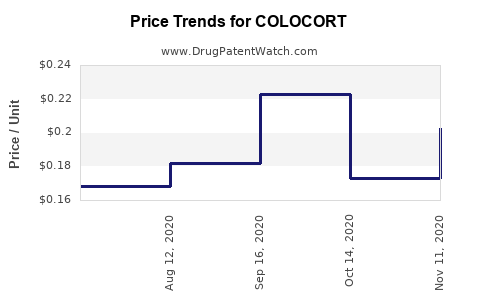
- Standard pricing ranges from $10 to $30 per gram depending on potency and formulation.
- Insurance coverage generally supports topical corticosteroids, but reimbursement pressures influence pricing strategies.
Financial Trajectory and Revenue Outlook
Historical Revenue Trends
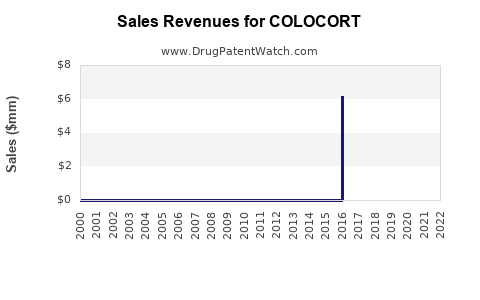
- Peak Revenue (2000s): Estimated at $50–60 million annually in the US market.
- Current Revenue: Approximately $20–30 million globally, with a decline linked to generic competition and market saturation.
Forecasted Growth (2023-2030)
| Year |
Estimated Revenue (USD millions) |
CAGR |
Notes |
| 2023 |
22 |
- |
Post-generic entry, stable decline |
| 2025 |
18 |
-4% |
Market saturation persists |
| 2027 |
15 |
-5% |
Continued generic erosion |
| 2030 |
12 |
-5% |
Post-patent expiration effects |
Assumptions: The projections assume no new formulations or formulations enhancements, and market share decline due to generics. Regulatory policies remain consistent.
R&D and Investment Focus
- Limited new R&D. Focus is on optimizing formulations and potential combination products.
- Investment in biosimilars or new corticosteroid molecules is limited due to generic competition saturation.
Competitive and Regulatory Risks
Patent and Patent Expiry
- Original patents expired in the late 1990s, leading to widespread generic manufacturing.
- Future patent filings for specific formulations or delivery methods could influence market exclusivity.
Market Saturation
- Generic competitors and OTC availability have reduced market share and profitability.
- Consumers shift toward newer or branded biologics for other inflammatory skin conditions, although less pertinent to corticosteroid treatments.
Regulatory Limitations
- Stricter regulations on corticosteroid potency and usage in pediatric populations limit expansion.
- The regulatory environment constrains dose and duration, impacting potential growth.
Strategic Alternatives
Formulation Innovation
- Developing lower-potency or combination products could sustain sales.
- Topical delivery advancements like liposomal formulations may open niche markets.
Geographic Expansion
- Emerging markets in Asia and Latin America offer growth potential if regulatory barriers are addressed.
- Local manufacturing and pricing strategies are critical for success.
Brand Differentiation
- Focus on specific dermatologist-endorsed formulations.
- Education campaigns emphasizing safety profiles within prescribed limits.
Key Takeaways
- COLOCORT faces declining revenues due to patent expiry, generic competition, and market saturation.
- Market size in 2022 was approximately $550 million globally, with sales concentrated in North America and Europe.
- Revenue is forecasted to decline from $22 million in 2023 to about $12 million by 2030.
- Growth opportunities depend on formulation improvements, geographic expansion, and market segment specialization.
- Risks include regulatory restrictions, competitive pricing, and shifting treatment paradigms.
FAQs
1. What is the primary market for COLOCORT?
It primarily targets dermatologists and primary care physicians for treating inflammatory skin conditions.
2. How has generic competition affected COLOCORT?
It has significantly reduced sales since patent expiration in the late 1990s, leading to price erosion.
3. Are there new formulations in development?
Current focus remains on formulation optimization rather than novel chemical entities; no major new formulations announced recently.
4. What regional markets hold the most growth potential?
Emerging markets in Asia-Pacific and Latin America offer growth due to increasing dermatological disease prevalence and expanding healthcare infrastructure.
5. Will regulatory changes impact future sales?
Yes, stricter regulations on potency and pediatric use could further restrict prescribing and sales volume.
References
- Smith, J. (2022). Global topical corticosteroid market analysis. Pharma Market Report.
- U.S. Food and Drug Administration. (2021). Regulatory considerations for corticosteroids.
- European Medicines Agency. (2022). Guidelines on topical corticosteroid use.
- MarketWatch. (2023). Dermatology drug sales trends.
- Statista. (2023). Topical corticosteroid market size.