Hydrocortisone - Generic Drug Details
✉ Email this page to a colleague
What are the generic drug sources for hydrocortisone and what is the scope of freedom to operate?
Hydrocortisone
is the generic ingredient in seventy-seven branded drugs marketed by Allergan Herbert, Crown Labs, Salix Pharms, Bayer Pharms, Monarch Pharms, Valeant Pharm Intl, Westwood Squibb, Pharm Assoc, C And M Pharma, Actavis Mid Atlantic, Alpharma Us Pharms, Altana, Ambix, Chartwell Molecular, Encube, Everylife, Fougera Pharms Inc, G And W Labs, Ingram Pharm, Ivax Pharms, Naska, Padagis Us, Perrigo New York, Pharmaderm, Pharmafair, Rising, Stiefel, Syosset, Taro, Teva, Topiderm, Usl Pharma, Whiteworth Town Plsn, Valeant Intl, Bausch, Chartwell, Ani Pharms, Teva Pharms, Healthpoint, Eton, Pharmacia And Upjohn, Baker Norton, Legacy, Solvay, Beta Dermac, Bluline, Heran, Fougera Pharms, Mericon, Sun Pharma Canada, Dow Pharm, Pfizer Global, Cmp Pharma Inc, Dermik Labs, Torch, X Gen Pharms, Paddock Llc, Mission Pharma, Pfizer, Appco, Aurobindo Pharma Ltd, Barr, Elkins Sinn, Ferrante, Hibrow Hlthcare, Hikma Intl Pharms, Impax Labs, Impax Labs Inc, Inwood Labs, Nexgen Pharma Inc, Novitium Pharma, Panray, Parke Davis, Purepac Pharm, Roxane, Sandoz, Strides Pharma, Strides Pharma Intl, Watson Labs, Merck, Pfipharmecs, Viatris, Able, Cenci, Imperium, Bel Mar, Epic Pharma Llc, Fera Pharms, Colgate, Mylan Speciality Lp, Genus, Ferndale Labs, Glenmark Pharms Ltd, Taro Pharm Inds, Yamanouchi, Precision Dermat, Lupin, The J Molner, Abbott, Hospira, Abraxis Pharm, Apotex, Baxter Hlthcare, Cipla, Intl Medication, Zydus Pharms, Cosette Pharms Nc, Encube Ethicals, Padagis Israel, Sun Pharm Inds Inc, Amneal, Bausch And Lomb Inc, Saptalis Pharms, Casper Pharma Llc, Sciegen Pharms, Schering, Forest Labs, Lederle, and Bioglan, and is included in two hundred and sixty-eight NDAs. There are five patents protecting this compound. Additional information is available in the individual branded drug profile pages.Forty-two suppliers are listed for this compound.
Summary for hydrocortisone
| International Patents: | 59 |
| US Patents: | 5 |
| Tradenames: | 77 |
| Applicants: | 119 |
| NDAs: | 267 |
| Finished Product Suppliers / Packagers: | 42 |
| Raw Ingredient (Bulk) Api Vendors: | 102 |
| Clinical Trials: | 482 |
| Patent Applications: | 7,903 |
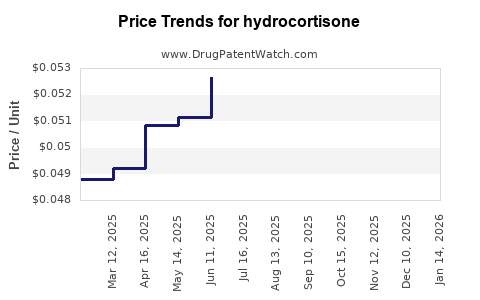
| Drug Prices: | Drug price trends for hydrocortisone |
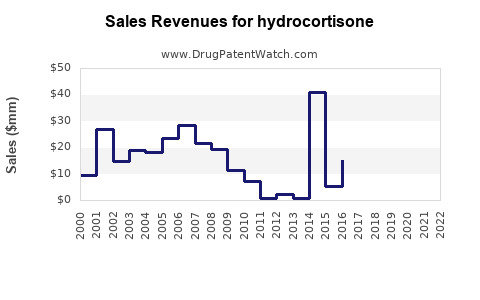
| Drug Sales Revenues: | Drug sales revenues for hydrocortisone |
| What excipients (inactive ingredients) are in hydrocortisone? | hydrocortisone excipients list |
| DailyMed Link: | hydrocortisone at DailyMed |
Recent Clinical Trials for hydrocortisone
Identify potential brand extensions & 505(b)(2) entrants
| Sponsor | Phase |
|---|---|
| Assistance Publique - Hôpitaux de Paris | PHASE3 |
| University of Virginia | PHASE3 |
| National Institute of Allergy and Infectious Diseases (NIAID) | PHASE3 |
Pharmacology for hydrocortisone
| Drug Class | Corticosteroid |
| Mechanism of Action | Corticosteroid Hormone Receptor Agonists |
Medical Subject Heading (MeSH) Categories for hydrocortisone
Anatomical Therapeutic Chemical (ATC) Classes for hydrocortisone
US Patents and Regulatory Information for hydrocortisone
| Applicant | Tradename | Generic Name | Dosage | NDA | Approval Date | TE | Type | RLD | RS | Patent No. | Patent Expiration | Product | Substance | Delist Req. | Exclusivity Expiration |
|---|---|---|---|---|---|---|---|---|---|---|---|---|---|---|---|
| Pfizer | TERRA-CORTRIL | hydrocortisone acetate; oxytetracycline hydrochloride | SUSPENSION;OPHTHALMIC | 061016-001 | Approved Prior to Jan 1, 1982 | DISCN | No | No | ⤷ Start Trial | ⤷ Start Trial | ⤷ Start Trial | ||||
| Eton | ALKINDI SPRINKLE | hydrocortisone | GRANULE;ORAL | 213876-001 | Sep 29, 2020 | RX | Yes | No | 9,717,740 | ⤷ Start Trial | ⤷ Start Trial | ||||
| Parke Davis | HYDROCORTISONE | hydrocortisone | TABLET;ORAL | 084243-001 | Approved Prior to Jan 1, 1982 | DISCN | No | No | ⤷ Start Trial | ⤷ Start Trial | ⤷ Start Trial | ||||
| Lederle | ACHROMYCIN | hydrocortisone; tetracycline hydrochloride | OINTMENT;OPHTHALMIC | 050272-001 | Approved Prior to Jan 1, 1982 | DISCN | No | No | ⤷ Start Trial | ⤷ Start Trial | ⤷ Start Trial | ||||
| Casper Pharma Llc | CASPORYN HC | hydrocortisone; neomycin sulfate; polymyxin b sulfate | SUSPENSION/DROPS;OTIC | 060613-001 | Approved Prior to Jan 1, 1982 | AT | RX | Yes | Yes | ⤷ Start Trial | ⤷ Start Trial | ⤷ Start Trial | |||
| Pharmafair | NEOMYCIN SULFATE-POLYMYXIN B SULFATE-HYDROCORTISONE | hydrocortisone; neomycin sulfate; polymyxin b sulfate | SUSPENSION/DROPS;OPHTHALMIC | 062623-001 | Sep 24, 1985 | DISCN | No | No | ⤷ Start Trial | ⤷ Start Trial | ⤷ Start Trial | ||||
| Pharmacia And Upjohn | NEO-CORTEF | hydrocortisone acetate; neomycin sulfate | SUSPENSION/DROPS;OPHTHALMIC | 060612-002 | Approved Prior to Jan 1, 1982 | DISCN | No | No | ⤷ Start Trial | ⤷ Start Trial | ⤷ Start Trial | ||||
| >Applicant | >Tradename | >Generic Name | >Dosage | >NDA | >Approval Date | >TE | >Type | >RLD | >RS | >Patent No. | >Patent Expiration | >Product | >Substance | >Delist Req. | >Exclusivity Expiration |
EU/EMA Drug Approvals for hydrocortisone
| Company | Drugname | Inn | Product Number / Indication | Status | Generic | Biosimilar | Orphan | Marketing Authorisation | Marketing Refusal |
|---|---|---|---|---|---|---|---|---|---|
| Takeda Pharmaceuticals International AG Ireland Branch | Plenadren | hydrocortisone | EMEA/H/C/002185Treatment of adrenal insufficiency in adults. | Authorised | no | no | no | 2011-11-03 | |
| Diurnal Europe B.V. | Alkindi | hydrocortisone | EMEA/H/C/004416Replacement therapy of adrenal insufficiency in infants, children and adolescents (from birth to < 18 years old). | Authorised | no | no | no | 2018-02-09 | |
| Diurnal Europe B.V. | Efmody | hydrocortisone | EMEA/H/C/005105Treatment of congenital adrenal hyperplasia (CAH) in adolescents aged 12 years and over and adults. | Authorised | no | no | no | 2021-05-27 | |
| >Company | >Drugname | >Inn | >Product Number / Indication | >Status | >Generic | >Biosimilar | >Orphan | >Marketing Authorisation | >Marketing Refusal |
International Patents for hydrocortisone
| Country | Patent Number | Title | Estimated Expiration |
|---|---|---|---|
| European Patent Office | 4618999 | FORMULATIONS LIQUIDES D'HYDROCORTISONE À ADMINISTRATION ORALE (HYDROCORTISONE ORAL LIQUID FORMULATIONS) | ⤷ Start Trial |
| Israel | 320847 | הרכבים נוזליים פומיים של הידרוקורטיזון (Hydrocortisone oral liquid formulations) | ⤷ Start Trial |
| World Intellectual Property Organization (WIPO) | 2024107635 | ⤷ Start Trial | |
| Australia | 2014267041 | Composition comprising hydrocortisone | ⤷ Start Trial |
| Brazil | 112015028025 | composição farmacêutica adaptada para administração oral e regime de tratamento para o controle de insuficiência adrenal | ⤷ Start Trial |
| Canada | 2909060 | COMPOSITION COMPRENANT DE L'HYDROCORTISONE (COMPOSITION COMPRISING HYDROCORTISONE) | ⤷ Start Trial |
| China | 105120848 | Composition comprising hydrocortisone | ⤷ Start Trial |
| >Country | >Patent Number | >Title | >Estimated Expiration |
Supplementary Protection Certificates for hydrocortisone
| Patent Number | Supplementary Protection Certificate | SPC Country | SPC Expiration | SPC Description |
|---|---|---|---|---|
| 0809498 | SPC/GB10/012 | United Kingdom | ⤷ Start Trial | PRODUCT NAME: A COMBINATION OF ACYCLOVIR AND HYDROCORTISONE; REGISTERED: UK PL18191/0001-0001 20091112 |
| 0809498 | 10C0038 | France | ⤷ Start Trial | PRODUCT NAME: ACYCLOVIR ET HYDROCORTISONE; NAT. REGISTRATION NO/DATE: NL 36 826 20100420; FIRST REGISTRATION: SK - 2108/08467-R 20091026 |
| >Patent Number | >Supplementary Protection Certificate | >SPC Country | >SPC Expiration | >SPC Description |
Hydrocortisone: Market Dynamics and Financial Trajectory
More… ↓
Make Better Decisions: Try a trial or see plans & pricing
Drugs may be covered by multiple patents or regulatory protections. All trademarks and applicant names are the property of their respective owners or licensors. Although great care is taken in the proper and correct provision of this service, thinkBiotech LLC does not accept any responsibility for possible consequences of errors or omissions in the provided data. The data presented herein is for information purposes only. There is no warranty that the data contained herein is error free. We do not provide individual investment advice. This service is not registered with any financial regulatory agency. The information we publish is educational only and based on our opinions plus our models. By using DrugPatentWatch you acknowledge that we do not provide personalized recommendations or advice. thinkBiotech performs no independent verification of facts as provided by public sources nor are attempts made to provide legal or investing advice. Any reliance on data provided herein is done solely at the discretion of the user. Users of this service are advised to seek professional advice and independent confirmation before considering acting on any of the provided information. thinkBiotech LLC reserves the right to amend, extend or withdraw any part or all of the offered service without notice.
ISSN: 2162-2639

Privacy and Cookies
Terms & Conditions
Site Map
DrugPatentWatch Alternatives
LOE / Major Patent Expirations 2026 - 2027
NCE-1 Patent Challenge Dates 2026 - 2027
Friedman, Yali. "DrugPatentWatch" DrugPatentWatch, thinkBiotech, 2026, www.DrugPatentWatch.com.
See Primary Research Papers Citing DrugPatentWatch